The Fine Art Of Piping Down After Piping Up
Saturday 18 January 2014. The last of three weeks where all I’ve really done is struggle to stay on top of college assessments, alongside doing the reading for the regular classes. It’s just been essays, and coughing a lot (typing this up on the 12th day of a cold).
Sitting here to write up my life, I bemoan the distinct lack of a life. Sometimes a diary can work as a warning. One feels the need to explain away the time gone by. Yet so much of it can be taken up by utter mundanities. One night this week was dominated by my having to re-install the right driver for my computer printer. Not the greatest of nights ever lived in the history of literature.
There is also The Tale of The Missing Ryman’s Receipt, the details of which I shall spare the reader, but suffice to say it guzzled a disproportionately higher amount of hours than any small piece of paper has a feasible right to.
There’s so much in life which shouldn’t be work, but ends up becoming work. All too easily, an errand can become an epic. Beowulf has nothing on stationery receipts.
* * *
Sunday 19 January 2014. The current essay is on Dorian Gray. Many discussions of Wilde’s novel quote a particular letter of his, replying to a reader. The letter must have been a very minor thing to Wilde, yet it’s been used ever since as one of the great comments on his novel.
It’s a letter to Ralph Payne, of 50 Ennismore Gardens, London. Postmarked 12 February 1894.
‘Dear Mr Payne… [The Picture of Dorian Gray] contains much of me in it. Basil Hallward is what I think I am: Lord Henry what the world thinks me: Dorian what I would like to be – in other ages, perhaps.’
There is a missing character from this line-up, though: Sibyl Vane. It’s tempting to suggest that she is what Wilde hoped not to be – but did become. The artist who gives up on their art when life (and love) gets in the way.
* * *
Monday 20 January 2014. Class text for tonight: the strange fashion for ‘it-narratives’ during the late eighteenth century. As in entire novels about the supposed life of inanimate objects. ‘The Story of a Thimble’, and so on. These were, it seems, just as popular as Pride and Prejudice at the time. Less so now. No Penguin Classics editions, so we have to read PDF scans of first editions, complete with all the letter ‘s’s looking like ‘f’s.
Tuesday 21 January 2014. I often wake up with a song playing in my head, a random selection from one’s iPod of the mind, forever on shuffle mode. Today it’s ‘Talking About A Revolution’ by Tracy Chapman. I have no opinion either way on Ms Chapman’s oeuvre, and indeed I am not aware what she thinks of mine. But let history pay witness: her inoffensive folk-pop outing from the late 80s has risen unbidden this morning from the crevices of my mind, and will not away.
In dutiful Proustian mode, the song has also dragged up, seaweed-like, various associated memories: the debut album it was on, ‘Tracy Chapman’, being everywhere when it came out – summer 1988. Our family owning it on cassette. Me staying in a Ludlow youth hostel, the woman on reception playing it loudly in the background while I check in.
But an unkind joke also pops up too, from an Alexei Sayle TV show, commenting on the lyrics of the song.
‘Poor people are gonna rise up and take what’s theirs…? No they’re not!’
* * *
Thursday 24 January 2014. Class texts: Plowing the Dark by Richard Powers and Salome by Oscar Wilde.
‘I’d like this class to be more of a seminar than a lecture,’ the tutor for 21st Century Fiction says, optimistically.
Although I’ve read the book and made lengthy notes, I’ve forgotten that this isn’t enough. You also have to boil your insights down into a few concise, seminar-ready soundbites that tutors want to hear. As it is I’ve spoken up a lot in previous classes. I don’t want to be known as That Sort Of Student, the kind that puts their hand up only for the tutor to say ‘Somebody else?’ So I feel it’s okay to keep quiet for this one.
Only one other student pipes up, who is a lot less concerned about annoying the others than I am. She is an older Spanish woman who has a tendency to go off into long, rambling monologues. Her conclusion tonight is: ‘And that’s why I think he wrote this – to make money’.
Still, at least she read the book. As it turns out, when the exasperated tutor finally grills each of us in turn, most of the class haven’t been able to finish the novel – probably due to all the essays they’ve had to turn in this month.
The art of being a good seminar student is tricky, though. You’re meant to contribute, but at the same time be concise and stick to the point.
The same problem often happens at public Q&As. Many audience members don’t realise that a question needs to be taut and pithy rather than an overlong thesis that they want to broadcast to the world. If the rest of the room is sighing heavily, that’s the time to stop talking. And yet, sighing heavily is still no good if you’re not going to say anything yourself.
* * *
The most discussed TV show this week is Benefits Street. I’ve not seen it myself, mainly because it’s a series rather than a one-off documentary. There’s always an element of fiction in one-off documentaries as it is, but in a series the artifice to fact ratio has to be much higher. The main message of such a series is not ‘this is how life is’ but ‘tune in next week’.
The illustration side of news and topical TV is always fascinating, though. There’s the strange world of stock photos (‘a lion, not this one, escaped from a zoo today’), while local newspapers often have articles over, say, pot holes in a road (which is fact) alongside a photo of the person doing the complaining, crouching next to the pot hole (which is fiction). I think about the setting up of such photographs: lighting, wardrobe, hair and perhaps even make-up must be concerns too, never mind holes in the road. ‘Can you look more cross?’
Tags:
another fool judging a tv programme they've not seen,
classes,
isn't baby I love you by the Ronettes an amazing record?,
no life for Dickon,
passing off deleted scenes from essays as diary entries,
piping down after piping up,
poor richard powers,
poor tracy chapman,
the art of speaking up
Through A Class Snuffly
Wednesday 8th January 2014. I note how the phrase ‘please do not hesitate to contact us’ is usually appended to emails trying to tell you to go away.
Thursday 9th January 2014. Looking at the internet today, I want to gesture at the screen and say, ‘how can I compete with all… this?’ Just adding to the sheer volume of stuff seems wrong. And yet here I am. Adding to it.
***
Saturday 11th January 2014. I meet Liam J, a student friend of Tobi H, originally from Tennessee, now based in New York, and currently staying in London on a study exchange. They’re (they prefer gender neutral pronouns) friendly, charming, and like a lot of US friends count Stephen Fry and the Mighty Boosh among their favourite British things. Despite being in town for 9 days, Liam hasn’t seen the West End. Their lodgings and campus are close to Shoreditch and the trendier East End areas, so that’s been their main haunt up till now. It wasn’t that long ago that the idea of Dalston and Stoke Newington as hip places for a night out was unthinkable. Now many bars in the West End are cheaper than some of those in Hoxton.
I’ll always be grateful for the friends-of-friends who’ve shown me around foreign cities, so am happy to do my tour guide bit. We start out with afternoon tea at the Coach & Horses, going for the full version (£17.50), as they don’t take bookings at the weekend for anything cheaper. Possibly too full for both of us: after the sandwiches, the scones and one fairy cake each, the larger cakes at the end defeat us entirely.
I explain to Liam about the Coach & Horses history, about Jeffrey Bernard and Private Eye magazine and why there’s a framed photo of Ian Hislop looking down at us. And indeed, who Ian Hislop is. The old Heath cartoons inspired by the pub (‘The Regulars’) are still on display, and are still funny.
Given Liam’s a Mighty Boosh fan, I point out Maison Bertaux next door, which has Noel Fielding’s art on the walls. Then off to the Ku bar in Lisle Street. First time I’ve been in a gay venue for a long time, probably since First Out closed. Pleased to find it has a healthy mix of ages and genders. They’ve still got the policy – their trademark, really – of having good-looking barmen who look particularly good with no shirt on. But it’s still early in the evening, so they’re wearing their skimpy vests instead. There’s a time and a place.
I show Liam the Prince Charles cinema (my idea of a ‘studenty’ cinema), the ICA bar and bookshop in the Mall, the lights of Leicester Square and Piccadilly Circus, and the cavernous Waterstones Piccadilly. Then we walk to the geographic centre of London, always good for showing visitors. It’s the equestrian Charles 1st statue on the south side of Trafalgar Square, the site of the original Charing Cross. I’m disappointed, however, that the large blue cockerel isn’t properly lit up at night.
Then a walk on Hungerford Bridge – both sides. A good spot for pointing out the Thames, the Millennium Wheel, St Paul’s, the Shard, the Southbank centre, and Big Ben. I remember how it’s the location for one of the opening shots of Love Actually. It’s in the montage where a passer-by carries a Christmas tree past the camera, to reveal the view from the west walkway: Big Ben and the Wheel at once. A very quick way of saying ‘Look, we’re in 21st century London! And it’s Christmas! Got it at the back? Right!’
Liam’s main observation about London is one of absence: there’s so much less rubbish on the street than in New York. Another is that ‘cold’ in London is really not that cold.
Monday 13th January 2014
I always seem to get ill around the time of an exam. Today a heavy cold descends. Â I’d assumed the winter flu jab I thought I’d been so sensible in getting would prevent colds as well. But no, no it doesn’t. This week sees most of the full menu: ugly coughing, even uglier running nose, a croaky voice, a touch of fever, wooziness, and general unpleasantness.
Tuesday 14th January 2014.
Coughing. Revising. Coughing some more. Could be worse, I say. I could be Dave Lee Travis. Someone has to be. Not his best week.
The news today is a parade of greying gentlemen from the history of British TV entertainment, their various alleged pasts catching up with them in court.
I understand that Operation Yewtree was just a random codename picked by the police. It’s a coincidence, then, that a yew tree tends to be incredibly old and has a distinguished reputation; it often hangs around old churches. Yet parts of it turn out to be highly toxic.
* * *
Meet up for a drink in the Birkbeck student bar with Martin W, once singer in The Boyfriends. He took the same Birkbeck course as me – BA English – 2 years earlier. He’s been very encouraging, passing on a rare textbook and offering practical advice.
He’s now doing a cultural studies MA, and his latest work is very up to date: on Morrissey’s Autobiography and how it fits in with theories of commodification (the Penguin Classics packaging and so on). Not at all an unusual subject, as there’s been a proliferation of academic work on The Smiths in the last few years. The first generation of teenage Morrissey fans are now the generation in charge of everything. Not least the Prime Minister.
Wednesday 15th January 2014.
I take the Anglo-Saxon module’s translation test. I feel absolutely awful right up to sitting down in the classroom. Then I suppose the adrenalin must kick in, because everything is suddenly razor sharp. Something in my body has told other parts ‘this is too important to cough and sniff through’.
Thursday 16th January 2014.
Classes. I cough so much in 21st Century Fiction that my eyes water. Roberto Bolano does not deserve this.
I don’t cough in Fin De Siècle, but have a highly unattractive, non-stop nose blowing session instead. Still, I learn an important style tip: fin de siècle is only hyphenated when it’s an adjective (‘during the fin-de-siècle era’), and is not hyphenated when it’s a noun. Never noticed until now.
Friday 17th January 2014.  I barely do any work on the latest essay (on Dorian Gray, due in next Thursday), due to being ill and having to write up the diary. But my mental well-being receives a booster jab when I get a ’75’ mark for the essay before this one. A decent First. The tutor’s comments include ‘a pleasure to read’, which is even more important to me than the mark. The work still doesn’t get any easier (and I really wish it did), but feedback like this becomes a form of cheering on from the sidelines.
Tags:
coach and horses,
coughing for sympathy,
I know my Richard Curtis montages,
London tour guide duty,
one day one of these tags will change your life,
the less fun side of tissues
Share This
Friday 3rd January 2014. My old problem persists: I have insomnia during most of the night, and as a result sleep straight through till noon, alarm clock and all. I know that to sleep through the morning is a cliché of student life, but for a mature student the joke is tired and old, because the student is tired and old too (and no amount of sleep ever seems to properly refresh me). It can only make one wake up in a foul mood, angry to feel time has been lost, and that the carefully prepared list of things to do must now be frantically revised to fit into whatever time remains. The next three weeks are particularly busy: a logjam of college deadlines. I have to finish an essay on Old English riddles, read Ms Austen’s Northanger Abbey, study an academic article about that, start revising for a translation test (again on Old English), write an essay on Dorian Gray, and prepare extracts from Pater’s Studies in the History of the Renaissance. For me, just getting up in the morning is a definition of fist-pumping athletic success.
* * *
Saturday 4th January 2014. Time wasted today includes at least twenty minutes trying to get the zip on one of my boots unstuck.
One New Year’s Resolution is to favour independent cafes while they still exist. Today I’m in Bar Bruno in Wardour Street, one of the few of the 1960s kind left in Soho, and sit in the booth that Sebastian Horsley was fond of.
This month will see the closure of the Candy Bar in Soho, the lesbian hostelry which I’ve spent quite a few happy evenings in over the years – at the invite of Sapphic friends, I feel obliged to add. The overwhelming memory is not feeling unusually male in such a crowd, but feeling unusually tall.
Like the First Out café before it, the Candy Bar is the victim not of a lack of customers but of a prohibitive increase in the property’s rent. This combination of unchecked greed on the part of landlords, coupled with a lack of intervention by the authorities, is certainly not limited to London. But it does boil down to a worrying widespread shift in priorities: the pursuit of wealth for the few placed well above the pursuit of basic quality of life for everyone else. What are cities for? One definition is for hubs of variety and diversity, for spaces like the Candy Bar, where the likeminded and minorities can feel in the majority for once. The wealth of a city exists in more forms than money.
On the Internet, ‘Share this’ is a common mantra, a box to click on next to some offering of ‘content’. I want to tick such a box for London. Share this. Share this.
* * *
Sunday 5th January 2014
Today I investigate Soho’s Secret Tea Room. ‘Secret’ because one has to ask the bar staff of the Coach and Horses pub in Greek Street to gain access. This is the old stomping ground of Mr Jeffrey Bernard, and indeed forms the setting of the play Jeffrey Bernard Is Unwell. Today it identifies as ‘London’s First Vegetarian Pub’, serving very reasonably priced veggie roast dinners on Sundays. Mr Bernard and the old host ‘Norm’ may be long gone, but the pub’s other long-term association – with Private Eye magazine – seems to be still going strong. I have butternut squash stuffed with quinoa while being gazed upon by framed photographs of Ian Hislop, Richard Ingrams and Francis Wheen. Â
Best of all is the décor in the upstairs room: a style of what can only be described as Unabashed Ruined Splendour. Some of the walls are in the shame shade of green as the Colony Room, and 1940s music plays in the background, much like it does at High Tea of Highgate. What I’ve not seen before is that your pot of tea arrives with a little hourglass, so you don’t pour out your tea too soon.
A grizzled-looking man sitting in my carriage on the Northern Line home. I suppose he counts as an actual wino. Visibly drunk, shouting and singing at anyone within range. But also swigging from a full bottle of white wine.
‘How many assumptions have you made in your life, eh?’ he shouts suddenly, at no one in particular. ‘291?’
Then he starts singing ‘Cherry-oh Baby’, the 1980s hit by the band UB40. The group’s oeuvre is normally thought of as remarkably inoffensive. Not today. I presume their much bigger hit, ‘Red Red Wine’, was rejected from the addled jukebox of this man’s mind, on the grounds that it’s the wrong colour of wine. Even drunks have consistency.
Except he can’t remember any more words than ‘Cherry-oh, Cherry-oh Baby’.
‘Cherry-oh, Cherry-oh Baby…’ Pause.
He thinks.
No. No, that is all. That is all the UB. All the 40.
‘Cherry-oh, Cherry-oh Baby…’
And so on, as we go forth together unto Tufnell Park.
I stare away. On the curve of the carriage wall above him there’s an advert for Boots, with the slogan ‘LET’S FEEL GOOD’. Not ‘feel better’ or ‘feel well’, but ‘feel good’. That can’t be helpful. The drunk man feels good.
* * *
Monday 6th January 2014. First class in a new module today: ‘Fiction of the Romantic Age’. Jane Austen, Mary Shelley, William Beckford and so on. So Monday night is now Bonnet Night.
I watch the new episode of Sherlock, where Martin Freeman’s Watson gets married. It daringly plays up the comedy and character development at the expense of much actual crime solving. I find myself rather empathising with Cumberbatch’s Holmes in one respect: having a demonstrably decent brain (if not exactly to his extent), yet socially useless to the point of tragic weirdness. If self-aware with it. I hope.
* * *
Tuesday 7th January 2014. An email from someone who must work in the Search Engine Optimisation business. She is offering to write a free blog post for my diary site, in return for linking some of the words in her text to the website of various commercial companies. As I understand it, the power to affect the order that results come up in Google searches is now worth a lot of money: hence the whole SEO trade. The deliberate proliferation of carefully chosen words linking to such sites is what such people do all day. Illustrate that, Richard Scarry.
She writes that each link will ‘add to the value it gives your visitors.’ What rather subtracts from the value of her offer is that she has clearly not even looked at my website. Even the briefest of glances indicates that it is manifestly not a blog for other people to submit their own pieces to, never mind those pseudonymous, hidden-advert, algorithm-like pieces that clutter up the web.
At least the last time this happened, I was offered money. Someone wanted me to host a Marks and Spencer advert on the diary, forever, for a one-off fee of £60. Â I replied, saying that although I am indeed ready to sell my soul faster than it takes to eat one of their packs of M&S mango slices, which they insist on calling ‘Mango Madness’ to the delight of no one, I like to think I can get a better price for my soul than £60.
They didn’t reply.
Tags:
bar bruno,
candy bar,
coach and horses,
drunks,
first out,
London,
SEO madness,
soho's secret tea room,
UB40,
vegetarianism
On Camp: Gaga v Perry
Saturday 28th December 2013. To Bildeston to visit Mum and Dad. Dad is pretty much the same as he was the month before: restricted to either the sofa or the bed in the living room, still relying on an oxygen mask and round-the-clock care. But he’s also still very chatty, enthusing about the latest escapist films on DVD, his Christmas presents from the family: Iron Man 3, Man of Steel. ‘I’m still that boy buying the first issue of Eagle comic’.
What he never watches is that baffling default prescription for the bedbound, the type piped into hospital wards at the request of no one sane: daytime TV. No fan of Bargain Hunt, my father.
I make myself useful by organising Dad’s DVD collection, gathering them from several scattered piles around the house into a single cabinet downstairs, then arranging them into alphabetical order. He has about 150. We wonder where best to file The Amazing Spider-Man, the recent big screen frolic starring the nervy Andrew Garfield (who really should play the young David Byrne if there’s ever a Talking Heads biopic). Should it go under ‘A’ for Amazing, or ‘S’ for Spider-Man, given that Dad also has the Tobey Maguire triptych of a few years ago? We agree on the latter. Keep all the Spider-Men in one place, and hope that Mr Maguire will not take the implication personally that he is officially… Not Amazing.
(As I type this up, a real spider dangles down from the ceiling onto my hand. It’s a thin greenish little thing, certainly not one of those False Widow spiders that the British newspapers got so aroused about last year. This one sadly has not bitten me and so I remain without a hyphenated secret identity. I have now carefully relocated the interloper to the outdoors, via the time-honoured dance of Mr Tumbler and Ms Nearest Piece of Paper. Before I go on, though, I think I should type the words ‘unmarked fifty pound notes’ and ‘Tom Daley’ in case they too need to fall from above. Nothing. )
* * *
Sunday 29th December 2013. Â End of year lists. My heroes of 2013: Young Ms Malala, obviously. The brave Mr Snowden too. Closer to home: Ms Jack Monroe, the food blogger turned fearless anti-poverty campaigner. And also Caroline Lucas, the Green Party MP. For her involvement in the protest against fracking (for which she was arrested), for being asked to cover up her ‘Ban Page 3’ shirt in a Commons debate, and for voting ‘yes’ to the food bank investigation and ‘no’ to MPs getting a pay rise. I know I’m biased, but Russell Brand’s calling for people to not vote seems unfair on the MPs who are trying to change things for the better. Though admittedly, they’re not quite as visible as he is.
* * *
Monday 30th December 2013.  Shamefully, I waste time on Twitter as a distraction from writing an essay on Anglo-Saxon poetry. Still, I hope I am redeemed  when I provide the author Sarah Churchwell with a dull but useful tip about how to copy text from a Kindle e-book (you use the ‘Kindle for PC or Mac’ program, open the book within it, use the ‘search’ facility to locate the passage, then copy and paste as normal). Ms Churchwell wrote Careless People, one of my favourite books of the year, about the influences behind The Great Gatsby. She tweets back that the tip worked for her, with thanks. I know so little about computers that supplying this mundanity, and hearing it was of use, makes my day.
A second good deed on Twitter: Ms Amber, whom I slightly know from the world of dressed-up London parties, asks the Twitter world for serious definitions of ‘camp’. Ideally, not from the over-quoted Susan Sontag essay.
I offer two: ‘The lie that tells the truth’ from the title of Philip Core’s 1980s book. And ‘a charging of the tension between performance and existence’, from Gary McMahon’s 2006 book Camp in Literature.
The trouble then is that I find myself distracted from the essay with my own musings on the subject. Is Lady Gaga a ‘Queen of Camp’, for instance, as some quarters have described her? Using the McMahon definition, I’d say no. There’s no ‘charging of the tension’, no wink, no knowing smirk. For her, performance is existence. But she may become camp as she gets older, because age ups the tension. A case in point is Grace Jones: all Gaga-esque performance when she was young, now very much camp. Katy Perry, on the other hand, is camp. She has that charged quality of self-awareness, finding the line where the self meets the performance, and then exaggerating it. That’s camp.
All this comes to me when I should be thinking about translating Old English from the Exeter Book.
* * *
Tuesday 31st December 2013. I meet with Laurence Hughes, up from Oxford. Mulled wine at The Flask in Highgate Village. He thinks I should take the academic thing further, doing a Masters and so on when I graduate. He says I ‘look’ the part of an academic. Perhaps in my case it’s just the air of an inability to cope with the physical.
At home, I work on the essay, then take a Nytol sleeping tablet, put in earplugs, and sleep through the fireworks. It’s the happiest New Year’s Eve I’ve had for some time.
* * *
Wednesday 1st January 2014. I start the year by appearing in the Guardian, to my surprise and squealing delight.
Or rather, I appear on the Guardian website, as the article in question is not in the printed newspaper (I buy a copy to check). Funny how prepositions work with new technology. It’s in the paper, but on the website. Or in an article on a website. Anyway.
The article is Travis Elborough’s Top 10 Literary Diarists. Here’s the link:
http://www.theguardian.com/books/2014/jan/01/travis-elboroughs-top-10-literary-diarists/print
I am included along with Samuel Pepys, Alan Bennett, Elizabeth Smart and Virginia Woolf.
* * *
Thursday 2nd January 2014. A few weeks ago I reviewed a graphic novel by Oscar Zarate, The Park, for The Quietus’s comics round-up column. The book is set mostly on Hampstead Heath. Here’s the link:
http://thequietus.com/articles/14192-behold-december-quietus-comics-round-up-column
Having been reminded about Elizabeth Smart’s diaries by the Travis Elborough article, I look them up at The London Library today. The first volume, Necessary Secrets, is a work of art, reading more as fully-formed literature than as a hastily jotted-down journal. It’s so close in style to her novella By Grand Central Station I Sat Down And Wept that it deserves to be considered on the same level. Yet it’s been out of print for over twenty years. I recall how the Morrissey song ‘Late Night Maudlin Street’, from his album Viva Hate, is full of quotes from By Grand Central. No mention of Ms Smart’s influence in his Autobiography, sadly.
Tags:
andrew garfield,
bildeston,
camp,
caroline lucas,
dad,
elizabeth smart,
guardian,
katy perry,
lady gaga,
laurence hughes,
mum,
quietus,
sarah churchwell,
spiders,
travis elborough
Xmas Week Diary and Christmas Message 2013
Friday 20th December 2013. I am pleased to receive about two dozen cards this year, made all the more special by the high cost of postage and the dominance of the internet. Post from abroad is especially meaningful: I’m sent a beautiful pop-up one from Eileen C in New York and a pictorial Christmas aerogramme from Danika H in Australia.
Although people rarely send cards and letters today, two Christmas books this year on the subject have proved to be very popular. There’s Shaun Usher’s anthology Letters of Note and Simon Garfield’s historical account, To The Letter. The Usher book is based on his website, where the very technology that killed off the letter – the internet – has turned out to be perfect for celebrating it. I feel all the more grateful for receiving an actual letter at Christmas, from Danika, and I’ll make sure I reply in kind.
Another sign of the times this week: the gay section in Time Out magazine has been axed. It’s assumed that, like cinema listings, there’s no longer any need to turn to a paper magazine to find out about events: Facebook events pages and online listings have become the default. Gay issues, meanwhile, are more mainstream than ever, with Conservative politicians supporting campaigns for gay marriage, and campaigns against homophobia around the world (such as in Russia and Uganda) given decent coverage by the media. This week has also seen Alan Turing finally pardoned for the crime of having consensual sex with another man. His mistake was to have it in the 1950s. Actually, as my dad once told me, it was pretty much frowned on to have sex in the 1950s if you were heterosexual, too.
But the question of promoting gay culture separately in terms of identity and role models is an ongoing one. As it is, London still has its annual LGBT film festival (at the BFI) and its own gay bookshop (Gay’s The Word in Marchmont Street – hitting 35 years old next January). Coming out as gay is still a big issue – Tom Daley making the headlines of late. So Time Out’s decision does seem premature. But then, like all paper listings magazines, it’s been struggling full stop.
* * *
Saturday 21st December 2013. To Somerset House with Ella Lucas, to see the exhibition on the late British fashion editor, collector, string-puller, muse and Lady Gaga lookalike, Isabella Blow. Ingeniously, the exhibits that can’t go on mannequins, such as letters and faxes, are in white display cases which sit surreally on mannequin legs – with shoes from Ms Blow’s collection on the cases’ feet. One letter, on Harpers notepaper, is from Hamish Bowles, who is also one of the other dandies in the I Am Dandy book. He writes to Ms Blow, ‘Long for your next appearance – stepping out of a reverie by Ronald Firbank…’
Much of the exhibition is of Philip Treacy’s exotic hat and mask creations, Ms Blow being his biggest champion. One mask has a grid of jewelled Swarovski crystal nails in a black silk net, rather reminding me of the Pinhead monster in Clive Barker’s Hellraiser. I check the caption, and it turns out to be a direct homage: ‘Hellraiser mask with nail detailing‘. Any exhibition which references Ronald Firbank and Hellraiser is fine by me.
A word learned: ‘chopine’. A historical type of women’s platform shoe, popular in the 15th to 17th centuries. Modern versions of which are in the Blow collection. More like a platform clog, really.
One of the information panels on Ms Blow’s history begins with the phrase ‘Forced to work for a living…’
* * *
Sunday 22nd December 2013. I visit the Museum of London, and am pleased to see that its shop stocks A London Year, the diary anthology which includes me alongside Pepys and co. It’s the closest I’ve come yet to being a museum piece.
On the raised pedestrian walkway around the corner, I take a look at the ruins of the original London Wall, where the layers of medieval brickwork can be seen on top of the Roman foundations. There’s an information panel about the ruins, provided by the museum. It’s dated 1980 and has been laminated against the elements, though 33 years later the elements have won, and much of the text is now faded and illegible. The panel about the ruins is itself a ruin.
In the evening I turn a corner in Clerkenwell Green and suddenly see the Shard and St Paul’s from a distance, both lit up. From this angle they appear as if standing right next to each other, though the Thames and several districts separate them geographically. Tonight the former looks like a Christmas tree, and the latter like a bauble. I stare up from the silent street at them, thinking how London always was this constant shrug of old with new, just like the two parts to the Wall and the ruined panel. Inside the Crown Tavern, more shrugging: Wizzard’s eternal Christmas song on the pub stereo, while the first word I overhear as I enter is someone saying  ‘Facebook’.
* * *
Monday 23rd December 2013.
The London Library’s last day before closing for Christmas, and the last day of its late night hours, closing at 9pm. It transpires that not enough members use the library quite that late, so in 2014 ‘late closing’ will mean 8pm instead. I sit in the historic Reading Room from 8.30pm till the end, which as expected means I am the only one there. Just me, all the books and journals, the famous soporific armchairs, the fireplace, and the Christmas tree. Utter, serene peace. I soak it in.
As soon as I leave, though: chaos. Heavy wind and rain has hit Britain, causing transport shut downs and power cuts at the worst possible time of year. Although the effect on London is relatively minor, my umbrella is a wreck before I make it out of St James’s Square. At Piccadilly Circus, where I get the tube, the clear plastic bubble over Eros has burst, scattering polystyrene chips of fake snow all over the road. Like some Biblical retribution against worshipping false gods, this idealised image of Christmas weather – pretty fake snow in a bubble – has been eclipsed by real Christmas weather – ugly, uncontained wind and rain.
* * *
Tuesday 24th December 2013.
To the Hackney Picturehouse to see a 1940s Christmas-themed film I’d not seen before, The Bishop’s Wife, in which Cary Grant plays an angel helping a troubled New York priest, played by David Niven. Despite his otherworldly role, Cary Grant is just dressed as Cary Grant, with the usual immaculate dark suit. One character is an eccentric aged scholar,  an atheist who nevertheless loves the traditions of Christmas. On discovering Cary G’s celestial identity, he remarks ‘Oh, that’s annoying.’ I think that’s how I’d feel.
Even though the story centres on David Niven’s bishop, the film’s parting message about Jesus feels unusual, even jarring. Yet I remember how it works fine in The Holly and The Ivy, a British film from the early 50s, also about priests at Christmas. I think the fact that Niven’s daughter is played by ‘Zuzu’ from It’s A Wonderful Life reminds me why: American films are happy to tell Christmas stories about angels, but they usually leave out Christ himself.
It’s still an issue today. I read a piece in the Guardian this week where an American writer remarks how the British are perfectly happy to say ‘Merry Christmas’ to each other, as opposed to ‘Happy Holidays’, regardless of religion – or lack of it – of those present. It’s just tradition. But among the cards from British people I get, some are indeed saying ‘Happy Holidays’, so perhaps that’s changing.
The first time I saw the word ‘holidays’ used to mean Christmas was in a TV advert. The product was that great ambassador of the American way, Coca-Cola. That may be another reason why ‘Happy Holidays’ has yet to catch on: for some (and I include myself), it feels too American.
* * *
Wednesday 25th December 2013. I spend Christmas by myself in Highgate, once again enjoying the palpable and rare peace in the city. The changed background hum of low traffic without buses. Morning spent hungover from mixing prosecco and Baileys the night before. I chat to Mum at length on the phone.
At 1pm, I meet up with Silke R once again for my own tradition of feeding the ducks in Waterlow Park. Silke is currently staying in the flat attached to Archway Video, the film rental library on Archway Road where we both once worked. An independent family business since the 1980s, the shop stocked a huge range of films, first on VHS, then DVD, and eventually, Blu-Ray. The customers included Daniel Craig, Maureen Lipman, Ray Davies of the Kinks and Brett Anderson of Suede. This year, the shop is an empty shell, closed for good since the summer. Silke now works for Odeon, an irony given that video shops were first thought to be bringing about the death of cinema. It wasn’t cinema that killed video shops, though, but online services like Lovefilm, Netflix, and of course Amazon.
In Muswell Hill a few months ago I bumped into one of the shop’s old customers. ‘I do miss that shop,’ he said fondly. ‘Though of course I hadn’t been in for years.’ He didn’t seem to notice how one statement was related to the other.
Thursday 26th December 2013.
With the lack of traffic on Boxing Day, combined with the sense of enforced family gatherings reaching the point of strained boredom, some local teenagers play football in the street outside. I first worry about them breaking any windows, but then I realise that young people playing ball games in the road is very old indeed. All the museum photos say so.
I walk around St Pancras in the afternoon. Most of the people I see fall into two categories. There’s aimlessly wandering tourists, who seem baffled that everything is shut for a second day. A handful of them climb on the gates of the British Library to take photos of the empty piazza. The other category is football fans, because Boxing Day means sport. People in Chelsea scarves are looking particularly pleased with themselves.
Friday 27th December 2013.
CHRISTMAS MESSAGE 2013.

This year’s photograph of me with a London tree is of course a ‘selfie’, one of 2013’s Words of the Year. With thanks to the London Review Bookshop for letting me take it on their premises on Christmas Eve.
The bookshop tree represents not just my current life as a student of literature, but my increasing concern about the effect of digital culture on independence, in every sense. On a blunt commercial level, the online tax-dodging colossus that is Amazon is obviously threatening the future of independent, non-corporate shops like the LRB. Bookshops, like cinemas and libraries, are pleasant places for staff to work in and for customers to go and immerse themselves in culture, at their own pace, offline and away from the ubiquity of the computer screen. No advertising sidebars tearing your concentration to shreds. One book I bought at the LRB this year was The Circle by Dave Eggers, which paints a near-future world where Amazon and Google and social media have reduced people’s lives to a banal flatness of public algorithms and vanished privacy.
This theme also connects neatly with Channel 4’s Alternative Christmas Message by Edward Snowden, the whistleblowing fugitive of the USA security services. Mr Snowden cited another novel about a world without privacy, 1984, and said some rather powerful things:
‘A child born today will grow up with no conception of privacy at all. They’ll never know what it means to have a private moment to themselves, an unrecorded, unanalysed thought… And that’s a problem, because privacy matters. Privacy is what allows us to determine who we are and who we want to be.’
The Queen’s own Christmas message also touched on the need for personal time alone, though she linked it more with prayer and meditation. Certainly a child born today in the case of baby Prince George has even less privacy than most children, but the point stands. What grabbed my attention with the Queen’s message was that she also mentioned ‘even keeping a diary’ as an example of creating a space for private reflection. Which is where I come in.
This year saw my online diary’s first emergence in book form, in the form of extracts in the anthology A London Year. Like the books about letters, it’s a celebration of individual minds reflecting in privacy. Their words are only later published when the appropriate permissions have been sought, and when an editor has done their own reflecting on what part of private writing might, as Shuan Usher puts it, be ‘deserving of a wider audience’. An amount of consideration and reflection has been applied, in other words. Although my own diary is published online first, it actually begins life as a series of far more personal notes made in my own paper notebooks. And even when published online, I try to evoke the more private nature of the printed page by the omission of one key element: no comments box.
A blog with no comments is as close to the reflective, personal and locked-off experience of the printed page as it can get. If you write online, I highly recommend it. Let comments belong on social media. Writing and reading are after all anti-social activities, and need to be. Humans are social creatures, but socialising needs to be kept apart from the production and consumption of writing. The more people can disconnect by way of balance, the better.
(I’ve now realised that Mr Usher also omits a comments box from his Letters of Note website too.)
It’s rather impractical to call for a boycott of Amazon, Google and social media now, and I wouldn’t want to. I use those things all the time myself. But my wish for 2014 is to try to resist the technology that wants us to only live through an endless scrolling of screens, that only what matters is to join the shallow noise, the unconsidered chatter, the indiscretion, the unkind photos passed around at the expense of others and the Fear of Missing Out. I wish to balance these activities with more appreciation of three beautiful ‘I’s: individualism, independence and immersion.
And I wish you a very happy what’s-left-of-Christmas, and a splendid New Year.
Tags:
cards,
christmas,
dave eggers,
gay issues,
hackney picturehouse,
hamish bowles,
hellraiser,
isabella blow,
letters,
london review bookshop,
london wall,
museum of london,
Proper Letters,
ronald firbank,
shard,
The London Library,
time out
The Relief Of Missing Out Revival
Further diary for Friday 13th December: I bump into Erol Alkan on the tube. I don’t see him much these days but today he’s as sweet and friendly as ever. There was a time in the mid 1990s when I would see him several times a week at various London clubs, pubs, gigs and music biz parties. I even met his parents in the house in Archway where he’d grown up. Back then he was a DJ at the more popular indie music clubs in London, like Going Underground and Trash. He then started playing in guitar groups himself (I saw his band Guernica a few times), before he concentrated on DJ-ing full time, then he got into remixing and producing, and today he is one of the country’s biggest DJs full stop.
On the tube he tells me he’s just released his debut single, after all these years: ‘A Hold on Love’. He’s en route that evening to Amsterdam for a charity DJ gig, along with the act Justice. I think I must have pulled an expression of barely concealed ignorance, because Mr A laughs and guesses (rightly) that I have no idea who they are. Later on I look them up. Wikipedia has a whole separate page titled ‘Awards and nominations received by Justice’.
I suppose I could attempt to keep up with the cultural big names one is meant to know, but it’s been years since I took a more than cursory interest in what’s on the A-list at MTV and Radio 1. The last time I was exposed to Radio 1 was about five years ago, when I had to visit the NHS sexual health clinic on Archway Road. It was their waiting room music of choice. Â
There’s a fashionable acronym doing the rounds about this sort of thing: FOMO, short for Fear Of Missing Out. It’s the form of anxiety that technology has meant to have brought into people’s lives. It can be the need to constantly check updates in the personal lives of others (particular on Facebook), or the need to be up-to-date with current affairs due to its addictive overexposure (via Twitter, websites, free newspapers, screens in railway stations). People may become terrified of being the only person in the room who, say, wasn’t aware of X getting married, or of Y having children, or Z dying, or such and such a band reforming, or knowing what ‘selfie’ means. All because they missed seeing the right updates. They were looking in the wrong direction at just the wrong time, and so they Missed Out.
But missing out is nothing to be afraid of. It’s certainly nothing new. No one can watch every ‘must-see’ TV series, or investigate every vaguely celebrated new release in music, or read every shortlist of every literary award, and get the dog shampooed. So becoming anxious about missing out is nonsensical. Instead, we should cultivate our natural specialism, plough our own individual furrows of taste, and mutiny against the construction that is General Knowledge, whoever he may be.
Instead of Fear Of Missing Out, I propose we should embrace a Relief Of Missing Out. Or ROMO for short. It’s almost as if that acronym was made for me.
* * *
Tuesday 17th December 2013. Something modern that I do get anxious about is the Mid Transaction Hustle. I go to Ryman’s on Lower Regent Street to stock up on stamps for Christmas Cards. Halfway way through the transaction, the assistant suddenly asks if I want to buy batteries as well. They are on special offer, and she gestures to a pile of them cluttering up the counter in an attention-seeking way. I have to stop myself saying ‘Please understand that if I had wanted to buy batteries, I would have asked for batteries. I have just come here to buy stamps and I rarely react well to mid-transaction surprises.’
In my case I think this particular anxiety is a symptom of my dyspraxia. One thought at a time is hard enough for a mind which is already struggling to get itself in order. The Mid Transaction Hustle can throw a spanner into some already fragile works. Thankfully, at the Ryman’s counter I manage to bottle up my cognitive confusion and mumble a simple ‘No thanks’. It is, after all, not the staff’s fault.
WH Smith are the worst culprits, though. For some time now, their till staff have been forced to ask every customer if they’d like all manner of additional unhealthy items to go with their newspaper or magazine. Haribo? Toblerone? An unacceptably oversized bar of Galaxy? As a result, the counter at Smiths is often covered in an unhappy clutter of these garish packets. Even if one uses the self-service machines (an innovation particularly suited for the British dislike of talking to strangers), by the time you’re about to pay, the screen suddenly asks you if you’d like to buy a reduced packet of Haribo there.
* * *
Thursday 19 December 2013. To the Odeon Tottenham Court Road to see the new Hobbit film, with fellow student Jon S. Like Mr Jackson’s other Middle Earth outings. it’s so beautifully designed and realised that I don’t mind the requisite ho-hum fight scenes and nick-of-time action scenes, which aren’t my sort of thing. What I do enjoy is the immersive creation of a whole world. The dragon Smaug is well worth the wait, made even more potent by being plummily voiced by Benedict Cumberbatch. Fans of Sherlock therefore get the double pleasure of seeing the two lead actors from one successful interpretation of classic genre fiction, playing hero and villain in another adaptation of classic genre fiction. On top of that, the new Hobbit films are themselves revisits of Mr Jackson’s Lord of The Rings series. So the Smaug scenes have an acute sense of genre celebration several times over.
Good to see Lee Pace in there too. He was the lead actor in Tarsem Singh’s The Fall, one of those films that really should be better known. In The Fall, Mr Pace had an otherworldly kind of prettiness about him, so it makes perfect sense that he’s now been cast as an Elf King.
* * *
Amid all the Doctor Who 50th anniversary celebrations was a welcome repeat of a radio documentary about Target Books. This was the range of paperback novelisations of the old Doctor Who TV stories. They fulfilled several generations of fans’ needs to relive the programmes, at a time when home video and DVD was yet to come. The documentary was by Mark Gatiss, and he reminded me of the stock phrase the Target writers used to describe the way the Tom Baker Doctor dressed: ‘casual bohemian elegance’.
It is only now that I realise two things about this phrase. One, that this would have been my first introduction to the use of the word ‘bohemian’ to mean a way of dressing. As a child, I remember being confused by it (wasn’t Bohemia a country?). And two, that ‘casual bohemian elegance’ sums up the way I think I dress now.
[Mark Gatiss article on Target Books: http://news.bbc.co.uk/1/hi/magazine/8113603.stm ]
Tags:
doctor who,
erol alkan,
hobbit,
lee pace,
mid-transaction hustle,
target books
An Attempt To Go Weekly
I have finally conceded that daily diary updates are beyond me. So starting with this entry I’m going to compile a weekly thousand-word diary instead. I hope to publish a new one every Friday morning, as that makes it feel like something to look forward to. Sunday night will have to suffice for this one.
* * *
Monday 9th December 2013. The final set texts of the term are Olive Schreiner’s Story of An African Farm, Rana Dasgupta’s Tokyo Cancelled, and the Anglo-Saxon poem The Battle of Maldon. Schreiner’s novel  is a perfect example of a book I’d never pick up were it not for taking a course in literature. When I do, it moves me to tears.
* * *
Rachel Stevenson has been reviewing all the songs in John Peel’s 1991 Festive Fifty. This was the Year of Noisy Americans. I remember being in student haunts of Bristol at that time and seeing the ‘baggy’ fashions of long sleeved tops and flares give way to checked lumberjack shirts:
http://millionreasons.livejournal.com/tag/festive%20fifty%201991
In the evening I walk past the Kentish Town Forum. Despite the changing ways of consuming music, the sight of touts outside large venues still endures. It’s the same aggressive shouting at pedestrians. Only the band names being shouted come and go. Tonight it’s ‘Buy or sell tickets for Haim.’
* * *
Good to see critics agreeing with one of my favourite films of 2013: Frances Ha. In one scene, two characters discuss how to spend the evening:
‘We should go to the movies.’
‘But the movies are so expensive!’
‘Yeah, but you’re at the movies.’
* * *
Thursday 12th December 2013. On the day of my last classes for the term I receive my highest essay mark yet. It’s an 80. This is defined in the classification guidelines as a High First Class, for work that ‘may display characteristics more usually found at postgraduate level or that demonstrate the potential for publication.’Â I’m rather stunned. I’m still uncertain about which direction to take this skill in order to earn a living, but at least it is proof that I can do this sort of thing well, and can do it on time, and should probably develop it further between now and the grave. The essay was on ‘technotext’ theories of materiality, with reference to Chris Ware’s comic strip story for the iPad, Touch Sensitive.
The same day sees a grading of my former work as a songwriter. The quarterly PRS statement arrives and pays me a total of £1.41. Orlando’s album Passive Soul has sold 7 copies on iTunes, while the Fosca song ‘Confused and Proud’ has been played 139 times on streaming services like Spotify and Last FM. Well, I’m pleased if the songs are being listened to at all.
* * *
Meanwhile my work as a diarist in the anthology A London Year has managed to receive some attention. Here’s a positive review, which quotes from my diary:
http://onelondonone.blogspot.co.uk/2013/12/on-shelf-london-year.html
This further review calls me ‘as well-read as Samuel Johnson and Johnny Rotten but polished to a dandyish sheen’. I also have ‘a certain essential Londonness’:
https://www.kirkusreviews.com/features/new-anthology-diaries-explores-life-british-capita/
A few weeks ago, Kensington & Chelsea Today reviewed the book and called me ‘Dickson’ Edwards, which suggests I have some distance to go in the notability stakes. Still, it also called me ‘the youngest’ diarist in the book, which is the best possible thing you can say to anyone over, oh, 24. Here’s a pdf of the review:
http://www.chelseaspace.org/images/pdf/wilson/kct.pdf
The other 2013 book I’m in, I Am Dandy, appeared as a prop in a colour supplement article (name forgotten, possibly the Sunday Times). It was, of all things, a piece on the comedian Frank Skinner. Mr Skinner was photographed reading I Am Dandy in his underwear.
* * *
I am sent a photograph of a sign on a building. They saw it and thought of me. It says ‘Centre For Useless Splendour’.
A little Googling reveals this to be part of the Contemporary Art Research Centre at Kingston University. The artist responsible is Elizabeth Price, the Turner Prize winner who once sang in a couple of my favourite bands, Talulah Gosh and The Carousel.
* * *
Saturday 14th December 2013. Mum comes up to London for a well-earned day trip, while the hospice looks after Dad. We have mulled wine and mince pies in the Somerset House Ice Rink café, something of a pre-Christmas tradition.
Another Christmas tradition that seems to be bigger every year: adults in Santa costumes wandering noisily en masse through the streets, swigging bottles of alcohol. An expected late night activity, perhaps, but today they’re on the Strand at noon. These are often organised group events (an inflated version of pub crawls), though not quite organised enough for some of us. What irks is the implication that it’s fine to extend an office party across a whole series of public spaces.
Mum and I have lunch at St Martin’s Café in the Crypt, and on the way out I point out a couple of sights in Trafalgar Square which mark this moment: Katharina Fritsch’s blue sculpture of a cockerel on the Fourth Plinth, and the pool of floral tributes to Mandela outside South Africa House. The queue to sign the embassy’s condolence book is now small enough to fit into the lobby, but it’s still going.
We visit the Tate Britain’s newly revamped permanent collection. Mum is pleased to see the inclusion of works by Josef Herman, Edward Middleditch and Nigel Henderson, all of whom she and Dad knew in the 60s and 70s. Henderson taught Dad photography. Josef Herman, meanwhile, lent my parents a car around the time I was born. ‘A beaten up Mini’ says Mum. ‘Full of sweet wrappers.’
* * *
Saturday evening: I watch the whole series of Adam Buxton’s Bug, his TV show about music videos. By far my favourite is one he shows from 2010. It’s for the song ’70 Million’ by the French indiepop band Hold Your Horses. They dress up as recreations of paintings: Vermeer’s Girl With A Pearl Earring, Géricault’s Raft of the Medusa, Delacroix’s Liberty Leading the People, and so on. I love how this concept is channelled through the ragged charm of the song and the band’s visible enjoyment, playing irreverently with the paintings’ gender roles and depictions of nudity:
Video: 70 Million by Hold Your Horses
The Bug website interviews the ’70 Million’ directors, and lists all the paintings:
http://www.bugvideos.co.uk/home/l-ogre-recreate-masterpieces-for-hold-your-horses-.go
Tags:
70 million,
a london year,
art,
birkbeck,
chris ware,
degree,
diary,
frances ha,
haim,
i am dandy,
mum,
Rachel Stevenson,
somerset house,
tate britain
The Outsider Of Obituary Space
Sat 30th November 2013: My brother Tom and I visit Dad and Mum in Suffolk, for Dad’s 77th birthday. Dad needs round the clock care, but at least he’s at home and gets much of the care from nurses, who visit the house and work in shifts. When Tom and I visit, Dad is dressed, seated on the sofa and is chatty. It’s very different from our visit the month before, where he was in bed and barely able to open his eyes. That time, he said to me: ‘This is all very boring, I’m afraid’.
***
Dad relies on mains power for his oxygen pump, so a recent power cut due to the now-regular floods proved to be something of an ordeal. I find out afterwards that the electricity network has a priority register for people who are particularly vulnerable when the power goes down.
[Here’s the link in case anyone reading this knows someone in a similar situation]
Something that I’ve insisted Mum gets for future power cuts is a ‘corded’ phone, as in the pre-digital sort that just plugs into the landline socket. No need for batteries, chargers or any sort of power supply. It’s everything else that needs electricity: mobile chargers, answering machines, speed dial buttons, hands-free bases. Strange to think the phone evolved from not needing electricity to needing it badly.
Tom is currently playing guitar for Roddy Frame’s band. They’ve been performing all the songs from the 80s Aztec Camera album High Land Hard Rain, one of the concerts being at a sold out Drury Lane. These ‘classics albums live’ gigs are more popular than ever, though not all the bands stick strictly to the list on the back of the (inevitably reissued) CD box. I’m told that when Primal Scream performed ‘Screamadelica’ live, they mucked around with the song order, and even missed some tracks out.
Meanwhile, Monty Python have reformed for live concerts too. I suppose they could tour a set-list of all the scenes from each of their films, in the way bands do their back catalogue albums.
* * *
A notice in St Pancras library today, announcing a book of condolence for Nelson Mandela, this particular one at Camden town hall around the corner. There’s also a book at South Africa House in Trafalgar Square, where people are shown on TV queuing around the block.
Colin Wilson, the cult writer of ‘The Outsider’ and countless other books, dies on Thursday 5th, the same day as Mr Mandela. It’s reminiscent of Jeffrey Bernard going on the same day as Mother Teresa: not just the timing but the contrast. Global humanitarian bumps selfish British writer in the scrabble for obituary space. Only The Times manages to run an obituary for Mr Wilson the next day. I myself find out about his death through social media. I also find it’s best to check Twitter for things like the status of rail services and power cuts when -as there was this week – floods in Suffolk. For all my misgivings about it, Twitter is much better at supplying news than, well, the news.
Two media clichés that make me wince. ‘Tributes pour in’ (the only thing that tributes ever seem to do, with no explanation of exactly how they’ve attained this liquid form), and ‘took to Twitter’, which gives what is often a  perfunctory, kneejerk act a misleading air of effort and considered choice. It’s also the alliteration that irks, giving it a unsuitable jaunty, skipping connotation. ‘He took to Twitter’. While I take to drink.
***
Recommended reading on Colin Wilson:
A highly naughty Guardian interview from 2004:Â http://www.theguardian.com/books/2004/may/30/biography.features1
An excellent piece on the blog Another Nickel In The Machine: http://www.nickelinthemachine.com/2010/01/hampstead-heath-and-the-rise-and-fall-of-the-author-colin-wilson/
Tags:
aztec camera,
colin wilson,
dad,
grumbling,
monty python,
mum,
nelson mandela,
power cuts,
the outsider,
tom,
twitter
The Queen Is Dead Trees
Morrissey’s autobiography is published. I duly buy my copy from Gay’s The Word in Marchmont Street.
It certainly deserves to filed alongside the works of Ronald Firbank, Saki and EF Benson; much of it is baroque, haughty camp.
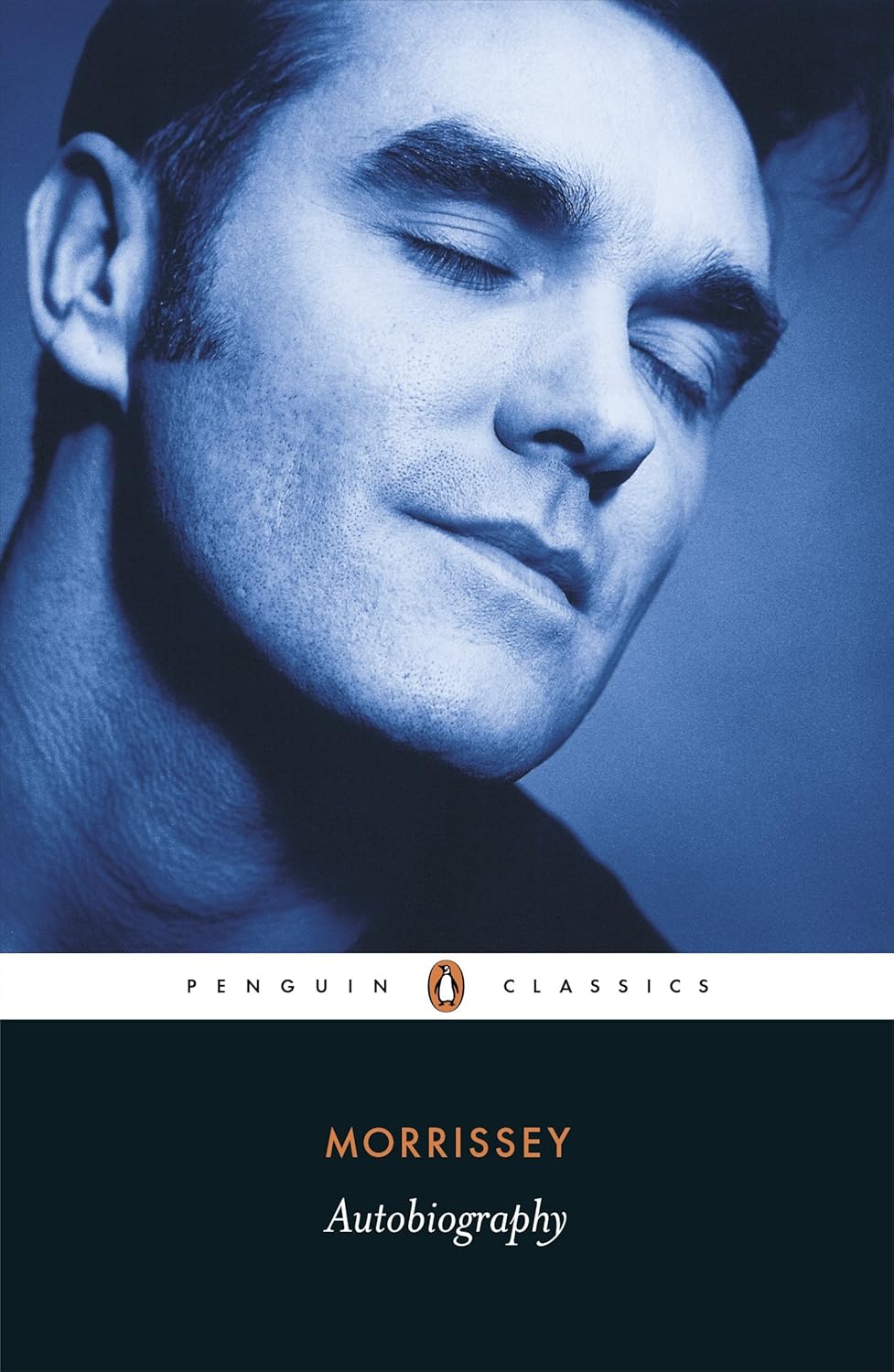
I’m a fan in a restrained, not-queuing-up-overnight sort of a way, enough to know he’s been threatening the book’s appearance for years,  much like Kevin Shields did with talk of a new My Bloody Valentine album. Both these 80s indie veterans finally made good on their promises this year (something astrological about 2013?), and both managed to do so without sending out early press copies or agreeing to promotional interviews. Few magazines, chat shows and radio shows would have said no to a new Morrissey interview plugging the book, yet his only concession appears to have been a single signing appearance in a bookshop in Gothenberg. Gothenberg has a reputation as the Manchester of Sweden, in terms of its passionate love of alternative music. I’ve performed in the city a few times myself, both with Fosca and with Spearmint. In the book, Morrissey returns the compliment: ‘Sweden always feels like a reward… It is warming to be a part of Göteborg life… Nothing but promise erupts from everywhere in Sweden, and the life-giving enthusiasm of the audience feeds me.‘
So Morrissey does no interviews, and I can’t say I blame him. The book itself is full of incidences, after all, where journalists have twisted his words against him – sometimes to libellous effect. But the British media, like nature, abhors a vacuum, so there’s been a slew of comment pieces – including several before the book was even out, built on sheer speculation about what the book might contain. In this way, Morrissey is like a member of the royal family he so despises: I couldn’t help thinking of the coverage of Kate Middleton, hacks waiting for her to give birth, filling up time and space that could have been gone to actual facts, with reams of unnecessary, un-asked for, and utterly unqualified comment.
The only fact that was known about the Moz book was that it would be a Penguin Classic, the result of a jokey wish the singer made in a Radio 4 interview a few years ago. Penguin Books were, it turns out, happy to indulge him in this piece of wry and knowing packaging, and good for them.
It should go without saying – but it turns out it doesn’t – that it’s not a proper Penguin Classic, not least because it lacks the usual scholarly annotations and critical introduction and Note On The Text and so on. The back cover blurb is also in a different typeface to the usual PC one, thus announcing the Moz book as a separate animal in its own right, if only people would pick it up to see.
Aesthetic jokes aside, Penguin has often played fast and loose with what counts as a ‘classic’ in their eyes as it is. They ditched the date barrier that roughly kept the Classic Classics pre-1918 and the Modern Classics post-1918 long ago. It’s not even the first time a rock star still alive in 2013 has had their words published by the imprint. Bob Dylan’s lyrics can be found in The Portable Beat Reader.Â

Actually, Morrissey constantly quotes his own lyrics in his book too.
But predictably, several commentators have insisted that Penguin has now ‘damaged’ its Classics line’s reputation. Such writers are only damaging their own reputation. If anything, Penguin has enhanced its brand further, by showing it has a sense of humour and a respect for wit. Wit is, after all, the brevity of the soul. I also salute Penguin for allowing a high profile book’s first edition to come out as an affordable, easy-to-recycle £8.99 paperback rather than a £19.99 resources-guzzling hardback (the publishing ‘two tier’ system is a bete noire of mine).
Two favourite revelations in the book. One is that Morrissey didn’t think ‘There Is A Light That Never Goes Out’ was good enough for The Queen Is Dead. Mr Marr won him over. The other is that Peter Wyngarde always answers the phone with the phrase ‘There you are!’
Tags:
Books,
morrissey
Dandies In An Underworld
Friday 11th October 2013. A rainy afternoon spent in Piccadilly with Ray Frensham, fellow subject of the book I Am Dandy and author of Teach Yourself Screenwriting. He takes me for lunch at Brasserie Zedel in Sherwood Street. Once the Atlantic Bar, it’s now a rather splendid and ornate place to meet friends for a meal. Like the Wolseley, it’s actually possible to eat there relatively cheaply if one chooses carefully. You forget it’s in a basement somewhere under Regent Street – the ceiling is so high and the decor so gilded that it manages to feel downright airy.
Mr Frensham is full of entertaining anecdotes, and talks about how his romantic life became more fun after he hit 50 rather than before. The key ingredient being the sense of finally being at home in one’s skin. I certainly find that reassuring. We mooch around Hatchard’s bookshop afterwards, and take photos of each other with the dandy book. Hatchard’s has quite a few copies, filed under Fashion.  I’ve since re-bleached my hair so it’s now a little less yellow. Not keen on resembling a sexually confused Eminem.
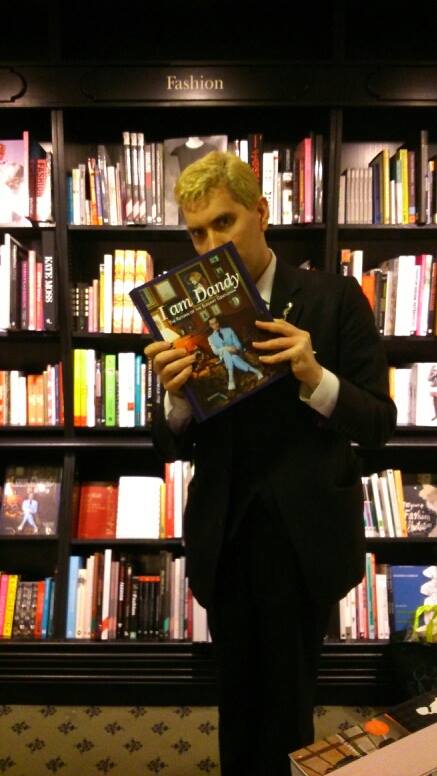

There’s also a new blog post about the book at the website for Bergdorf Goodman, the New York department store. I am featured as an example of The Dandy As Decadent, with an ‘under-worldly style’.
http://blog.bergdorfgoodman.com/mens-style/dressing-dandy-the-return-of-the-elegant-gentleman#slide-2
Mr Frensham tells me that his appearance in the book has already led to offers for modelling suits and so forth. Â I haven’t heard anything myself – yet. It would obviously be nice if something came of appearing in either that or in the big new diary book (A London Year).
But then, it’s just nice to be included for something I’m happy to be included for. As I think it says on the gates of the Underworld.
Tags:
a london year,
Books,
brasserie zedel,
hatchard's,
i am dandy,
London,
ray frensham




