My main work this week is finishing an essay on Vathek and Northanger Abbey. I’m also reading Jane Eyre for the first time. I had no idea the childhood chapters would be so grim. It makes Oliver Twist look like the Mickey Mouse Club.
* * *
I have a new article published in issue 10 of New Escapologist, which is out now. The theme of the issue is ‘the absurd’. I chose to write about the Theatre of the Absurd in connection with Harold Pinter’s London. I researched it properly, too – probably too properly.The magazine can be bought from this link:
I never know the kindest way of saying ‘no’ when someone approaches me and says ‘do you remember me?’  My heart always sinks when this happens and I know I make a mess of it. My idea of hell is a school reunion. Never mind the point-scoring about careers: I dread the inquisition of ‘remember when?’
An old school friend contacted me recently. He said he always thought of me as being ‘the one who was obsessed with ISBN numbers’.  I had forgotten that little hobby entirely, though it more or less sums my teens up. So I can barely remember myself, let alone others. Too much alcohol under the bridge. Even if I do remember a shared event, my account is probably different to theirs anyway. All one can do is debrief oneself on the page when the memories do come, but always with the assumed disclaimer that events can be mis-remembered.
* * *
Some advice from others, on the dilemma of being asked, ‘Do you remember me?’
From someone I won’t name, as they regularly use this advice themselves:
‘Say “I do, but I can’t remember where from”, even when you don’t.’ Â
This is a sensible solution, as it forces the other person to fill in the blanks. The context is often the real problem anyway.
Martin White’s suggestion:
 ‘Just say ‘yes’. And walk off.’
Joking aside, I think I’ve actually done this in the past, out of sheer panic.
And from Keith TOTP:
‘Say nothing. When they go to introduce themselves shout “NO! I’m thinking”, then say nothing. Repeat until they leave.’
What I do remember is a story from Tom Baker’s memoir. A woman approaches him in a bar, smiling.
‘Tom! How are you? It’s been an age!’
He struggles to remember who she is.
‘Um… Was it Doctor Who? Touring in rep?’
Her face falls. ‘We used to be married.’ And she storms off.
* * *
Tuesday 1st April 2014.
To the Hackney Picturehouse to see Under The Skin. It’s a sold-out screening. The audience is rapt and well-behaved. Ms Scarlett Johansson plays an unkind alien, who devours the men of Scotland one by one for no very good reason. Her victims are not deep fried – perhaps that would be too easy. Instead, she seduces them in her large van, which we assume has a sticker saying ‘No Horny Scotsmen Left In This Vehicle Overnight’. She then takes them to a house of decrepit awfulness, even for Glasgow, where they disrobe and walk calmly into her fridge – a large tank of black liquid.
Now, whether this is the same alien black liquid from Prometheus we are not told. Actually we are not told very much about anything. So it’s like Prometheus in that respect as well. There does seem to be a new vogue for science fiction films that don’t fully explain themselves. The greatest example of this genre is Mr Kubrick’s 2001: A Space Odyssey. Mr Kubrick knew exactly what to do with a mysterious black liquid. He had it frozen into a nice firm monolith, and everyone was happy. As a general rule in life, it’s better to be on solids.
The ‘alien succubus’ plot is not new. Without checking the TV Tropes website I can think of the film Species, an episode of Torchwood, and an episode of The Outer Limits. However, Under The Skin does do new things. It’s a twist on the connection between space alien-ness and the loneliness that can come to anyone – a theme that hasn’t been done this well since The Man Who Fell To Earth. There are three memorable special effects scenes, two involving skin, and one involving an eye. Half the film is Ms Johannson asking for directions in an English accent (thus resembling a one-woman Edinburgh Festival). The other half is her wandering around the landscape lost, not saying very much full stop. Deacon Blue’s ‘Real Gone Kid’ plays in a bleak kitchen, as it always must.
I can’t say I prefer the film to Sexy Beast by the same director, but I do admire its nerve.
* * *
On the Overground train from Hackney Central to Camden Road, about 11pm. Two young women on the seat opposite are kissing passionately. Both are swigging from cans of lager when they’re not swigging from each other. One has dyed blue hair, so I wonder if a screening of Blue is the Warmest Colour has gone down particularly well.
In London, I’m used to seeing pairs of gay men snogging nonchalantly on the Tube like this. But I think this is my first female couple seen frolicking in the open. They might even be newlyweds – the laws allowing gay marriage came into effect this very week. But as happy as I am for the changing times, my awkwardness around heavy petting is equal-opportunity too, and I move to a different carriage.
* * *
Wednesday 2nd April 2014
To Vogue Fabrics, 66 Stoke Newington High Street, for the launch of La JohnJoseph’s new novel, Everything Must Go (available at http://itnapress.com/titles/everything-must-go-by-la-john-joseph). The book is a surreal gender-bending black comedy about a road trip in a futuristic world. The blurb on the back cover mentions Ronald Firbank twice. It’s safe to say it’s my sort of thing.
The venue has a speakeasy feel. You have to walk down a black corridor from what looks like a residential door, then continue down some steps into a dark basement. There is a stage area at the far end, plus a DJ booth and a modest bar on the left side. No taps or fridges, just cans of lager & cider, plus bottles of spirits and mixers. A small stuffed rocking horse rests on the counter.
I catch readings by R Justin Hunt (who also serves drinks) and Bertie Marshall, one of the 70s punk scene’s Bromley Contingent. Â La JJ is in lipstick and earrings, blue blouse and leopard skin skirt. He signs my copy of the novel. I’m hoping to cite it in my thesis about literary camp next year.
* * *
Thursday 3rd April 2014.
London is covered in some sort of high pollution, apparently caused by sand from the Sahara. I think of those old comic book adverts for Charles Atlas, where muscular men kick sand in people’s faces. Â I think I can taste the smog at the back of my throat, but that may also be a symptom of being exposed to hysterical headlines.
I meet Danika H and her partner Cherie at the British Library café. I last saw Danika in New York at Lawrence Gullo’s wedding, nearly five years ago. Since then we’ve been exchanging aerogrammes (I think Australia’s postal service still makes them). This week she moves from Australia to the UK. I welcome her and Cherie to London, and apologise for the smog.
Even though it’s past 4pm, the BL café is swarming with people. Empty seats are like gold dust. While I’m waiting for Danika, one woman swipes a chair from my table without even asking – she does it stealthily when I’m looking away, choosing her moment. On the table is a sign: ‘Diners only until 3pm – No computers, meetings or student’ [sic].
This must be the usual peak time of the year, as the library has installed a bank of extra lockers, by the basement toilets. Â ‘Just until Easter’, says the man in the cloakroom. It’s a time when classes have ended and students have to go somewhere to do work under their own steam: revision, dissertations, essays. And I’m one of that number too.
Saturday 22nd March 2014. To the Phoenix in Cavendish Square for the 60s soul & indiepop club night How Does It Feel To Be Loved. It’s been going for nearly twelve years now, and I’ve been a guest DJ there once a year for quite a few of those years.
It’s flattering that Ian W keeps asking me back, as I’m not exactly a ‘name’ DJ. In fact, tonight I worry that my name might have the opposite effect. When I arrive at 10pm, one hour after it opens, he says I’m the first person through the doors. Thankfully a respectable amount of people eventually trickle in. I play records from 11.30 till about 1 am. Then I leave at about 2.30am, when Ian gently stops me from falling asleep in the corner of the DJ area. I’m not the all-nighter I used to be.
At my DJ stint there last year I was chatted up by a visibly intoxicated woman. I declined her advances, but for me the incident was so rare and so surprising that it topped up my self-esteem for months. Tonight there is no repeat of the incident, but enough people dance to the records I play. So I feel ‘desired’ in that sense at least.
Fosca’s Rachel Stevenson and her partner David H are there tonight. I’m very happy to see them, after what must be years (previous HDIFs? the last Fosca gig?). Rachel S makes an anti-request: can I not play Prince’s ‘Raspberry Beret’ this time?
1. Broadcast – Before We Begin
2. Camera Obscura – The Sweetest Thing
3. Dressy Bessy – Just Like Henry
4. The Cookies – I Want A Boy For My Birthday
5. The Chiffons – He’s So Fine
6. The Honeys – He’s A Doll
7. The Ronettes – Baby I Love You
8. Velocette – Get Yourself Together
9. The Aislers Set – Hit The Snow
10. Frankie Valli – You’re Ready Now
11. The Angels – My Boyfriend’s Back
12. Spearmint – Sweeping The Nation
13. Belle and Sebastian – Women’s Realm
14. Morrissey – Sister I’m a Poet
15. The Chills – Heavenly Pop Hit
16. Carole King – I Feel The Earth Move
17. Shirley Bassey – Spinning Wheel
18. Dexy’s Midnight Runners – Plan B
19. The Supremes – Come See About Me
20. Aztec Camera – Oblivious
21. Stereolab – French Disko
22. Camera Obscura – French Navy
23. The Smiths – Ask
24. The Shangri-La’s – Give Him A Great Big Kiss
25. Nancy Sinatra – These Boots Are Made For Walking
26. Chairmen of the Board – Give Me Just A Little More Time
27. Gloria Jones – Tainted Love
28. Labelle – Lady Marmalade
29. Modern Lovers – Roadrunner
30. The Who – Substitute
31. Blondie – Dreaming
32. Sister Sledge – Thinking of You
When Ian plays ‘Turn, Turn, Turn’ by The Byrds, I mishear one line as ‘There is a time for everything / And a time for breakfast.’
I’m reminded of another gem of a misheard lyric, related to me recently. It’s the opening line of Elvis Presley’s ‘Suspicious Minds’: ‘We’re courting a tramp.’
Ian W plays a new artist he’s keen on, Withered Hand. Sweet and pretty music, if a rather unattractive name. Still, once the music becomes known, a band name becomes meaningless.
* * *
Tuesday 25th March 2014. To the Hackney Picturehouse to see The Grand Budapest Hotel, the new film by Wes Anderson. Like Moonrise Kingdom and his other work it exists in its own strange and idealised bubble world, where everything is a treat for the eyes and people act in a quirky and unrealistic way.
It’s often the case that a comedy wants to be the audience’s friend. Just as stand-up comedy tries to connect with everyday observations, comedy films usually say ‘here are people just like you in funny situations’. There is none of that in Wes Anderson films, where the people are very much not like the audience – or indeed like any real person. Â In Moonrise Kingdom, though, he managed to cut through this barrier by turning up the artifice to the point it became a kind of magical campness, while offsetting this with the poignancy of the two child actors.
Children cannot do camp. They’re still learning how to operate on a nominal level, let alone a knowing one. We are all born without irony, and only acquire it on the day we get the big cosmic joke – that the world isn’t made for us after all. Some of us bravely carry on as if we haven’t realised this joke, but I digress.
In The Grand Budapest Hotel, what makes the audience care is a combination of two things: Ralph Fiennes’s energetic and charismatic main character, and the device of nesting his tale within three outer frame stories. Like Shahrazad in the Arabian Nights, the tension of having to hold a frame story in one’s head increases the connection: we keep watching to see not just how Mr Fiennes’s story ends, but how the stories of Jude Law, Tom Wilkinson and the girl in the graveyard end too.
But what really intrigues me about the film is the way the Fiennes character is camp himself, in the aloof and sexually ambiguous sense. His discussion of a priceless stolen painting, ‘Boy With Apple’, is rather more Ronald Firbank than Allo Allo. The villainous Adrian Brody character, meanwhile, sees the flamboyant and perfume-obsessed Fiennes as something of a threat to masculinity de facto (see also David Tennant in the early 2000s BBC TV series Casanova).
If someone were to revise Susan Sontag’s ‘Notes on Camp’ essay today (and by ‘someone’ I obviously mean ‘me’), they’d definitely have to include The Grand Budapest Hotel. And given the film is by no means a niche taste – it’s number one in the charts – perhaps Wes Anderson has become the mainstream saviour of old-fashioned camp.
* * *
Thursday 27th March 2014. I get the mark back for the class presentation. It’s a 71 – a low First. This seems something of a dip compared to my recent trio of 80-plus marks, but as it’s my first graded presentation and not an essay, I can’t complain. According to the tutor’s comments, my shortcoming was to skim over too many different points within a limited slot.
I still find the art of conciseness and selectivity difficult – which may be something to do with my dyspraxia. I either find it hard to start writing, or hard to stop. Writing for me is a long, slow bleeding process onto the page, followed by the equally long and slow trimming and moving about of what’s there. The second process is more enjoyable, but it still takes me ages.
I meet Ella L for tea and eclairs at Maison Bertaux, the long-running patisserie and Soho landmark. It features in Derek Jarman’s diaries from the early Nineties, andappears as itself in The Look of Love, the Steve Coogan film about Paul Raymond, which came out last year and which not enough people went to see, frankly. Maison Bertaux itself now features permanent doodling on the walls by Noel Fielding of the Mighty Boosh.  On the upstairs window sill by our table is scrawled the phrase ‘Jane Birkin dances like a deaf woman’.
* * *
Sunday 16th March 2014.
To the Pembury Tavern in Hackney for Travis E’s birthday drinks. It must be one of the few pubs in London to not have any background music or TV screens. It’s also the first pub in the city to accept Bitcoins.
I buy a bottle of cider from the bar, and note the health warnings that have popped up on alcoholic packaging lately. The sentence ‘please drink responsibly’ is a common enough sight, but there’s also a tiny pictogram in the ‘DON’T’ style of a diagonal bar across a circle. Inside is a little silhouette of a woman with a ponytail and a baby bump, drinking from a bottle. An update of Hogarth, I suppose.
I’m currently reading George Gissing’s 1890s novel The Odd Women, about changing attitudes towards marriage in London at the time. Alcohol and pregnancy are represented there too, but Gissing is no Hogarth; he drenches both in euphemism.  To indicate the pregnancy of one character, Monica, he writes: ‘With a moan she lost consciousness. Two or three women who were in the room rendered assistance. The remarks they exchanged, though expressing uncertainty and discreetly ambiguous, would have been significant to Monica.’ Thus Gissing is ‘discreetly ambiguous’ too.
* * *
Tuesday 18th March 2014.
At the Prince Charles Cinema to see Only Lovers Left Alive, a new film by Jim Jarmusch. It’s something of a contrast to the last new film I saw, Gravity (at the BFI IMAX the previous Tuesday). Gravity is all about the film as fairground experience: the director throws a series of jolly space-based obstacles at Ms Sandra Bullock until she starts saying aloud ‘Now what?’, thus pre-empting the audience’s response. Â The answer being, ‘Now this, Ms B – a fire on the space station! Purely because you’re in a thriller, and we need a reason to introduce Chekhov’s Fire Extinguisher. That way it can be suddenly reused in a different way later on, and the audience will not question it.’
At first I found myself wincing at these clichés of the form. Another one in Gravity is the third astronaut of the mission dying early on, because he is (a) foreign, and (b) not played by a Hollywood star. For years this sort of thing was a joke made by stand up comedians about the 1960s Star Trek – the unknown ‘guy in the red jersey’  who would always perish on alien missions.
But after a while I realise it’s missing the point to mind these archetypes in Gravity – the film is really all about the innovations of its effects. So the hoary old plot stuff is needed, to cast the visual elements into starker relief. And besides there are still a few twists – what happens to George Clooney, for one.
Gravity has been at the IMAX for months, while Only Lovers Left Alive seems to have done a Look of Love at the box office. It has big stars (Tilda Swinton, Tom Hiddleston, John Hurt) and a cultish fanbase-baiting story (rock star vampires mooch about elegantly, in present day Tangier and Detroit). Yet it seems to have been all but dismissed by the public. Perhaps it’s for the crime of being what Quentin Crisp once called ‘unabashed festival material’. It’s unashamedly slow and atmospheric, and doesn’t throw obstacles at the characters for the sake of it. They just mope about prettily between sunrises, which is all anyone can ask of them.
It’s the sort of film I can see playing on a Prince Charles Cinema bill alongside the 1980s cult vampire film The Hunger, and indeed alongside Ms Swinton’s Orlando too – more otherworldly and immortal goings on. It’s only surprising she hasn’t played a vampire before. Mr Hiddleston, meanwhile, is the spitting image of Morpheus from Mr Gaiman’s  Sandman comic. And Mia Wasikowska appears too, as the sort of volatile waif that I thought only Ms Juno Temple was allowed to play (indeed, either would make a good Delerium in a Sandman film).
The listings at the Prince Charles Cinema are an entertainment in themselves. One forthcoming event is a ‘weep-along’ screening of Les Miserables, where the ticket includes free tissues.
* * *
Thursday 20th March 2014. Afternoon: I meet Mum in Primrose Hill, and walk with her through to Camden before catching a bus to Euston. Â We have tea in the Quaker café opposite the station.
How to tell you are entering Camden: when a young woman in a black t-shirt and multicoloured hair suddenly looms into view carrying a foil tub of fried noodles. She eats them with a wooden fork while walking along the canal. She is An Eternal Camden Figure.
A prominent sign outside Camden Market reads ‘Piercings. Tattoos. Tattoo Removals.’  The full arc of youthful remorse right there. One stall purely sells t-shirts featuring variations on the ‘Keep Calm And Carry On’ poster. Even on an overcast Thursday afternoon, there’s still plenty of punkish young people from other lands sitting on the pavement outside the World’s End, like so many have done before them. Camden Town is not so much a place as an awkward phase.
* * *
Friday 21st March 2014. I get the mark back for another essay. It’s an 80, for Ms Bechdel’s Fun Home, as part of the 21st Century module. I was in a bit of a state during its writing, due to Dad dying (an irony not lost on me given the subject matter). So I was concerned it would get a decent mark at all. I’m pleased and grateful.
And it’s very good of Kate Bush to mark my academic success by announcing her first concerts in 35 years.  She has made an awful lot of people happy today. I think my favourite Kate Bush song is the ballad ‘Under The Ivy’, as championed by Sebastian Horsley. ‘A great song should ache,’ he wrote in the appendix to Dandy In The Underworld. ‘And this song does. It has an aching creative heart. Its scope spans my life.’
Monday 10th February 2014. Room 321 at 43 Gordon Square, part of the Birkbeck campus. I am obliged to do a class presentation on Romantic Age Fiction, as part of the English degree. I choose William Beckford’s Vathek along with Jane Austen’s Northanger Abbey. This is partly in order to say something about the gothic and gender and camp, but mostly because the two novels rarely get discussed together as it is.
This is a sign that I’m starting to enjoy looking for these little gaps in literary studies, knowing that here is a space on the big collective bookshelf which I might be able to fill. The thought is one I used to view as impossibly vain and arrogant – the inner critical voice saying: ‘who are you to add yet more stuff to the world? The world doesn’t need more books, more words, more records. Other people do those. Not you.’ But arrogance and confidence have a shared border. And if everyone thought like that, there would be no books and records full stop.
The fun is knowing that it is possible to say something new and original and fresh about anything, even Jane Austen. So I stand up in the room in Gordon Square and I argue how Jane Austen is camp. Well, okay, she’s camp just for that one novel, and inadvertently on her part. Effect, rather than intention. But I’m convinced that when dipping her hands into the gothic with Northanger Abbey, Ms Austen accidentally comes out wearing black nail varnish.
Quips aside, I do my best to back this claim up with a decent amount of research and quotes and theory, and hope for the best. Arrogance plus commitment equals art.
No problem arguing that Beckford’s Vathek is camp, though. In his introduction to the Creation Books edition, Jeremy Reed singles out the Caliph’s unceremonious exit from a black marble bath: ‘he flounced from the water like a carp’. Â Reed adds that ‘no camper note was ever sounded in the late eighteenth century novel.’
* * *
Tuesday 11th February 2014. In the British Library I find myself getting into spontaneous ‘research binges’, particularly when seeing a quotation without proper citation. The quote I’m thinking about this week is a favourite joke about footnotes:
‘Encountering a footnote, as Noel Coward remarked, is like going downstairs to answer the doorbell while making love.’ – GW Bowersock, ‘The Art of the Footnote’, American Scholar, Vol  53 No 1 (1984).
Did Noel Coward really invent this joke, I wonder? It seems a little too… physical for him.
I’ve also seen it in Chuck Zerby’s 2007 book The Devil’s Details: A History of Footnotes, but that just cites another book, Anthony Grafton’s The Footnote: A Curious History, from 1997. Grafton credits a 1989 essay on footnotes by Betsy Hilbert, which in turn cites the 1984 Bowerstock essay, as quoted above. With supreme irony, Bowerstock goes without any references or footnotes full stop.
Today, however, I find a revised edition of the Grafton book, from 1999, which says Noel Coward got the joke from John Barrymore, as in the vintage Hollywood actor. He refers to a 1976 biography by Cole Lesley, The Life Of Noel Coward (also known as Remembered Laughter), where the joke is a little more sexually explicit. According to Lesley, Coward ‘could never bring himself to glance at [a footnote], he said, after John Barrymore expressed the opinion that having to look at a footnote was like having to go down to answer the front door just as you were coming.’
Naughtier versions or not, there’s no mention of where Barrymore said it himself. So I keep digging away until I find Gene Fowler’s Good Night Sweet Prince: The Life and Times of John Barrymore, published in 1944. It has an anecdote about the actor preparing for Hamlet in 1922. He buys a copy of the play with no footnotes:
‘[John Barrymore] detested footnotes of any calibre, and said of them ‘It’s like having to run downstairs to answer the doorbell during the first night of the honeymoon.”
The joke certainly suits the four-times-married grandfather of Drew much more than it does the publicly asexual Coward, and Coward is thought to cite Barrymore when he used it. To attribute the quote to Noel Coward alone does a disservice to both men.
* * *
Wednesday 12th February 2014. The web is 25 years old. I started using it at London’s first internet café, Cyberia, in Charlotte Street in 1995. The browsers were all Netscape – it was just before Internet Explorer. I once saw a man storm out of Cyberia saying ‘What a waste of time. You might as well make a phone call.’
* * *
Thursday 13th February 2014. I get my highest essay mark yet on the degree course. It’s an 85, for a piece on Wilde’s Dorian Gray. To put this in context, a First for a BA English is a 70, while an 80 is a High First, for showing ‘characteristics more usually found at postgraduate level’. And I still have over a year of the undergraduate course to go. Tonight the tutor takes me aside after the class to urge me to consider postgraduate courses when I finish.
I call Mum to tell her. It’s quite an emotional call, as it’s the first achievement of mine that she can’t share with Dad.
My original plan was just to get an English degree full stop, partly out of being fed up with feeling uneducated beyond GCSE level, but also because I felt instinctively that I might be one of those people better suited to doing a degree in later life. This has now turned out to be true – and then some.
Right now I have to admit I’ve no pressing desire for a career in academia, but I don’t dislike the idea either. My main concern, as ever, is how best to earn a modest living from this ability. It surely has to be of worth, to someone, somewhere. I’d even consider living abroad if it came to it.
* * *
After class, I dash off to the Platform Bar, a trendy Hackney hostelry, two floors up in an aging tower block. It’s the launch for The Yes, Sarah Bee’s uplifting book for children. Very Dr Seuss-like, illustrated with colourful abstract animals by Satoshi Kitamura. There’s a website at www.sarahbee.co.uk
I see the dentist about my ongoing jaw aches. He’s now convinced I am grinding my teeth in my sleep, even though there are no signs of wear. It’s the muscles that have been taking all the punishment, he thinks. But it’s also a condition triggered by anxiety. I have to admit that the problem has been clearing up as more time passes since Dad’s funeral. I never seem to take anxiety as a physical problem seriously, yet clearly it’s something I’m prone to. The dentist has ordered a bite guard, which I’ll have to wear in my sleep.
* * *
I’m reading Savage Messiah, Laura Oldfield’s Ford experimental montage of art, photography, collages and text on early 21st century London. Â The introduction by Mark Fisher is dated 2011, yet it’s already become a historical relic. There are references to the widespread dread of the then-forthcoming 2012 Olympics. As it turned out, many Londoners actually enjoyed the Games (often despite themselves) and now think of them fondly. Fisher also alludes to London civil disobedience of the past, such as the 1980s riots, as something very much confined to the past. This specifically dates his piece to early 2011, as there’s no doubt that the riots of later that year would have warranted a mention. Likewise the Occupy protests, with the camp outside St Paul’s.
What stands out most, however, is his mention of 2012 as the alleged end of the world, according to the Mayans. Fisher supplies this information as if it’s barely known at all. In 2014, after all the Mayan discussion during 2012 itself (and the disaster movie, 2012), the reader is rather more likely to be aware of it. In fact, it was Ms Ford who became a kind of anarcho-punk Mayan, with her drawings of riot police now steeped in pre-2011 prescience.
One can argue that all published writing is diary writing of a kind, because as time goes on the writing becomes more attached to its own moment.
* * *
Saturday 1st March 2014
I notice how mobile phones have changed architecture. The modern British Library in St Pancras was only opened in 1998, yet parts of it are already ruins of their original purpose. In the basement, there’s a row of booths designed for payphones. Today the phones are all stripped out, though the direction signs for them are still in place (a sign pointing to an empty space always unnerves me). Any Luddite soul who wants to make a call and doesn’t have a charged-up mobile is directed to St Pancras station next door, where working payphones can still be found.
Today, though, the Library’s empty phone booths have come into new use. The building’s foyer is hosting some science-based activities for toddlers (fun with soap bubbles and so on). As a result, the old phone booths have become a temporary baby buggy park. Each pushchair fits the booth space perfectly.
* * *
On a similar note, I’m curious to see that printed phone directories still exist, though only just. This week the latest Thomson’s directory arrives. Phone directories were once thought of as hefty and thick volumes, destined to be torn in two by circus strongmen. Today the Thomson’s directory is a slim A5 affair. Barely a book at all. Even I could tear it in half.
* * *
Monday 3rd March 2014
The British Library’s café, with its free Wifi and lack of piped music, is now so popular during the day that I have given up using it during my research breaks. Hundreds of people are there every weekday now, all at their laptops, filling every possible seat and table, and seemingly there all day. Many are happy to sit on the floor, typing away in the fluff and dirt. I’m happy that so many have this blissful, office-free life, while resenting that there’s no room for me. Still, other cafes are available, and I have no problem in finding a Reading Room seat to do my college research, which is really what I’m there for.
In today’s tea break I do find a mostly empty seating area, the outdoor balcony grove high up on the third floor. It’s a circular space, with a single continuous bench around the circumference, so sitting there one feels watched by everyone else. It’s a kind of panopticon for packed lunches.
Although there are plenty of places to sit down, the only other people there are a young couple, snogging away. So instantly I have to perform the self-conscious role of Embarrassed Lone Person Entering a Space Claimed By Others. I walk around trying hard not to make eye contact with them, and look out through the vines at the view over the back of St Pancras, as if to suggest that is what I have come for. But I hear their lips smacking away, and feel impossibly self-conscious. I go back inside, trying to act as I have satisfied my curiosity of the view.
If there were other lone persons there too, it would be okay – I would have reinforcements. But when a public space contains one lone person and one couple (or a group), a heightened awareness descends. Or at least, it does with me.
Back inside to the safety of the crowded café Â – where I can’t find a seat.
* * *
Wednesday 5th March 2014
This week I’m studying the sci-fi writer Charles Stross’s Accelerando,for my 21st Century Fiction class. Obligingly, Mr Stross is also in the news today, over something that must seem like science fiction to people of the past: a heated argument in a virtual reality space. He was one of the writers cited in a Twitter controversy, about whether or not Jonathan Ross should host the Hugo Awards for science fiction. The online fuss resulted in Ross stepping down from the job, while his wife left Twitter for good.
Mr Stross’s novel features humans uploading their minds to live in digital spaces, away from the shortcomings of the body. This is all very Utopian, but is some distance away from today. Right now there is the hybrid frustration of being able to communicate virtually, yet still being dependent on a body that keeps you apart physically. I think this must be one reason why people can get so angry so quickly on social media: they are there, yet not there. It’s hard to imagine the same degree of anger happening if the conversations were carried out in person.
I feel relieved at not being sucked into these sort of spiralling social media arguments, but I also feel strangely left out too. Even a fight is a party of a kind.
Am starting to notice how a university degree re-wires the mind. Â Before I took the course, to me all non-fiction was either commercial (ie books I could understand), or academic (books I couldn’t). Now academic books are finally opening up to me, and it’s like being able to read a new language. The flipside, though, is that I started to get impatient with a lot of commercial non-fiction, wincing at their generalisations and agendas. Â But then I discovered that’s possible to switch reading levels, like switching between languages. One can then enjoy a commercial book on its own terms. There is a danger in calling a book ‘too light’ – such a phrase says more about the reader than the book.
Writing this down, I smile when I realise that this is more or less the plot of Educating Rita. Still, the message of Willy Russell’s play hasn’t changed: higher education doesn’t change people wholly – it gives them more options for approaching the world, which is quite different. A bigger toolbox.
Saturday 22nd February 2014
I meet with Mum in the basement café of Waterstones Piccadilly, in the old Simpsons building. It’s a rare example of a non-place being converted back into a place-place. The café used to be a Costa, but is now run by Waterstones themselves, decorating the walls with nice old book covers, rather than the corny photographs of continental bonhomie that can splatter the walls of every Costa everywhere. It may still be a franchise café, but any café which isn’t a Starbucks, Costa, Caffe Nero or Pret has a definite sense of being somewhere in particular, as opposed to nowhere in particular.
Mum and I have a vegetarian lunch at the Coach and Horses in Greek Street. At the table next to us is a group of young Japanese women using their smartphones to take photos of their afternoon tea.
Then we go on to the National Portrait Gallery. The David Bailey exhibition is sold out, so we take a look at the permanent collection instead. The unflattering painting of Kate Middleton – the one which makes her look 50 – is displayed more matter-of-factly than I’d thought, tucked within a row of other portraits and not very well-lit.
We also stumble on an engrossing mini-exhibition about Vivien Leigh. I’m reminded that even though Gone with the Wind is meant to be the most successful film in the UK ever (going by sales of cinema tickets), I have yet to get around to it myself. That and St Paul’s Cathedral: on the list of things one is assumed to have done, but which the same assumption puts one off doing.
Sunday 23rd February 2014
My anxiety over the funeral hits me so hard that I spend the entire day in bed, trying to get over excruciating stomach pains.
Monday 24th February 2014
Dad’s funeral. I brave the morning rush hour Tube in order to get to Tom’s place on time, and am staggered by the awfulness of what must be a daily experience for so many. Not only do people have to brave the train journey with strangers bodies’ pressed against them throughout, but the journey itself is delayed at each stop, due to the mass of passengers preventing the doors closing on the first go. Whatever the rewards of being a rail commuter must be (a decent salary? a house?), to me they can’t possibly be enough. A commuter friend once told me, ‘You just get used to it’. I don’t think I ever could.
So I go from the lack of respect for bodies per se, to paying respects to one particular body. Mum has insisted on no dress code, but I’m in a three-piece black suit and black tie anyway, because that’s me. I add a seahorse brooch, though, in case I’m mistaken for one of the crematorium staff.
Tom drives me to Bildeston to meet with Mum and Uncle Mike (Mum’s brother), and we all get into a hired people carrier. It’s then that I see Dad’s coffin for the first time, in the back window of the hearse in front of us.
Fittingly, it’s a cardboard coffin, looking just like one of Dad’s many boxes of comics in the loft. It also has a base made from the same sort of hardboard that Dad used, when he built scenery for Tom and myself to play with as children; rocket ships and puppet theatres. One of Mum’s homemade quilts covers the coffin, a beautiful science-fiction themed work with planets and stars. ‘I’m having that back before the actual burning,’ says Mum about the quilt. ‘It’s too nice!’
Seeing the coffin for the first time is the first of several moments when I nearly, but not quite, burst into tears.
We arrive at the crematorium at Nacton, near Ipswich. Then we get out and walk behind the pallbearers with the coffin, into the chapel. Unexpectedly, all the seats are taken: standing room only for Dad.
The Humanist host of the ceremony, Chris, does most of the reading. Then I follow with my own eulogy. At Mum’s request, it’s based on extracts from my diary, but I’ve added some of the liner notes from the Fosca album The Painted Side Of The Rocket, the album which features myself and Tom together. I wanted to make the point about creativity being something children do naturally, and which adult artists have to do on purpose. A quality of childlike unselfconsciousness – something Dad manage to manifest easily throughout his life, in both his art and his personality.
Then I read from the diary entry about Dad’s death, ‘Seeing Dad’, and I very nearly break down, twice. But only nearly.
We file out to ‘Monster Mash’, as promised. Dad’s favourite song, ‘Macho Man’ by the Village People, then follows on, with its opening line of ‘Body! Wanna feel my body, baby!’
Both are very silly records indeed for a funeral, and Dad, a fan of Joe Orton and Family Guy, knew this more than anyone else. We put little explanations about the choices – or warnings, rather – into Chris’s reading and mine, so one hopes the mourners understood.
* * *
In the courtyard outside the chapel, the mourners gather to chat. The first thing spoken to me after the service is, ‘Look! Muppet socks!’
A man in his seventies has collared me. He slips off his loafers to show off, yes, his Kermit the Frog socks. This turns out to be one of Dad’s schoolfriends from Clacton, a jokey gang raised on The Goon Show and who, like Dad, have managed to extend their in-jokes down the decades. One of them is wearing a luminous high-vis jacket: whether it’s for cycling or an outdoors day job I’m not sure, but it’s certainly a sign his own body has some years to go yet.
‘I’ll come visit you’ says one to the other as they part.
‘I don’t like threats’, says the other, deadpan.
Afterwards there’s sandwiches and tea at Chamberlin Hall, the new village hall in Bildeston. I chat with cousins I’ve not seen for decades, and some I’ve not seen full stop. Some live in Brighton, some in London, some in Sussex. There’s also people who babysat me in the village, or taught me in the local schools, and indeed the woman who helped Mum with Baby Dickon things when I was born, doing the sort of job that (I think) is now called a doula.
‘Do you remember me?’ is something I’m asked a lot. And for the most part, I do. Sometimes I don’t, and probably make a mess of pulling the right expression.
I still don’t know how I’ll be different now he’s gone. It’s still too soon.
In the evening, Tom drives me back to London.
Thursday 27th February 2014
Tom has made a little video memorial for Dad. It’s made up of photos of Dad (sometimes with me as a child), along with examples of his art. The soundtrack is an original instrumental written and performed by Tom:
Friday 14th February 2014. In one corner of the Euston branch of Marks and Spencer is a huge display of unsold tins of shortbread, all close to their expiry date. It’s a special edition brand, made last July to commemorate the birth of the Royal Baby. The cover design is a twee painted trio of marching little boys, one in a sailor suit, one in a Beefeater uniform, and one dressed as a Queen’s Guard, with the red tunic and black bearskin hat. I stand there in the supermarket looking at the tins and pondering this tacky monument to cash-in hubris. I wonder if the unsold tins can somehow be converted into flood defences.
I suppose they could now rename the biscuit tins in honour of Simon Cowell’s baby, as this week his happy news is getting the same manic coverage allotted to the royal infant last year – days on end of front pages. In the supermarket, I stand around gazing at the fronts of these popular newspapers, wondering just who is interested, and why I am not like them.
* * *
Saturday 15th February 2014
I stumble on an old quote by Peter Nichols, which might now be regarded as an early version of the internet saying ‘don’t feed the trolls’:
‘Never reply to a critic. It’s feeding the hand that bites you.’
* * *
Sunday 16th February 2014
I finish writing my latest essay for college. It’s on Alison Bechdel’s Fun Home, about her dead father. And then I go straight on to finishing my own eulogy for Dad’s funeral.
Unlike the college essay, the eulogy lacks a word count. So I put together what I think will be okay, hoping for the best.
Thankfully there are people who do know how long such pieces should be. A few days after I email the eulogy to Mum, the man from the Humanist Society, who is conducting the ceremony, steps in, reads everyone’s intended contributions, and tells us they all need to be drastically edited down in order to fit the time slot at the crematorium.
Dad would have found this amusing, being no man of few words himself.
* * *
I watch the film BAFTAs on TV. Peter Greenaway gets a special award, some years after the British film industry had more or less turned its back on him. He’s still around, still making films that properly put the Art into Art House. Martin Freeman starred in one he made in 2007 about Rembrandt, Nightwatching, which really should have been better known.
He gets the award from Juliet Stevenson, who talks about her part in Drowning By Numbers, my favourite Greenaway movie. It was filmed around Southwold in Suffolk, and gives the local landscape a defiantly spooky yet very English ambience – the Sebald kind which was already there. Greenaway added his trademark taste for the grotesque, but didn’t have to add too much. The film has a touch of Kit Williams too, with its numbers of 1 to 100 hidden in sequence throughout the film. Its soundtrack is also Michael Nyman’s best – I remember it even appeared in NME’s Albums Of The Year list for Christmas 1988.
Monday 17th February 2014
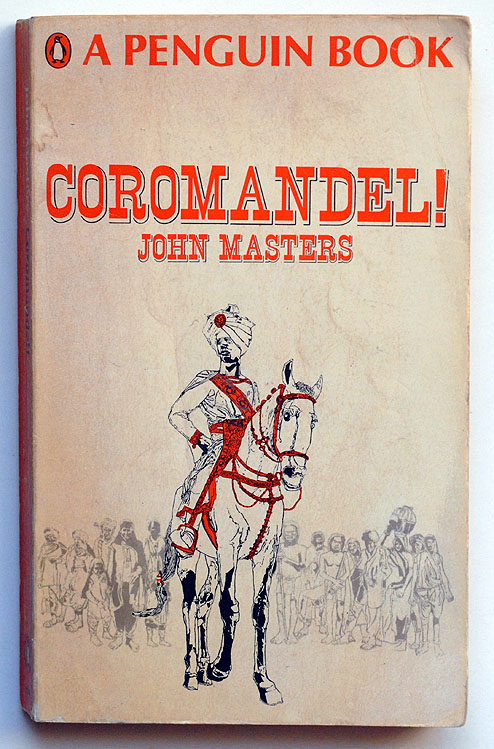
Mum tells me how in looking for Dad’s birth certificate, she found a letter from the author John Masters, from the time in the 60s when Dad illustrated book covers for Penguin. At some point during the author-to-illustrator process, Masters noticed Dad’s Bildeston address and wrote a full, personal letter to him from New York, revealing that he’d had a romance with a woman from Bildeston in the 1930s.
This is Dad’s cover for Coromandel!, published 1967.
Dad was also commissioned to do the cover for the first British edition of Kurt Vonnegut’s Slaughterhouse Five, though his art wasn’t eventually used. He told me how the publisher had trusted him with the only copy of Vonnegut’s original manuscript, longhand scribblings and all. That was the way it was done, before the rise of word processing.
* * *
Tuesday 18th February 2014
In London ambassador mode, I meet up with Liam J again. This time I show them the Museum of London (which we discover needs more than 2 hours to do properly), followed by fish and chips (Liam’s first) at Bar Bruno in Wardour Street. We end up at the Royal Vauxhall Tavern for Bar Wotever, the friendly club night for trans people, androgynes and anyone of uncommon gender identity. The US writer S. Bear Bergman gives an entertaining reading of anecdotes, and I have my boots polished by Alex, a charming ‘shoe-shine boi’ (pronounced ‘boy’) in a checked shirt and bow tie, who has a proper shoe-shine stall set up in one corner. Alex takes a good fifteen to twenty minutes on my boots, applying a host of different unguents and waxes. This is bookended by the gentle rolling up and down of the ends of my trousers. It’s the closest I’ve come to having a sex life for some time.
* * *
Wednesday 19th February 2014
A teenage girl in Coventry writes, asking for permission to use my lyrics in her A-level art project. I duly give her my blessing. It’s good to know I have some sort of value,  even it’s ‘the wrong kind of worth’, as a Job Centre employee once told me.
Meanwhile, I am besieged by what people are currently encouraged to view as the ‘right’ kind of worth – unabashed corporate greed. Today I get a letter from BT demanding I pay them a fee of £40 purely so I can leave them for another phone company. It’s a kind of telephonic alimony. The main reason I’m switching providers, of course, is BT’s spontaneous displays of legalised grasping, like this one. I am just grateful we never had children.
* * *
Thursday 20th February 2014
Two new marks in from college. Â The New Year essay on Old English poetry gets 77, while the January test on Old English translation also gets 77. This concludes my half module on Old English per se, giving it an overall grade of 77 in the process. A good First. Given my previous module grades have all been in the low 70s (Firsts, but only just), this either suggests I have an unexpected gift for Old English, or that I’ve more or less worked out how to tick the right boxes. The latter is more likely. I didn’t find Old English at all easy, as it requires not just hours of literary criticism but hours of translation and historical research on top. I’m slow enough with Modern English as it is.
I am approached by a charity street fundraiser on Tottenham Court Road. ‘No thanks,’ I say. ‘Are you sure?‘ he says, following me along the pavement. Â I’m tempted to reply, ‘My dad’s just died, you pestering git, leave me alone’. But that would be, as they say in warfare, a disproportionate response.
Saturday 8th February 2014.
To Suffolk to visit Mum. As I get on the train to Marks Tey I recognise that the only other person in the carriage is the comedian Stewart Lee. I enjoy his work enough to know where he’s probably going – and am slightly unnerved that I know this. Earlier this week I’d read an East Anglian Daily Times interview with him online, promoting his show in Ipswich (a reminder that local news is no longer local, thanks to the Web). He told the journalist that the fact he was speaking to the newspaper at all must mean he hadn’t sold enough tickets. Typically for Mr Lee, this was both a grumpy joke and a joke about the act of daring to make that sort of grumpy joke.
Recognising someone in a train carriage requires rather different etiquette to recognising them in the street. The latter predicament always makes me think of a line from a Half Man Half Biscuit song:
‘He’s seen me / And we both realise / That we’re going to have to put into operation / That tricky manoeuvre / that is Acknowledgement Without Breaking Stride’.
It’s more complex if the person you recognise is slightly famous, and though you have chatted to them socially in the past, that had been some years ago. And in Stewart Lee’s case, that Act of Recognising Stewart Lee in Public – and his resulting irritation – is something he has put into his work. There’s one stand-up show where he reads out a long list of unkind statements from Twitter:
‘I saw that Stewart Lee on the bus,’ goes one. ‘He looked fat and depressed and fat.’
I’m too socially awkward as it is to be the one that makes the move in such scenarios, whoever the other person is, and tend to prefer people coming up to me rather than the other way round. As it is, I think to myself, he might be well in a state of mental preparation for his show, and so shouldn’t be disturbed.
Something else I always worry about is – what if something terrible has happened to the person you’ve just recognised, and now is really not the time to bother them? A parent might just have died, for instance. That happens to people. That definitely happens to people.
So I don’t approach him during the journey. When I get off at Marks Tey, though, he sees me, recognises me and says hello.
I have to add that he looked thin and reasonably happy and thin.
***
Travelling on the little diesel train to Sudbury along the Stour Valley, I pass a line of pylons. They are standing in several feet of flood water.Â
***
I spend the afternoon in Bildeston with Mum and my aunt Anne. There’s no traces of the medical equipment that cluttered up the living room last time I was here. The hospital bed, the noisy oxygen machine, the mask, the tubes and the commode have all been taken away by various medical services. No sentimental value attached to those. I’m grateful that they kept him alive, but grateful to see the back of them. Off to sustain someone else.
It turns out that Anne wasn’t intending to be in the village on the day that Dad died. The floods in the South-West had wrecked the train track for her journey back to St Ives, and staying with Mum a few more days was the only option. So Mum had the benefit of her company when she heard from the care home. In fact, it was Anne who took the call. A silver lining of some literal clouds.
* * *
Mum and Anne are convinced Dad’s handwriting closely resembled mine, and vice versa. But I like to think I can see evidence of both parents’ styles coming together in my own spidery hand. It’s as good a reason as any for varying my typing with my longhand writing. Every time I write with a pen, there he is.
***
Sunday 9th February 2014
Dad’s phrases keep coming back to me. One is ‘I have better things to do’, in response to some conversation about a national talking point. As in ‘Did you see that Benefits Street everyone’s on about?’ ‘No, I have better things to do.’ Not meaning it unkindly, but honestly. And he was usually right. It seems a mundane, even obvious piece of life advice, yet it’s one that’s so useful and so easy to ignore. Dad was a fan of silliness, but it was always intentional and purposeful silliness. Mindful Silliness, I suppose. That’s the difference.
As a habitual procrastinator I try to ask myself, ‘Is this the best thing I could be doing right now?’ Â Or if I’m idling full stop, I wonder ‘What’s the best thing I could be doing now?’ Â That the phrase comes to me in Dad’s voice helps all the more.
Wednesday 12th February 2014
I’m currently being driven crazy by some sort of facial aching, with hot-and-cold sensations around my teeth, jaw and facial muscle area. Today I see the GP, who thinks it is a flaring up of TJD (Temporomandibular Joint Disorder), which I’ve always had a touch of (my jaw clicks). This might well have been brought on the stress of the more intensive college work in January, coupled with general anxiety over my penury, and now of course, Dad’s death.
‘Do you grind your teeth in your sleep?’ she asks. I have no idea. I live alone.
Valentine’s day is close, and like many I start to think about the pros and cons of relationships. The ability of couples to detect warning signs in each other’s health is one definite advantage. Still, I have to admit I enjoy my own company, and am relieved not to have to join the ranks of all the confused-looking men in card shops this week.
 ***
Thursday 13th February 2014.
Mum has written an introduction to be read out at the funeral by the Humanist official in charge (not sure what the correct term is – certainly not priest). It explains how he was known as Bib Edwards to some, and Brian Edwards to others. He tended to prefer the more informal nickname of Bib, but answered happily to either.Â
My brother Tomhas been balancing his helping with the funeral, with his work as a guitarist. Today he performs in Adam Ant’s band on ITV’s This Morning.
Tom must have mentioned Dad’s passing to Mr Ant, because the singer introduces ‘Ant Music’ on national television with the phrase ‘This is for Bib’.
At 9.20am Mum phones me to say that Dad died in his sleep, at about 8 this morning, very suddenly. He was 77 years old.
(This isn’t going to be a very cohesive diary entry. ‘What’s new?’ says the reader.)
In mid-January the pulmonary fibrosis had eaten his body away – as opposed to him -Â to the point where he needed live-in, round-the-clock nurses. There was no other option for Dad but to finally move out of the home in Bildeston, Suffolk where he had lived since the late 1960s, the house I grew up in. Thankfully the care home that took him in, Laxfield House, was one the family knew well and liked. It had looked after my Grandad 10 years earlier. Dad had his own room, which he could personalise. He had a Marvel Comics calendar, and a huge TV with a DVD player with which to watch his voluminous collection of films – never daytime TV. That helped.
(What Virginia Woolf said about a room of one’s own applies to everyone full stop, male or female, whether they’re writers or not.)
He was there for exactly two weeks. On Wednesday night Dad was visited by Mum and Auntie Anne, Dad’s sister. He wasn’t in any pain, just utterly exhausted, and he was as talkative as he could manage. Mum says the last thing he said before they left was ‘I have to go to bed now… ‘. This made them laugh. He’d been bedbound for months and had meant to say ‘sleep’, of course. But like many last or last-ish words, the phrase now acquires a strange, significant poignancy.
After Mum phoned, I had a good cry. Then a good think. Then another good cry. Then I felt a bit better and went into town and got on with the work for my current essay, as best I could. The text I’m writing about is Alison Bechdel’s Fun Home, about the death of a father. So that didn’t help. But then virtually all literature is about death in one way or another.
It’s already a miserable day in London. Rain hammers down, and there’s a tube strike. I walk through Islington, close to the cinema where Dad and I went the last time he visited the city. We saw the second Sherlock Holmes movie with Robert Downey Junior – right up Dad’s street. Unabashed blockbuster entertainment, with a sense of comic book escapism. But he’d also seek out and champion lesser known imaginative films, like Mr Nobody with Jared Leto. I’ve still not seen it yet (sorry, Dad).
* * *
In 1971, in a hospital waiting room in Ipswich, waiting for me to be born, Dad reads Philip K Dick’s The Unteleported Man.
* * *
Dad wasn’t a Londoner by birth, but he moved here when he was at art school. It was London where he met my mother. When they dated – ‘courted’ I think is more accurate for the time – Mum and Dad used to meet by the stone lions at the back of the British Museum.
In the 60s, he worked in Newman’s art bookshop in Charing Cross Road and bought his clothes from the trendy boutique ‘I Was Lord Kitchener’s Valet’. I think he had a cape.
Members of the Bonzo Dog Doo Dah Band came in to the shop on a regular basis. He knew John Gorman off The Scaffold and Tiswas. He knew Paddy O’Hagan off Pipkins, and saw him play the Meat Loaf part in the very first stage production of The Rocky Horror Show.
* * *
‘I know not all that may be coming, but be it what it will, I’ll go to it laughing.’   – from Moby-Dick, Dad’s favourite novel.
I’ll miss his silliness. His jokes, his whistling, and his too-loud laugh. I’ll miss the way I could hear him laughing aloud to himself in his studio in the attic, because he’d just remembered something funny in his head. It could have been a bit from a Laurel and Hardy film, or it could have been something a school friend said to him in 1950. Whatever the funny thing was, it wasn’t there, but it didn’t need to be there. Dad still saw it.
Dad wanted the main song at his funeral to be ‘The Monster Mash’ by Bobby ‘Boris’ Pickett. I’m hoping that will happen. His favourite song ever was ‘Macho Man’ by the Village People. I’m hoping that can be played at his funeral too. There’s no way I can type that without smiling, and Dad knew it. Knows it. The tenses are hard to get used to, this soon.
He made beautiful playthings out of wood for me and Tom when we were small: puppet theatres, soldier forts, painted rocket ships you could pretend to be inside. He made comic strip adventures featuring his own superhero character, Captain Bi-Plane, who lived in a world of airships and gears and gloves and goggles, some decades before people called such things steampunk. People who have seen the strip recently call it steampunk, of course.
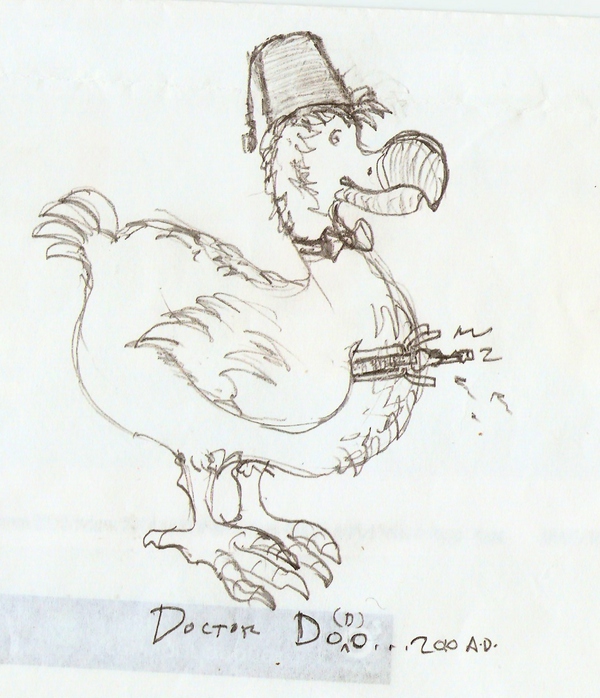
He also had a thing about dodos. In 2010, at my request, he drew a dodo dressed as Matt Smith’s Doctor Who.
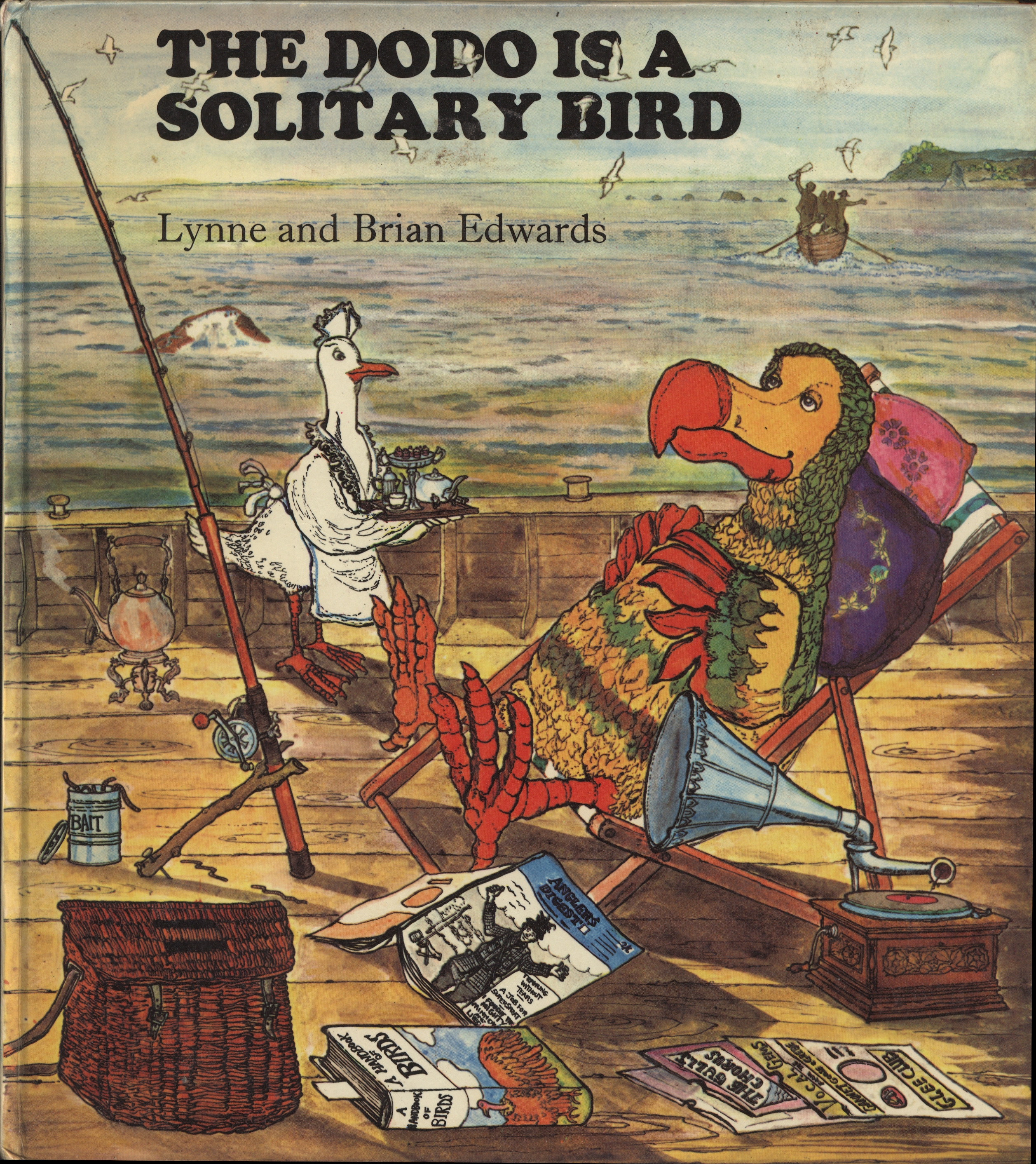
A long time ago, when I was about five, Dad made three children’s books about dodos, with Mum writing the words. He put me into one of them, The Dodo Is a Solitary Bird (Tadworth: World’s Work, 1977).
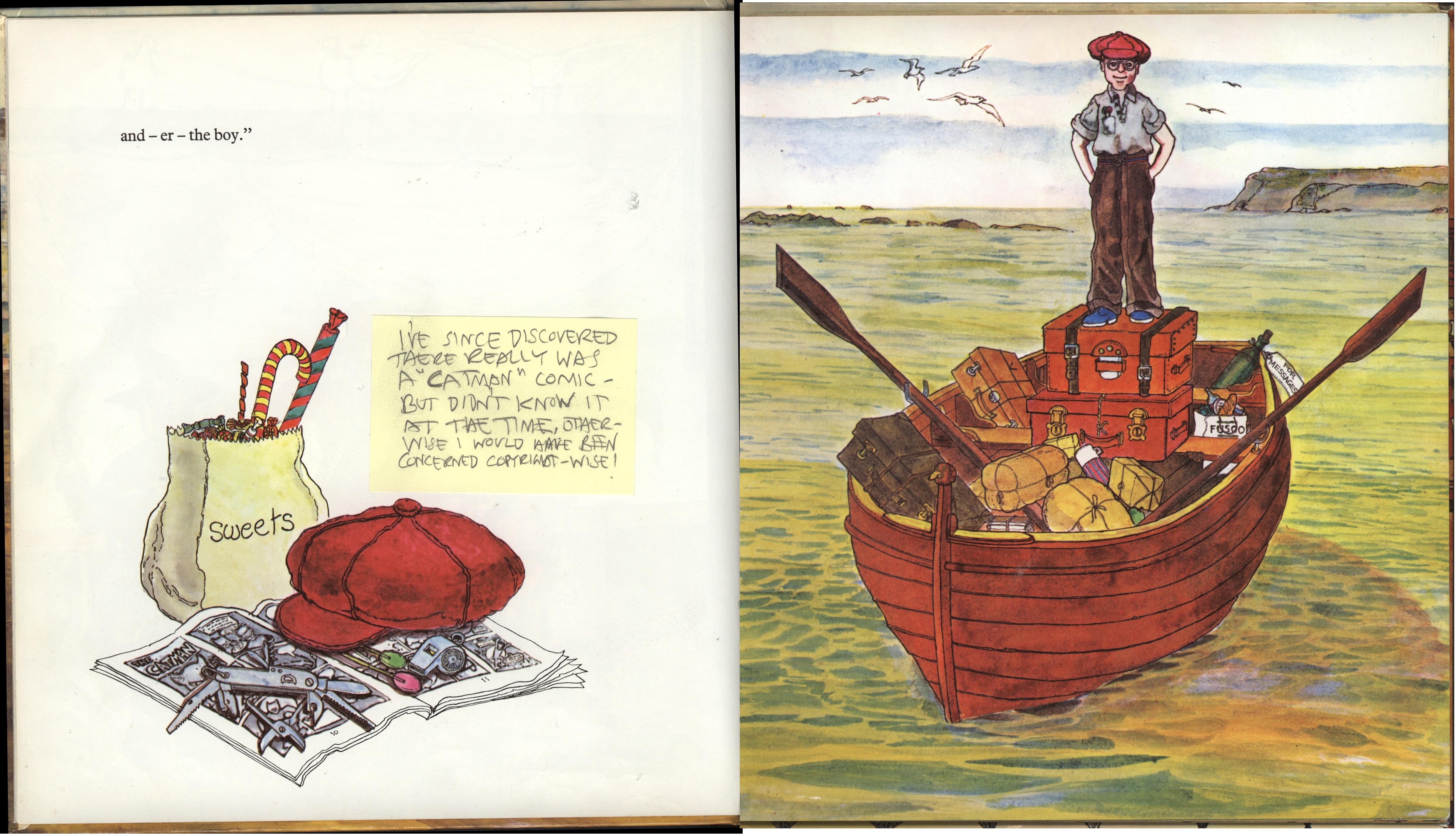
I posed for his drawings and became the character of ‘The Boy’.Â
This copy of the book has been annotated by Dad, using post-it notes. I’ll miss his handwriting too.
I was thinking of putting a ‘real’ photo of Dad here, but today I’m upset at the unfairness of his body collapsing, while his mind was still sharp.
Another quote from Moby-Dick:
Methinks we have hugely mistaken this matter of Life and Death. Methinks that what they call my shadow here on earth is my true substance. Methinks that in looking at things spiritual, we are too much like oysters observing the sun through the water, and thinking that thick water the thinnest of air. Methinks my body is but the lees of my better being. In fact take my body who will, take it I say, it is not me.
And besides, I worry that if I showed you a photo of Dad, you wouldn’t see the Dad I’m thinking about today (I’ll confess I’ve been reading Roland Barthes’s Camera Lucida today, on the meaning on photographs, and how he refuses to show the reader the one photo of his mother in which he can truly ‘see’ her).
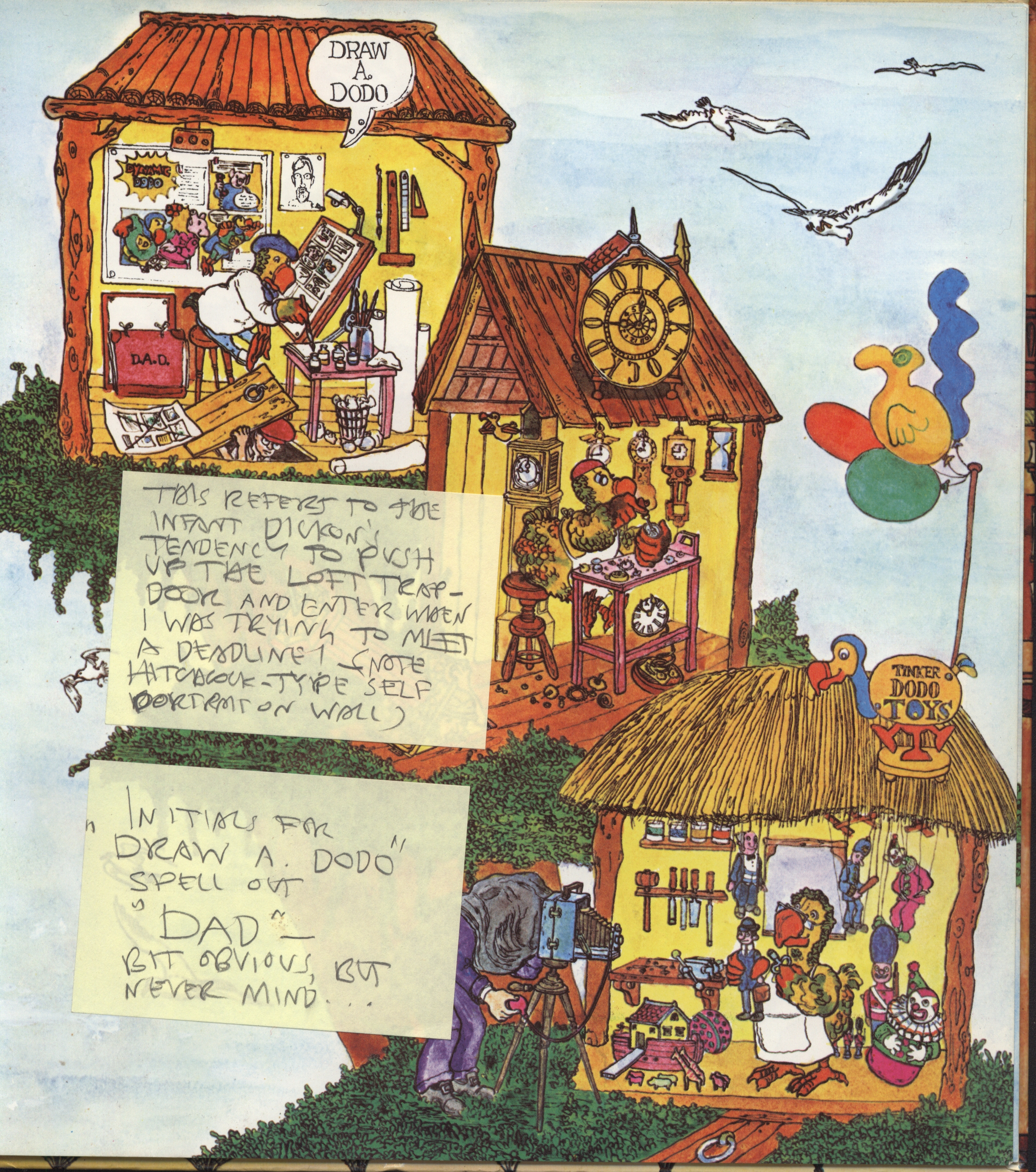
I’d much rather show you Dad through his artwork. In the top Dodo Tree House on this page from The Dodo Is A Solitary Bird is the studio of the artist Draw A. Dodo. It’s a version of Dad’s real studio in the attic of the house I grew up in. The child-me character, ‘The Boy’ is poking his head through a trap door.
Dad’s Post-It annotation reads:
This refers to the infant Dickon’s tendency to push up the loft trap-door and enter when I was trying to meet a deadline! (Note Hitchcock-type self portrait on wall)
And there’s Dad. A tiny drawn self-portrait, on the wall of a dodo’s studio, tucked away in the world of a children’s book. A little mirror, in a larger mirror of the studio he worked in. Where he’ll always be drawing, and always laughing too loud at something only he could see.
Friday 24 January 2014. The day after much of the Victoria Line was closed due to ‘flooding’, it turns out what really happened was somewhat surreal. The place being flooded was an automated signal control room at Victoria station, which seems reasonable enough. Less reasonably, though, the liquid in question was not the rainwater that has dominated January (the wettest ‘since records began’, as ever) but a knee-deep tide of fast-setting concrete. Intended to seal voids created in the endless construction work, the concrete had somehow been pumped into the wrong hole. When they realised what had happened, engineers were sent to nearby supermarkets to buy bags of sugar, which, it transpires, slows down the setting process. What pleases is the unlikely image of frantic, hard-hatted men rushing into a Sainsbury’s Local and asking directions to the Silver Spoon section. Whether it had to be just white granulated, or whether Demerara, cubes, Canderel and Sweetex worked just as well, we are not told.
For the first time since I was at school, I’m reminded of the entirely unacceptable term for the type of brown sugar which isn’t Demerara: ‘moist’.
* * *
Saturday 25 January 2014. Reading Ms Austen’s Sense and Sensibility for this week’s college classes. I also watch the 1995 film version, the one with Emma Thompson. The film particularly focuses on how poor the Dashwood women have to live, once they move to the Devonshire cottage. There’s scenes where Ms Thompson is going through their shopping budget and cutting down on food, while in another one, the sisters have to huddle together in the same bed to keep warm. Like the impoverished family in The Railway Children, what baffles (and fascinates) is the one item of middle class expenditure retained above all else, including food: their servants. I suppose the equivalent now would be hanging onto mobile phones or computers. Essential servants of a kind.
Sunday 26 January 2014. A video is doing the rounds of extracts from Noel Gallagher’s audio commentary on an Oasis greatest hits DVD. Always good value in interviews, Mr Gallagher regales the purchaser with his candid dislike of the pop video form. ‘I f—ing hate videos… I hate the fact they cost a fortune. I hate the fact you’ve got to be there at 8 in the morning. I don’t like the fact that the people who’re making them think they’re making Apocalypse Now… ‘ But as the songs move onto the later albums, he attacks his own music too: ‘Is this video meant to be all backwards? Pity the song isn’t too – it might sound more interesting… Maybe the motorbike is rushing to the radio station to say, ‘Stop! This is shit!’… Can we listen to this with the sound down? We shouldn’t have really made this album, if I’m being honest.’
The album in question at this point is Standing on the Shoulder of Giants (2000), which despite its creator’s misgivings still went to Number 1 and sold in double platinum amounts. Some regrets are the dreams of others. Though I’m hardly their sort of target market, I rather liked the first two Oasis albums, and admired the Gallaghers as public characters, bickering like a music hall act.
* * *
Monday 27 January 2014. Peter Capaldi’s new costume as Doctor Who is unveiled. It includes a red-lined Crombie coat, which is exactly what I’m wearing when I find this information out. I’ve worn them for at least 20 years. I suppose this means that even a stopped clock keeps the right Time Lord twice a day.
I had thought Crombies were mainly associated with the British Mod subculture (characters in This Is England wear them), but I’m told they were also popular with the less trumpeted Suedehead look of the 1970s. The youth on the cover of Richard Allen’s Suedehead has a Crombie:
* * *
Tuesday 28 January 2014. Reading about the Theatre of the Absurd, I realise how so many umbrella terms for art and literature are often the invention of critics with theories to throw at the world, rather than arising from the art itself. Martin Esslin is at pains to point this out himself in a later edition of his 1960s book The Theatre of the Absurd, but lurking behind this is still the sense of pride at immortality by proxy. In lieu of creating lasting art himself, a critic creates a lasting term to describe art.
Thinking about Oasis, there is, of course, the 90s umbrella term Britpop, which the music critics Stuart Maconie and John Robb have both laid claim to coining. There was also a BBC programme of 1995 called Britpop Now which had live performances by various bands thought to illustrate the word: Blur, Pulp, Menswear, Gene, Echobelly. Oddly, the very un-Britpop PJ Harvey was on it, while Oasis were left out. No critic would call PJ Harvey a Britpop artist now – and not then, either.
Terms don’t always last, though. Despite Esslin’s decision to include Harold Pinter in his 1960s book, Michael Billington’s 1990s biography of Pinter ignores the phrase ‘Theatre of the Absurd’ entirely.
Wednesday 29 January 2014. A recent New Yorker cover has a new illustration by Chris Ware. It’s of an audience at a school play, all of whom are holding up their various smartphones and tablets and are viewing the performance entirely through their respective screens. His comment on the cover is just as striking:
‘Sometimes, I’ve noticed with horror that the memories I have of things like my daughter’s birthday parties or the trips we’ve taken together are actually memories of the photographs I took, not of the events themselves.’
I’m writing an essay on Alison Bechdel’s graphic novel Fun Home. There’s one large panel  – a double page spread – which recreates a clandestine photograph taken by her father. It’s of the family babysitter, Roy, posing in his underwear. The babysitter was one of the young men her father, now deceased, had been having affairs with.
The panel takes on added significance as the book gets older, though, as the action of physically picking up a material, printed photograph from a storage box is itself becoming a thing of the past. Ms Bechdel draws her own hands holding the photograph at either side, with all the symbolism that implies: touching the past, touching the hidden, trying to connect and understand across the years. Had the events of Fun Home taken place now, the father’s secret snap would have to be lurking on his computer hard drive, and the resonance of the discovery would be quite different.