Be Your Own Cosplay
Saturday 17th October 2015.
I watch a new Ted Hughes documentary made by the BBC, Stronger Than Death. Unusually for a TV documentary, there’s no celebrity presenters trampling their own uncalled-for views all over the material. Instead the film lets the poems, the archive footage and the interviewees do all the talking. There’s still omissions and bias, of course: Jonathan Bate appears, and it’s clearly timed to coincide with his major new Hughes biography.
Despite having 90 minutes to play with Hughes’s life, a lot of time is given to the shadow of Sylvia Plath. There’s a recital of a US feminist’s poem which openly dreams of Hughes’s murder, as revenge for Plath’s suicide. This is at the expense of even mentioning The Iron Man or Meet My Folks (both of which delighted me as a child). Hughes’s widow Carol is also noticeably absent – perhaps because she’s appeared in the news headlines lately, complaining about ‘damaging and offensive claims’ in Mr Bate’s book. Instead, one of TH’s extra-marital flings speaks about the poem she apparently inspired, with clear pride.
It’s tempting to say a lot of this is unfairly intrusive or even gossipy, but as Simon Armitage says early on in the film, Ted Hughes is one literary figure where the biography really is essential when considering the work. For my own part, I find myself reaching for my copy of Emma Tennant’s memoir Burnt Diaries, to look up her own contributions to the Tales of Ted. There’s much about Ms Tennant’s own affair with the poet in the 70s, but most memorably for me is the anecdote about his encounter with a mentally ill poet. This man had stalked Hughes for months and had even threatened him with a knife. Finally confronted by the man on a London street, Hughes shoves him into the passenger seat of his car, binds him with the seatbelt, and grabs a sheet of plain A4 paper from his satchel. Then he gets out his penknife, shouts, ‘Look at this!’ to the stalker, and slices the paper diagonally in two.
According to Ms Tennant, who witnessed all this from the back seat of the car, the stalker sat there looking at the paper, ‘as if a living creature had been sacrificed before his eyes – or his soul had been cut in two.’ He was then let out of the car and shambled off into the city. ‘He won’t trouble us again,’ said Hughes.
Bate’s new biography includes this story, and adds that the stalker in question may have been Henry Fainlight, troubled brother of Ruth, though he thinks the anecdote is ‘probably exaggerated in order to dramatise Ted’s quasi-occult powers.’ But Hughes was steeped in ideas of mythology himself, and what else is gossip but a form of mythology? From Leda and the Swan to Kim Kardashian, it’s all tale-telling of a kind.
* * *
Wednesday 21st October 2015.
To the Tate Britain for the big Barbara Hepworth exhibition, Sculpture for a Modern World. It’s labelled as the first major Hepworth show for nearly 50 years. Perhaps the long gap is because people are used to Ms Hepworth’s work being part of the landscape – literally, given her association with outdoors art. This large-scale indoor exhibition brings out the ambient, calming side of her sculptures: a world of humane and peaceful geometry. One room recreates a 1960s outdoor installation in the Netherlands, the Rietveld Pavilion. The pavilion’s concrete walls have been transplanted inside the Tate’s galleries, to show Hepworth’s works in the intended context, though without the grass and sky. I see more visitors sitting and sketching the exhibits than usual. Perhaps there’s something about Hepworth’s sculptures that particularly invites sketching. Carving away at the paper, joining in.
* * *
Thursday 22nd October 2015.
I’m reading Margaret Atwood’s The Year of The Flood. A satisfying sequel to Oryx and Crake, focussing on two women caught up in a post-apocalyptic world, where a ‘waterless flood’ – a global pandemic plague – has destroyed most of humanity. A pull-quote for the cover praises the novel for being ‘as pacy as a thriller’. This is a very telling statement on the way genre is viewed by the British literary scene: it implies that literary novels aren’t meant to be pacy, and thrillers aren’t meant to be read. But it’s also accurate for The Year of the Flood: the book uses short chapters, cliffhangers, parallel viewpoints, and flashbacks. All are devices of thrillers. I wolf through its 500 pages in three days.
* * *
Friday 23rd October 2015.
To the ICA cinema for The Lobster. A surreal black comedy, in the Absurdist tradition – shades of Ionesco and Bunuel. It’s by a Greek writer and director, but is filmed in English, and has an impressive cross-European cast (including Colin Farrell, Rachel Weisz, Ben Whishaw, Olivia Colman, Lea Seydoux). The dialogue has a stilted, almost robotic feel, as if translated by a computer program, but this is clearly part of the whole deadpan aesthetic. The plot concerns an alternative world where single people are forced to find a compatible partner in a month, while imprisoned in a rural hotel. If they fail, they are surgically transformed into an animal of their choice. Mr Farrell escapes one such hotel, only to find that the woods-dwelling ‘loners’ he joins have brutal rules of their own. It’s a very strange film indeed, but like the best Absurdist plays, the comedy balances out the alienation.
Then to Vout-o-Reenee’s to prop up the bar with Debbie Smith. I also bump into Hazel Barkworth, a friend I’ve not seen for years. We discuss how we’ve solidified our own looks – my blond hair and suits, her bob hair and black dresses. ‘Be your own cosplay’ is our decree. (cosplay being short for ‘costume play’, the practice of dressing up as a genre character).
Tonight the venue is hosting the launch of two new poetry pamphlets (I think ‘chapbooks’ is the proper term). Both are published by Annexe Magazine: Susie Campbell’s The Frock Enquiry and JT Welsch’s The Ruin. The former uses historical research into the plight of early 20th century British female workers, a kind of Suffragette in poetry form. Mr Welsch’s work is inspired by a visit to the ruined ancient temples of Tunisia, and makes some nice comments about the way Star Wars fans now make a similarly holy pilgrimage to this area, due to the landscape’s role as a Star Wars location. Certainly, the latest Star Wars sequel is generating anticipation on a level of religious rapture, and it’s not even out for another two months.
I also take a look at the latest exhibition in the venue’s Stash Gallery, Wilma Johnson’s Cat Amongst The Dogs. Ms Johnson lost her life’s work of paintings in a house fire last June, so this show represents something of a rebirth of her creative spirit. Some forty or fifty canvasses are here – not bad for four months. The theme is a playful and colourful celebration of film icons and pets, with a touch of the mythic about both. There’s also a little of a Pop Art Frida Kahlo in the mix. There’s Garbos and Hepburns and Taylors amongst marmalade cats and borzois. Perhaps proving the point about the British love of pets, about half the paintings have already been sold – and the cat paintings are going more than the dog paintings. Tonight, I chat to the artist and discover that she’s staying at her mother’s house in Highgate, which turns out to be the house opposite mine. We share an obvious cab home.
* * *
Tags:
annexe magazine,
barbara hepworth,
ICA,
margaret atwood,
tate britain,
ted hughes,
the lobster,
vout-o-reenee's,
wilma johnson
Teases, Not Summaries
Monday 12th October 2015.
This week’s MA class is on Hollinghurst’s Line of Beauty. I’d read it before earlier this year, but read it again anyway. It’s a joy to do so: the carefully-controlled wit running through every sentence. The seminar takes in ‘retromania’, via Simon Reynolds’s book and the TV series Mad Men. We’re shown a clip where Don Draper gives a speech to clients about a new home slide projector. He muses on the nature of nostalgia, how the word is based on a sense of an ache, or a form of pain, while showing snaps from his own troubled family. The scene is as good as any from literature.
* * *
Tuesday 13th October 2015.
To the Barbican Cinema 2 in Beech Street for Suffragette. The trailer for this film has played heavily in cinemas for months, so much so that at times the actual film feels like the extended 12-inch remix. Trailers should tease, not summarise. And yet all of Meryl Streep’s moments as Emmeline Pankhurst turn out to be the same as those in the trailer. It’s barely a cameo role. The posters mislead too, implying that Ms Streep is in the film as much as Carey Mulligan and Helena Bonham-Carter: the image is just of the three of them, lined up against the Suffragette flag. Today at a Tube station I see a small girl jump in front of the poster, and point out Helena BC to her parents – I’m guessing because of her vampy role in the Harry Potter films. Is Suffragette for children? It has the air of an important history lesson, and bears a 12A certificate, so technically children are allowed to go and see it if accompanied by an adult (I can certainly see it used in schools). But there are one or two scenes that are certainly not for smaller children. One is the unpleasant and painful force-feeding of Carey Mulligan’s fictional heroine, in order to thwart her hunger-strike in prison. The real death of Emily Davison at the Epsom Derby is also presented as a traumatic moment (if a brief and gore-free one).
I feel the film’s script is a little eclipsed by its mission to educate. Its characters are more illustrations of issues than they are living, breathing humans in their own right. But everyone involved with the project clearly believes in it wholeheartedly. The acting and staging lifts the film out of the Worthy History Lesson field and into something more lasting. It’s designed to get people talking about feminism, the value of voting, and the morality and pitfalls of ‘deeds not words’.
* * *
Thursday 15th October 2015.
Marlon James, the new Booker Prize winner, is interviewed in the Guardian. He mentions how his first novel was rejected 78 times by publishers. One of the rejection letters included the phrase ‘not for us’. ‘Luckily for them,’ says the interviewer, ‘James can’t remember their name’. This is a common narrative in tales of literary success, the inspiring message for budding writers being that those whose job it is to spot talent frequently fail to do so, even when it is offered to them on a plate. So don’t give up. It’s an idea that has been backed up with experiments, such as the one a few years ago where one of the more obscure Booker winning novels was submitted to slush piles under a pseudonym. Inevitably, it couldn’t find a publisher. But the explanations that arose, once the true nature of the manuscript was revealed, were perfectly reasonable. Tastes change, tastes differ, and sometimes publishers really are just looking for something else. Everything is ‘not for us’ to someone. It doesn’t mean the publishers in question are fools; it just means one should look elsewhere.
* * *
I give another tour of the Viktor Wynd Museum for an attentive group. After that, to Vout-o-Reenee’s for a talk by the author Petra Mason, fresh in from Miami, on the subject of 1950s American Pin-ups. Her books are glamourous tomes in every sense: one covers the career of the striking model Bettie Page, while another celebrates Bunny Yeager, the beauty queen turned photographer, who indeed often worked with Ms Page. There’s much leopard skin in evidence, whether on bikinis or on actual live leopards, used as props. These days, one need only look to the videos of Katy Perry to see the influence. That same cartoonish sexuality – and so very American.
Ms Mason’s latest book turns to the same era’s male ‘beefcake’ photography. 100% Rare! All Natural! Â These are essentially muscular male nudes and near-nudes, which appeared in ‘health and fitness’ magazines – the camper side of Charles Atlas. Obscenity laws meant that the only ‘permissible interactions’ between two men in such photographs were for ‘wresting or fighting’ only. Then it was okay. What’s also interesting is that this was a pre-steroids era, so all the muscles on show have a quaint bygone aesthetic to them. They are the same kind of gym boys that Jane Russell tiptoes around in Gentlemen Prefer Blondes, as she sings that knowing number, ‘Ain’t There Anyone Here For Love’.
In Ms Mason’s talk, she mentions that sometimes the beefcake genre crossed the line, and many photographers found themselves in jail. ‘But prison only gave them more ideas… and more models.’
* * *
Friday 16th October 2015.
To the Imperial War Museum for the exhibition Lee Miller – A Woman’s War. Like Bunny Yeager, Ms M was another American model turned photographer. This must be the third Lee Miller show I’ve been to in ten years – she clearly remains a reliable subject for an exhibition, with her fascinating life story. The commercial modelling, the Surrealist muse work, the move into photography, and then into war photography. Here the focus is on the latter, with lots of her shots of women in wartime, in uniform, in the workplace (typists in bomb-proof basements in London), or just women caught in the day-to-day coping with it all. Fashion shoots against Blitz ruins, girls in Paris cafes, casually sipping drinks against bullet-shattered windows.
The news this week says that Kate Winslet is about to play Ms Miller in a biopic, and there’s certainly some photos of the older 1940s Miller in this new show where there’s a resemblance, particularly the mouth. The one of Miller washing in Hitler’s bathtub is present and correct, but I’m also impressed by the large amount of her personal possessions on display: her war correspondent uniforms, her portable typewriter, her camera equipment, letters to and from the Front. There’s also a rare colour photo in which she returns to a kind of War Effort Surrealism by posing nude in camouflage-coloured body make-up, under a net, while lying on a garden lawn in Highgate (The Elms, Fitzroy Park, to be precise). Apparently this was to help illustrate Roland Penrose’s wartime lectures in camouflage instruction – but it’s clearly meant to provoke more than educate. The pose is Penrose’s idea but like the Hitler bathtub photo, it’s taken by the US photographer David E. Scherman. Scherman was also Miller’s lover, a relationship that Penrose – her husband- consented to at the time.
Tags:
alan hollinghurst,
beefcake,
birkbeck,
imperial war museum,
lee miller,
mad men,
petra mason,
suffragette,
vout-o-reenee's
‘What A Personality!’
Saturday 3rd October 2015.
Evening: to the Silver Bullet rock venue in Finsbury Park. I’m here to see Debbie Smith’s band Blindness, playing as part of a benefit for women’s charities, ‘Loud Women’. Entrance is donation only, and there’s a raffle and a table of home-made cakes. Let it not be said that noisy bands cannot provide a good cake stall. Blindness have a textured, gothic and moody sound, a bit like Garbage and Curve (the latter being another of Ms Smith’s groups). I also catch the band on before them, Argonaut, who sound like a classic post-punk indie group with female vocals – a touch of the Raincoats, perhaps.
What is rather more up-to-date is a machine in an alcove at back of the venue: a Bitcoin ATM. I try asking people how exactly Bitcoin works (other than being a ‘virtual currency’), but no one around me seems to be in the know. My gut feeling is that it’s the money version of Esperanto: a nice idea but no, really, you go first, I’ll wait and see. As it is, tonight the futuristic Bitcoin machine is out of order.
(As I write this, my internet broadband has also broken down. Douglas Adams: ‘technology is the name we give to things that don’t work’).
Still, a trio of young men come into the venue at one point, purely to use the ATM, and leave disappointed. And near to the Bitcoin ATM is a poster advertising the services of ‘London’s first Bitcoin-accepting professional photographer’.
Raffle prizes at this gig include CDs donated by the bands (I win an Argonaut CD), and books such as Caitlin Moran’s How To Be A Woman, and a collection of Anais Nin’s erotica. I chat with Dawn H, Deb from Linus and Scarlet’s Well (and from Fosca at one point), and Jen Denitto, also of umpteen bands. It’s good to see such faces again.
* * *
Sunday 4th October 2015.
I’m reading some academic texts for the first MA class. The ideas are stimulating enough, but my brain seems to be resisting the dense and sometimes convoluted style of the authors. These are sentences that need a run-up from a distance; sentences that still refuse to give up their meaning after running one’s eyes over them for a fifth time. And there is the anxiety that there is still another fifty pages of this impenetrable stuff to go, and it’s late on a Sunday night, and I’m still not sure I’ve grasped the basic argument. But as I lack the excuse of the novice, the only excuse I can offer is the analogy of starting a car on a frosty morning. I feel I need a few seminars to properly warm up.
What I also suspect is going on, though, is a question of taste. After steeping myself in literary prose for four years, I find myself automatically thinking about style, even for a text where all that matters is content.
In the Sunday Times bestseller list is a rare appearance of a graphic novel, Username: Evie. In fact, it’s the fastest selling graphic novel in the UK full stop. This turns out to be written by Joe Sugg, one of the young stars of YouTube. His sister is an even bigger star, Zoella. Spin-off books by celebrities are nothing new. What is new is the DIY type of fame that has emerged with video bloggers, where the stars cultivate an audience on the internet directly, without having to go through a more traditional showbiz system of agents, magazines, TV shows and so on.
Recently, Mr Sugg’s sister came under fire for using a ghostwriter for her novel, which also broke all kinds of records. A famous person using a ghostwriter is again nothing new – one thinks of Katie Price’s novels. But what fascinated me in the case of Zoella was that she said she had to hire a ghostwriter because books take a lot of time to write. As a YouTuber she was already busy making videos (sometimes on a daily basis), on top of having to write all the comments and tweets that are necessary for sustaining internet stardom. In effect she was too busy being creative online, to be creative offline. Her brother has similarly confessed to using a more experienced co-writer on his graphic novel.
I suppose a positive spin on this is that it shows how an invention as ancient as the book can have a role in ultra-modern, digitally-steeped young lives. The blogging fame is not enough: a tactile product is needed too.
* * *
Monday 5th October 2015.
First proper MA seminar, for the film Beasts of the Southern Wild. The class room is familiar from the BA (Room 124 of Birkbeck’s School of Arts, in Gordon Square), as is the tutor (Anna Hartnell). I also recognise a couple of my fellow students from the BA course. But what’s changed is the atmosphere. There’s a much higher ratio of academically articulate students than there was for the BA. It’s very clear that this is a class of not just students, but high-achieving graduates. To use a suitably contemporary phrase, for an MA on contemporary culture, I have to ‘up my game’.
* * *
Tuesday 6th October 2015.
The winner of the BBC National Short Story Award is announced. Jonathan Buckley wins with ‘Briar Road’; Mark Haddon gets the runner-up with ‘Bunny’. My own choices were quite different: I favoured Hilary Mantel’s ‘Assassination of Margaret Thatcher’, with Jeremy Page’s ‘Do it Now, Jump the Table’ as second. I really am baffled by the judges’ choices this time. I wonder if it’s to do with Ms Mantel and Mr Page daring to employ elements of humour, and the judges mistaking humour for relative lightness. I think the opposite: humour adds depth.
* * *
Wednesday 7th October 2015
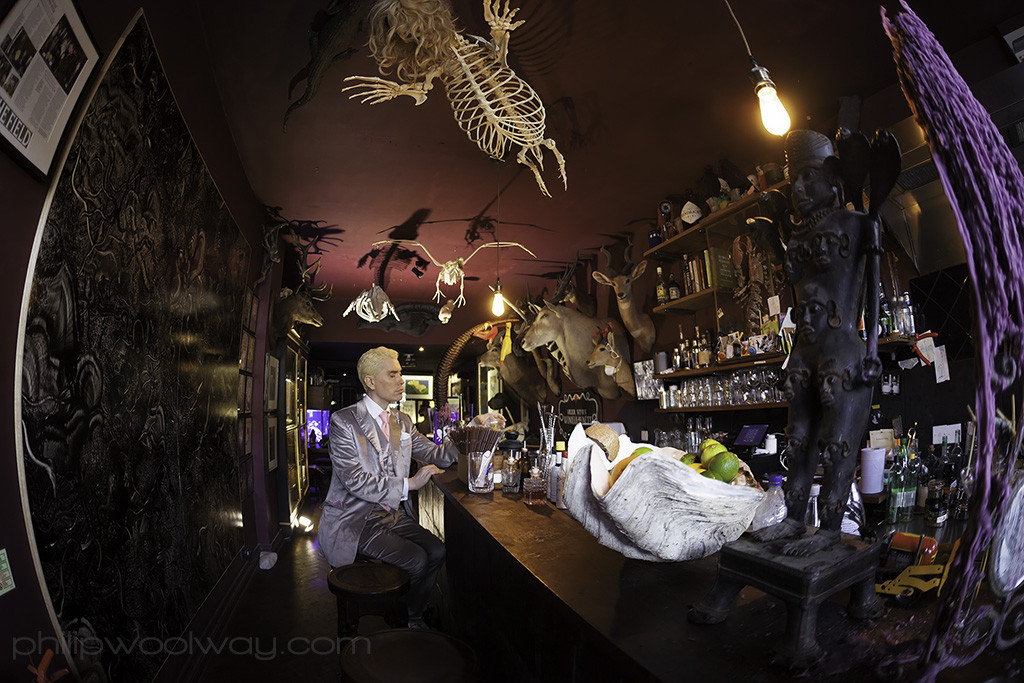
I give another tour of the Viktor Wynd Museum of Curiosities, this time to a visiting party of foreign tourists. I’m wearing the Horsley suit once more, and have freshly bleached my hair. One of the tourists comes up to me, looks me up and down and says, ‘Wow! What a… personality!’
The photographer Philip Woolway is taking photographs for a feature on the museum. He asks me to pose for a shot of the cocktail bar.
Then to the crypt café of St Martin-In-The Fields, near Trafalgar Square, to meet up with my friend Maud Young. Maud is one of the people I sometimes exchange letters and postcards with. This time we see if we can actually arrange a meeting purely via postcards, without recourse to the internet or phones. It takes three or four cards, but we manage it, and here we are today. I wonder, out of all the thousands of meetings set up in London today, if ours is the only one organised via postcard. If nothing else, it has lasting anecdotal value.
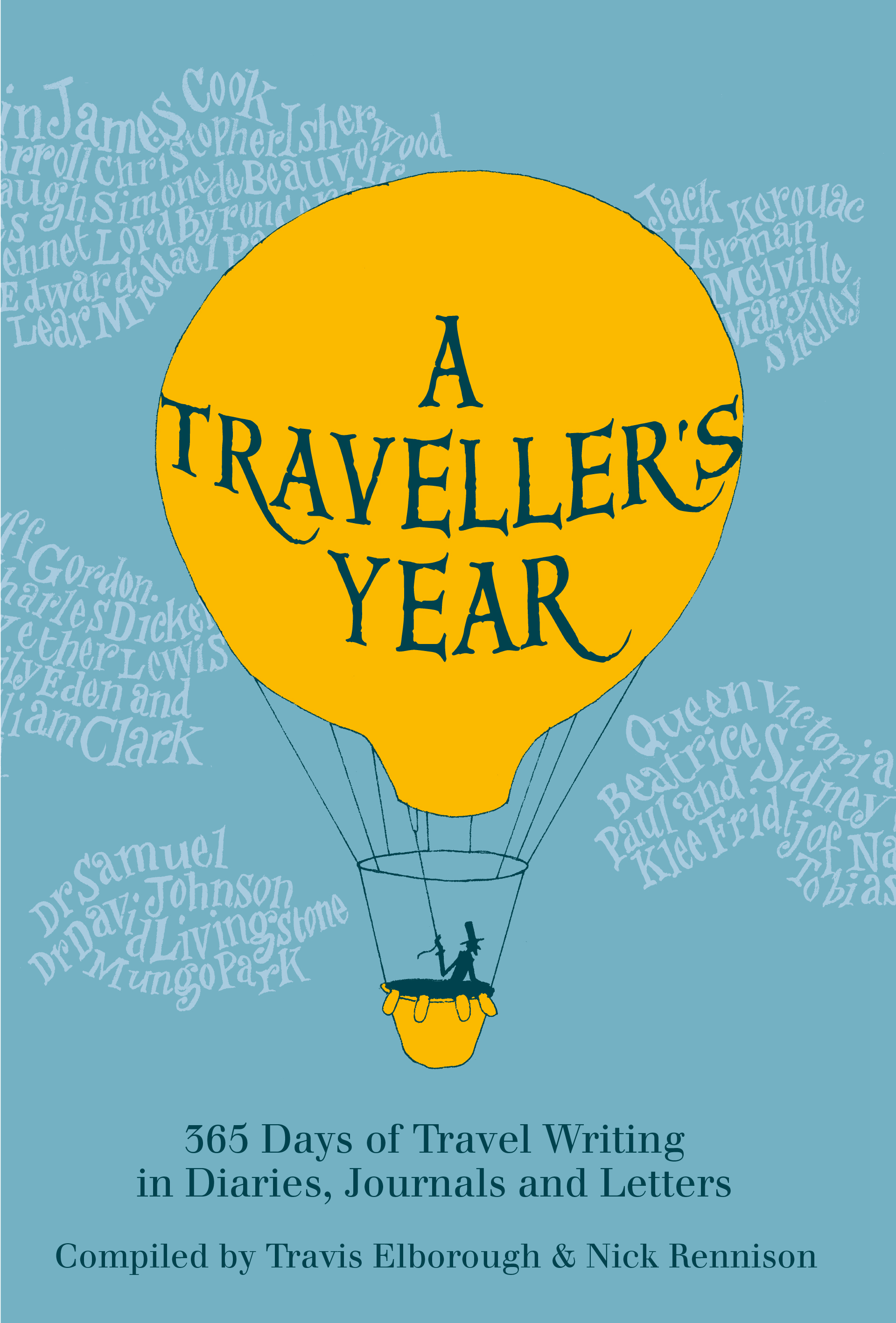
Then to the basement of Stanfords Travel Bookshop, in Long Acre, Covent Garden, for the launch of A Traveller’s Year. This is a new anthology of diary entries on the theme of travel, edited by Travis Elborough and Nick Rennison. There are extracts from my blog in there, covering trips to Brighton, Tangier, Bruges, New York, Sweden and The Hague, and then one on taking forever to get from Harwich back to London, on a day of replacement rail services. It’s a reminder how a lot of travel is carried out in a spirit of undiluted irritation, and even murderous rage. As anyone who has tried to take a train in Britain on a Sunday will tell you, sometimes travel narrows the mind. I read the Brighton extract read aloud tonight, for the crowd. Also say hello to Emily Bick, Andrew Martin, Cathi Unsworth, Karen McLeod, and Guy Sangster Adams.
Then off for drinks at the French House in Soho, where we’re joined by Shanthi S and her friend Helen, finishing with a late meal at Café Boheme on Old Compton Street. At which point I am visibly wilting and dash off to catch a late tube home.
* * *
Thursday 8th October 2015.
Something of a hangover, thanks to the large amounts of free drink at three different locations on Wednesday (the Wynd museum bar, the book launch, the French House).
Despite this I stagger off to a private view all the same, this time at the Stash Gallery, in Vout-O-Reenee’s. The show is called ‘held’, by Jane Fradgley, and comprises many black and white photographs of Victorian straitjackets, spookily shot again black backgrounds for a ghostly effect. The collar label of one is clearly identified as ‘Bethlem Hospital’. If it were not for the sinister straps at the end of the sleeves, some of the garments look quite pretty.
* * *
Friday 9th October 2015.
To the East Finchley Phoenix to see the new film version of Macbeth, starring Michael Fassbender and Marion Cotillard. It’s a gritty and intense rendition, dominated by outdoor locations. Lots of battle scenes, smoke, mud, and (naturally) blood. Some nice medieval make-up and costumes, when they’re not covered in mud. There’s a number of interesting choices taken with the text, though the cutting of the ‘toil and trouble’ speech by the witches is quite common these days, particularly as the supernatural details are thought to be added by Thomas Middleton. What is original in this film is visions of dead children as justification for the whole plot – either visions of Macbeth’s own offspring, or boy soldiers whom he feels responsible for. The dagger he sees before him is actually held by a ghostly boy, while Lady M’s ‘damned spot’ is not a vision of indelible blood on her hands, but spots of disease (or possibly burns) on the face of a dead child.
On leaving the cinema, I overhear a group of middle-aged women in front of me. ‘I think we’ll choose something cheerier next time’, says one. As if they were expecting Macbeth to be a light-hearted romp.
* * *
Tags:
a traveller's year,
birkbeck,
blindness,
Jane Fradgley,
macbeth,
Silver Bullet,
stash gallery,
viktor wynd museum,
vout-o-reenee's
Pogonophobia, Twinned With Geminiphobia
Saturday 26th September 2015.
Much discussion in the media – and on social media – about the attack on the Cereal Killer Café in Brick Lane, by anti-gentrification protesters. Since it opened last year, this harmless novelty café that purely serves bowls of cereal has received a baffling amount of ire. Usually the criticism is based on the fact that the cafe serves cereal for several pounds more than it would cost to buy in a supermarket, as would be the case with food in any café. This is such a mind-scorchingly obvious point, yet there’s something about the café that has led to it being held up as a symbol – nay, the symbol – of The Trouble With London Hipsters. In recent years, East London has seen a surge in fashionable emporiums aimed at the affluent young, but with little of this wealth reaching the poverty-stricken communities who have lived there for generations. When the cereal café opened, the owners were forced to justify their very existence to the press. This is despite London having always been a city for quirky concept shops – I’m rather a fan of the Tintin and Moomin shops in Covent Garden, and the Cybercandy shops, with their imported sweets.
It would have been far more logical to throw accusations of gentrification at East London estate agents, landlords, and the corporate coffee franchises that speckle the streets. But as with the David Cameron pig story last week, the man-bites-dog angle wins out. Tonight’s anti-gentrification protests did indeed attack estate agents too, but once the cereal café – an independent business – was splattered with paint, and had the word ‘scum’ scrawled on their windows, a lot of public sympathy for the protest was lost.
A few days later, some of the protesters complained of biased reporting. They stressed that the café attack was collateral damage, rather than a prime target. It seems the revolution will not only be televised, it will be unfairly edited.
I wonder, though, if the attention on the café also borders on a form of phobia. ‘Hate crime’ is too much, but there is certainly a disproportionate level of hatred being thrown about. This week, the café owners, two young-ish brothers from Belfast, are ludicrously called ‘the most hated men in London’ by the Evening Standard. Perhaps some of this is to do with their having not only the current hipster look of bushy beards and swept-back hair, but also being identical twins. To be a fashionable-looking man is yearning to be a twin too – a twin of thousands. So the brothers are twins twice over, which must add to the resentment.
For years, a common question in games like Trivial Pursuit was ‘what is pogonophobia a fear of?’ Answer: beards. Writing this entry, I learn the word for an irrational fear of identical twins: geminiphobia. This must be an instance where both words can legitimately be used.
* * *
Monday 28th September 2015.
First class of the MA. A gentle introduction to the course, in a Birkbeck building in the north-west corner of Russell Square, which I’ve not been in before. Seems to be a converted townhouse. Spiral stars (like the ones in Somerset House), moulded patterns on high ceilings. Then a group trip to a pub. This turns out to be the aptly-named Perseverance, in Lamb’s Conduit Street. A pleasant and quiet little bar, the kind one wants to keep a secret.
* * *
I read the shortlisted entries for this year’s BBC National Short Story Award, as I’ve done most years. Comma Press publishes them in an attractive little paperback, brought out in time for the announcement of the winner, which will be next Tuesday.
All five are well-written enough and do what they set out to do, though this year there’s nothing as truly ambitious as, say, a story by Jorge Luis Borges, or as stylistically bold as something by Angela Carter.
I admire the straightforward style of Mark Haddon’s ‘Bunny’, about a lonely and chronically obese man, though I’m disheartened by the grim ending. I wonder if Mr H thinks that, as his name is synonymous with the feel-good resolution of The Curious Incident of the Dog in the Night-Time, he could use this new tale to play against that expectation. It’s also a reminder of the joke about the difference between commercial and literary fiction. Commercial fiction pleases with happy endings, literary fiction pleases with miserable endings.
Of the others on the shortlist, Jonathan Buckley’s ‘Briar Road’ demands a certain amount of re-reading to fill in the blanks. It’s one interpretation of that popular piece of creative writing advice: ‘show, don’t tell’. In this case I rather prefer Mr Vonnegut’s maxim: ‘pity the reader’.
Frances Leviston’s ‘Broderie Anglaise’, meanwhile, has a touch of Woolf about it, with its relatives using domestic tasks to take up power positions. It’s well-crafted, but doesn’t quite come alive for me.
My choice of runner-up would be Jeremy Page’s ‘Do it Now, Jump the Table’. A young man negotiates the awkwardness of staying with his girlfriend’s parents, who like to be naked around their house. There’s a similar scene in David Nicholls’s Starter For Ten, and one in The League Of Gentlemen TV series. But Mr Page properly explores the implications of this awkwardness, bringing in pathos and character depth alongside the humour.
But my favourite is Hilary Mantel’s ‘The Assassination of Margaret Thatcher’. I realise Ms Mantel does not need the extra acclaim, and the collection that includes this tale has already been a bestseller (a feat indeed for a book of short stories). But if it were down to me she would still win. Her story thrills, amuses, shocks and grips from start to end, and shares the confidence and precision of a sniper, appropriately enough. One line particularly stays with me, describing the walk of the doomed Baroness: ‘High heels on the mossy path. Tippy-tap. Toddle on.’
* * *
Thursday 1st October 2015
My first ever visit to an osteopath, at the Highgate Holistic Clinic on Archway Road. I come away feeling better twice over. Once for the treatment of my back’s muscular tension, then again for not making a comment about the osteopath’s name, Ms Payne.
* * *
Friday 2nd October 2015.
To the ICA to see By Our Selves (£3), directed by Andrew Kotting. I enjoyed his last film, Swandown, and this is a similarly experimental documentary based around a journey in contemporary England, again with a lot of Iain Sinclair and a little of Alan Moore. No Stewart Lee this time, though the comedian appears in the thank-you credits.
The subject matter is the nineteenth-century poet John Clare, and specifically Clare’s four-day walk across Middle England in 1841, from a mental asylum in Epping Forest to his home near Peterborough. Clare is personified by the actor Toby Jones (looking like a dishevelled Samuel Beckett character), while his father Freddie Jones also appears (now in his late 80s). Jones Senior once played Clare in a 1970 BBC film, and can still recite some of the poems by heart. He shares the narration with Iain Sinclair, the latter stalking Jones Junior while wearing a Wicker Man-esque goat mask.
There’s lots of dream-like sequences merging Clare’s work and English folk costumes with 2014 props and landscapes. One of the discussions speculates on Clare’s initials, J.C. – did they give him a messianic complex? Do all people with those initials have a sense of self-importance? (Jeremy Clarkson? Jeremy Corbyn?). Am surprised that Ronald Blythe isn’t involved with the film – he constantly champions Clare in his Word From Wormingford diaries.
* * *
Then to Gordon Square for the launch party of the Open Library of Humanities digital platform. This is a major project built by two Birkbeck lecturers, Caroline Edwards and Martin Eve, involving the publishing of academic humanities journals in an ‘open-access’ space online, so everyone can read the articles without having to pay, subscribe or be a member of an institution. The OLH is also a ‘megajournal’, a charity, and a community space, as well as a non-profit publisher. Tonight in Gordon Square there are speeches, wine, and a special OLH launch cake, courtesy of Bea’s of Bloomsbury. I have ‘open access’ to that too (delicious).
Tags:
alan moore,
andrew kotting,
BBC National Short Story Award,
birkbeck,
by our selves,
cereal killer cafe,
iain sinclair,
OLH,
open library of humanities
The Devil Wears Car Robes
Saturday 19th September 2015.
I learn that I am affected by the Department for Work and Pensions’s ‘new rules’, and may have to get by on less than I’d thought. Much of this week is spent on the phone to their blameless staffers, resisting the urge to make comments about the whereabouts of Mr Duncan Smith’s heart. I suspect they get that a lot. They sigh down the line and use phrases such as ‘our hands are tied’. They also tell me to try the Citizens’ Advice Bureau.
This is a clever ploy, because many of the CABs are themselves on the receiving end of ‘new rules’, in the shape of government cuts. There are now fewer of them per borough, and the ones that are still going are rarely open for more than a handful of hours a week. The upshot is that I traipse over to Tottenham twice this week. There, I sit in a prefabricated bungalow located in an alleyway near Bruce Grove station, in a colourless waiting room not unlike the ones in documentaries about prisons. I have to go twice, because the first time all the appointment slots are filled up before me. The second time I go, I still have to wait two and half hours in the waiting room before finally seeing an advisor. Her advice, such as it is, is that I need to take my money woes to a more specialist office in Crouch End. And so it goes on.
I take a train from Bruce Grove into Liverpool Street, and walk around the gleaming skyscrapers of the financial district. The contrast between these looming citadels of wealth and the rundown, deprived streets of Tottenham, mere minutes away, has never been more shocking. Anyone doubting the appeal of Mr Corbyn needs to make this journey.
* * *
Sunday 20th September 2015.
Jackie Collins dies. In the papers there are a number of ‘guilty pleasure’ tributes for her novels, along with lots of photographs taken during her modelling career. Like Joan Crawford, and indeed like her own sister Joan, she managed to project a level of camp at every stage. A picture from 1956 shows a 19-year-old Jackie at an Earl’s Court motor show, posing with ‘The Goggomobil T300 – the smallest family four-seater car on the market’. She smiles at the camera while stepping out of this stunted vehicle, showing off a zebra print two-piece which matches the car’s own upholstery. A caption confirms that her clothes are indeed designed by ‘Car Robes, makers of car seat covers’. Low Camp she may have been at the time, she went on to turn this ability into a knowing and deliberate form of High Camp, and to lucrative effect too. It is what Quentin Crisp calls getting the joke on your own terms.
* * *
Monday 21st September 2015.
I am on a bus in Crouch End when a man in a corduroy suit gets on and engages me in conversation. It turns out that he knows me from the book I Am Dandy. We have a conversation about the various definitions of dandyism, and how dandyism relates to the breaking of one set of rules while adhering to another. Then he asks me for employment advice, given he sees himself as a dandy too.
I quote Crisp on the subject – try life modelling in art schools, because it fulfils a societal role while having the mild air of scandal. The other suggestion is anything involving the use of one’s own unique persona. This can include teaching, performing, lecturing, writing, or even tour guide work. As I’ve found from my own experience, a tour guide can often be dandy-like in spirit. They can tailor the facts of a gallery or museum to fit their own bespoke personality. And of course, tour guides have to perform a form of outsider’s view, because tourists and outsiders share a common border.
I was reminded of the time I was recognised in the street for being in the band Orlando. This was long after I’d left the band and was back on the dole. The person who recognised me said that he too was in a band, and did I have any advice on how to make it in the music business?
* * *
Wednesday 23rd September 2015.
The Daily Mail runs excerpts from a unkind book on David Cameron, written by Lord Ashcroft, his former friend. Chief among the revelations – or rather, allegations – are those involving debauched conduct at Oxford University during the 80s, especially an act involving an ‘intimate part of the future Prime Minister’s anatomy’ with a dead pig’s head. What interests me is the mention of Brideshead Revisited. At the time, the TV series had apparently made such an impression on Mr Cameron’s college friends that they all wanted ‘to play at being Sebastian Flyte’ and ‘live the Brideshead lifestyle’, according to the new book. The pig incident was part of this aspiration. As tributes to Evelyn Waugh go, the very public circulation of this one takes some beating, regardless of its veracity. I think Waugh himself, who so bemoaned the defeat of the Conservatives in 1945, would have been very pleased, even proud.
* * *
Thursday 24th September 2015.
Snark: a word that combines ‘snide’ and ‘remark’, often used as a default emotion on social media. But when viewed properly, snark is just a less honest kind of loneliness.
This occurs to me when I glance at the online response to the Morrissey novel, List of the Lost, which is published today. The trouble is, it’s impossible to judge the novel for its own worth, because of who the author is. The only reviews I’d really want to read are ones from a parallel world, where it was published pseudonymously.
I will read it and judge for myself as soon as I can. But then, I’m already on its side, just because so many critics rushed to savage it. From the extracts, it sounds a little like Ronald Firbank.
* * *
Facebook can sometimes feel like a memorial of gently-faded friendships. Today the site briefly crashes. I imagine it being hacked by someone who couldn’t take any more photos of weddings they had not been invited to.
* * *
Friday 25th September 2015.
To the Invisible Dot in King’s Cross, for a comedy show by Mae Martin, ‘Us’. The venue is east of Caledonian Road, in an area of King’s Cross that the big clean-up hasn’t quite reached. The Invisible Dot is small, brick-built, and single-level, with rows of skylights; probably a former workshop or garage. The stage is flanked by two toilets, which turns out to be something of a design flaw. Anyone getting up to use the toilet immediately pulls the focus of the show, and this happens towards the end of Ms Martin’s hour-long set. I wonder if her friendly persona allows it to happen, more so than it would for other performers. Her comedy style is a kind of sweet and knowing nervousness (belied by her years of experience). She also channels her physical androgyny into a form of female boyish charm, much like Tig Notaro. This cunningly means that it is impossible to heckle her when she’s on, as she never takes a ‘high status’ position – quite unusual for a comedian. Much of ‘Us’ is serious and heartfelt: themes of sexual identity, the pitfalls of bisexual dating, and the conflict of wanting to eschew labels while still attracting homophobic catcalls in public. I like Ms M a lot. So much so, that I wonder if I could ever do stand-up comedy myself. I already have the ill-advised suits. (This is not entirely a joke, though…)
* * *
I have my hair cut short into its natural brown, ready to be freshly re-bleached. It makes me realise how large my head is. I look like a camp Easter Island statue.
* * *
If you enjoy this advert-free diary, please help support it with a donation to the Diary Fund. Thank you.Â

Tags:
brideshead revisited,
david cameron,
evelyn waugh,
facebook,
i am dandy,
jackie collins,
mae martin,
morrissey,
twitter
Dough Balls With Virginia
Saturday 12th September 2015.
Jeremy Corbyn is voted leader of the Labour party. For much of the weekend his critics call him ‘unelectable’, an odd thing to say of someone who has just won an election. So much is said about this man this week, much of it hysterical. Not nearly enough is said about how he is just that rare thing: a MP that people like.
The 1997 style of Labour, with its focus upon slickness, spin and presentation, seems to be over for good. A rougher, ‘grass roots’ Labour is popular once again. If nothing else, I hope this means MPs will at last stop copying Mr Blair’s strange. Staccato. Way. Of Speaking. When. Making. Speeches.
* * *
I wander into town, and drift into the ICA to find that there’s a small-press fair on. Phoebe Blatton is running a stall for Coelacanth Press. She’s put out a new issue of Strangers In A Zine, her fun little Patricia Highsmith fanzine. This issue is a ‘Carol Film Special’, to celebrate the new film with Cate Blanchett (out in the UK in November). In the zine, PB relates an anecdote from a few years ago, where she met a film distributor on a plane, enthused to him about Highsmith’s novel Carol, and mentioned that, given he made Far From Heaven, Todd Haynes would be perfect for directing a film of Carol. The distributor told her he happened to be a good friend of Haynes’s, and would ‘pass the message on’. PB is not certain that she was inadvertently the seed of the new film, but it’s a nice tale, and indeed a very Highsmithian one: a fateful encounter between two strangers.
* * *
Tuesday 15th September 2015.
To Lauderdale House in Highgate Village. It’s a venue mentioned by one noted diarist – Pepys – and the setting tonight for a talk by another: Michael Palin, currently promoting his third volume of journals. The event is a charity fundraiser organised by the Mayor of Camden Council, a rather assertive, motherly woman who makes sure everyone stays behind afterwards to listen to the support act – a saxophone recital by a 16-year-old Camden schoolboy.
Lots of other mayoral types in the audience. They tend to be ordinary looking people of a certain age, often former councillors, who just happen to be walking around in heavy, clunking ceremonial jewellery.
Mr Palin is a delight, of course. He gives what is clearly his honed ‘Evening With…’ talk. A good hour or so of anecdotes, something to please everyone, and a Q&A at the end. Tales from the formation of Monty Python, tales from the controversy around Life Of Brian – with a nice link from the mayors in the room to the story about how the actress playing Brian’s girlfriend in the film is now the Mayor of Aberystwyth. And that, with delicious irony, the Welsh town was one of the places that banned the film in 1979. Once she was in power, she made sure she lifted the ban. Then there’s tales from his travel programmes, tales about diary-keeping, some pleasingly rude quips (including one about how he hates being called nice), and some poetry: Cavafy, Wordsworth, Hilaire Belloc, and Spike Milligan. A perfect public speaker, really, and a good example of a Not-Grumpy Old Man.
* * *
Wednesday 16th September 2015.
Meet Hester R for a drink at the IOE bar, followed by a meal at the Pizza Express on Euston Road, the one that’s directly opposite the British Library. Artworks based on writers on the walls: Orwell, Kakfa, Woolf. It’s the place to go if you know someone who likes Mrs Dalloway and dough balls. There’s a display of books, all face out, on a trendy shelving unit near our table. I’m not sure if they’re for sale or to read or just to make the restaurant more bookish. One in my eyeline is about the history of stealth warfare, ‘From Ancient Greece To The SAS’. The book next to that is a memoir by Maureen Lipman. I try not to make too much of this.
Hester has a voucher of some sort. I always suspect everyone who goes to Pizza Express has A Voucher Of Some Sort.
* * *
Thursday 17th September 2015.
I visit the Ripping Yarns bookshop on Archway Road. It’s my last time before this treasure trove of a second-hand shop closes its Highgate premises for good. The business is going to continue trading online, at the house of the owner Celia, with occasional events and ‘open days’ planned. But the Archway Road shop will be gone.
Some symmetry. Today, people in the shop are talking about Mr Corbyn, just as they are doing so everywhere in London (this week I overhear the word ‘Corbyn’ in every café, bus and tube). On my first ever visit to Ripping Yarns, not long after I’d moved to Highgate, I heard an earnest conversation about the then Labour leader, John Smith, how he had suddenly died that day, and how he was ‘the best Prime Minister we never had’ (Gore Vidal: ‘Death is a good career move’). The date of my first visit to Ripping Yarns is thus easy to work out: May 12th, 1994.
I walk out from today’s visit with a 1961 Penguin Classic copy of Firbank’s Valmouth. It’s the edition that appears in Alan Hollinghurst’s The Swimming-Pool Library, with its Augustus John cover and what Hollinghurst calls the ‘faint smell of lost time’ about its pages. Jen Campbell is working there today. She points me out to Celia. ‘Would you believe this man is 44?’ Her book Weird Things Customers Say in Bookshops was inspired by the clientele of Ripping Yarns, who could indeed be eccentric. On my way out, I see a hunched man browsing through a box of paperbacks. He is in his bare feet.
* * *
To the House of Illustration in King’s Cross, for the exhibition on Ladybird Books. Lots of colourful paintings of rosy-cheeked, healthy and smiling children in a post-war Utopian vision of Britain. Peter and Jane and their impeccably polished ball are the stars, but there’s also the series of ‘Well-Loved Tales’: ‘Cinderella’, ‘Puss In Boots’, and the slightly less loved tale ‘The Big Pancake’.
I realise how interesting it is that ‘well-loved’ has been eclipsed by ‘much-loved’ in common speech. The changing fashions in adjectives say as much about a society as the changing fashions in clothes.
The main thing I learn from the exhibition is how these popular pocket-sized children’s books were born from a ingenious bit of wartime economising. A whole Ladybird book of 56 pages was designed so it could be cut from a single sheet of paper – the largest size that could be printed in the presses of 1940. All the books were priced at half a crown each – and remained at that price until decimalization in 1971.
I find the title of one Ladybird book, ‘Some Great Men And Women (1972)’ disproportionately amusing. I think it’s the pedantic implication of the modifier ‘some’; as if a simple ‘Great Men And Women’ was deemed too imperial for the softer, long-haired world of 1972.
I buy a postcard in the gallery shop. A young staffer seems amazed when I confirm that I am going to send it without an envelope. ‘With the message on the outside? But surely other people can read it?’
I tell her about the history of sending postcards – the text messages of times outworn. It really does seem to be new to her. But I wish now that I’d told her about the Postcrossing website, where the practice of sending postcards is very much alive and well. (https://www.postcrossing.com/)
* * *
Friday 18th September 2015.
Afternoon: to the V&A for tea in the Members’ Room, courtesy of Heather M. Ms M tells me about her experiences of dating websites. She prefers men to be at least her own height – ‘it’s to do with being hugged’. Judging by her encounters, it seems a lot of men lie about their height in their profiles. This seems a highly optimistic move, as if they hope that, by the time it comes to meeting in person, their shortness will be somehow… overlooked. But Heather says it’s sometimes necessary for a woman to adjust the truth too. ‘A woman aged 41 or 42 has to put ’40’, to attract people her own age. If she puts ’41’, all she gets are men over 70′.
After tea, we wander around the V&A, and I am quite taken with an interactive installation called Mise-en-abyme. It’s a series of shaped transparent arches across one of the museum’s walkways, each arch narrower than the one before. The phrase itself is one of my favourites in literary criticism, where it means a recursive framing of stories within stories. I’ve seen the phrase used for everything from The Canterbury Tales to Inception.
Evening: I watch the latest Woody Allen film, Irrational Man, at the Barbican’s Cinema Café. There’s a very good film to be made of this story, but this film isn’t it. Like so many late Allens, it’s oddly stilted and over-narrated when it should be brooding and organic. I find myself fantasising about being able to edit the script and improve the film, fix it. Still, the story has some fine twists, and the cast are superb. It’s so good to see Parker Posey, now aging into a sharp, Katherine Hepburn-like persona, while Emma Stone is the young generation’s Mia Farrow (and Allen’s camera adores her). Joaquin Phoenix, meanwhile, is perfect for the sort of character who plays with a loaded revolver at parties.
* * *
Ian Hislop speaking on Radio 4 today, re Jeremy Corbyn: ‘It’s a measure of how much current capitalism has failed that Dave Spart [Private Eye‘s joke socialist character] is back and seems to be making sense’.
* * *
If you enjoy this exclusive content, please help to keep it free from adverts and those suspicious ‘other news’ links that all the big websites do now, even the supposedly serious sites. A donation to the Diary Fund will also help to keep the impoverished author free from starvation, homelessness, and thoughts that he should just give up and hurl himself into the nearest pond. Thank you.Â
Tags:
coelacanth press,
ICA,
irrational man,
jeremy corbyn,
ladybird books,
michael palin,
patricia highsmith,
phoebe blatton,
pizza express euston road,
ripping yarns,
v&a
Route 66
Saturday 5th September 2015.
Viktor Wynd hires me to give a couple of guided tours in his Museum of Curiosities, in Mare St. The museum is so packed with objects that I have to be selective with what I talk about. As it is, I feel more confident in focussing on its ‘Dandy Corner’, my specialist subject. It has a handful of exhibits on the unholy trinity of Sebastian Horsley, Stephen Tennant and Quentin Crisp. I do the tours wearing SH’s silver suit, as a bonus for the visitors. Though perhaps I overestimate their interest in the history of dandyism. When I ask for questions, I get: ‘Where’s the shrunken heads?’
I’m given free cocktails by the museum bar. My favourite is a ‘Gone With The Wynd’ – absinthe, Chambord, raspberries, egg white. The late Mr H also has a cocktail, the ‘Sebastian Speedball’ – bourbon, pineapple and lime juice. There’s postcards for sale of SH during his crucifixion, plus one of a painting by Leonora Carrington. Tessa Farmer’s ‘evil fairy’ sculptures leave me in awe, such is their miniature intricacy. And humour, too, in the way they interact with the other exhibits. Two of her skeletal fairies hover around the Horsley suit, unleashing a vial of clothes moths.
* * *
Monday 7th September 2015.
Heather M is a volunteer at the V&A. Today she takes me as her guest on an in-house tour of Blythe House, near the Olympia centre in Kensington. This is the museum’s archive and storage depot for its theatre and performance collection. The building is an endless Victorian warren of towering, tottering shelves, costumes on rails, bookcases, and the largest amount of filing boxes I’ve seen in one room. What springs to mind is the last scene of Raiders of the Lost Ark. When the tour stops, I randomly lean out at a shelf and pick up a box to see what it contains. The correspondence of Paul Schofield.
In the archive reading room are two of the cardboard cut-outs used in the photoshoot for Peter Blake’s Sgt Pepper sleeve. Oscar Wilde and Edgar Allen Poe. I touch the Wilde cut-out, and feel almost giddy with history.
* * *
Tuesday 8th September 2015.
With Shanthi S to see Ricki and the Flash, where Meryl Streep plays an aging rock singer. The plot – about her reconciliation with estranged relatives – is very slight, but it all comes together pleasingly enough. A touch of Richard Curtis idealism in the finale. The film’s real highlights are its concert scenes, along with its refreshing depiction of an equally-matched older couple, who clearly have a youthful sexual chemistry – the energetic Streep with the boyish Rick Springfield. Both are 66. The same age as Jeremy Corbyn.
* * *
Thursday 10th September 2015.
I enjoy the Buzzfeed website, even though it’s clearly targeted at people younger than me. Today I idly start doing a quiz that is meant to guess your age. ‘Pick the phone you most loved as a kid’. It occurs to me that I have never once felt love for a phone.
* * *
I read Taylor Parkes’s article on attending a Jeremy Corbyn event, for The Quietus. He notes that the average age of the Corbyn fans is ‘probably fifty, but there are almost no fifty-year-olds. Mostly, it’s the under-30s and the over-60s.’ I wonder if this is because many of those aged between 30 and 60 tend to channel their political energies onto the internet, shouting with their fingers on discussion threads. Whenever I make the mistake of glancing at the comments under an article, I am amazed that so many people spend so much of their lives hammering out so many unasked-for words. And to what end?
A great number of internet comments can be paraphrased as the same comment: ‘I am lonely’.
* * *
Friday 11th September 2015.
Evening: to Vout-O-Reenee’s in Tower Hill for the launch of Liggers & Dreamers. It’s a new novella by Josie Demuth, published by Thin Man Press. The book is an entertaining depiction of a group of people who constantly gate-crash swanky parties and private views. The actress Jenny Runacre reads an extract, and later there’s a set of stunning, Bowie-esque piano songs by Bryn Phillips (who really should be putting records out). I chat to Debbie Smith and Mikey Georgeson (he of David Devant).
Manage to read the novella during the day. Some of the ruses of Ms Demuth’s characters remind me of my own attempts to get into rock aftershows in the past. Particularly the one where a single spare stick-on backstage pass can be carried back out by a second person, and used to get a group of people past a bouncer one-by-one, with much surreptitious unsticking and re-sticking going on. I suspect the rise of wristbands has made this less common.
Ms Demith’s novella also makes some thoughtful points, amid lots of broad satire, in-jokes and slapstick. One is that a party freeloader might think of themselves self-righteously, as if redressing the unfairness of the world. They might view their efforts as tantamount to being a canape-scoffing Robin Hood, however misguidedly (I thought of the woman caught on camera during the 2011 London riots, who said she was looting a small chemist’s ‘to get our taxes back’). Another is that some freeloaders might add to the atmosphere of an event, and so they ‘pay’ their way in that sense. There’s a scene where a gallery has managed to ban freeloaders so effectively that the only people at their openings are those who can afford to buy the paintings, ie wealthy bankers. As a result the events become uniform, perfunctory, and dull, and so the ban is soon lifted. For me, this is an optimistic take on what might happen with the current pricing-out of Londoners as a whole.
Though not just yet. The local newspaper regularly covers long-running independent shops which are having to close down, due to escalations in rent. This week it’s the second-hand bookshop Ripping Yarns in Archway Road, owned by Celia Mitchell since the 1970s (when it was named after the Michael Palin and Terry Jones TV series). ‘It’s like a death in the family,’ Ms Mitchell says in the paper. She’s talking about her own life, but the phrase applies to Highgate too.
Tags:
blindness,
bryn phillips,
debbie smith,
jenny runacre,
jeremy corbyn again,
josie demuth,
liggers & dreamers,
mikey georgeson,
ricki and the flash,
ripping yarns bookshop,
Sebastian Horsley,
thin man press,
viktor wynd,
vout-o-reenee's
A Bohemian Birthday
Tuesday 1st September 2015
To the ICA for a Carol Morley event. This comprises a launch of her new autobiographical novel, 7 Miles Out, along with a rare screening of her film from 2000, The Alcohol Years. I saw it on Channel 4 around that time (I think), and have looked out for Ms M’s name ever since. Her latest, The Falling, remains my favourite film of 2015. As is often the case, rewatching The Alcohol Years with an audience, and on a big screen, enhances the whole experience. The funny bits become much more funny, the shocking bits much more shocking.
At the ICA I bump into Debbie Smith and Atalanta Kernick, and spend the rest of the night with them, drinking. I also meet Ms Morley herself. When the ICA kicks us out at 11pm, we all head off in taxis to Sophie Parkin’s members’ bar, Vout-O-Reenee’s, in Tower Hill. It’s my suggestion, but to my delight it is seconded by one of Ms M’s friends, who produces a Vout’s calling card. So I end up having a perfect evening, drinking with lots of different people I admire, all brought together in a place where people know me, and where the spirit of the Colony Room is kept alive. Despite the inevitable gaps in my memory of this boozy night, what I do remember is being happy.
* * *
Thursday 3rd September 2015.
My 44th birthday. ‘Hope you gets lots of presents and cards’ says an automated email newsletter, for a product I can’t remember buying. Lots of cards and presents? Well, I do get some, from my closer relatives and from a couple of friends. But it’s Facebook messages that I’m more likely to receive in an amount that can be described as ‘lots’. The best part of a hundred, this time. Despite such messages requiring a few seconds’ keystrokes, not everyone on FB does it for every one of their contacts (myself included). So it’s still a gesture of niceness, of being thought of, and I’m touched.
I spend much of the day with my usual solitary exploration of new stuff. A birthday is a celebration of a still-working body, so one must mark it by giving still-working eyes new sights, and still-working legs new places.
This year, I finally tick off St Paul’s Cathedral. A Londoner who’s never gone inside St Paul’s is like a New Yorker who’s never been inside the Statue of Liberty: there’s plenty of them, but they don’t quite know why. For years they put off the visiting of a local treasure, feeling its fame with tourists somehow makes it harder to go. It’s like that definition of a literary classic: a book which everyone assumes you’ve read.
St Paul’s hasn’t got Westminster Abbey’s monopoly on dead kings and queens and poets, but it is much better looking. Commissioned from Wren as the first big Protestant cathedral since the split from Catholicism, it is nevertheless as giddily Baroque as Anglicanism gets. Soaring, elegant arches, golden circular mosaics and domes within domes. I love how the main blue dome is actually on top of a second dome, to get the building as tall as possible. I climb the umpteen steps to the Whispering Gallery, which frightens me with its narrow walkway, so high above the floor. Oddly, I find the external Stone Gallery much more calming, even though it’s higher up and exposed to the elements. The walkway is wide, and well-protected, and the view is unusual for being that rare thing: a London skyline without St Paul’s.
In the crypt are the big military graves and memorials: Nelson, Wellington, Churchill. But there’s plenty of artists and musicians too: the tombs of Parry and Sullivan, and a cenotaph to Blake. I’m in the crypt when I look down and realise I am walking over the bones of JMW Turner, lying next to Reynolds, Millais, and Holman Hunt.
* * *
Then to a beach in Vauxhall, to see some brand new art. Most of today’s newspapers have the same shocking photograph on the cover: the body of a Syrian migrant boy, washed up onto a Turkish beach. There have been calls for humanity and compassion across the board, even from the newspapers that tend to rail against migrants, like the Mail. Some are saying this might mark a tipping-point, towards an era where human life is finally valued above economic and political concerns. Well, that would be nice.
I wonder how much the setting of the beach contributes to the power of the image. The beach has always been a vivid symbol of change, of humanity stepping forward – or backward. On Vauxhall Beach today (on the south bank, a little downriver of Vauxhall Bridge) is a piece of public art by Jason deCaires Taylor. Titled ‘The Rising Tide’, it’s an ingenious warning about climate change, which uses the natural tide of the Thames to make its point. The artwork comprises four life-size sculptures of apocalyptic horse riders, two men and two children. The horses’ heads are surreally replaced with the lozenge-shaped metal heads of oil pumps. The mens’ horses are ‘grazing’ from the sand (presumably helping themselves to oil), while the children’s horses are yet to feed. All four figures have their eyes closed. When the tide is high, the sculptures are fully submerged. The artwork is only meant to be here for a month, but judging by the crowds around the sculptures today (at low tide, that is), it has all the makings of a public art hit.
* * *
After that, to a third new sight: the Heights Bar in Langham Place, next to BBC Broadcasting House. I read about the venue in the book Mindful London, which recommends it for moments of quiet contemplation of the city. It’s airy, friendly, and has lots of space, with large soundproofed windows looking out 15 storeys above Oxford Street. A certain secret knowledge is required: you have to walk into the lobby of the Saint George’s Hotel, then take the lift. Unlike many rooftop bars and restaurants in the city, Heights is reasonably affordable (even for me), and needs no advance booking. Not even if you’re on your own.
By this point, it’s early evening. After a day of solitary contemplation on turning 44, I suddenly feel the need for birthday company. Unfortunately I have made no plans whatsoever. It seems unfair to expect friends to suddenly drop what they’re doing and join me, birthday or no – that would be the friendship equivalent of zero hours contracts. But I try anyway, texting a few friends in case they’re available. Charley S happens to work at the BBC publicity department next door. Though she’s visibly drained by a busy day at work (it’s New Doctor Who Day today), she kindly joins me for a while, before heading off for an early night.
Then I decide to get on a tube to Tower Hill, and impose myself on Vout-O-Reenee’s once again. I enter to a rendition of ‘Happy Birthday’ by Ms Parkin and the regulars. Later on, Debbie Smith turns up and buys me champagne, this time accompanied by Beth, the singer from her current band Blindness. There’s another surprise when Ms Parkin suddenly presents me with a freshly-baked chocolate cake, hot from the Vout’s oven, and complete with a candle. I think it’s the first time I’ve had to blow out candles on a cake since I was about 9.
* * *
On waiting for a Night Bus home, I am laughed at by a group of young students. They are chatting as they approach, then suddenly pause as they pass, then burst into spluttering mockery as they walk on.
Today I’m wearing a birthday present, in fact: a brand new made-to-measure linen suit, being a gift from my mother. The tailor I saw at A Suit That Fits, in Glasshouse Street, had convinced me to have the jacket tapered around the chest, rather than my usual preference of a loose (and indeed louche) bagginess. While it’s not quite Zoot Suit territory, this extra definition in the cut must enhance my ability to stand out, for better or worse. On the Tube earlier, I had a couple of ‘nice suit mate’ comments. I suppose these catcalls may well be sarcastic, but at least they weren’t accompanied with group laughter. That’s the aspect that never feels nice, especially when walking alone.
So I struggle with twisting this ending to an otherwise pleasing day into some sort of positive conclusion to turning 44. I could look at it as confirmation of My Role in Society. Someone has to be Visibly Weird, so all the Confidently Normal people can feel good about themselves. (You’re welcome, society!)
But no, that’s an angry reaction. It’s better to just view all mockery as a compliment to one’s individuality. Indeed, much of the attention is because I am simply out in public by myself, and they are nearly always in groups. If I can receive the same sort of reactions that I’ve had since being a teenager, I have demonstrably still ‘got it’, whatever that may be. It’s proof that I exist, and it’s nice to exist. In other words, happy birthday.
Tags:
a suit that fits,
carol morley,
debbie smith,
heights bar,
ICA,
jason decaires taylor,
my birthday,
sophie parkin,
st paul's cathedral,
vout-o-reenee's
Modernist Cosplay
Saturday 22nd August 2015
My over-sensitivity to traffic noise is put to a new test. This week, gas works at the junction between Archway Road and Southwood Lane have meant that my quiet little avenue is soaking up some of the traffic from the A1. Today I learn that diverted traffic has a special sound all of its own. It’s not just an increased volume of vehicles: it’s an increased volume of newly angry vehicles. As they turn into the avenue, the drivers hit the accelerator and take out their frustration on the residents, just because they can. It is the motorist equivalent of flouncing out of a room and slamming the door.
* * *
Tuesday 25th August 2015
Days of rain and bad temper. I am beginning to discover how much of the financial help I’d received as an undergraduate isn’t available to postgraduates. MA students are expected to just have reserves of money. Today I have the confirmation that my discounted Tube travelcard cannot be extended for the MA. I put down the phone, seething, as the clouds burst over the city.
I brood on this an hour later, having trudged through the rain onto a Tube train. Then I learn something else: that my only summer shoes go into aquaplane mode if they so much as look at a raindrop. They also have the ability to retain a lethal amount of water on the soles. I learn this hard, as in the hardness of a tube station platform. I step off the train, and immediately slip over. Fully and bodily, the impact of the platform easily eclipsed by the impact of the watching tourists. I feel their eyes far more than the ground, and it is my dignity that really suffers. By Charing Cross Station I Fell On My Arse.
Miraculously, my white suit remains unsullied. A passing passenger checks I’m okay, as I scrabble to stand up. ‘Take it easy, man’.
* * *
Writing this up days later, I feel the need to apologise to the blameless escalator at Charing Cross. I’m ashamed to say that I suddenly thumped it – once, but as hard as possible – as I made my ascension from the platform. I was still reeling from the fall, but of course there was more to be angry about. It had really been the worry over money, as much as the rain, and the shoes. The punch was my version of the motorists diverted from Archway Road, with their little angry bouts of needless noise.
* * *
Wednesday 26th August 2015.
I’m reading Clive James’s new book of literary essays, Latest Readings. Given Mr J’s terminal illness, and its very public nature, it must have been tempting to call the collection Last Readings. But as Mr J himself has commented, with the dark humour suggested by the title of his book of poems (also just published), Sentenced To Life, medicine has developed to the point where a terminal diagnosis can still mean another five years. In which time, Mr J has had the condolence of the career-boosting attention of death, while still being alive to enjoy it. And he is no Harper Lee: there’s no shunning of the press. Despite being housebound, he still gives interviews and poetry readings for visiting media. Perhaps one reason is that he disliked the way an actor read his poem ‘Japanese Maple’ on the radio. ‘I tuned in on the web to listen,’ he says. ‘And I felt that I had been tied to a chair and beaten up by Basil Rathbone.’
Latest Readings is an account of the prose works he has consumed since falling ill (he’s already covered poetry in Poetry Notebook). The one work that ‘cured’ his fear of lacking enough energy for prose was Boswell’s Life of Johnson, which is over a thousand pages. Then he found himself devouring Patrick O’Brian’s Jack Aubrey yarns, the novel sequences of Evelyn Waugh and Anthony Powell, and large swathes of Ernest Hemingway and Joseph Conrad. His rediscovery of Conrad became an unexpected compulsion: ‘Time felt precious and I would have preferred to spend less of it with him, but he wouldn’t let me go.’ He also sings the praises of Game Of Thrones on DVD, while assuring the reader that he has not become an all-embracing saint either: Dan Brown’s novels are still of ‘semi-mental merit’, and the Carry On films remain ‘brain dead’. I can’t agree with the latter, though I have to admit it applies to Carry On Emmanuelle.
In the book’s last essay, ‘Coda’, Mr James links his reading of a new Florence Nightingale biography to his experiences of the nurses at Addenbrooke’s hospital, in Cambridge. On a night nurse who had to clean up his burst urinary tract, he notes how she herself ‘had a deformed body, with limbs all the wrong lengths. Life could never have been easy for her. But now she was making the end of life easier for me. […] I can only hope that the sum total of my writings has been as useful to the world as her kindness, but I doubt that this is so’. He dedicates the book to the hospital.
Books may indeed be little use when it comes to cleaning up urinary tracts (the absorbing properties of paper aside), but I like the way Latest Readings proves that sickbed reading can not only be a comfort, but a process of discovery.
When Dad was in the hospice in Ipswich, I found myself intrigued by the communal bookcase, noting which authors were deemed hospice-friendly. The most common names on the shelves were Agatha Christie, PG Wodehouse, and Terry Pratchett.
Tonight happens to be the release of Pratchett’s last Discworld novel, The Shepherd’s Crown. There’s news reports of a midnight launch at Waterstones Piccadilly, with photos of adult fans dressed up in wizard costumes (the practice is now called ‘cosplay’ – costume play). On Twitter I see a certain amount of sneering at this. And yet, how is this any different from the James Joyce fans who wear straw boaters when they go on ‘Bloomsday’ walks?
One Pratchett fan is interviewed. She says that her father found comfort in the Discworld books, while on his own terminal sickbed.
Terms like ‘award-winning’, ‘longlisted’ and ‘acclaimed’ are really all steps to the same thing; the one thing all writers want, whatever their genre or literary standing. They just want to be read. As Philip Glass says somewhere, to have an audience is success enough.
* * *
Thursday 27th August 2015.
I find a college jobs advert with a sentence in urgent capitals: ‘DUE TO THE HIGH NUMBER OF APPLICATIONS WE EXPECT TO RECEIVE FOR THIS POST, THERE WILL BE A CAP OF 100 APPLICANTS.’ It’s for a part-time library shelver.
* * *
To the Curzon Bloomsbury, and its documentary-only screen for The Wolfpack. This is a frustrating film on an intriguing subject. Six teenage brothers have been confined by their father to their New York apartment, for most of their life. They have been schooled at home by their mother, who has some kind of license and arrangement with the authorities to do so. In lieu of contact with the outside the world, the boys become avid DVD buffs, recreating scenes from Reservoir Dogs and The Dark Knight with the use of props made from cereal boxes.
Despite the appeal of such an unusual scenario, and the poignancy of letting these isolated boys tell their tale to a mass audience, I felt the film needed more voices. I wanted to hear from the social services, the police, the neighbours, even a narration from the off-camera director. It’s exactly the kind of film where a Q&A with the director feels necessary.
* * *
Friday 28th August 2015.
To the Curzon Victoria for Gemma Bovery. After my frustration with the true story of The Wolfpack, I thought I might be more satisfied with some straight-ahead fiction. Particularly as it was an adaptation of a graphic novel I’d enjoyed, Posy Simmonds’s 1999 book. I hoped it’d be as fun as the film of Tamara Drewe, the other graphic novel by Ms Simmonds. I also liked the symmetry of Gemma Arterton starring in both films, and I liked the way she was already called Gemma for this new one.
Or so I thought. The film turns out to be a lifeless bore. It omits all of Ms Simmonds’s wry humour and social satire, as if they were mere distractions from the plot. The film is French-made, so I wonder if Ms S’s style of comedy was just too English to be translated. Whatever the reason, what is left is a rather dull tale of English people in Normandy.
When I get home, I dig out the original graphic novel. As I thought, it’s packed with everything the film lacks: ingenuity, originality, wit. I love the French baker’s narration, the English husband’s matching of crossword anagrams to his ex-wife’s demands (‘”parent” is an anagram of “entrap”!’). I love the influence of Vanessa Bell on Gemma’s decorations for her farmhouse, the English ex-pat neighbours installing of red telephone boxes by their swimming pool (‘one for a shower, one for a changing cabin’), Gemma’s resentment that ‘all French women seem to have brand new handbags’, and her comment that her husband’s children ‘can recite the names of pizzas but not a single wild flower’. All this is missing from the film, every word of it, and I miss it madly.
The most revealing omission of all, though, is Gemma’s quip that her husband’s beret makes him look ‘like someone in a Stella Artois ad’. The film Gemma Bovery is exactly that. A misty, pretty idea of rural Frenchness, and not much more. I worry that far more people will see the limp film than will read the sparkling graphic novel. If so, it’s a real dommage.
Tags:
birkbeck,
clive james,
falling over,
gemma bovery,
latest readings,
london rain,
money worries,
posy simmonds,
terry pratchett,
the wolfpack
Typewriters Do Furnish A Cafe
Saturday 15th August 2015
Thinking about what to do on my 44th birthday, which is on 3rd Sept. My usual rule is to go somewhere I’ve not been before. Somewhere affordable, though. Still can’t afford to go abroad (and it’s been 6 years now). I get excited when I realise that the former NatWest Tower, in the City, has a bar at the top, and that I think it’s called Tower 44. Â But when I check, I find out that it’s actually called Tower 42, is rather pricey (at least for me), and that they don’t take bookings for parties of one.
* * *
Currently reading Mindful London, by Tessa Watt. Some useful advice on finding quiet spaces, practicing mindfulness in the city, and dealing with over-sensitivity to traffic noise (a current problem of mine). Thje trick is to imagine yourself acting like a microphone, simple hearing the distracting sounds rather than thinking about them. Seems so simple, but for me it takes an enormous amount of effort. I’m still working on it. Some days I just feel besieged by irritations. ‘What fresh hell is this?’ – Dorothy Parker’s response to the phone ringing.
* * *
Current work: the Birkbeck summer course, ‘Step Up To PG Arts’. A lot of reading and academic exercises, all to help me warm up to doing the MA. I’m also going to one-off workshops on the separate ‘Get Ahead’ programme.
* * *
Wednesday 19th August 2015.
To the Keynes Library in Gordon Square, to deliver a short PowerPoint presentation, as part of the ‘Step Up to PG Arts’ course. .
I talk about the Alan Moore & Oscar Zarate graphic short story from 1996, ‘I Keep Coming Back’. It takes me long enough just to scan the pages into PowerPoint. I also make things harder for myself by linking it to a recent news story, about the controversial new museum in Cable Street. The museum reportedly applied for planning permission on the grounds that it was to be an archive of women’s history in the East End. When it opened, it was simply The Jack The Ripper Museum. Lots of protests, and the controversy is still ongoing. It’ll be interesting to see what happens to it. I should really take a look myself.
Moore typically stuffs his story with references to other books, like Peter Ackroyd’s 1985 novel Hawksmoor, and Iain Sinclair’s 1994 book Radon Daughters. The latter is particularly subtle: just a mention of an ‘author friend’ of Moore’s who has recently written about a one-legged protagonist. I feel disproportionately pleased about working out he means Radon Daughters. So much so, I can’t cut it out of the presentation, even though I know I need to. As a result I end up rushing through the slides, when I really should be pausing and reflecting. Still, it’s all good practice for the next time. Always more to do, always more to say.
* * *
Friday 21st August 2015.
I do some reading in the pleasant, anti-corporate café in the Quakers’ Friends House on Euston Road. I like how a centre for a religion based around silent meditation is on one of the most traffic-clogged roads in London. The café gives discounts for Birkbeck students, as the college rents some of its rooms for classes.
Then to Haggerston station on the Overground. Like a lot of the new-ish Overground stations (this one was opened in 2010), it’s airy and high-ceilinged. Filling one wall in the ticket hall is a trompe l’oeil mural by Tod Hanson. Titled The Elliptical Switchback, it’s based around a huge red and silver magnetic compass set within concentric circles. The design pays tribute to Edmond Halley, of comet fame, who was born nearby. It’s a reminder that Halley did rather more than just map the stars: he also invented magnetic compasses, put forth the idea of the Earth having a hollow structure (hence the concentric shells), devised weather charts, designed diving bells, translated Arabic, and commanded the first British scientific voyages around the world. So he’s something of a Haggerston hero.
From there, I walk west along Regent’s Canal. AÂ bright and sunny day, not too hot. I take a look at The Proud Archivist, a new arts venue right on the towpath. It’s fashionable-looking but friendly. I note Richard Herring is doing some comedy previews here. There’s also an intriguing ‘Library’ with a wall of bookshelves, where the books are shelved according to the colour of their spines. Anthony Powell’s title Books Do Furnish A Room has never been more true. I’m reminded how another common decorative element in London cafés is old manual typewriters. Even the Caffé Nero outside BBC Broadcasting House has several on view. These spidery old machines now exist as a kind of visual punctuation between the lattes. They sit on their shelves and glower dustily at their upstart successor – the laptop.
Today the Proud Archivist is full of people in wedding dress. I wander into the main room, and catch the best man giving a speech by the DJ booth. I am not challenged, and wonder if it’s because of the way I dress. One of the cat-calls I have had on the street is, after all, ‘OY MATE – WHERE’S THE WEDDING? Har! Har!’  For a moment I compare my situation with the Owen Wilson film, The Wedding Crashers. Then I realise I am not Owen Wilson, not even slightly, and leave.
* * *
I walk further west to Whitmore Road, a quiet street between residential tower blocks, to visit an even newer café: The Trew Era, owned by Russell Brand. It was opened in March as part of Mr B’s social enterprise schemes. It’s also connected with his campaign to prevent the residents of the adjoining New Era estate from being evicted by greedy landlords. The cafe is small, but there’s a garden section in the back, and a pleasant set of seats al fresco out front. The staff are apparently recovering drug addicts, on the abstinence-based programmes that Mr B champions. All non-corporate brands in the chiller, as might be expected: Thirsty Planet bottled water, rather than Evian. I have a home-made iced latte in a jam jar. A slogan on the wall says ”To live will be an awfully big adventure’ – Peter Pan’.
* * *
I walk further west along the canal. There’s signs along the towpath that say ‘Priority to Pedestrians – Share The Space, Slow Your Pace’. To little effect. Most of the cyclists I pass this evening – and I should mention it is rush hour – just pedal aggressively at full speed and ring their bells at walkers like myself, firmly implying that they have priority instead.
I turn off the canal at Noel Road in Islington, take a moment to look at the Joe Orton plaque, enjoy a light vegan dinner at the Candid Café (a rare wifi-free cafe), then go to the Vue cinema to see the new Pixar film, Inside Out.
I learn today that it’s better not to see family films in the afternoon, in case the screening turns out to be one of the many ‘kids clubs’ screenings, where lone adults are not admitted. This is fair enough, except that the special nature of these screenings often doesn’t show up in the general cinema listings. So it’s better to go to an evening showing, and as late as possible. The Vue Islington audience, at 7.45pm, are mostly adults.
Inside Out is another Pixar triumph, up there with Monsters Inc. It’s based on a simple enough idea – the inside of a little girl’s head becomes a factory run by anthropomorphised emotions: Joy, Sadness, Fear, Anger, and Disgust. But this is fully explored to a dazzling, hilarious & moving extent. It’s frequently sophisticated and original on a level far above most mainstream cinema (childrens’ or not), and is clearly influenced by some proper research into child psychology. Yet I’m sure small children can still enjoy it as a tale of cartoon characters having slapstick adventure. Just the opening sequence of Joy being ‘born’ and becoming self-aware, inside the darkness of a baby’s mind, is a breathtaking moment. The extra short film, Lava, is a little tear-jerking masterpiece, too.
Tags:
birkbeck,
Edmond Halley,
Haggerston,
Inside Out,
not being Owen Wilson,
Pixar,
Proud Archivist,
russell brand,
Trew Era Cafe