Italo Calvino Prats About
Saturday 4th June 2016. More clearing out. I find some 1970s issues of Puffin Post, the magazine of the Puffin Books children’s club. There’s accounts of events like an audience with Tove Jansson, held for children (‘Did you know I have my own island?’ These days the adult Jansson fan’s response would be ‘Yes, yes, we do.’). I have a feeling the British Library has a run of copies with gaps. Mustn’t throw any of these out without checking with them first.
O, the thin line between archiving and hoarding. Must keep some things, can’t keep everything. I find a good tip is to write down in one’s diary what one throws out, as in the more notes-based diary I keep in school exercise books.
Also jettisoned: mid-1990s address books. I glimpse a phone number for the House of Kenickie in Camden, a mews pad where all the band lived together, not unlike the Monkees. And a number for David Walliams in his pre-Little Britain days. Â Both would have been circa 1996, both are landlines, with mobiles still in the future – just. Even the London dialling codes are obsolete: 0171, rather than 020.
To date this further: I think the first mobile I perused was shown to me around the same time, by Sarah from Dubstar. It was in the Good Mixer, too, that ne plus ultra of Britpop locations.
Another memory from a few years earlier: an unkind news report in an early 90s music paper. David Gedge of the Wedding Present seen using – O horrors! – a mobile phone at a music festival. The caption implied that this was evidence he’d sold out. Today, in the film Green Room, the retrieval of a rock band’s iPhone triggers the whole plot.
***
I have my hair cut on Archway Road: £13.50, including tip. Cropped short to the roots, which seem to be darker than ever. Then I re-bleach it myself with a £5 kit, until 90 minutes are up, or when my scalp is aflame in agony. Whichever happens first.
***
I read Calvino’s If On A Winter’s Night A Traveller (1979). It has so many of the things I believe in: humour, experimentation, daring, skittishness, and a sense of all things being possible. If there is a shortcoming, perhaps it is a lack of full engagement with the characters. But that’s the price of all the fragmentation and, well, all the pratting about. Or as they say in universities, all the ludic discursiveness.
David Mitchell has cited the novel as an inspiration for Cloud Atlas, except that where Calvino keeps starting new stories, Mitchell goes back and gives each of his tales an ending. The current paperback edition of Calvino makes this link, too, with a quote on the back reading Breathtakingly inventive – David Mitchell’.
Actually, this doesn’t specify which David Mitchell. To say the David Mitchell is no good. There’s nothing to stop this back cover quote being not from the literary novelist but from the one off the TV, the actor from Peep Show and Upstart Crow and panel games. Or perhaps it’s another David Mitchell, one who isn’t either of these two, but who is a Calvino fan. It’d be a very Calvino-esque move for a publisher to find such a man and quote him instead. Â
In the novel, Calvino’s list of books in a bookshop is honest and funny:
‘Books You Mean To Read But There Are Others You Must Read First’
‘Books That If You Had More Than One Life You Would Certainly Also Read But Unfortunately Your Days Are Numbered’
‘Books Too Expensive Now And You’ll Wait Till They Come Out in Paperback’
‘Books You’ve Always Pretended To Have Read And Now It’s Time To Sit Down And Really Read Them’.
The last category is the one that always confronts me. Indeed, it includes the other works of Calvino.
***
Sunday 5th June 2016. To the Lexington in Pentonville Road for a gig by Blindness, with Debbie Smith on guitar. They announce it as the band’s last show: singer Beth is moving to a different country. Debbie wears a vintage flat cap, waistcoat and matching trousers. ‘I’ve just realised what this look is called,’ says at the microphone. ‘Peaky Blindness’.
***
Tuesday 7th June 2016. Evening: To the ICA for The Measure of A Man. £3. A contemporary French film that fits neatly with the current celebration of Ken Loach, given it’s about a man struggling to make ends meet during unemployment. It’s also filmed in a very naturalistic style – even more so than Loach. The dialogue, which must be based on improvisation, frequently goes into bursts of repetition, where people say the same things to each other over and over again. This is the way conversations go in real life, of course, but it’s so tricky to do this on screen without boring the audience rigid. That the film manages to carry this off is, I think, partly thanks to the charisma of the main actor, who mopes around under a moustache that rather recalls a French Bernard Hill. Les Garcons Du Black Stuff. Another reason is the use of footage from supermarket security cameras, where a desperate security guard is forced to spy on other desperate people. It’s CCTV as reality TV, where poverty and spectacle collide.
***
Wednesday 8th June 2016. Evening: to Victoria Park in Hackney Wick. This is for the launch of Travis Elborough’s latest book, A Walk In the Park, on the history of public gardens. I get a copy, and am flattered to find myself in the thanks list at the back. It’s billed as ‘everything about parks from Gilgamesh to Gary Numan’. I check: there really is a fair bit about Gary Numan in there.
I’ve never been to Victoria Park before, and am fascinated with the two stone alcoves that can be found near the east gate, surreally plonked on the grass. They’re labelled as alcoves from the old London Bridge, which is a nice coincidence, given the bridge was the subject of TE’s last book. That said, Travis himself goes on to tell me that there’s a chance the alcoves are from the old Westminster bridge instead.
The book launch is at the sleek and trendy Hub building in the middle of the park. It’s a warm day, and we sip wine outside, our view of the park somewhat obscured by the long fence of green hoarding that encloses the Field Day festival site. I see from the posters that the headline act will be PJ Harvey – and I suddenly remember how that was first the name of the band, rather than the singer. Â
Further drinks afterwards, at the People’s Park Tavern, walking into the tail end of the pub quiz. I open a door and suddenly met with an amplified voice: ‘What colour is Marge Simpson’s dress?’. Over drinks, a discussion about camp and indie music leads to the theory that Morrissey found the photos for several Smiths sleeves from the same book, Philip Core’s Camp – The Lie That Tells The Truth. Then I stagger home via Homerton, and think of the way that station lends itself to Simpsons jokes.Â
***
Friday 10th June 2016. To the Bishopsgate Institute – first visited as a child for a Puffin Club show. Today I’m here too see the display on Lady Malcolm’s Servants Ball. This was the notorious series of parties at the Royal Albert Hall in the 1920s and 30s, ostensibly intended to let servants and gentry dance in fancy dress together. Its atmosphere of rule-breaking en masse soon led it to be associated with the London gay and lesbian scene, such as it was back then. The later tickets to the balls carried a statement that gave away what had been going on: ‘No man impersonating a woman will be admitted’. It must have helped that Jeanne Malcolm, the aristocrat who hosted the events, had an official name that sounded like a cross-dressing act in itself – Lady Malcolm.
Evening: To Birkbeck Cinema in Gordon Square for an event about the science of stage magic. It includes a free screening of The Prestige, as in the Christopher Nolan Noughties thriller about Victorian  magicians, which I’ve not seen till now. The film is superb. It makes the link between the masculine world of magic tricks, and Nolan’s recurring themes of male obsession and confusion.  There’s one key scene where Christian Bale’s character performs his ‘Transported Man’ trick for the first time. Nolan suddenly cuts away from the climax of the trick – the ‘prestige’ section – and has the characters narrate what happened instead. It’s a disorientating device that Nolan uses in all his films, but in this case it also stops the audience guessing the big twist at the end.Â
There’s then a talk on the science of misdirection by an academic from Goldsmith’s. He is a practitioner of magic himself, and performs a couple of the classics: the one with the rope cut into three pieces, and the one with the three cups and three little balls. I surprise myself at being delighted by his sleight of hand. Perhaps it’s the way that stage magic allows adults to tap into a pure form of wonder, the kind not felt since childhood.
***
If you enjoy this exclusive content, please show your love and make a donation, via the PayPal button below. A donation to the Diary Fund helps to keep the diary free from adverts. It also helps to keep the author free from thoughts that he should give up. Thank you!

Tags:
birkbeck,
christopher nolan,
david mitchell,
ICA,
italo calvino,
lady malcolm's servants ball,
puffin post,
the measure of a man,
the prestige,
travis elborough
The Line of Bottom
Monday 30th May 2016. I enjoy the new BBC film of A Midsummer Night’s Dream, as adapted by Russell T Davies. Maxine Peake is Titania, Matt Lucas is Bottom. Both are perfectly cast. Ms Peake already has that angular face one finds in Victorian paintings of fairies, while Mr Lucas brings cuddliness to the pompous Bottom even before he acquires the ass’s head (and then he really is cuddly, like a giant soft toy).Â
It’s made with the same team as Mr Davies’s Doctor Who productions, the ones with Christopher Eccleston and David Tennant. I’d say it’s especially like the Davies mini-series just before that: the David Tennant Casanova. It’s that same feeling of a fizzy, dressed-up world operating on a line of tension, with a progressive approach at one end – deliberate anachronisms, multi-ethnic casting, gay characters – and an embracing of popular entertainment at the other. This latest take on Shakespeare went out at 8.30pm on BBC1, so it had to appeal to as many people as possible. Yet it still had Davies’s personal vision at its heart: a world where fascist flags are ripped up into party decorations, where love comes in all shapes and sizes, and everyone dances to Bernard Cribbins singing ‘It Was A Lover And His Lass’. Can’t argue with that.
For all the liberties taken with the story – such as Theseus as a fascist dictator with an iPad – it’s difficult to say it’s any more radical than an average modern stage production. Since I visited the British Library’s Shakespeare exhibition, I’ve been reading about the Peter Brook 1970 RSC Dream, with its minimalist white squash court, stilts and trapezes. Birkbeck Library has two books about that production alone: a detailed making-of account by David Selbourne, and an RSC script with all the stage directions, where one can study Brook’s decisions line-by-line. His Bottom, for instance, merely gains a red nose when transformed by Puck. If a modern production has Bottom with ass’s ears, as in the BBC one, it’s still more traditional than Brook.
In the press there was a slight fuss about the BBC Titania kissing Hippolyta. This is nothing new. I read that the current Globe production of Midsummer Night’s Dream has Helena as a gay man called Helenus, with Demetrius as his lover in denial. The Globe’s previous Dream three years ago had Puck and Oberon passionately kissing. That particular Puck was played by Matthew Tennyson, a very pretty young man who happens to be a descendent of the Tennyson. He now pops up in the BBC film as Lysander, with a pair of glasses that rather makes him resemble Harry Potter. I read that as a deliberate nod to the way Shakespeare has direct links to popular culture now. If it uses the English language, it’s connected to Shakespeare.
I’ve also just remembered that there’s a lesbian bar on the Charing Cross Road, called Titania.
***
I’m going through my untidy piles of old papers, with a rule of throwing out five things every day. Discarding the ephemeral is easier when you realise it gives more value to the things you keep. And yet I do like the physical evidence of a life; the proof that whatever I’ve done, I’ve lived.
Today, with my head full of thoughts of A Midsummer’s Night’s Dream, I find a couple of letters from Dad that reference that very play.
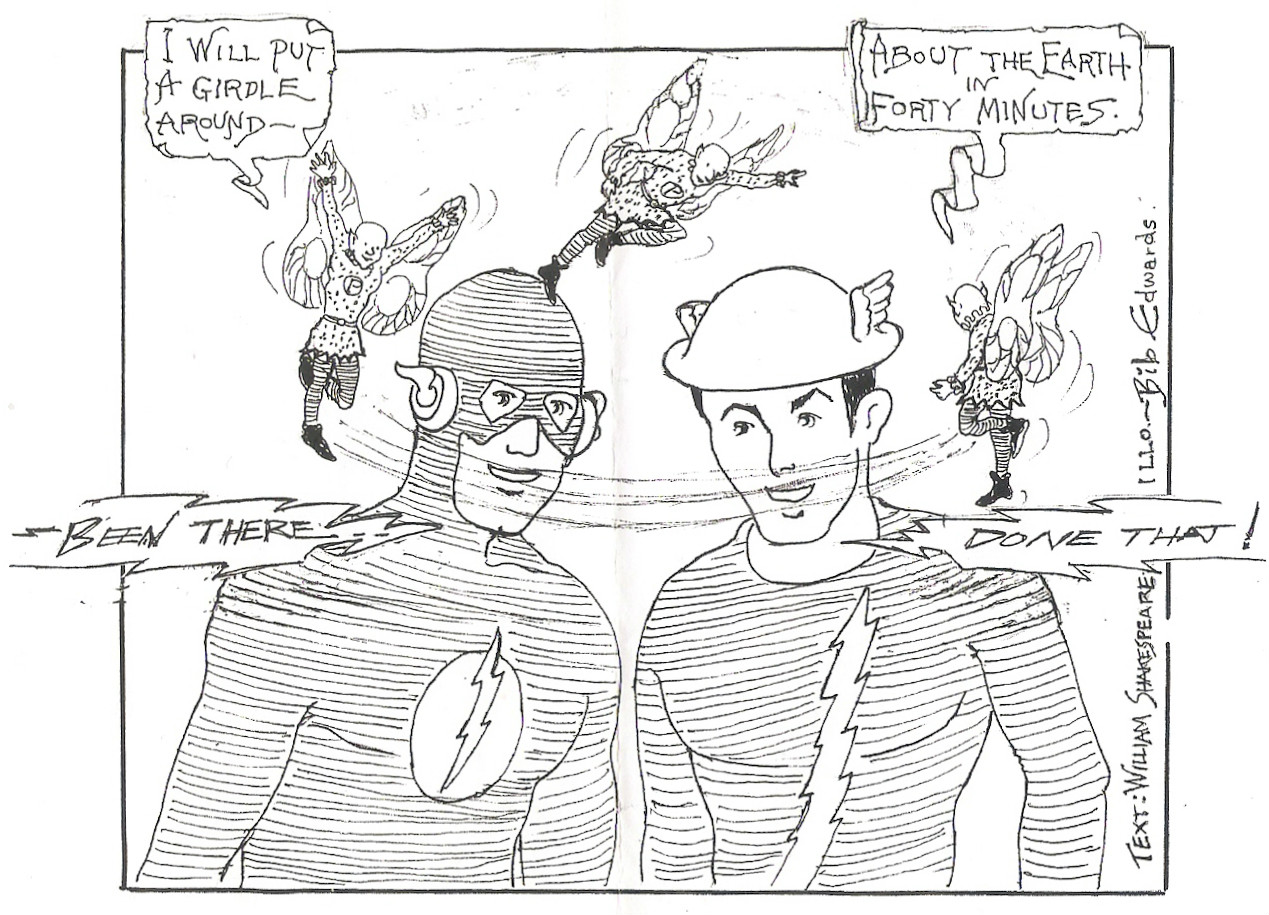
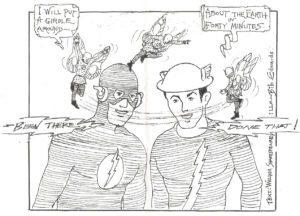
They’re written on the backs of his own photocopied cartoons. One has a tiny Puck flying around the shoulders of two American comic book superheroes. Or rather, two versions of the same superhero, The Flash. One is the 1940s Golden Age Flash, with the winged hat; the other is the later Silver Age incarnation, with the one-piece costume and the mask.
Puck is saying: ‘I will put a girdle around the Earth in forty minutes‘. The two Flashes reply, ‘Been there, done that!’
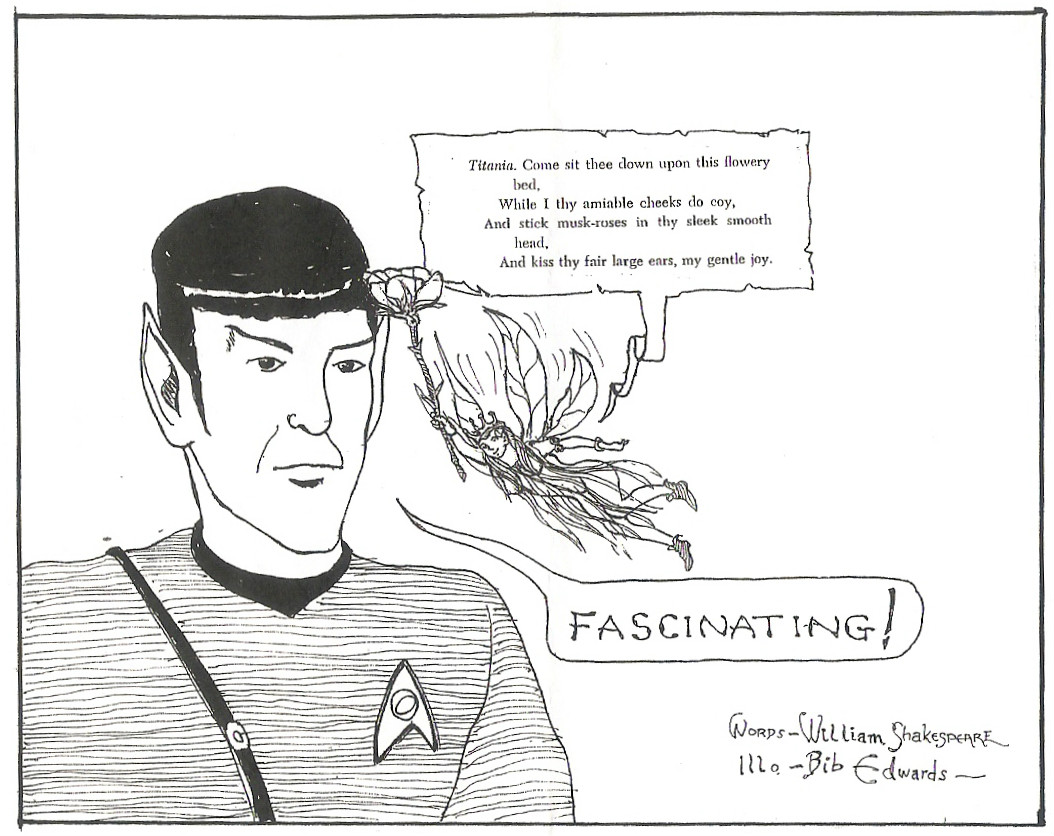
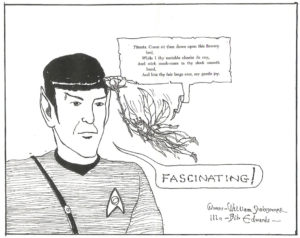
Dad’s other cartoon has a tiny Titania offering a rose to Mr Spock from Star Trek. Says Titania: ‘Come sit thee down upon this flowery bed / While I thy amiable cheeks do coy / And stick musk roses in thy sleek, smooth head / And kiss thy fair large ears, my gentle joy.’
Mr Spock, who of course has ‘fair large ears’, replies, ‘Fascinating!’.
***
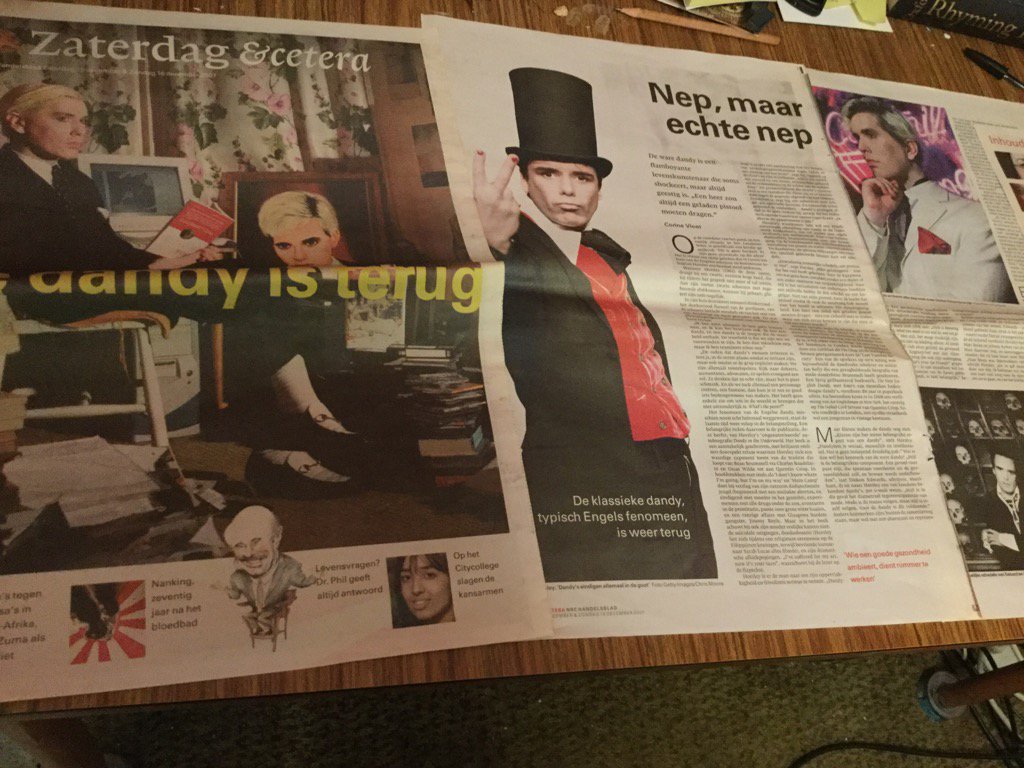
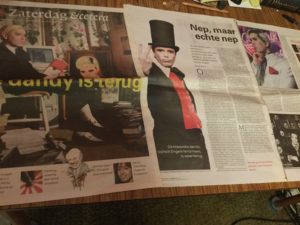
Friday 3rd June 2016. I find a Dutch newspaper supplement from late 2007, where I’m the cover star. Well, that’s if the cover of a supplement counts as a cover. It’s for an article on Modern Dandies of London (I think). Me alongside Sebastian Horsley, with his two fingers up to the camera. I still live in the same room, albeit with different curtains.
***
More mopping-up of unpublished activity.
Friday 6th May: While people have stopped me in the street to ask me why I hadn’t written more about the death of Prince, no one has yet chided me for my complete omission of the London mayoral election. Perhaps that sums up what sort of diarist I am.
Still, it needs to be said that I did indeed vote. Voters had a second preference, so I gave my first choice to the Greens’ Sian Berry, and my second to Labour’s Sadiq Khan. Khan triumphed, his victory announced late into the night of the 6th (after an agonising delay of many hours). Ms Berry came in at an impressive third, after the Conservatives’ Zac Goldsmith. She also took up a seat on the London Assembly, thanks to the Greens doing well enough on the ‘London-wide’ polling sheets.
It’s the first election result in years where I’ve felt optimistic about the future.
***
Films seen recently:
Tuesday 17th May 2016: Green Room at the ICA. £3. A horror thriller with the unusual backdrop of a right-wing skinhead music scene, in contemporary rural Oregon. Rather different to the Portland liberals of that same state, as spoofed in Portlandia. But then I suppose it’s analogous to the way parts of Sussex can be rather less progressive than Brighton.
Imogen Poots’s character has one of those skinhead-scene girls’ haircuts that flatter while adding a certain toughness: long at the sides with a sharp fringe at the front (a Chelsea Fringe? a Feathercut? not sure). The boots and braces look for the men is well-researched too – straight out of 1970s Britain, but jostling here alongside iPhones and American accents. Much significance given to the colour of laces in DMs. A couple of the scenes are extremely gory. But then it is meant to be a horror film too. I suppose boxes must be ticked in plot, in the same way that the characters must tick boxes with their clothes, their taste in rock music, and with their beliefs. These days, I find discussions about belonging thrilling enough; blood and violence less so.
Friday 20th May 2016: Heart of a Dog at the ICA. £3. Laurie Anderson’s stunning film essay, ostensibly about the death of her rat terrier Lolabelle, but touching on life and death in all kinds of ways, from the passing of friends and relatives, to the changes in New York after 9/11. Her husband Lou Reed’s death (which happened during the making of the film) isn’t explicitly referred to, but he’s there briefly as an actor (playing a doctor), and as himself (in footage of the couple on a beach). He also provides the closing song, and in the very last shot he is seen holding the dog.
At one point Anderson talks about that unhappy experience that most pet owners must endure: going to the vet to hear what she calls ‘The Speech’. The one that asks the owner if the pet can be put to sleep. It reminded me how I was recently told, separately, of the deaths of two cats I used to look after in North London: Claudia Andrei’s cat Sevig, and Jenn Connor’s Vyvian. When Sevig became very frail, Claudia pushed him around the streets of Edinburgh in a shopping trolley – ‘the Sevig-mobile’. After seeing Heart of a Dog I realised how lucky I was to have the pleasure of living with these beautiful creatures, without ever having to face The Speech.
Tuesday 24th May 2016: Troublemakers: The Story of Land Art, ICA. £3. A documentary on a group of artists in the late 60s and early 70s, who turned vast, desolate parts of the US into their own canvasses in the pure pursuit of Making Art. I was familiar with the Lightning Field artwork – all those lightning rods against the sky- but I hadn’t heard about works like Double Negative, where two gigantic rectangular chunks were carved out of a rocky mesa. According to the credits, some of the works begun in the 1970s are still in progress today.
Thursday 26th May 2016: Love and Friendship at the BFI. Free, courtesy of Tim Chipping, a fellow Whit Stillman fan (we went to see Barcelona together on its 1990s release). The film is followed by a Q&A with Whit Stillman, who is in typically eloquent and wry form. The film adapts Jane Austen’s Lady Susan, though there are touches of Wilde in Stillman’s script too. It’s verbose without ever being dry, and in terms of quips and jokes, it’s funnier than most modern comedies. My favourite film this year.
Friday 3rd June 2016: The Witch at the Prince Charles. £4. A tale of supernatural goings-on amongst a family of Puritan settlers, in seventeenth-century New England. Like Green Room, it blends the horror genre with more unusual aspects, in this case, gritty historical drama. The dialogue is lifted straight from the literature of the time: all ‘thy’s and ‘thee’s. As with Whit Stillman, the style only works once you realise what the director is trying to do: in this case, make a film that takes folk legends as real without question. It’s as if the film was made by seventeenth-century Puritans, as well as being about them.
***
A useful acronym from Atalanta K, who lost her bag after a night of carousing: ‘I had a CRAFT moment. As in: Can’t Remember A F-ing Thing.’
Tags:
a midsummer's night dream,
bbc,
Claudia Andrei,
dad,
dandies,
Dandyism,
films,
green room,
heart of a dog,
ICA,
jenn connor,
laurie anderson,
love and friendship,
Prince charles cinema,
Sebastian Horsley,
sevig,
shakespeare,
the witch,
vyvian,
whit stillman
Little Threads of Infinity
Sometimes, writing can feel like tugging at little threads of infinity. This is a simile suggested by the jacket I’m wearing today. It’s a beloved linen number of some ten summers, as a result of which the jacket is now unravelling along a number of seams. It has reached the stage where it makes my dry cleaner suck in his breath so much, I wonder if there’s a point where the sound of reluctance ends and asthma begins.
I have the same fear of an infinite unravelling whenever I sit down to write. There’s a point where the mind has no reason to stop dwelling on even the tiniest detail – one thinks of the Woolf story ‘The Mark on the Wall’. Everything is interesting, really.
But the problem with this is that I have a backlog of events from the last few weeks, which really should be at least declared, if only to paint in the parameters of my funny little life. This week’s selection of diary entries, and the next one, will therefore be more of a mopping-up. The temptation to tug on The Threads of Fact until they become The Unravelled Garments of Reflection will just have to be resisted.
***
Tuesday 4th May 2016. To the Cartoon Museum in Bloomsbury. A small gallery that nevertheless crams in two superb exhibitions: a major one about ‘The Great British Graphic Novel’, and a smaller one upstairs about the Doctor Who Target novelisations, which came out regularly in the 70s and 80s. Virtually every Doctor Who adventure was turned into one of these little books. I remember them well as a child. It was the era just before TV shows were available to buy on home video (long before DVDs). To revisit a favourite story, the fans had to read prose fiction. How strange now to think of novels as catch-up TV.
Each Target paperback had a specially commissioned cover rendered as a painting (hence the exhibition), branding the books more as imaginative explorations in their own right, rather than disposable cash-ins. They also encouraged a feeling of community, which is what merchandise and events like Comic-Con should always do. Join our club.
***
Thursday 5th May 2016. In the TLS I read a review by Tom Lean of Electronic Dreams, a book about 1980s computer games. One game, Deus Ex Machina, apparently featured a segment ‘in which the player has to guide a sperm to an egg in order to fertilize it. The astronomer Patrick Moore had been invited to voice the semen; he consulted his mother and, on her advice, declined.’
***
Sunday 8th May 2016. Afternoon: To a marquee in St James’s Square, for one of the Words in the Square events. This is a miniature literary festival, held by the London Library to mark its 175th anniversary. I attend ‘Desert Island Books’, a group discussion about favourite reads. Six authors sit on a stage and explain their choices in categories such as ‘Childhood Favourite’, ‘Biggest Influence’, ‘Guilty Pleasure’, ‘Tarnished Favourite’, and ‘Recent Favourite’. The authors are Philippa Gregory, Deborah Levy, John O’Farrell, Sara Wheeler, Nikesh Shukla and Ned Beauman. A gender note: all three men try to make the audience laugh, while the three women are more serious and wistful about the pleasures of reading. Though that’s a kind of playing to the crowd too.
Ned B’s ‘Guilty Pleasure’ is to go on Amazon and use the ‘Look Inside’ function to read the bits in crime thrillers where the killer reveals his motive. Nikesh S’s ‘Tarnished Favourite’ is a poetry anthology he contributed to in his teens. His initial excitement at having his dream realised was soon doused; the book turned out to be a scam by a vanity press.
Evening: To the Constitution in Camden for Debbie Smith’s Nitty Gritty club night. It’s such a sunny day that I walk all the way from St James’s, via the canal. At the club I meet the singer from the band Bete Noire, who I’m reliably informed have been making waves with their song, ‘Piss On Putin’.
***
 Saturday 29th May 2016. Mum in London for the day. We visit the British Library’s big summer exhibition, Shakespeare in Ten Acts. As usual with the BL, it’s a rich mix of the familiar (lots of rare books, a couple of First Folios present and correct), the educational (in-depth histories of early female and black actors) and the unexpected. In the latter case I’m fascinated with the details of the first overseas production, an amateur Hamlet on board a ship off the coast of Sierra Leone, as early as 1607. Shakespeare was still alive.
Also learned: King Lear was performed in a sanitised version for 150 years. This Restoration rewrite had a happy ending and omitted the character of the Fool entirely. When the full Shakespearean Lear was revived in the 1830s, the first actor to play the Fool was a woman, Priscilla Horton.
For me, the highlight is a whole room dedicated to Peter Brook’s 1970 production of A Midsummer’s Night Dream. This was the radically minimalist version, staged against plain white walls, with brightly coloured costumes, trapezes and stilts. In the exhibition, all the rooms are dark except for this one, a witty recreation of Brook’s clean white box. There’s even a trapeze one can sit on, albeit firmly anchored.
Lunch at Albertini in Chalton Street, followed by a walk around Camley Street Natural Park and a quick visit to the House of Illustration. Three small exhibitions in the latter: 1920s Soviet children’s books (when animal tales were suppressed as bourgeois constructs), a permanent Quentin Blake gallery, and a display of Japanese girls’ Shojo manga comics. Am intrigued about Keiko Takemiya, who is thought to have pioneered the yaoi genre: comics about gay male love, made by women for girls.
It’s a sunny day, and we have drinks outside in Granary Square (buying them at the trendy Granary Store bar). The area is still being finished, but it’s already King’s Cross’s answer to the South Bank, the canal standing in for the Thames. As with the Royal Festival Hall, hordes of people now descend here at the weekend, and seem to just sit around all day. Alcohol on concrete, bridges over water, art galleries, and the inevitable small children playing in fountains, the kind made up of jets of water springing up from the pavement.
In fact, the Granary Square fountains seem to be more artily-minded than the South Bank ones, perhaps because St Martin’s is next door. The jets switch constantly between different patterns of varying rows and heights. On the South Bank, the jets just rise up and go down. Either way, the children seem happy. Or at least, busy. Which with children, unlike adults, is the same thing.
Tags:
bete noire,
British Library,
cartoon museum,
doctor who,
house of illustration,
king's cross,
mopping up,
nitty gritty,
shakespeare,
target books,
The London Library
The Artist Known As…
Tuesday 17 May 2016. To Vout-o-Reenee’s to take a photo. It’s for my entry to a Birkbeck competition, which is asking for photos on the theme of ‘London Relocated’. An idea occurred to me, so I thought I’d give it a go. I thought about the way the Vout’s club is effectively the spirit of bohemian Soho relocated, in this case a few miles east in Tower Hill. Tonight I get Sophie Parkin to pose at the bar for my hopeful little image, alongside her book on the deceased Soho club, the Colony Room. I also get my own membership card of the Colony into the shot, visible on the counter of the Vout’s bar.
Sophie tells me about the charity Little Paper Slipper, which is having a major event at Vout’s in June. This is a charity that organises therapeutic art workshops, for women affected by domestic abuse. The end result is a series of exhibitions of the eponymous slippers, each one personalised by the woman who made it. There’s about 150 of them now.  The event at Vout’s is going to be a fundraising auction, featuring shoes specially made for the charity by a group of artists, including Gavin Turk, Molly Parkin, and John Claridge.
I’m happy to help publicise the event. There’s further details at Facebook here.
There’s some fascinating photos of the workshop slippers at the charity website:Â www.littlepaperslipper.com/slippers.html
***
Wednesday 18 May 2016. Evening: my debut as a conceptual artist. I am given a sticker for my lapel which says: ‘Dickon Edwards – Artist’. So it must be true.
The venue is Birkbeck’s School of Arts, on the east side of Gordon Square, once home to Virginia Woolf. This week is Birkbeck’s annual Arts Week, a series of free talks and events that are open to the public. Over the cast iron railings at the main entrance are the words ‘ARTS WEEK’ rendered as huge, colourful knitted letters. I discover that this display is not, as I’d hoped, the product of an MA course in Comparative Knitting, but the handiwork of two knitting-loving administrators, Claire Adams and Catherine Catrix.
Given the building’s history, I wonder what would have happened if those fateful railings in Mrs Dalloway had been similarly wool-clad. Septimus Smith might have ended the novel in better shape. Another thought is The Muppets’ Mrs Dalloway. Starring Miss Piggy as Clarissa: ‘Moi will buy the flowers myself!’
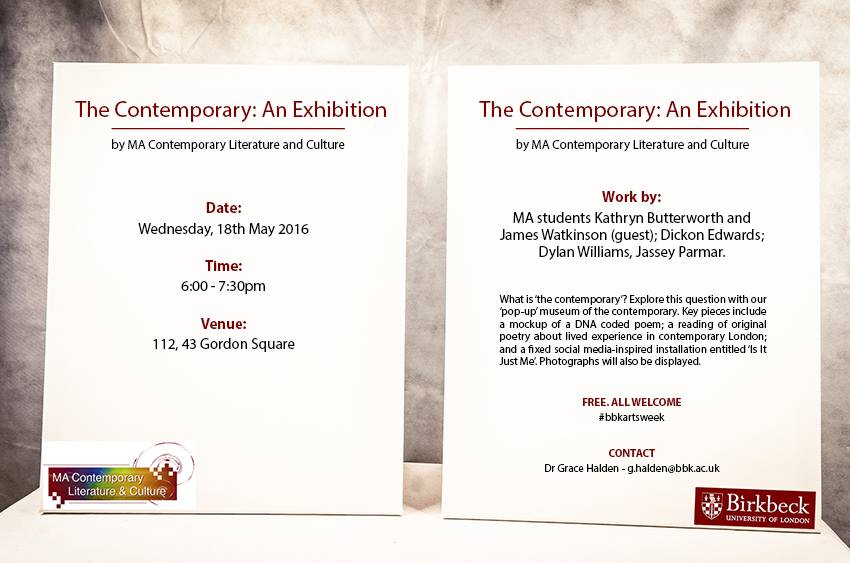
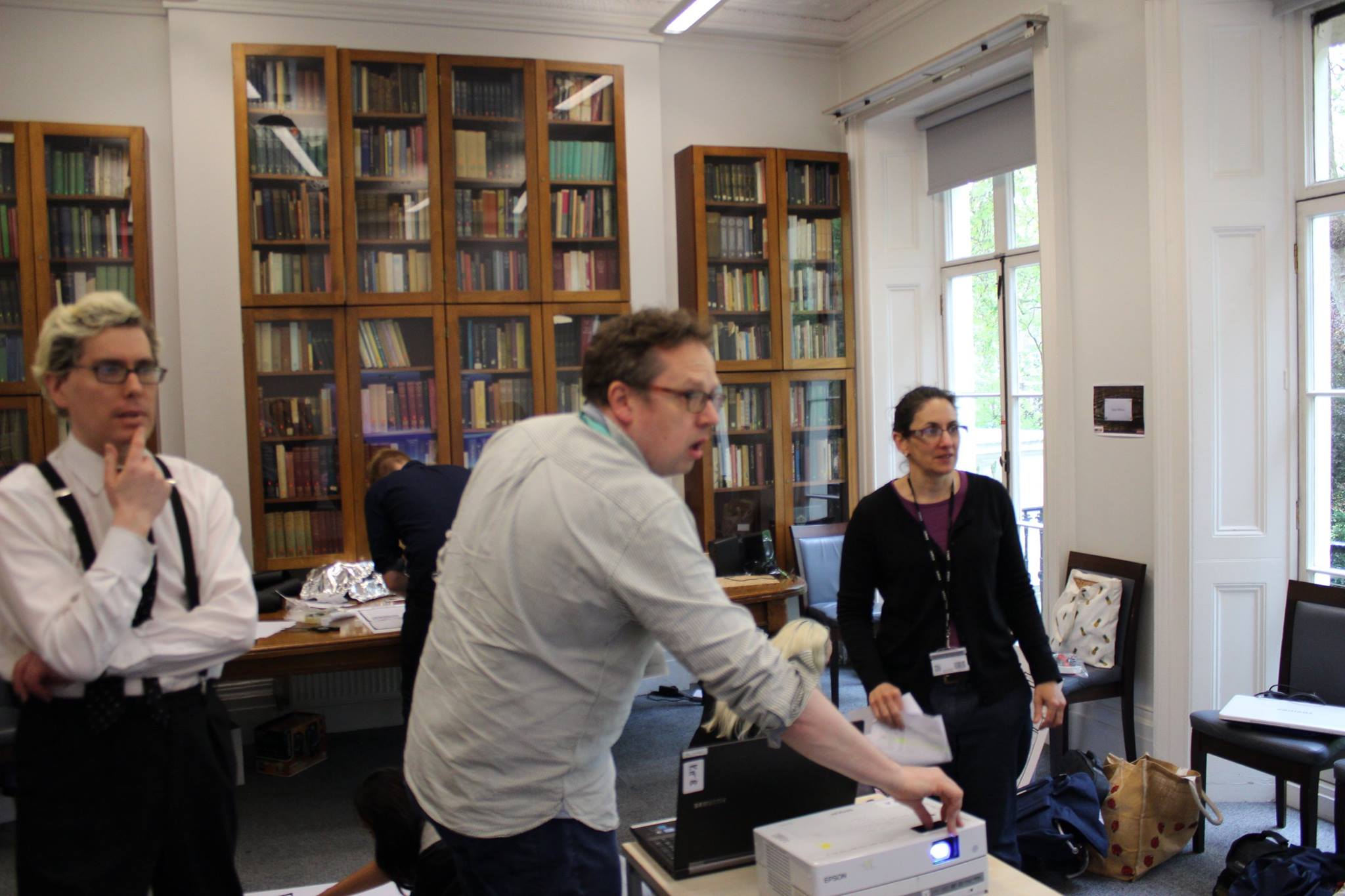
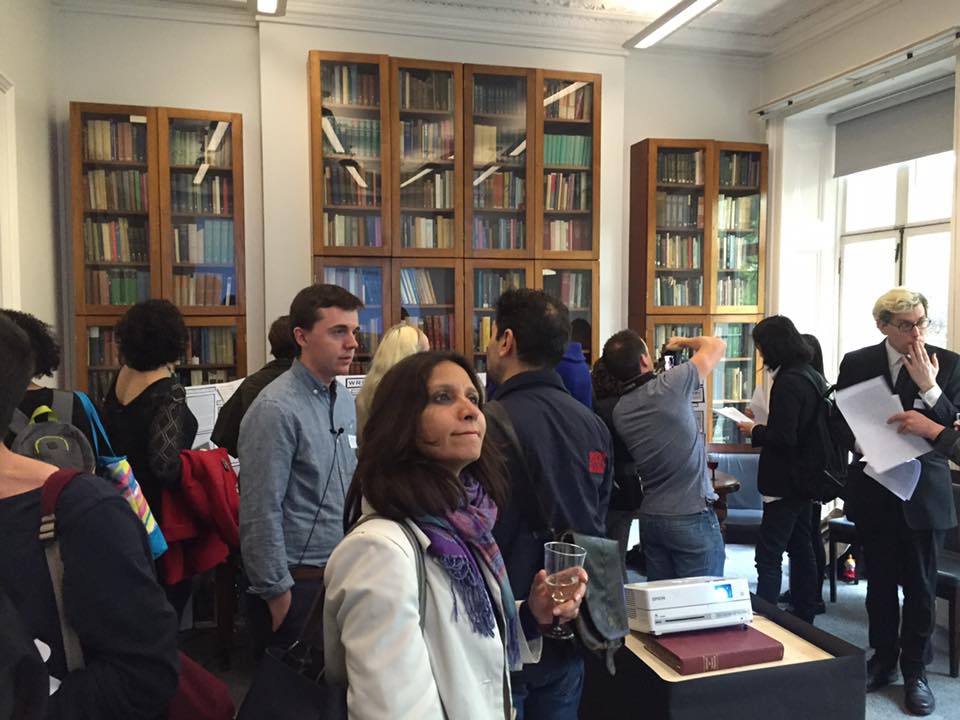
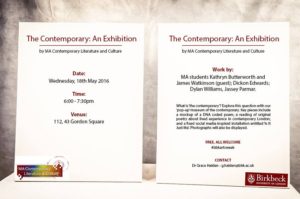
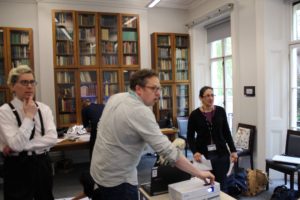
Inside, Room 112 hosts The Contemporary: An Exhibition. This is a ‘pop-up’ show by four students of the MA Contemporary Literature and Culture course, and addresses the question: what is ‘the contemporary’? The contributors are Kathryn Butterworth (in partnership with James Watkinson), Jassey Parmar, Dylan Williams, and myself. The event is the idea of the main course tutor, Grace Halden, who thought it would be good to have the MA represented during Arts Week.
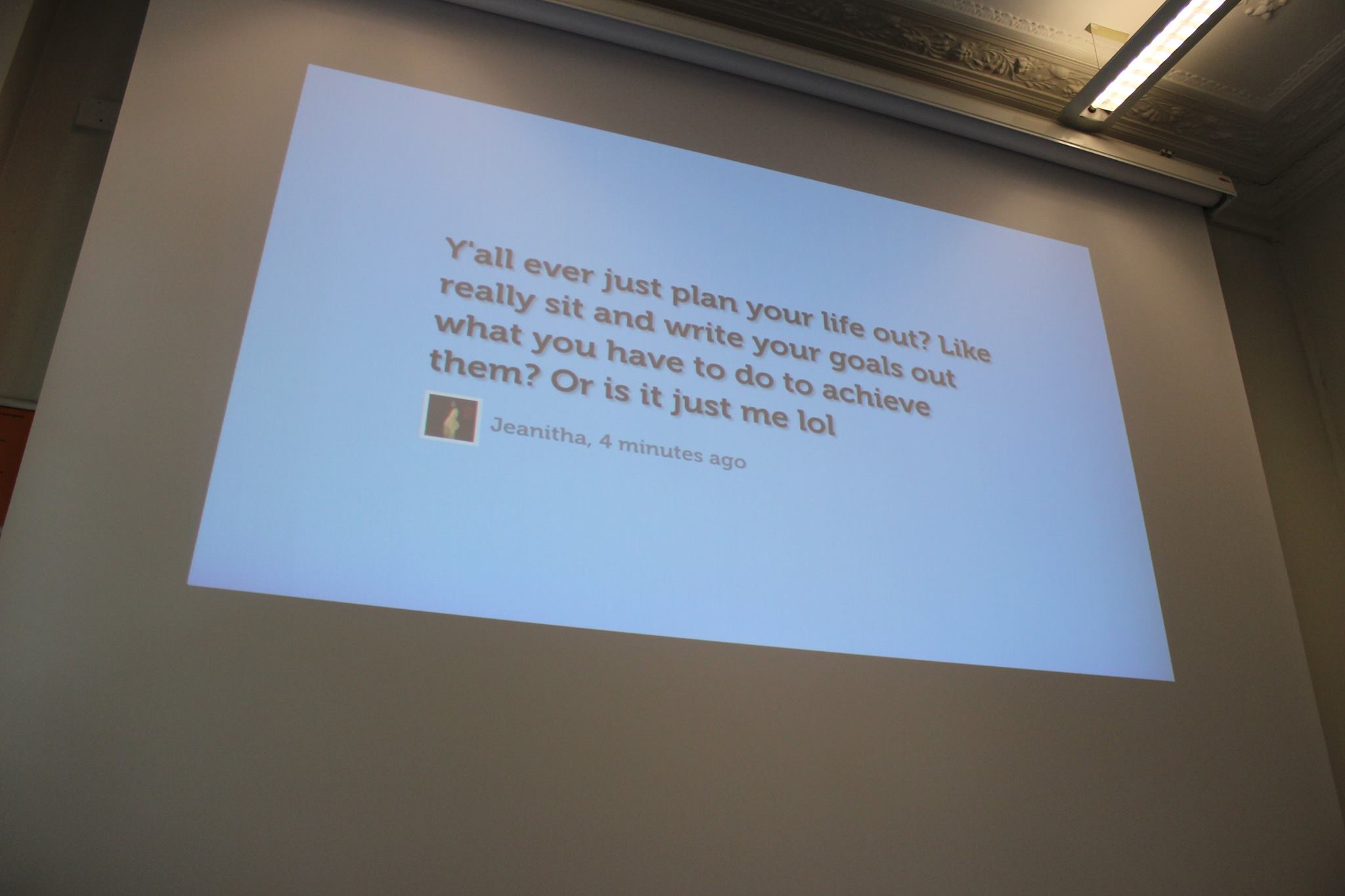
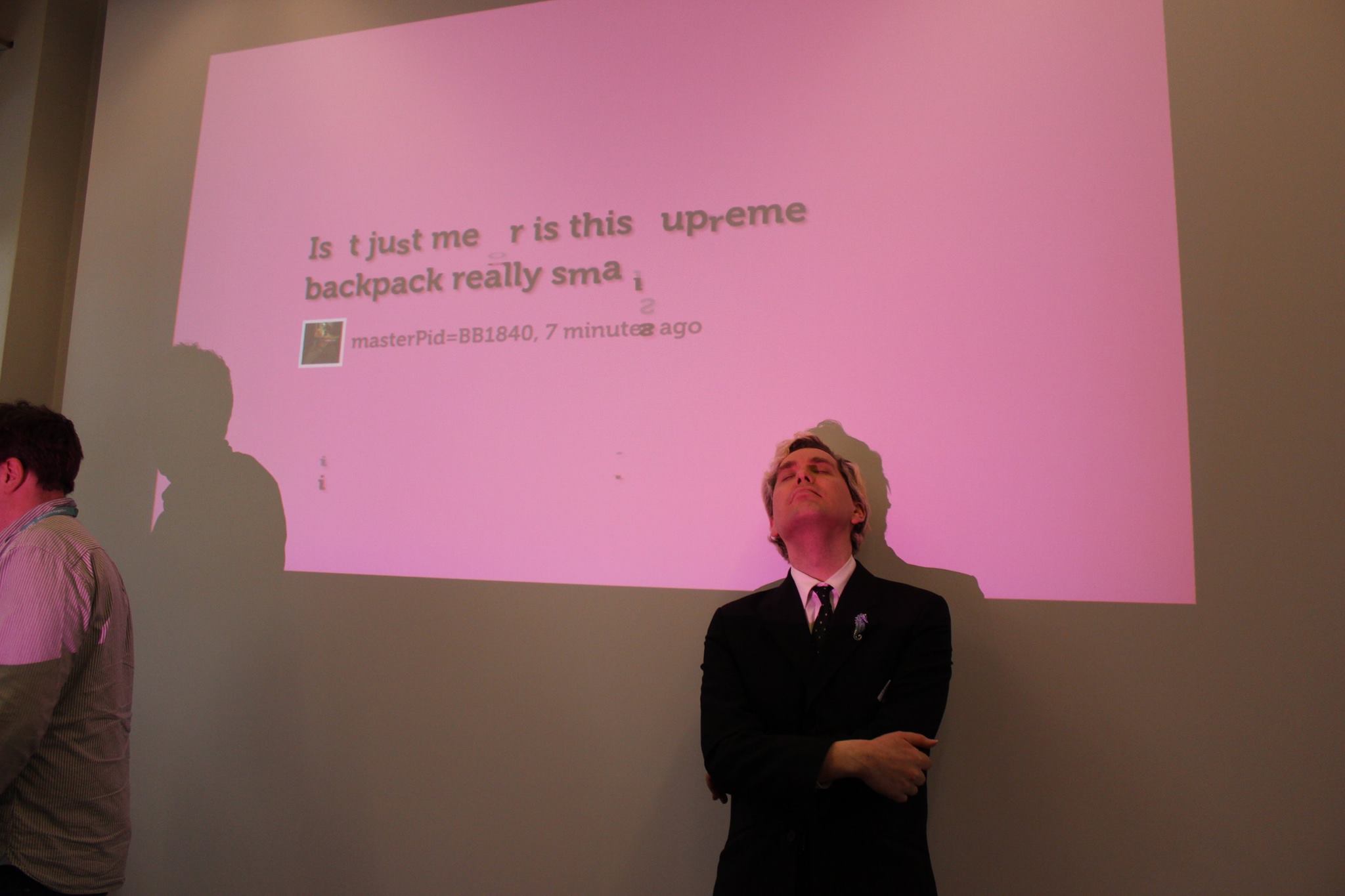
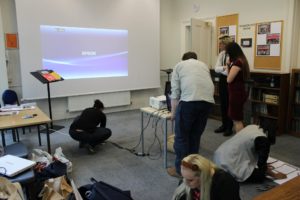
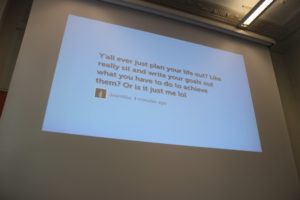
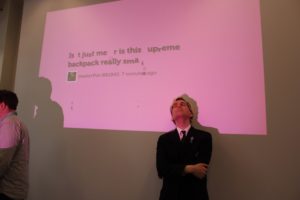
Kathryn and James’s display is a multimedia look at technology and literature: there’s large boards covered in texts, computer diagrams, a model of DNA code, and laptops playing audio and video content. Jassey’s exhibit is a series of photographs of London shop fronts, which blend different cultures and brands in unexpected ways. Twice during the evening, Dylan performs a selection of his own poetry. And I’ve contributed a social media installation titled Is It Just Me?
I had the idea some years ago. It was one of those ideas that don’t go away. So I thought I’d either put it in a story, or just keep it in reserve, in case someone asked me to contribute to an exhibition.
So one day someone did, and here I am. A debut artist.
At the event, I give out an A4 handout to explain my thinking behind the installation. I’ve uploaded it here as a PDF:
Is it Just Me – installation handout
I also leave out a sheet of my handwritten notes for the project. I like the juxtaposition of the shifting internet content on the screen, with the fixed artifact of my handwriting on paper. Private traces of the body, versus public traces of the mind.
The event turns out to be decently attended, with tutors stopping by to say kind things. It all seems to go okay, and there’s no technical hitches, thanks to the efficiency of Birkbeck’s staff. How wonderful it is to have an idea which involves cables and equipment, but not have to worry about the cables and equipment oneself.
Here’s some photos from the course’s Facebook page (most of them taken by Lee Smith, used with permission):
And here’s a link to the Facebook page for the MA in Contemporary Lit and Culture
***
Thursday 19th May 2016. Thinking more about Prince, and about camp uses of the colour purple, I’m reminded of this anecdote from Gary McMahon’s Camp in Literature (2006, p. 144):
‘Brigid Brophy notes that [Ronald] Firbank often wrote his tales in purple ink on blue postcards, surface and colour being everything to camp. Brophy reveals that she too wrote her critical biography of the man [Prancing Novelist, 1973] in purple ink. My working copy of Brophy’s book is on loan from Manchester University’s library. At this purple confession on page 173, a university student […] has written this response in the margin:
“Are you [Brophy] really as besotted as this? If so, we don’t want to know. At least maintain a pretence at objectivity, please.”
McMahon remarks that this student represents a certain academic sensibility ‘that is always going to be exasperated and offended by camp’.
Returning to Prince, I think of a friend’s anecdote along the same lines. When this friend was growing up in the 80s, some blokish gentleman known to them – a friend or possibly a dad – took one look at a Prince record sleeve and remarked, quite out of the blue, ‘I don’t care what he sounds like. I’m not listening to anyone who dresses like that.’
***
Friday 20th May 2016. I receive the grade for my second essay on the MA. Despite my struggles with it, I am very pleased indeed to get a 76 (a mark over 70 is a Distinction, the MA equivalent of a First). The first essay got a 73. It’s a nice boost to my confidence when I needed it most, wracked as I was with Difficult Second Term Syndrome.
For the rest of the summer, I have to get on with postgraduate-y things under my own steam, such as attending open lectures and pursuing my own research. But as far as the big assessments go, the pressure is off until the autumn.
Tags:
art,
birkbeck,
birkbeck arts week,
brigid brophy,
colony room,
little paper slipper,
Prince,
ronald firbank,
sophie parkin,
vout-o-reenee's
Diamonds and Beaus
Friday 13th May 2016. Early afternoon: I’m recognised in Jermyn Street by a gentleman who says he enjoys this diary. In fact, he crosses the street to tell me this, narrowly avoiding being run down. Surely no writer can ask for higher praise than this: a reader risking their own life to pass on a good review. Perhaps it should go on the back of a book. ‘I enjoyed Dickon Edwards so much, I was nearly hospitalised’.
He adds that he was disappointed I didn’t say more about the death of Prince, given what I’d said about Bowie a few months earlier. This is a perfectly good point.
I think one reason might be that, when I was growing up, I’d always regarded Prince as one of my brother Tom’s favourites; his territory more than mine. For some reason we divided up singers and bands between us, as if they were soft toy animals. I got to cuddle New Order, the Pixies and the Smiths, Tom had the Cult, the Beastie Boys, and Prince.
But if one loves good pop songs, and believes, as I do, that pop music is at its best when used as a platform for individuality, eccentricity, and indeed dandyism, obviously one has to admire Prince.
It’s all the more apt that this request took place on Jermyn Street. The street is something of a dandy Mecca, being home to some of London’s most stylish menswear shops, to the church of St James’s Piccadilly, where Sebastian Horsley had his funeral in a red squinned coffin, and to a statue to that most influential of London dandies, Beau Brummel. It is a statue close enough to the ground to be hugged, an act which dandyish American friends of mine make a point of doing whenever they visit.
A further coincidence is that I was on my way to the London Library, a block away in St James’s Square. After parting company with the reader, I remember that I’d once found a book on dandyism in the library, one which directly compared Prince with Beau Brummell. So today I go straight into the stacks and retrieve the book in question.
The book is called Rising Star: Dandyism, Gender and Performance in the Fin de Siècle, by Rhonda K. Garelick (Princeton, NJ: Princeton University Press, 1998). As part of a chapter on the legacy of dandyism, Garelick reprints a 1995 Esquire cover, on which Prince pulls a definite dandyish pose. It’s from his Artist Formerly Known As phase, just after his hit, ‘The Most Beautiful Girl In The World’. His hair at this point is short, dark, combed and straightened, with a touch of the silkily feminine (even a Hugh Grant-ish schoolboy floppiness). He has a thin pencil beard that seems an extension of his cheekbones, and wears a slim pinstripe suit, buttoned down, over a white shirt with big cuffs. He sports a dark tie (collar button undone), fingers covered in rings, and leans against a silver cane.
According to Garelick, Prince’s image at this point follows in the classic nineteenth-century dandy traits. Prince ‘borrows unmistakably from the likes of Beau Brummell, Baudelaire and Jean Lorrain’. The main criteria are his aloofness, his air of contempt for convention, and his highly stylized persona. On top of that, his 1990s adoption of an unpronounceable symbol allies him with Barbey d’Aurevilly’s idea of the dandy life: one of pure surface and symbol, an influence beyond language: the dandy is ‘that which can hardly be recounted’. Certainly, changing one’s name to an actual symbol takes that aspect of dandyism to the limit. Though I’d say Prince had already put his stamp on language by that point, given his love of turning words into single letters or numbers, as in ‘I Would Die 4 U’.
The gendered aspects of Prince’s dandyism were equally fascinating. Granted, it may not have been original for a male, black, American performer to play with femininity in the rock and pop field; one thinks of Little Richard and Rick James. But Prince used his influences in order to do as Bowie did: make something new. He especially intensified the androgynous aspects of his imagery, imbuing them with that most deviant of colours – purple.
I think of that campest of pre-war dandy writers, Ronald Firbank, and his love of writing with purple ink. I also think of Brigid Brophy taking this detail of Firbank’s so much to heart, she apparently switched to using purple ink for the longhand manuscript of Prancing Novelist, her 1973 study of Firbank. The Brophy book is 600 pages long. That’s a lot of purple.
Through these deviant codes, Prince’s dandyism became an outrageous queering of heterosexuality – a machismo-troubling version of Camp Rock which he shared with such figures as Marc Bolan, Tiny Tim and Russell Brand (who isn’t even a musician, but he hasn’t let that stop him).
Garelick’s book also compares Prince’s use of female dancers and co-singers with names as Vanity, Apollonia, and Mayte, as echoing 1890s Decadent ‘tableaux’, such as ‘Aubrey Beardsley’s Salome drawings of androgynous, erotic, and nearly twin creatures’. Though in Prince’s case, says Garelick, the women were not so much twins as shadows in his wake, a ‘merging of the dandy and the danseuse‘.
Certainly, any woman appearing with Prince had to become remade in his image. I never saw Prince in concert, but I was interested enough to catch his 1987 concert film Sign o’ the Times, when it hit British cinemas. For the song ‘U Got The Look’, the female role was filled by the Scottish singer Sheena Easton, who’d already had a successful career in her own right. For ‘U Got The Look’, though, she became well and truly Prince-i-fied. From her singing to her clothes to her poses, she was not so much a guest vocalist as just another interchangeable cog in the man’s machine. When in Purple Rome, you do as the Purple Roman does.
More recently, I thought of Prince when I heard the song ‘Quicksand’ by La Roux, aka Elly Jackson, a young singer who might herself be described as a dandy (the National Portrait Gallery’s shop currently has her on a postcard, wearing a very Bowie-esque mustard yellow suit). Musically, ‘Quicksand’ is clearly influenced by ‘When Doves Cry’, from the chords to the clipped 80s synths. But Ms Jackson’s singing is a very Prince-like style too: shifting across the genders from high feminine falsetto to low, growing boyish swagger. For me, that’s when art is at its best: when there’s a breaking out of prescribed roles, and the same trappings of said roles are re-used on the artist’s own terms, to communicate their individualism. And that’s also a definition of dandyism, in my book.
***
Evening: to the ICA to see Mustang, a Turkish film, set in the present day, about five teenage orphan sisters living in what seems like an idyllic picturesque setting: a hillside village near the Black Sea coast. Their mildly rebellious behaviour during the school holidays, however, sees them dramatically punished by their guardians – first with imprisonment in their own home, complete with bars on the windows, and then into forced marriage to equally reluctant young men. The film’s sensualised, slightly surreal atmosphere accentuates the idea of a close-knit group of girls disappearing into a world of their own, thus placing the film in the same tradition as Picnic at Hanging Rock, The Virgin Suicides, and last year’s The Falling.
With the added dimension of the conservative Turkish setting, though, Mustang has more complex questions about the role of arranged marriage in a changing world. The girls’ captor, their grandmother, is no fairy tale tyrant; she merely believes that, because she herself was married off straight after puberty, that’s the way it should be. Indeed, for one of the sisters, her marriage to the boy she was already seeing is shown as a good thing, if a hasty one. For the others, though, freedom comes in the form of escape to the big city – Istanbul – and to the parent they really want: a beloved schoolteacher. The real asset of the film, though, is the utterly naturalistic and convincing performances, particularly by the youngest sister.
Tags:
brigid brophy,
Dandyism,
ICA,
jermyn street,
la roux,
Mustang,
Prince,
ronald firbank,
The London Library
Letters As Pandas
Monday 25th April 2016. Working on the second draft of the MA essay. It’s 3000 words over the limit, so most of the work is working out which bits to cut. Some are obvious – simply any sections that I feel less confident about. Others fall into the category of ‘Fascinating And Original Insights That I Feel The World Will Benefit From, But Which Aren’t Relevant To The Current Matter At Hand’.
***
Reading Hollinghurst’s Swimming-Pool Library, I find a line in which a character refers to Brideshead Revisited as ‘that deplorable novel’. All the more amusing, given that the AH’s later works The Line of Beauty and The Stranger’s Child are often compared to Brideshead.  Today, Sebastian Flyte and his teddy bear seem more invulnerable than ever: there’s a new stage production of Brideshead doing the media rounds.
***
Tuesday 26th April 2016. To Senate House Library, for one of the many Shakespeare exhibitions for the 400th anniversary of his death. This is one is called Shakespeare: Metamorphosis. It presents a history of the Bard in print, via a ‘Seven Ages of Man’ theme. The last age, the decrepit ‘sans teeth, sans eyes’ one, is used for the digital era, now that every play is easily accessible online. Thus the great man is now ‘sans binding, sans pages’. Some irony, though, as I’m writing this up from the exhibition leaflet.
Among the exhibits is a copy of Golding’s sixteenth-century translation of Ovid’s Metamorphoses, an edition similar to the one that inspired Shakespeare. The title page says: ‘Tr. Arthur Golding Gentleman. A work very pleasant and delectable.‘ I’m also intrigued by some pristine copies of a 1940s series aimed at schoolchildren, The Satchel Shakespeare. Each play was published as a slim, dark green paperback, light yet somehow sturdy enough to survive a child’s satchel.
As is increasingly the case with historical exhibitions, displays of personal letters tend to be a highlight. Given that the medium of letters is more of an endangered species than the medium of books, even a copy of the First Folio can seem less exotic than letters from a few decades ago.  One only has to point to the success of the Letters of Note books and the Letters Live events to show the changing role of letters; from commonplace pursuit to otherworldly public spectacle. If curators are the zoo keepers of culture, letters are the new pandas.
Consequently, my favourite item in this Shakespeare show is a 1957 correspondence between the University of London’s JH Pafford, and the German scholar Richard Flutter. At the time, Pafford was editing the Arden Shakespeare edition of The Winter’s Tale. Flutter had just published a letter in which he argued that Shakespeare only wrote a fraction of the play. Pafford duly wrote to Flutter asking him to explain this theory in more detail, though he adds that he’s already firmly convinced the play is fully Shakespeare’s. In the reply, also on display, Flutter replies, quite reasonably: ‘Why do you want me to mix a cocktail for you when you are firmly determined not to drink it?‘
***
Saturday 30th April 2016. The essay seems to be taking forever. I’m finally on the third draft, working most days in Birkbeck Library, in Torrington Square. Today I don’t finish till half past ten at night. As I walk out, thinking this is late enough, I notice that dozens of students are still hard at it. The library doesn’t close until quarter to midnight.
***
Sunday 1st May 2016. Weather getting warmer at last. Speak to Mum on the phone in the morning. Then off to the library again. Fourth draft of the essay.
***
Bank Holiday Monday, 2nd May 2016. Essay deadline at noon, so I’m up early to revise the fifth draft in pen. By the time I finish, it’s getting on for eleven. I still have to type up the corrections. So I hit the PCs in Birkbeck Library and frantically type away, barely taking a breath. I upload the finished version to the college website just in time, with about a minute to spare. It’s like a scene from a bad thriller.
All done now. The essay is by far the one I’ve worked the hardest on, at least to date. I only hope the effort comes across. Still, I’m at least confident that it’s full of uncommon and useful insights – the silver lining of a mind stuck in Lateral Mode.
There’s a phrase used to describe Peter Cook which I feel sums up the sentiment: ‘at a slight angle to the universe’. To be worried about being the wrong kind of ‘different’ in some respects, yet hoping to be the right kind of ‘different’ in others, such as in one’s writing. That’s the hope, anyway.
***
Evening: to the Odeon Leicester Square, in one of the smaller screens reserved for the less recent films. I see Star Wars: The Force Awakens, nearly five months after it opens. I’m making good on my (slightly silly) promise, made as a reaction to the aggressive, ubiquitous marketing of the film last December. I resolved to only go and see it when it had been reduced to one screen in central London. Which is now the case.
Tonight’s screening is still fairly well-attended, with a mixture of ordinary-looking people and tourists, and of all ages too. No rabid geeks seeing it for the umpteenth time – at least not visibly.
Then again, Star Wars fans come in all forms. A while ago I listened to an edition of A Point of View on BBC Radio 4. Helen Macdonald, the author of H is for Hawk, who is the same generation as me, talked about going back to see The Force Awakens six times. And this was back in February.
Ms Macdonald explained that for her, the new film represented a reassessment of her late 70s childhood, filtered through more up-to-date concerns, like a moving away from older stereotypes of race and gender. She also suggested that it acknowledged the rise of fan fiction, the genre where admirers of a fictional world remodel it for themselves and write their own amateur stories – often improving on it. They are like the heroine Rey in the film – ‘scavengers’ of the old, seizing on the elements which still work, and giving them new purpose. I’d say that Benedict Cumberbatch’s Sherlock does the same. What might look like indulgent nostalgia at first, becomes an expression of human continuity.
Actually, the original Star Wars was itself a kind of 1970s fan fiction, what with George Lucas drawing on the campy Flash Gordon serials of his own youth, and bringing in Joseph Campbell’s theories of an even older continuity – classical mythology. Harry Potter has similar aspects: the orphan hero, the boarding school, touches of E Nesbit and CS Lewis – but with the less troubling and politically incorrect bits updated. A sense of exploring within a tradition, though, rather than mere box ticking.
The first half hour of the new Star Wars has some stunning imagery, particularly the isolated use of blood stains on a white Stormtrooper’s helmet – the first sign that the bad guys might be complicated humans too. Adam Driver steals the show: a walking, ready-made metaphor for all kinds of masculinity. From the way little boys can be inexplicably drawn to violence (I think of the Saki tale, ‘The Toys of Peace’), to the sons who join Islamic State, to the long-haired villains in manga comics.
I’m still not wholly converted to the cause, though: for all the reports of the director, Mr Abrams, making the film look more physical and haptic than the wafer-thin prequels, there’s still some pedestrian CGI monsters with tentacles halfway through. I miss the fabulous rubbery tentacles of the 1977 Trash Compactor Monster. Perhaps that’s where the line is drawn these days. The making of rubber tentacles has become a lost art. As with ‘craft beer’, perhaps there needs to be a revival in ‘craft tentacles’.
***
Wednesday 4th May 2016. Evening: to the Dalston Rio with Shanthi S and Rosie. We see the biopic of Miles Davis, Miles Ahead. Don Cheadle growls his way quite convincingly through the life of the volatile trumpeter. The film constantly flashes back and forth in time, often quite randomly. So the audience is grateful for Mr Cheadle’s vivid changes in appearance: neat short hair and shirt sleeves for the classic phase in the 50s and 60s, then afro and loud shirts for the sadder, reclusive Davis of the late 70s. Ewan McGregor turns up as a Rolling Stone reporter, looking like he’s auditioning for the next Kurt Cobain biopic.
It’s the later showing, at 9.20pm, and we down a few drinks at the Arcola Theatre bar first. Drinks and lateness turn out to be perfect companions for Miles Ahead, just as they were for Victoria the other week. Both films are steeped in an atmosphere of booze, late nights and city bars. The main difference with Miles Ahead, though, is that it’s a period piece. So there’s a huge amount of smoking inside the bars, too. Ashtrays sit on the tops of pianos in darkened clubs, each one duly cradling a lit cigarette. The smoke snakes its way up and around the scene, as much part of the visuals as the actors. It’s an unthinkable sight for a city bar now. It’s How We Used To Smoke.
Tags:
birkbeck,
essay writing,
miles ahead,
senate house,
shakespeare,
star wars
The Morning Would Be A Miracle
Tuesday 19th April 2016. Still struggling with basic motivation, so I read a couple of books in the self-help vein. One is on depression, Reasons to Stay Alive by Matt Haig. Despite the title, Haig manages to avoid any sentimental irksomeness. Instead he goes in for a lot of self-deprecation, honesty, and little wry jokes. The advice isn’t so uncommon (yoga, mindfulness, breathing exercises, travel, walks in parks), but Haig’s tight prose style and lack of vanity make the book quite special.
The other is The Miracle Morning by Hal Elrod, as recommended by my college mentor, Katie W. The gist of this one is to force oneself to get up earlier than useful, but in a deliberate spirit of hopefulness, with added meditation, exercise, reading and writing tasks, a sense of savouring the day, and all that. It’s probably very obvious stuff, but I’ve lately come to resent not being much of a ‘morning person’, and need all the help I can get.
I’ve found that getting on the Tube at Highgate before 7.15am makes all the difference in terms of one’s nerves. Any later than that, the madness of the rush hour starts to kick in.
I’ve been getting to Birkbeck library for its opening time, at 8.30am. There’s usually three or four other people keen to go in at this time, though not quite to the point of forming a queue. This is nothing compared to the British Library in St Pancras, which usually has a queue of at least thirty, long before opening time at 9.30. I think the ones at the front of the queue must insist on having the same desks. I’ve noticed that some foreign visitors find this hilarious, and take pictures of the queue for Twitter. ‘British people: any excuse for a queue’.
* * *
Friday 22nd April 2016. Have reached 8071 words on the essay, with just over a week to go. So now I have to decide which 3000 words I can lose without risking the tutor comment, ‘you could have said more…’ Am fairly confident that there’s original and useful insights in there. One thing I’m particularly pleased about is that I’ve quoted a new academic book called Cool Characters: Irony and American Fiction, by Lee Konstantinou. It has lots of pertinent quotes on the texts I’m using, like the way Jennifer Egan’s A Visit from the Goon Squad is structured like ‘an online social network of short stories’. The book only came out last month, but I’ve managed to borrow a copy via the London Library. I like the feeling of an essay being bang up-to-date.
* * *
Saturday 23rd April 2016. Prince and Victoria Wood die this week. Radio 4’s programme on topical statistics, More or Less, gives an interesting argument for what seems like an increase in celebrity deaths this year. They note there was a surge of ways to be famous in the 1960s, due to the rise of TV and rock music. So that generation is now starting to hit its autumn years. Well, that may apply for Bowie, but Prince and Ms Wood were still too young.
Victoria Wood was a fellow Highgate resident. I glimpsed her once in a rather apt setting, given her association with Englishness: she was sitting in High Tea of Highgate, a 1940s-style tea shop.
My favourite Wood sketches were the ‘Kitty’ monologues, as delivered by Patricia Routledge:
She said, ‘What do you think of Marx?’ I said, ‘I think their pants have dropped off but you can’t fault their broccoli.”
* * *
Sunday 24th April 2016. On my way to the ICA this morning, I duck my way through the London Marathon crowds on the Mall. Lots of police about, stalls representing charities, and several jolly teams of St John’s Ambulance volunteers. The marathon gives central London a kind of village fete atmosphere. There’s a sense of an uncommon cheeriness among strangers.
Afterwards, I’m standing at a pedestrian crossing in Trafalgar Square. One of the runners stands there too, still in his shorts and vest, but now wearing a medal on a red ribbon. He is on his way to the Tube like the rest of us. Two elderly passers-by chat to him at the lights. Â ‘Well done! How long?’ He holds up three fingers.
* * *
At the ICA, while the Mall is rapt to all the sporty goings-on, I spend two hours in the dark watching the film Mapplethorpe: Look at the Pictures. This is a new, full-length documentary about the life and work of the New York photographer, Robert Mapplethorpe. I guess he’s now more or less synonymous with three things: serene black & white homoerotica, serene black & white celebrity portraiture, and for being Patti Smith’s companion in the 1970s, thanks to her recent memoir Just Kids. Ms Smith’s book was such a bestseller that I think it’s managed to rebrand Mapplethorpe as a character within the Patti Smith story. I wonder if that’s one reason behind the appearance of this new film. It’s certainly not a Patti Smith product, as, rather significantly, she’s not one of the people interviewed. As with the omission of Dave Grohl in the recent Kurt Cobain film, there does seem to be a trend in documentaries to play down or leave out key voices. I think of Ted Hughes’s widow left out of the recent film on the poet, or Amy Winehouse’s father accusing the film Amy for portraying him as a villain. Â The recurring lesson is that there’s no such thing as non-fiction, only perspective.
In the case of this new film, though, the documentary works as a neat compliment to Patti Smith’s book. It plays up the side of Mapplethorpe’s life that she wasn’t involved with, even while she was around. So for the 1970s, the film acknowledges Smith’s role, but dwells far more on his connection with the New York gay scene, notably his relationships with several men, many of whom appeared in his work. Then from 1980, Smith moved away from New York while Mapplethorpe’s fame rocketed. There’s testimonials from his celebrity subjects (like Debbie Harry), gallery owners, critics, studio assistants, and most notably from his younger brother Edward, with whom Mapplethorpe seems to have had a rather tense relationship, complicated by Edward’s own ambitions as a photographer.
Mapplethorpe himself comes out of the film as a great talent whose life was tragically cut short by AIDS in 1989, which we knew already. But it also suggests that he was a ruthless careerist who could let his ambition steamroll over the feelings of others. I suppose that might be an unfair impression, as Mapplethorpe isn’t around to defend himself. History is written by the ones who lived longer.
What’s unquestioned, though, like all these arts documentaries, is the objective merit of the work away from the subjective ambiguities of the life. The photographs are properly discussed in detail, from his explicit S&M images (some of which are still rather shocking), to the well-known head and shoulders shot of the two bald young men in profile, one black, one white. Both models are interviewed today, both not looking much older (the silver lining of youthful baldness). The black model is asked: was Mapplethorpe making a statement on race, by positioning the white model in front, craning his neck over the black model’s shoulder? ‘No, I just have a shorter neck.’
Tags:
birkbeck,
birkbeck library,
British Library,
essay,
hal elrod,
ICA,
just kids,
matt haig,
robert mapplethorpe
Distracted By Silence
Saturday 9th April 2016. I browse in Muswell Hill Bookshop, having not been inside for a while. Am dismayed to see it’s halved its size for the first time in twenty years, changing from a double-fronted premises to a narrow single-fronted one. The jettisoned half is now a dog grooming parlour. Similarly, the former premises of the Ripping Yarns bookshop in Archway Road is now a trendy barber’s. I suppose services for the body, and indeed services for the animal body, are less vulnerable to competition from the internet.
At least the older version of the Muswell Hill bookshop is immortalised on film, thanks to a scene in Tamara Drewe.
* * *
Sunday 10th April 2016. I listen to LBC. One of the adverts in heavy rotation (which always puts me off commercial radio stations) uses the Deacon Blue song, ‘Real Gone Kid’. It is an advert for hearing aids.
* * *
Tuesday 12th April 2016. Evening: to the ICA to see the new German film Victoria with Ms Shanthi. Except that we don’t see it there. I make the mistake of assuming there’ll be tickets available when we turn up. For the first time since I became an ICA member (3 years now), the cinema is sold out. It’s proof that Victoria is a bona fide word-of-mouth hit. That said, the fact that it’s still only £3 to see a film at the ICA on Tuesdays – for both of us – is probably a contributing factor.
Thankfully this is London, so we just see Victoria elsewhere. Shanthi uses her smartphone to find that it’s on at the Curzon Soho a few blocks away, and the Curzon is always a pleasant place to go anyway. I often just use the café to read and write. We wince at the more expensive tickets (over £10, even on a Tuesday night), but remember about booking the ICA in advance next time. ‘Tuition fee’, my dad used to say.
Victoria doesn’t disappoint. Like Boyhood, it’s defined by an impressive experimental concept: to tell an engrossing narrative in a single take. It lasts two and a bit hours without cutting once. This would be tricky enough if the action took place in a single location, but Victoria follows the heroine across real life Berlin in the early hours, moving between an underground nightclub, up a rickety ladder to the roof of an apartment block, then across the city to a café, a car park, a luxury hotel, a family flat, the inside of various vehicles, plus plenty of streets and open spaces.
The first half of the story is a sweet romantic drama, accurately capturing the way young people fall out of city nightclubs at 4am, yet are still keen to team up with fellow revellers to find more drink and continue the party elsewhere. It’s the story of many people’s twenties and thirties – certainly of mine – and it feels very real and very familiar.
But then the sun comes up, and the film changes gear to become, of all things, a full-on heist thriller. Guns are fired, people run for their lives, police officers give chase, hostages are taken, and blood is spilt. And still the camera has not cut. By this point, the thrills of the plot are only intensified by an awareness of all the planning and rehearsal involved. There’s a shot towards the end where Victoria stares at herself in a bathroom mirror, and the camera swings around to catch her reflection. Had the angle been a few degrees off, the camera would have been seen in the mirror too, so the whole film would have to start again.
As with Boyhood, there’s the question about whether the film would be of note without its central gimmick. Certainly, some of the plot twists seem unlikely when properly thought through. But as with Hitchcock’s Rope, one of my favourite films, which also pretends to a be a one-shot affair, the concept is so engrossing that all contrivances are forgiven. Besides, the well-observed realism of the first half makes Victoria much more than the sum of its parts. It is pure cinema, and a complete triumph.
* * *
Thursday 14th April 2016. To Colchester for the funeral of Uncle Bob, Dad’s brother. Tom and Mum meet me at the station, and we head for the civil funeral at the Co-Op chapel in Wimpole Road. Cousin Beth does the readings. The music includes ‘My Way’.
Then there’s a proper burial, my first, half an hour away at Firs Road Cemetery in West Mersea. We drive across the causeway, thankful to miss high tide. I find the sight of the dry Mersea mudflats adds to the symbolism: thoughts of earth, transition, the inevitability of nature. At the grave, the chapel celebrant, a spiky-haired woman, reads the rites. I discover that the coffin is first placed onto a couple of wooden supports that span the grave, so the straps can be attached. Then the supports are taken out, and the coffin is lowered. As music plays on a portable CD player, Bob’s family take turns to scatter earth onto the coffin. The sun shines throughout.
* * *
Saturday 16th April 2016. I reach 4727 words on the MA essay. I still have to add a few sections, which will take me well over the 5000 word limit, but I look forward to sorting that out in the editing stage. Two and a bit weeks to go.
I’m doing a lot of writing in Birkbeck Library, which I find conducive. Though today I glower at the woman at the computer next to me, when she launches into an eternal packet of Rich Tea biscuits. It’s not the rustling that irritates, so much as the munching. I hear every mastication of every molar.
And yet I work in cafes all the time, surrounded by people eating and talking, and that doesn’t bother me. Silence can be more distracting than a wash of noise, because it works like an amplifier on the few sounds there are. It’s the syndrome of the dripping tap at night.
Tags:
birkbeck,
bookshops,
curzon soho,
edwards family,
essay writing,
lbc,
muswell hill,
uncle bob,
victoria
The Age Of Skeuomorphs
Friday 1st April 2016. April Fool’s Day seems increasingly redundant in this digitally-driven world of ever-uncertain contexts. Everyday life now relies on consulting the shifting facts of Wikipedia, or checking for the blue-ticked ‘verified accounts’ on Twitter. On social media one is used to seeing the phrase ‘genuine question’. This implies that any default question is not in the least bit genuine. Or indeed, that nothing is genuine full stop, if it’s online.
I think the turning point was a few years ago, with the case of the man arrested for making a joke on Twitter, the one about blowing up Robin Hood Airport. Someone then suggested that all future Tweets should come with the warning ‘may be a joke’. A genuine suggestion. I think.
But April Fool’s Day still goes on. The enforced jollity must be disheartening for any workers forced to smile at the unfunny pranks of management. It’s similar to the way New Year’s Eve parties can be no fun at all, not if there’s no option to opt out. I hear of some wag referring to April Fool’s Day as ‘W—ers Christmas’.
Still, today I quite enjoy Foyles’s elaborate YouTube gag, announcing a new cost-cutting measure: their first holographic sales assistant. In the video, which has the sort of special effects that were once quite expensive, but which now probably cost nothing, they jokily reassure people that they still need human staffers, as the hologram can’t pick up any books.
Holographic staffers are already a reality in some places. There’s one in King’s Cross station by one of the escalators, though it’s technically more of a projection, the screen being a flat, human-sized cut-out. This poor flickering soul is charged with telling people to grip the handrail. After five seconds it warns them again, and then again. It looks like a punishment for holograms: an eternal loop of banality.
* * *
I watch a newspaper review programme on one of the news channels. The Independent is no longer available in print, but it does continue to exist as a digital daily edition. This is a fixed document, best read on iPads, that is a separate entity to its ever-changing website. My head starts to reel with the implications of something that is ‘fixed’ like print, yet still virtual.
In this way, it still has a ‘front page’, so it can still appear on the review programme alongside all the other newspapers’ covers. But this disturbs me a little. Where is the ‘front’ of a digital document? A PDF or a Word document has a Page One, but a ‘front page’ implies it has three dimensions. In this manner, a digital object imitates an obsolete physical one. The term for this is a favourite word of mine: a ‘skeuomorph’ – a retained design that no longer fulfils the original purpose. Like the fake sound of a camera shutter used on a smartphone. We are in an era of enhanced simulation – which is again why April Fool’s Day feels redundant. With all the skeuomorphs, reality is skewed enough.
* * *
To the Barbican’s art gallery for Strange and Familiar: Britain as Revealed by International Photographers. A fascinating and extensive display of social history from the 1930s to the present. Cartier-Bresson is among the names I recognise. Like many overseas visitors, he seems especially fascinated with the crowds that turn out for royal celebrations: Jubilees, Royal Weddings and so on. It’s something which I forget other countries often associate with the UK.
Also on display is Bruce Davidson, whose ‘Girl Holding Kitten’ from 1960 is now fairly well-known. The juxtaposition of vulnerability: the tiny kitten with its owner, a wide-eyed waif with a sleeping bag, caught on a wet London street.
What strikes me here is the way a photograph can capture objects and places that were already out of date at the time, making a kind of a double historicity. One example is an empty greasy spoon café in Peckham, which looks very 1950s to me, but is in fact from the 1980s. Another is a sign at a railway station: ‘All Season Tickets To Be Shewn’. This archaic spelling for ‘shown’ was apparently in use in public signage as late as 1962.
I wonder what an equivalent sign might be today. It might be the ‘Six Items Or Fewer’ signs at some supermarkets. Though grammatically correct, ‘fewer’ sounds increasingly clunky in some sentences, compared to ‘less’. Certainly in that one.
* * *
Saturday 2nd April 2016. To Vout-O-Reenee’s in Tower Hill, for Debbie Smith’s excellent club night, Nitty Gritty. Cocktails, vintage 60s soul and girl groups, dancing. A proper bohemian London ‘safe space’, the Nitty Gritty regulars (more women than men) mixing with the Vout’s Colony Room-style regulars. I sit with Fenella H, Vadim K and Lily, chat to members of Joanne Joanne, and get pleasingly drunk.
* * *
Tuesday 5th April 2016. To the ICA for the film version of JG Ballard’s High-Rise (£3). The film already has a reputation as being rather divisive, with reports of some people walking out, while others have called it an instant classic. Certainly, I find the heavy use of montages off-putting. At one point Jeremy Irons’s architect says that the problem with the failing tower block is not that he left things out, but that he put too much into it. Which rather sums up the film. It starts well, with Tom Hiddleston moving in and getting to meet the residents, but then gets increasingly messy and confusing. I suppose I wanted it to be more O Lucky Man and less Britannia Hospital. As in the latter, there’s some gory business with body parts that seems less of a clever metaphor for society and more just straightforward gore. However, I can’t fault the 70s aesthetics, from the clothes to the hairdos to the Brutalist architecture (Belfast posing as London, I think), which do a superb job of creating an alternative 1970s version of futuristic life. Particularly the horse in the penthouse garden.
* * *
Tags:
ballard,
barbican,
high-rise,
ICA,
nitty gritty,
vout-o-reenee's
The WiFi in the Hall
Saturday 26th March 2016. A sign of the times. In the Fitzwilliam Museum, Cambridge, there are three public lavatories. Male, female, and a door marked ‘All Gender Toilet. Anyone can use this toilet regardless of gender identity or expression’.
* * *
Sunday 27th March 2016. The spring term is over. Current work: a second 5000 word essay, deadline of 2nd May. Reluctance overwhelms me, and I spend much of this week either working too slowly or not working at all. My diary is similarly affected (apologies for its lateness). It’s at times like this that I’m jealous of anyone who gets any work done at all.
I wonder about the psychology behind my problem. I can hardly put it down to lack of experience or lack of ability, what with my previous marks and my prize from Birkbeck last year, the one for showing ‘the most promise in English Literature’. But then I think about Cyril Connolly’s quip: ‘whom the Gods wish to destroy they first call promising’.
Interesting to think about Connolly now. A well-known public intellectual in his lifetime, being the mid-twentieth century, but not so much read today. Perhaps his work is too of its time. I once remarked on this in a bookshop, to a middle-aged woman at the till. She looked at Connolly’s bald, ogre-like face on the cover of Enemies of Promise. ‘Well, it doesn’t help that he was no oil painting. I’d rather spend time with Billy Connolly’.
He became synonymous with one particular excuse for a lack of productivity: ‘the pram in the hall’. But while parenthood is obviously demanding, there’s no shortage of people who’ve managed to get other things done too. Indeed, for many writers and artists parenthood actually fuels their career, as it gives them an enhanced sense of purpose. For some, it might be a lack of a pram in the hall that can lead to apathy: there might be less of a feeling that the world truly needs them.
A far greater ‘enemy of promise’ these days is surely the internet. If Connolly were around today, perhaps he’d be less worried about the pram in the hall and more about the WiFi in the hall. Indeed, there’s been reports of a new trend where people deliberately go without broadband connections at home, in order to get more done. Phones are enough. Never mind the current desirable pastime of ‘Netflix and chill’. There’s now the temptation to Netflix and Procrastinate.
Connolly was full of great lines, though. ‘It is better to write for yourself and have no public than to write for the public and have no self’. Again, it’s a sentiment that begs questions of ‘what about…’. I think of Pepys’s coded diary. He was writing for a public too, just not the public of his own life. All writing for the self is still public writing. Today, social media has blurred the distinction completely.
I also love Connolly’s description of his wartime magazine Horizon closing down, when the office was cleared out: ‘Only contributions continued inexorably to be delivered, like a suicide’s milk.’
* * *
Wednesday 30th March 2016. Ben Innes, a British hostage on the hijacked Egypt Air plane, uses his phone to have his picture taken alongside his captor. The hijacker, who is bespectacled and unusually frail-looking for a terrorist, stands with a neutral expression, his belt of explosives in clear view (which will later turn out to be fake). His expression is one of vague confusion. Innes, meanwhile, who is big and young and resembles a rugby player on a package holiday, pulls a broad ‘Hello Mum!’ grin.
The photo is soon everywhere in the media. It is a gift to contemporary cultural discussion, touching on such themes as terrorism, appropriate behaviour, selfie culture, the ‘banter’ of modern lads (something other men do, I believe, not me), the tradition of British pluck in the face of adversity abroad, and perhaps most British of all, pedantry. Though the photo is soon known as ‘that hostage selfie’, people rush to point out that it’s not technically a ‘selfie’ at all, because the photograph is taken by a third party (an obliging stewardess).
I think of Lee Miller’s photograph of herself in Hitler’s bath tub, taken during the Allies’ liberation of Germany in 1945. That too was taken by a third party, but it was Miller’s idea. Her name is thus the one more associated with the image. So I would call that, like the Ben Innes photo, a ‘selfie’, because of the person instigating the image, the pose, and the self-presentation.
Selfies are about control. One resentment against terrorism is the double unfairness for the victims. Their life stories are not just brutally interrupted, but eclipsed within wider narratives. Footnotes in bigger tales. Innes’s photo turned this aspect around, rewriting the event in his favour. The captured hijacker, now awaiting trial, is being referred to as the ‘selfie hijacker’. In the eyes of the media – the reality that most matters to society – he has become a hijacker, hijacked.
If I were Innes, I’d tell the world that the ‘selfie’ was part of an art project, and contact the Tate Modern at once. But Innes is no Lee Miller: as soon the news cameras came for him at the airport, he put his hand over the lens and talked about the need to get back to his normal life. Though, rather wonderfully, his day job is in health and safety.
* * *
Thursday 31st March 2016. To the ICA to see Anomalisa, the stop-motion animated film by Charlie Kaufman. Very much not for children, with a sex scene that would be considered unusually realistic were it not made of clay. The main character has David Thewlis’s British accent, but most of the other characters have the same adult male American voice, including all the women and children.
This only really hits me in the scene where the Thewlis character is on the phone to his wife, and the wife puts the child on the line. There’s no change in the speaker. When Thewlis eventually meets the Lisa of the title, she is his world’s ‘anomaly’, with a normal female voice. She alone connects with him. The film doesn’t quite open its ideas up fully, in the way that Eternal Sunshine of the Spotless Mind did, but like much of CK’s work, it’s funny and original, and stays with me for days.
* * *
Tags:
anomalisa,
birkbeck,
cyril connolly,
fitzwilliam museum,
ICA,
selfies