One Evening, Two Library Parties
Today: Last lecture at college. We’re looking at a literary essay on the St Etienne film Finisterre, as part of the module on London in literature. Rather unexpectedly, the lecturer shows clips of Notting Hill and Love Actually alongside Finisterre itself. Her argument is that although Richard Curtis’s films present a rather sugary ‘tourist gaze’ version of London, Finisterre is doing the same thing, despite its more arthouse, cliché-free aesthetic. It’s still saying ‘come to London – it’s really great, even the bits which aren’t so great.’ Interesting theory, but I’d say Finisterre also plays with enough notions of detachment and uncertainty to keep that aspect in check. So sad that the New Piccadilly Café, which features in Finisterre, is now gone, but pleased it’s immortalised on film.
Then to two Christmas parties in a row: both in Victorian libraries with connections to Virginia Woolf. First, the end of term party for Birkbeck’s English and Humanities department, held in the Keynes Library in Gordon Square, once home to Maynard Keynes and Woolf and Vanessa Bell, and now part of the Birkbeck campus. No less than three Bell paintings on the walls.
Then a quick tube journey to catch the London Library‘s party in St James’s Square. As they only invited selected supporters, I feel extremely privileged to be asked along. I chat to the head librarian, Inez Lynn, and the press  officer, Aimee Heuzenroeder, before getting mince pie crumbs on the carpet. Drinking wine amongst history & books, twice in one evening, all over by 9pm. I would say this is fast become my idea of a good night out, but the night before I was amongst the last ones to be thrown out of the Boogaloo at closing time, so things haven’t changed all that much.
Stephen Fry has just written an excellent blog entry about the London Library here, which mirrors much of my own feelings about the place.
Tags:
birkbeck,
finisterre,
The London Library
Imperial Dyspraxia
The website has changed its URL to dickonedwards.com.
(please update your links and bookmarks)
This is because the dickonedwards.co.uk domain was left to starve and expire without our knowledge, poor thing, even though the registering company was paid in time to have it renewed. The company have not only messed up, but they’ve failed to reply to emails.
So Rhodri Marsden to the rescue, rejigging the site with a fresh new suffix. I’m so grateful to him. Please read his stuff in the Independent, add him on Twitter, and buy all his books, several times.Â
I hope to get the .co.uk domain back at some point, but for now it’s .com all the way.
I like being a Dot Com. Makes me feel… imperial.Â
***
In other news, I have discovered a new thing about me. After a visit to an educational psychologist in Bethnal Green, I’ve been diagnosed as officially dyspraxic, with a touch of dyslexia thrown in (‘surface dyslexia’ Â it’s called). I know I can read and write and spell okay, but my reading technique is slower and more stilted than average. I used to think I was just being more thorough and anally retentive with my reading, going over passages again and again, but there it is. It certainly helps to explain my general clumsiness, physically and socially, and why I’ve found some things in life easy to learn, while others have eluded me (driving, understanding computer code, playing guitar in the proper way). In fact the more I find out about dyspraxia, the more I realise how it accounts for so much of my past failures to do things, or finish things, or sort things out, or The Trouble With Me in general. Not quite an alibi or or an excuse, mind, but it’s a major step in helping me deal with, well, Life.
What happens now is that the college will provide me with a dyspraxia-tailored range of study support to take this into account, including tutoring in reading techniques and specialised software. One program, for instance, reads aloud texts while highlighting words on the screen as it goes.
What’s interesting is that these programs are not the same as audiobooks. Audiobooks have performances, usually by actors (or authors in actor mode), and these can actually be less helpful to dyspraxic people than the computerised text-to-speech programs. One can become distracted by thinking, for instance, ‘What an interesting accent the actor has given that character. Isn’t Martin Jarvis fabulous?’ – and before you know it, you’ve missed the next sentence. A computerised, evenly-toned voice, on the other hand, supports the text rather than interprets it. At least, that’s the theory. I’ll certainly give it a go.
On the plus side, I was told that I have an IQ of 141, with a percentile of 99.7. This apparently puts me on the level of ‘genius’ according to Mensa.
I’m not convinced IQ tests are any use by themselves, but if nothing else they’re good for self-esteem. Nice to be called a genius.  Just a bit of a slow genius.
Tags:
dyspraxia,
website
Joining The Ministry Of Truth
Saw this cartoon (thanks to Minerva Miller):

Good joke, though obviously it doesn’t bear much examination – the little girl is able to read the books ON the device. A library card is not much use as an object until you go to the library.
As before, I think it’s so wrong to view these things as competing with each other, or like mp3s versus vinyl. Better to think that when it comes to ways of accessing books, the more the merrier.
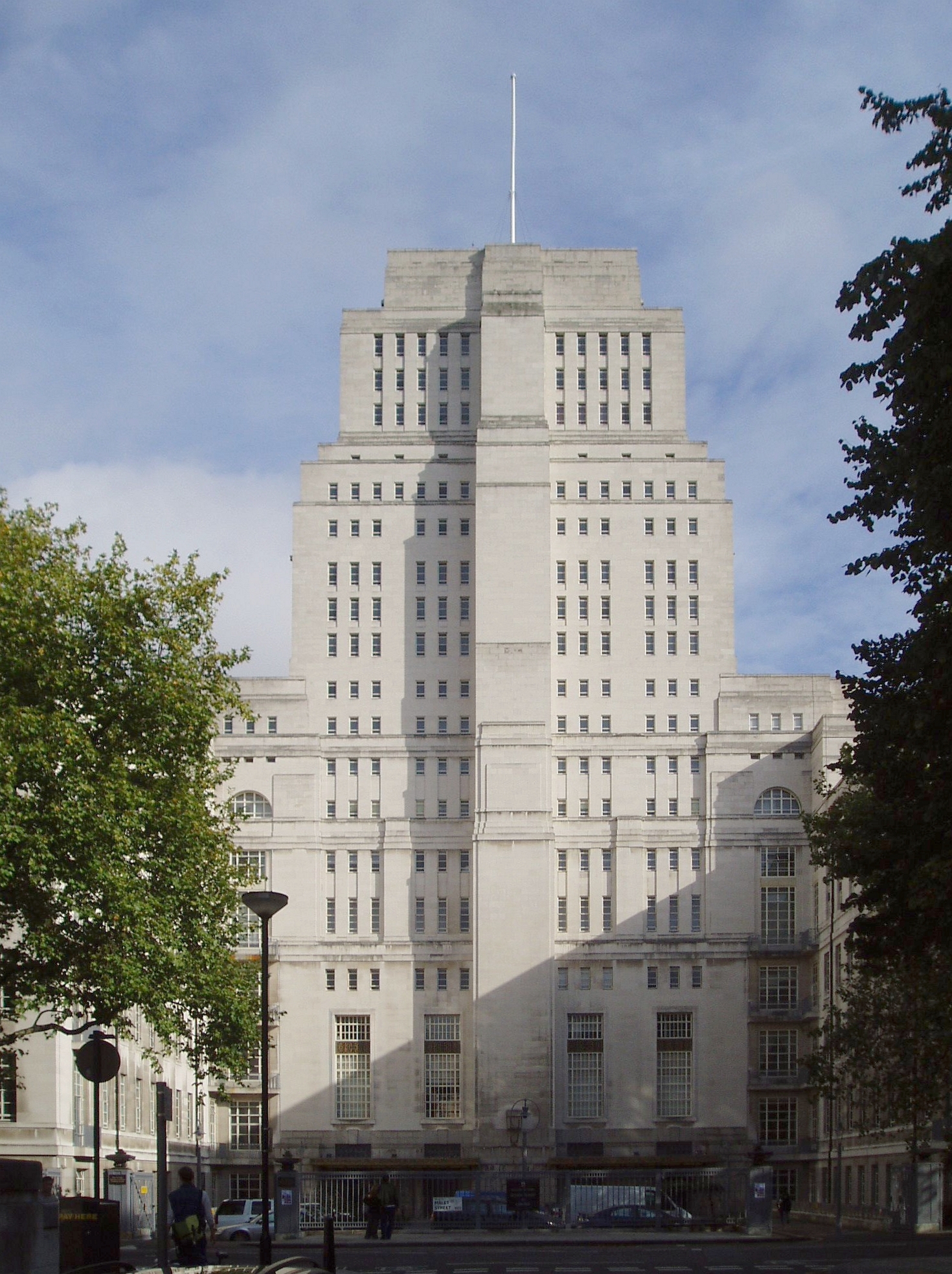
To this end, as well as being an avid Kindle user, I’ve just acquired my seventh London library card. It’s for the University of London’s Senate House, which caters for all the UOL colleges, Birkbeck included. Birkbeck’s own library is well-stocked, but I’ve already found that its limited copies of textbooks tend to get snapped up by the other students on my course if I’m not fast enough, even the reference copies. One option is to buy them, of course, but many of these doorstoppers cost upwards of £25 a time. Even if you resell them to other students when you’ve finished with them (via Amazon Marketplace, say) you still have to find the money upfront. And besides, it feels wasteful.
So I’m milking every possible library option. I’m currently a member of:
Haringey Libraries (public lending)
Islington Libraries (public lending)
Camden Libraries (public lending)
The British Library (public reference)
The London Library (private subscription, via their grant system)
Birkbeck Library (academic)
Senate House Library (academic)
Plus I’m getting a free SCONUL Access card, which lets me use a further 23 academic libraries in London.
So if I still can’t get hold of a book now, I know it won’t be for want of trying.
Getting a Senate House card has also been an ambition for years as a lover of beautiful buildings and libraries, ever since I was first shown it in the early 90s. This was while walking around Bloomsbury with Keith Girdler, the singer with Blueboy. He pointed out the way the building suddenly leered out at you with its gorgeous, Art Deco Orwellian majesty (literally Orwellian too – Senate House inspired the Ministry of Truth in 1984). He also told me it was a university library, so we couldn’t go inside.
Keith died of cancer a few years ago, not much older than me. I’d like to show him my new library card and say: thanks. Got there eventually, Keith.
Tags:
keith girdler,
libraries,
senate house
Lawrence, Movie Star
Postscript to yesterday’s thoughts on Julian Barnes and ebooks: I also wrote an email to the Evening Standard making roughly the same points, and they printed it.
Actually, I only wrote it because the Standard asked me to, on Twitter, after I Tweeted about the subject. I obliged, partly because I thought what I had to say re ebooks helping dyslexics needed to be spread to counteract a lot of knee-jerk negativity, but also because I just like to be helpful. I don’t know if this is how letters pages now work, with staff actively soliciting contributions, but at least it was my own words. There’s a sense that people are satisfied Having Their Say all over the internet – Twitter, Facebook, comments boxes, forums – and the idea of writing such comments in an email to a newspaper now seems curiously redundant.
***
Today: to the NFT, or the BFI Southbank as it’s now rebranded, even though the actual screens are still called NFT1, NFT2 and so on. I pay my first visit to its Mediatheque, a wonderful drop-in area where one can book a session at a booth with headphones and watch a rare film or programme from the BFI’s archive. I choose a superb Angela Carter ‘Omnibus’ documentary from the early 90s, and a bit of  Inappropriate Behaviour, an intriguing 80s TV film by Andrew Davies, with Charlotte Coleman as a troubled lesbian horserider (of course). The BFI’s Mediatheque is absolutely free – no membership or deposit required.
Then: to the afternoon screening of Lawrence Of Belgravia, the full length documentary about the eccentric, surname-less frontman of the bands Felt, Denim and Go-Kart Mozart. Beautifully made, if rather sad. The central theme is his lack of commercial success and life on benefits in a council flat (when he’s not being evicted), despite decades of critical acclaim and endorsement by The Smiths, St Etienne, Belle & Sebastian, Pulp and so on. The film itself, however, has already done well: its three screenings at the London Film Festival have sold out, with a fourth added due to demand. The festival’s programmer introduces the film, and it turns out he’s a serious fan of Lawrence’s music. A woman in front of me confesses that she had no idea who Lawrence was, but saw the film in the festival brochure and was interested enough to buy a ticket.
It certainly has the Captain Scott factor – the British love a tale of failure (or of success tinged with sadness, eg Kenneth Williams), added, perhaps, to the Syd Barrett factor – the image of a crazy old cult rock icon moping around the shops.
As one of the interviewers in the film says, maybe the film will finally make Lawrence a proper star. Or at least get him off the dole.
I say hello to Bob Stanley (and tell him that my degree course is studying the St Etienne film Finisterre), Tim from Baxendale and Harvey Williams, who says he saw my brother playing in Roddy Frame’s band.
Lawrence still refuses to do the most obvious thing of these reunion-saturated times – reform the now much-revered Felt and perform all the old songs – even though it would make a lot of people happy and – surely – would finally enable him to make a living from his talent. Â Still, I admire his defiance, and make a note to buy the new Go Kart Mozart album when it comes out. Jan 2012 apparently.
***
Evening – lecture on Oliver Twist at Birkbeck, followed by workshop on literary research – at UCL’s medical lecture hall, for some reason. Large painting of what looks like a Victorian vivisection class on the wall. Also: at one side of the blackboard is a working dentist’s chair.
Memo to self: always eat before a lecture. Rumbling stomachs take on an embarrassing level of amplification in a big room with only one person speaking. Particularly ironic during a talk on the little boy who asked for more.
Tags:
dickens,
felt,
lawrence,
NFT dammit it's still the NFT
Dickens, Barnes and The Book As Object

Here’s an article on The Quietus website featuring myself and Tony of Turbonegro. We talked about suits & music. Tony was promoting his gig and I was promoting, well, myself in general. Good to have a chance to show off the Sebastian Horsley suit.
Link to Quietus article.Â
Link to S Horsley obituary, with pic of him in the same suit.Â
***
One of the Study Skills workshops I attended in the last fortnight was for Time Management. I was late for it.
A strategy that keeps coming up is to stick to a rigid schedule, putting aside study slots but keeping them to 45 mins at a time. After 45 mins concentration is thought to tail off drastically, and one needs a break. It’s also said that if you do the same thing every day for six weeks, you’ll do it forever. That goes for giving up smoking, giving up sugar in tea, taking up writing, whatever. Actually, six weeks in my skittish, near-addict case sounds too much: I think I form my habits after two.
***
Tonight was a lecture on Wordsworth and Milton, and how the former used the latter in his Prelude.
Then we had a seminar on The Book As Object. Although I’ve been careful not to pipe up too much in classes up to now, I couldn’t help chipping in on this topic rather more often than usual. I find it such a fascinating subject. I can link the way Dickens’s novels were originally published in cheap monthly paperback instalments, each packaged in green wrappers with a supplement of adverts that had been specially selected to go with the story. For me, that’s comparable to Search Engine Optimisation on the Web today. Victorian SEO.
I also linked the way Voltaire put out his works in varying editions, some with exclusive additions, in order to play the booksellers of 18th century France off against each other – not to make money, but to get his Enlightenment ideas as widespread as possible. This, I suggested, was comparable to the way Terry Pratchett has let Waterstones put out an special edition of his latest novel with an extra short story in the back – not a new marketing idea at all.
Meanwhile Julian Barnes, in his Booker acceptance speech the other day, praised his designer and added:
“If the physical book, as we’ve come to call it, is to resist the challenge of the e-book, it has to look like something worth buying and worth keeping.”
It’s interesting that Mr Barnes thinks the e-book is a ‘challenge’ to the paper book. I think he’s quite wrong. The e-book should be regarded as a third format, alongside the paperback and hardback. There’s a lot ebooks can’t do which paper books can, and vice versa. Â Many e-sceptics might not be aware that e-books have given a new lease of life to slow readers, dyslexics and the poorly-sighted, thanks to the way you can enlarge and space out the fonts. However, they’re still at the mercy of battery power, pricey tablet devices, DRM problems, and the sense that an ebook isn’t quite the personal property of the reader in the way a paper book is – you can’t easily get it signed, lend it to a friend, or scribble in the margin.
As Douglas Adams said somewhere, nothing is getting replaced. Things just budge up to make room.
The little Barnes hardback is beautifully designed, but whether it’s worth owning and paying the recommended retail price of £12.99, when the Kindle ebook version is only £3.59, is debatable. And paperbacks can be beautiful objects too (the Penguin ‘Great Ideas’ range springs to mind), but the Barnes novel won’t be in paperback until 2012.
That’s another issue. Â There is still this ludicrous, elitist idea amongst the British publishing and reviewing scene that a literary novel must come out in hardback first.
If, like Voltaire, you think the main thing is to get your work read by as many people as possible, you need to not only embrace e-books, but join the growing trend to put out a mass-market paperback alongside the hardback (like the rest of the Booker shortlist, in fact). There is no challenge to any format, unless you believe that novels are ‘meant’ to be in hardback form. Which would rule out Dickens and his original, cheap, flimsy, advertising-packaged installments.
Dickens and Voltaire wrote to be read, first and foremost. They’d have welcomed e-books. Why shouldn’t anyone else?
Tags:
charles dickens,
degree course,
julian barnes,
quietus,
Sebastian Horsley,
suits
The Thick Of It
Oh dear, it’s been too long since I wrote in here. I got ill, then I got better, but then I got lazy. And then I got hooked on Twitter. Twitter is a real sapper of the writing urge: you have something to say? You Tweet it. There, all done. Except it’s no good if you have something to say that you want people to actually read. It goes, it vanishes, and on top of it all, it probably needed more than 140 characters. And yet, it’s the big party where people are always at – just a click away. Hard to resist.
(you can find me there on @dickon_edwards. Nag me to write a new blog entry if you do)
Well, I’m now a degree student of English Literature at Birkbeck College, University of London. It’s Week 3 of the Autumn term. As well as the proper classes on Monday and Tuesday evenings I’ve also signed up for workshops and mini-courses on Study Skills, plus training sessions for various degree-helping software packages. All of which is free, so it seemed best to take advantage.
Because of these extra classes, and my own slow progress in learning how to process textbooks quickly and efficiently, what’s really meant to be a part-time student timetable has pretty much expanded into full-time status. Just as well I don’t have very much else going on.
The plan is to turn myself into a good Part-Time Academic, then when I’m confident enough, I switch the student work to proper part-time hours and sort out the whole Earning Money part alongside it. Â Ideally, some sort of part-time job involving the college (they have a careers guidance department) or writing for hire, or editing. Or even teaching. I’ve done a little of helping foreign students polish up their English grammar in their essays, so that’s one possible path.
As it is, it doesn’t seem to be the best time for finding paid work right now. Even people who seek conventional work – as opposed to dizzy bohemians like me – are finding it hard.
A friend that I used to work with at the news clippings office recently remarked, ‘It’s actually good that there are people like you who aren’t trying very hard to get work. Because that means that people like me who really need the jobs – people with families and children and mortgages – can have them instead of you.’
He was half-joking. And half not-joking. But there is this acute sense of there being a dwindling  amount of paid work out there, each position chased by dozens, sometimes hundreds of other people. And I know that for most conventional jobs I’m just not that one perfect candidate, the one that’s better than all the others.
Friends have told me that I have the air of an eccentric tutor as it is, so I should at least give the academia path a decent go. I do know that I definitely want a degree in English Literature. Â That, and to publish a novel. As ambitions go between now and the grave, that really is it. But at least that’s an improvement on recent years: two more than none at all.
Oh, and I’d also like to lose my gin-gut. Have to lay off the Sainsbury’s Flapjack Bites for a while.
***
The first year of the four-year course is spent in ‘foundation’ mode. This means none of the exercises and exams count towards the final degree grade. It’s a sort of training year, shaping the mind into an academic style of thinking, making your mistakes first and being allowed to make them.
In this initial year, I have to do three modules at the same time: one on the nature of reading (mainly via poetry), one on critical methods (via literary theory), and – best of all – one on London In Literature.
In my non-studying time I find myself drawn to articles on literacy and books and reading as it is – tonight’s Booker Prize announcement, for instance. I follow debates on e-books, on library closures, on book adaptations, on genre versus literary novels, on bestseller lists, all of it. So doing the English course feels like a formal justification of my own current passions. Now I’ve started a degree in the stuff, I feel in the thick of it, rather than worrying if I’m thick.
***
Tonight was the first seminar on the latter module: the theme of the city in Ian McEwan’s Saturday. Not a book I care for as a general reader – there’s an awful lot of deference to Mrs Dalloway, and rather too much squash playing and brain surgery for my taste – but as a literary response to London life after 9/11 (and crucially, before 7/7), it’s essential.
What’s particularly satisfying is that the Birkbeck classes are held in Gordon Square, Bloomsbury, in a building where Virginia Woolf once lived (she’s very much on the reading list), and a few blocks away from the main locations in Saturday – Fitzroy Square, University Street, the BT Tower.

Even though Saturday divides readers, including McEwan fans, there’s plenty of passages that have sceptics punching the air in support of literature, if punching the air is your sort of thing:
Standing here, as immune to the cold as a marble statue, gazing towards Charlotte Street, towards a foreshortened jumble of facades, scaffolding and pitched roofs, Henry thinks the city is a success, a brilliant invention, a biological masterpiece—millions teeming around the accumulated and layered achievements of the centuries, as though around a coral reef, sleeping, working, entertaining themselves, harmonious for the most part, nearly everyone wanting it to work. And the Perownes’ own corner, a triumph of congruent proportion; the perfect square laid out by Robert Adam enclosing a perfect circle of garden—an eighteenth-century dream bathed and embraced by modernity, by street light from above, and from below by fibre-optic cables, and cool fresh water coursing down pipes, and sewage borne away in an instant of forgetting.
– Ian McEwan, ‘Saturday’ (2005), p 5
By way of a companion to Saturday, I read Nicola Barker’s Clear (2004) immediately afterwards. Both are literary novels based around real-life London events in 2003: McEwan takes the march against the Iraq war in February, while Barker takes David Blaine’s ‘Above The Below’ stunt in September.
But whereas McEwan’s novel is a studied, calm string of Modernist musings from a responsible, middle-aged brain surgeon;Â Clear is a skittish, fidgety, giddy account of a young, slightly pretentious GLA worker who befriends a shoe-obsessed woman at the base of the Blaine event. It’s teeming with tangents and random references to pop culture, including Ian McEwan’s Comfort Of Strangers, where a couple on holiday are drugged and tortured by two seemingly friendly strangers:
‘She just Ian McEwaned you, man, and you’re still none the wiser!’
– Nicola Barker, ‘Clear’ (2004), p 51
Aside from turning a fellow novelist into a verb, I also loved Ms Barker’s description of the GLA building:
…a huge grey-green-glass Alessi milk-jug of a structure (a tipsy fat penguin): the Greater London Authority Building…
– ‘Clear’, p 8
And I thought, does the GLA building really look like a ‘tipsy fat penguin’? Really?
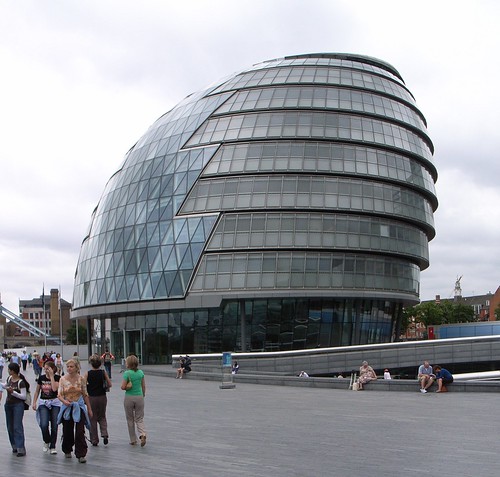
Oh yes! It really does.
Not the sort of thing Mr McEwan would come up with, but it’s closer to my own askew way of thinking.
Tags:
english degree,
ian mcewan,
nicola barker
Look Out, Here Comes Fenella Federal
Today: more researching Polari at the British Library (and more walking the 4 miles to get there).
Like all lexicons associated with criminality, Polari has many words for police. eg ‘Betty Bracelets’, ‘Hilda Handcuffs’, ‘Lily Law’, or ‘Lilies’ for short. Makes me idly wish that the term favoured by last month’s rioters, ‘The Feds’, is short for ‘Fenella Federal’.
Discovered that Polari pops up in a 1973 episode of Doctor Who, as spoken by Vorg, an intergalactic showman. Jon Pertwee plays the Doctor. Here’s the clip: http://dai.ly/pBH7Fc
In fact, although he says he’s using ‘carnival lingo’, which would make it the 19th century Parlyaree (one of Polari’s many ingredients) the phrases he uses are more like Polari.
‘Vada the bona palone’ (get a load of this pretty lady)
And:
‘Nanti dinarly round here, eh Jules!’ (no money round here)
It really sounds like Jules, too, as in Julian and Sandy. I’m guessing it’s a knowing Round The Horne reference for the family crowd of 1973.
I was also intrigued to learn that the 2010 arena show, Doctor Who Live, featured the son of Vorg – Vorgenson – played by Nigel Planer, getting up to similar tricks with Matt Smith’s Doctor. The writer, Gareth Roberts, confirmed to me on Twitter that he snuck a bit of Round The Horne into Vorg’s lines as a tribute.
Tags:
doctor who,
Polari,
round the horne
Josie Crystal!
I’m determined not to let another day pass without getting something in this diary, however dull.
Today, morning: dental check-up. Went so well that the dentist said I don’t need to come back for nine months, rather than six. This is actually quite a big thing for me – I think at the age of 40 I’ve finally managed to look after my teeth.
Afternoon: researching Polari for my talk on Tuesday. It’s at the Camden School Of Enlightenment, upstairs at the Camden Head bar, in Camden High Street. That’s in Camden, strangely enough. More details at: http://www.csofe.co.uk/
Learned today: ‘On your tod’ (meaning alone) is rhyming slang. After Tod Sloan, a US jockey popular in the 1890s. Tod Sloan = alone.
Found on the web: the entire Bible translated into Polari, courtesy the Sisters Of Perpetual Indulgence:
http://www.thesisters.demon.co.uk/bible/
Jesus Christ is ‘Josie Crystal’.
This evening: I attend Miriam Miller’s birthday do at the North Nineteen bar in Holloway. It’s in the same road as the flat where Douglas Adams wrote the novel of Hitchhiker’s Guide To The Galaxy (19 Kingsdown Road, according to the book I Was Douglas Adams’s Flatmate ). Miriam is a comedy fan and promoter. When I pointed out the proximity of this slice of comedy history, she and a gaggle of her comedian friends nipped out to have their photo taken outside it.
(Douglas Adams is actually getting a heritage plaque next year, courtesy of Islington Council. It’ll be at one of his other Islington addresses. I’m hoping to attend the unveiling).
Walked today from Highgate to the British Library: 4 miles, 1 hour. I’m trying to do at least an hour’s brisk walk every day now, in place of jogging or going to the gym. Not quite up to Dickens’s alleged 20-mile walks yet, but I’m working on it.
***
Recent activity: I spend my 40th not bothering with the stresses of organising a party, but going on an impromptu solitary day trip to Margate and Broadstairs, via the new high speed domestic trains. What better way to celebrate the continuing existence of one’s eyes and legs than to give them new sights to see, new paths to walk?
The sleek nose of Southeastern’s HS train looks too priapic to refuse, frankly, the big trainy Casanova  (Microsoft Word’s spellcheck isn’t accepting ‘priapic’. What can that mean about Mr Gates?). Top speed of 140mph, 82 minutes journey time to Broadstairs, and 88 to Margate. Canterbury is now a mere 56 minutes away: Chaucer’s pilgrims would have to condense their Tales into Tweets (I bet someone has done this).
The town of Margate is, like a 40-year-old person, getting on a bit. One of England’s first seaside resorts from the 1700s, its decades-old amusement park ‘Dreamland’ is now listed and in the throes of restoration, currently hidden behind hoardings and scaffolding: see www.dreamlandmargate.com). But also like a 40-year-old, it knows the story is not at an end, and it’d be a shame to just lapse into decay, moaning how things aren’t what they were. The past can be a burden (my ever decreasing energy, my lower tolerance for youthful things like noise and Mucking About, my ‘life experience’ proving difficult to use when chasing conventional employment), but it can also be a tool for building the future, if done carefully and properly. Just a question of knowing what to do.
One man’s regeneration is another’s despoiling. (‘Aw, I preferred it when it was falling apart’). The council rubbish bins are in brightly coloured plastic (red, blue, purple), emblazoned with the phrase ‘margate – the original seaside’ in self-conscious lower case and Helvetica font. One idea of what Taste means. I visit the brand new Turner Contemporary gallery: huge blocks of geometric White Cubes with slanted roofs joined together, a similar feel to the Tate St Ives. Staff in the gallery cafe wear black shirts and trousers: another indication of what Taste means.
I wistfully remember Break In The Sun, a 1981 children’s BBC TV drama based on a novel by Bernard Ashley, in which a young girl runs away from her awful stepfather in London to be with her mother in Margate.
Other Margate sights seen: the incredible Shell Grotto of underground tunnels covered in millions of seashells (discovered in the 1800s and still officially Unexplained), the Old Town shops around the old marketplace (very Brighton), and the town museum based in the old police station and court room (where 60s Mods and Rockers were jailed and called ‘seaside Caesars’ by the judge).
One unexpected memory of the trip: in the Margate museum, in a room of old Punch & Judy booths, a blind woman sits playing Una Paloma Blanca on the accordion.
Tags:
broadstairs,
camden school of enlightenment,
douglas adams,
margate,
Polari
“Renowned Diarist Dickon Edwards…”
Another photo from the Kim Cunningham shoot:

May 2011. Pond Square, Highgate.
Credit:Â www.kimcunningham.co.uk
Golders Green in the heat. Tempted to go without my jacket, but here – even at 30 degrees C – one sees the district’s famous community of orthodox Jewish men still in their full ensembles: black suits, hats, even coats. I find myself sharing their unspoken message. To strip down would be a let down. Dandyism is a kind of faith, too.
(Actually, as this day goes on I notice a few pious gentlemen just wearing waistcoats, or besuited but with shirts unbuttoned or untucked. But there’s still one or two in coats.)
Today on Golders Green Road: I see my first kosher ice cream van. Back among the Highgate heathens tomorrow, though.
***
Not much luck with attempts to secure employment. Am collecting rejection emails. One kind friend even pulled strings to get me an interview – customer service at PRS – and I went along and did my best with but no success. I didn’t really want the job as such, though,  just the money, and I suspect that showed in the interview. Feigning enthusiasm for wage slavery isn’t so easy after one reaches a certain age. Questions about what one is actually living for take over. Not in the teenage angst sense, but in the life lived sense. Justified world-weariness. Or rather, world-of-work-weariness.
I’m now past worrying about it, though. At the age of nearly 40 one’s priorities naturally regroup, and things like happiness and mental health count more than ever. The alibi “well at least I’m young, I’ll go onto something better” Â has long since expired.
This reluctance is not through wanting a life of pure selfish hedonism, mind. I instinctively feel the need to be of use to this world, just not doing something where I feel disastrously… miscast. I’m hoping something will turn up soon.
In the meantime, something I very much do want to do is to finally get a degree. To see if I’m of use in that respect at least – proving that I have a brain after all (unemployment makes one feel so… thick), and making a contribution to the world of academe. My BA in English Lit at Birkbeck starts in October, and I’m now starting to read text books and set texts for the first time since school.
Quite intrigued that the course includes a seminar on the St Etienne film, Finisterre, as part of a module about London-themed literature and films. Other set texts for Autumn include Oliver Twist, Mrs Dalloway, Jekyll & Hyde, and Ian McEwan’s Saturday.
Today I’ve been reading something very much not on the course list: Dan Brown’s Da Vinci Code. Partly because I’m trying to increase my reading speed for the degree and thought a proven page-turner would help (I zoomed through 300 pages of it today), but also because the English course has a module on the whole nature of reading, and I thought it might help to get my own opinion on the biggest selling novel of the past 12 years, rather than just join in with the literary consensus that it’s badly-written dross.
I was hoping it would turn out to be unabashed trashy pleasure, if only to not side with the literary sneerers, but I came away yearning for two crucial elements: charm and fun. The Sherlock Holmes and Agatha Christie books are equally non-literary, but they have heaps of charming characters and deeply enjoyable puzzles to solve. The Da Vinci Code is curiously unsatisfying. It’s not that awful – Brown flatters the reader with lots of short chapters ending in cliff hangers, and there’s a few impressive plot twists and intriguing theories – but the hero Robert Langford is no Poirot or Holmes or Bond. He’s just no fun.
As for other current bestsellers, I’m aware Lee Child’s thrillers have a Bond-style hero – Jack Reacher – that readers want to be, or be with, or be in bed with. That makes sense. Brown’s Langford, on the other hand, is barely there as a character. Someone who cracks cyphers shouldn’t be a cypher.
Tags:
bestsellers,
Books,
da vinci code,
dan brown,
english degree,
gallery,
golders green,
jobs,
literature
Part Crowd
I’m currently kitten-sitting in Golders Green, on and off for the next couple of weeks while the owners are abroad. Here’s a photo of the feline in question. Breed: Birman. Name: Piccadilly. Born in March.

In the hope of teaching him autonomous amusement, I’ve set him up with a couple of cardboard boxes from the local supermarket. But his favourite toy seems to be me. He has yet to learn that my trousers are not built for his teeth & claws. The owners have given me a water spray with which to teach him such boundaries, but it seems to have little effect. Either he’s one of those cats who like water, or he’s a bit of a masochist when it comes to suit-trouser love. ‘Yea, though the water jets may come, I will battle on to embrace my true beloved, The Trousers.’
I’ve been meaning to upload photos of myself from a session by Kim Cunningham. Here’s one. Taken May 2011 in Pond Square, Highgate:

Photographer credit: Kim Cunningham. www.kimcunningham.co.uk
This week: to the Everyman Baker Street cinema to see Bridesmaids. Produced by Judd Apatow, written by its star Kristen Wiig, and touted in the press as a rare mainstream comedy ‘chick flick’ that appeals to both genders. Which essentially means there’s a lot of broad slapstick and bad taste humour. Like Mr Apatow’s Knocked Up, however, it suffers from an unwieldy duration and insistence on pushing the jokes aside to end with some very traditional Hollywood moralising. I really wanted the touch of unpredictable anarchy of, say, Muriel’s Wedding or Romy & Michele’s High School Reunion. Still, the jokes are good enough, particularly the scenes of one-upmanship by Ms Wiig and her more glamourous, richer rival.
A matinee screening, with about ten people in the audience. Normally this would be quite a nice way to see a film – on the big screen in a proper cinema, with as few other people as possible to risk distractions. In fact, Bridesmaids is one of those films that does need a packed room of people. Otherwise one risks what happened with me – laughing aloud by myself in a room of strangers. For comedy films, one needs to laugh along with others.
For this reason, I rarely go to live comedy shows by myself. Stage & cinema comedy is unfinished without a crowd of friends and partners.
Tags:
cats,
cinemas,
comedy,
films,
gallery




