MC Escher’s IKEA
Saturday 7th June 2014. To the new Foyles bookshop at 107 Charing Cross Road. It’s a few doors down from the motley warren Foyles inhabited from the 1930s right up until last month. Number 107 is a more uniform space, being the former home of the St Martins School of Art, which is now at King’s Cross.
I’ve read that the old Foyles shop might become a hotel. Right now it’s a desolate shell. A lone security guard stands behind the glass doors, surrounded by bare walls and cardboard boxes. Despite the notices on the windows, some confused-looking people – possibly tourists – are banging on the door. So he spends much of his time passing on the same piece of information, via a combination of mouthing and waving: ‘GO NEXT DOOR. IT’S NEXT DOOR. NOT HERE. NOT ANY MORE.’
As I understand it, the actual amount of books on display is more or less unchanged. What’s different is that Foyles Charing Cross is now a lot better organised, more spacious, and more opened-out. It’s a bit furniture store-like, I suppose, complete with the smell of sawdust, but it’s still pleasingly labyrinthine too, with fixed staircases rather than escalators. MC Escher’s IKEA.
Ray’s Jazz shop is tucked away inside, with signs apologising for the late arrival of the shelves. The café on one of the upper levels has yet to be finished, but I can go up to see the space anyway, where there’s a superb view over the Soho rooftops.
A central London property turned into a huge bookshop rather than luxury flats is no small event. Foyles are not in it for the money. They see a future in physical bookshops, even now, and I salute their optimism. Blackwells across the road is closing, blaming the Crossrail development, while the excellent Foyles branch in St Pancras has had to close, apparently for not making enough to meet the lease. However, a branch of Hatchards is now to open in a different part of the station, so the day of the bookshop isn’t quite over yet.
Today there’s a long queue to get into Foyles, and the shop is soon packed. There’s the excited atmosphere akin to an Apple Store opening, if not quite on the same evangelical level (which would unnerve me).
Something else I admire, which it’s hard to think of other companies doing. Foyles are not only aware of the somewhat ‘mixed’ reputation they had under the eccentric Christina, they are even happy to single it out for customers today. One table labelled ‘Honorary Mentions’ displays novels that allude to the shop, and not always positively. From JM Coetzee’s Youth the display highlights this quote:
[Foyles] has proved a disappointment. The boast that Foyles stocks every book in print is clearly a lie, and anyway the assistants, most of them younger than himself, don’t know where to find things. He prefers Dillons.
* * *
Sunday 8th June 2014. To the Camden Head for ‘Z List Dead List’, a comedy show comprising mini-lectures about obscure historical figures. I go by myself but bump into Cat Rogers and her friends. Afterwards we go for drinks at The Spread Eagle in Parkway.
At Z List Dead List, the regular host is the very funny Iszi Lawrence, whom I adore. The guest speakers are Kate Smurthwaite, who does Mary Reed, a cross-dressing pirate; Pete Johansson, who does Pierre Trudeau, the Canadian Prime Minister who once dated Barbra Streisand; Tracy King, who does the Pompeii banker from the Cambridge Latin Course; and Richard Herring, who does Felix Yusupov, assassin of Rasputin. I find Ms King’s talk to be the funniest, despite her not being a proper comedian – she’s actually a producer of computer games and animations. I vote for the pirate woman, but Pierre Trudeau triumphs.
* * *
Tuesday 10th June 2014. To the Prince Charles cinema to see The Wind Rises, the latest animated film by Miyazaki. It’s set in the 1930s, about a young aviation engineer whose successes with the Japanese Air Force are marred by his wife’s tuberculosis. The moral question of a peace-loving person using his talents to aid warfare isn’t really addressed, though Miyazaki – himself a pacifist – makes it clear that all planes are beautiful in their own right. I think of Dad, another pacifist who liked tales of warcraft, and who would have loved this film rather more than me. War or no war, I’ve never found aviation history all that interesting. Still, like all Miyazaki’s work the film is aesthetically sublime, and the ending leaves me tearful.
* * *
Wednesday 11th June 2014. I receive the last mark for the third year of the BA English course. It’s 79, for a Fin De Siecle essay. So I’ve achieved what I was hoping for: a clean run of ten First Class marks throughout the year. Four of those were even High Firsts, ie postgraduate quality, something I never thought I’d achieve this early on.
The only competition is with oneself, of course. So this is rather a big deal for me. Last year my marks were constantly up and down. But now my highest essay mark in years 1 and 2 – 75 – has been my lowest essay mark in year 3.
It hasn’t been without obstacles, either. The work became more difficult (four modules rather than three, all at level 6 difficulty, as opposed to level 5 last year). Plus Dad passed away in February. It’s Father’s Day this weekend. I wish I could tell him how I’ve done.
The secret behind this improvement is, I’m afraid to say, very boring. It’s putting the hours in, and then spreading the hours across as many days as possible, so you don’t go too long without doing that kind of work. A couple of tutors have now approached me to consider doing an MA. Assuming I can get the fees covered by some sort of scholarship (which now looks possible) I think that’s what I’ll do. Till then, I have one more year of the BA to concentrate on.
* * *
In the evening: to Birkbeck in Gordon Square once more, for a talk by the writer and illustrator Joanna Walsh, aka Badaude. She discusses her stories in the collection Fractals, along with the campaign ‘#readwomen2014’, which she instigated to encourage people to read more female authors.
I ask Ms W about a tale of gendered publishing that’s always fascinated me: how Joanna Rowling was forced to adopt the androgynous ‘J.K.’ by her publisher, because they believed boys didn’t read books by girls (so much for Rosemary Sutcliff). She even had to invent the ‘K’ part of her name, because she had no middle name in real life. Ms Walsh points out how the recent Hunger Games books sold in huge amounts to boys, despite the author’s name being Suzanne Collins. So things have changed for the better there.
* * *
Friday 17th June 2014. Every time the World Cup comes around it seems more popular than ever. This is despite the inelegant millionaires of the England team still refusing to be any better at kicking a ball about than me.
[I write this up on Saturday afternoon to the sound of football too. A couple of boys are kicking a ball about in the road, despite cars passing every few minutes. I’m tempted to open the window and shout, ‘ISN’T THERE ENOUGH FOOTBALL ABOUT ALREADY?’]
Today I’m standing on one of the Northern Line platforms at Euston. As usual I glance at the dot-matrix board, which says how long the next train will be. Something new today, though. The bottom of the board clears, indicating that it is probably about to flash the words ‘NEXT TRAIN APPROACHING’. In fact it announces the latest score of Mexico v Cameroon.
 If you enjoy reading this diary by a slightly acclaimed yet penniless writer, please help support it, and indeed him, by using the PayPal button below. Many thanks, and may good fortune go with you as you saunter.
Tags:
birkbeck,
foyles,
is there not enough football?,
joanna walsh,
the wind rises,
world cup,
z list dead list
Gary Kemp’s First Wok
Saturday 31st May 2014. To the New Rose pub in Essex Road for Taylor and Sam’s birthday drinks. I chat to: Ella & Kosmos, Sarah Bee, Andrew Mueller, Suzanne, Seaneen & Robert, and Richard. The New Rose is something of a rock-fan compatible bar, with used festival wristbands dangling from the ceiling. It encourages festival goers to stop by on their way home from Glastonbury or wherever, and promises them a free drink in exchange for their wristbands.
* * *
Sunday 1st June 2014. To a birthday picnic in Regent’s Park (or THE Regent’s Park as it’s officially called now), this time for Martin Wallace. Martin sends me an invite in the post – first class, too. I recognise the illustration he uses: Mia Farrow in Broadway Danny Rose. The weather is sunny, the park teeming with picnicking people, wandering toddlers, panting dogs. I’ve known Martin on and off since – and we work this out today – 1995. It was at Erol Alkan’s indie disco, ‘Going Underground’, at Plastic People in Oxford Street. Since then he fronted the band The Boyfriends, and more recently did the very same course at Birkbeck as me: BA English. He finished it just as I was starting. We bumped into each other in the student bar on the day he had his final exam. Since then we’ve stayed in touch, and he’s given me lots of invaluable study advice, which I in turn pass on to my classmates, ‘paying it forward’, as they say. Some things haven’t changed, though: we rave about the latest Morrissey record, ‘Istanbul’.
* * *
Tuesday 3rd June 2014. To the ICA to see The Punk Singer, a film-length documentary. It’s about Kathleen Hanna, who fronted the Riot Grrrl band Bikini Kill in the 1990s, and then the electronic group Le Tigre after that. The topics discussed are deserving of a much wider audience than fans of Ms Hanna’s music. For instance, there’s the various issues of women in music, not just as artistes but as audience members. It reminds me of the clichéd media image of female fans at rock festivals – a girl sitting on a boy’s shoulders in the crowd. Every year, the press coverage of Glastonbury seems to include such an image. There’s rarely any asking of why it is a cliché. No addressing of how women might have a hard time getting a decent view of the band.
But Ms Hanna was known to stop her own gigs and demand that the men get out of the way and let the women move down to the front. The gigs are now over twenty years old, yet the idea is still provocative and relevant. Everyone with the slightest interest in rock and pop music should see this film.
Here’s a quote from Ms Hanna which stayed with me:
‘When a man tells the truth, it’s the truth. But as a woman, when I go to tell the truth, I feel like I have to negotiate how I’m perceived.’
I don’t think that feeling is limited to the world of indie bands.
* * *
Wednesday 4th June 2014. I read The Year of Reading Dangerously by Andy Miller. It’s a guilty pleasure: a book about books which I read when I know I should be instead reading the very books he discusses (ie good novels). The idea behind this one is that it’s an account of finally tackling all the classics Mr Miller has lied about reading for so long: Anna Karenina, War and Peace, Middlemarch. Much of Mr Miller’s childhood and taste is close to mine: he includes his schoolboy Puffin Club bookplate, which gives me a Proustian shudder, and is a fellow admirer of Sondheim’s Sunday In The Park With George, though he goes on the defensive about liking musicals (no need; be proud!). I am even familiar with ‘I Start Counting’, a Basil Kirchin song from a Truck Records compilation, which Mr Miller uses to wake up to.
After conquering his self-prescribed list of books, he says it hasn’t necessarily made him a better person; all that’s changed is that he can say he’s read those books. And being well-read is certainly no protection against literary errors. ‘Reader, I married him’ is not a quote by Jane Austen. It’s from Jane Eyre, by Charlotte Bronte. Mr Miller has got his Janes in a twist.
* * *
Thursday 5th June 2014. Something of an Edwards family day. In the morning I am a guest on my brother Tom’s music programme for Soho Radio, which broadcasts on the internet from a café on Great Windmill Street. Tom’s remit is mainstream rock, metal, goth and punk. I wear the Sebastian Horsley suit, partly because it plays up the Soho factor, but mainly because SH was more into that sort of music than me. So in tribute to him, I play three of his favourite songs, as listed in some editions of Dandy In The Underworld: ‘C’mon and Love Me’ by Kiss, ‘Double Talkin’ Jive’ by Guns N’ Roses, and ‘Personality Crisis’ by the New York Dolls.
Here’s the other songs I play, comprising my own favourite noisy records:
– My Bloody Valentine – When You Sleep (their concerts can damage the ears, yet their records can soothe and even heal; a friend used them to recover from a mental breakdown. She could only listen to MBV. The comfort of white noise.)
– Dressy Bessy – Girl You Shout! (love the muttered ‘sorry!’ at the 2.55 mark. More records should apologise for themselves.)
– Xiu Xiu – I Luv The Valley OH! (the volume of the screamed ‘OH!’ still impresses)
– Nirvana – Sliver (my idea of heavy metal; love how the guitar noise at the beginning always comes in at the moment you least expect)
– Pale Saints – She Rides The Waves (femme sweetness in butch noise)
– David Bowie – Queen Bitch (how an influential artist is himself a praise singer of his own influences – Velvets in this case)
– Dinosaur Jr – Just Like Heaven (the most irritating ending in rock)
– Bikini Kill – Rebel Girl (which opens The Punk Singer)
– Dresden Dolls – Girl Anachronism (my idea of a favourite ‘goth’ song, I suppose)
– Pixies – Gigantic (by coincidence, Tom was going to play this anyway. We are Pixies-brothers!)
* * *
In the evening: to Carlyle’s House in Chelsea for a talk by my mother. It’s on the story of quilts and the art of quilt-making. The evening is a marriage of two worlds for me, as the event is organised by Suzette Field of the Last Tuesday Society, who have booked me as a DJ on countless occasions for the last few years. A third world is present too, in fact, as I am still wearing Sebastian Horsley’s suit.
I’ve been reading about ‘female only spaces’ on Twitter, and Mum’s event reminds me that the issue is not new in the slightest. Women have used quilt-making as a way of securing time away from men for centuries. The only men in the audience are myself and Russell Taylor, Suzette’s partner. Mum is an engaging and eloquent public speaker – indeed, she’s done this sort of thing all over the world for years. I don’t know if TED Talks have quilt makers, but if they do, they need to book my mother.
Carlyle’s House is a painstakingly preserved Victorian home, once domain to Thomas Carlyle, he of the London Library. Who to compare him to today – a public intellectual who had the great and the good to tea? A more party-giving Will Self? Clive James? Melvyn Bragg? Certainly if Carlyle were alive today, he’d definitely have his own TV chat show. It’s a reminder that a house has a third use these days, after a machine for living in and a machine for making money (at the expense of those who just want somewhere to live). It can also be a vital machine for teaching, in this case about the way we used to live.
At the talk, the National Trust custodians serve wine. But they only allow white wine, not red, and you can’t take drinks into the upstairs rooms. So I have yet to visit the upstairs rooms.
* * *
Friday 6th June 2014.
To Ronnie Scott’s for a lunchtime event about Soho and songwriting, part of the ‘Soho Create’ festival. David Hepworth interviews Gary Kemp, the songwriter of Spandau Ballet, and Tim Arnold, once of the 90s band Jocasta, and now a devoted songwriter about Soho per se. Â Mr Kemp says that he was the lead actor in a Children’s Film Foundation film, long before he was a pop star. I look this up afterwards – the film in question was Hide And Seek (1972).
A quote from Gary Kemp at this event: ‘I remember when I started mixing with middle class boys. It was when I saw my first wok.’
* * *
I receive two further marks from the  BA English course, both of which finish off their respective modules. For my piece on Jane Austen and William Beckford, I get 77. This makes an overall grade of 76 for the ‘Romantic Age’ half-module: a First. For my essay on Rana Dasgupta’s Tokyo Cancelled and the film Inception I get an 80, making my overall grade for the ’21st Century’ module also an 80. So a First there too.
I just have the last ‘Fin De Siècle’ essay to come back and that will be the whole third year graded. I know I shouldn’t judge the year until I get that last mark. But I’m very, very, very pleased about it so far.
* * *Â
If you enjoy reading this refreshingly advert-free content, please consider donating below. Help the penurious Mr Edwards feel he has Worth.
Tags:
andy miller,
birkbeck,
carlyle's house,
gary kemp,
lynne edwards,
martin wallace,
new rose,
Sebastian Horsley,
soho,
soho radio,
suzette field,
taylor parkes,
tim arnold,
Tom Edwards,
year of reading dangerously
A Noted Woman Of Noise
Friday 23rd May 2014. The results of the local elections are in. My ward’s three seats (Highgate ward, in Haringey) all went to the Lib Dems, just as they’ve done for decades. Â But it’s a more impressive feat this time, given the party’s current lack of popularity nationally. A post-election map of Haringey usually has a block of red to the east (for Labour, where the wards are poorer, such as Tottenham), with a block of yellow to the west (for the Liberals, where the wards are wealthier, such as Crouch End and Highgate).
Today the block of red is still in place, but the block of yellow is covered in grey. The western wards’ council seats have been split between different parties. Only one ward has remained yellow: my own Highgate.
So low is the Lib Dems’ popularity nationally that their leader, the aspartame-like Mr Clegg, is fighting off calls to resign. But around my street, they could set fire to kittens. They’d still get on the council.
(That said, in the 2012 mayoral election, my ward chose the Tories’ Boris Johnson over the Lib Dems’ Brian Paddick. The unconvincing Mr Paddick must have been a loyalty too far.)
Am more pleased by the result a few blocks away, in the other Highgate ward; the bit of Highgate that falls under the boundary of Camden Council. Camden’s only Green Party seat is there, now retained by Sian Berry. The three Lib Dem candidates all came last. It’s a very London feeling: the reverse of anything only a few streets away.
* * *
I’m walking through the reception of Birkbeck’s School of Arts, Gordon Square, when one of the porters calls out, ‘Thanks for the mention in your diary!’ This is Bernie, who retrieved my lost sheet of essay notes the other week. ‘I don’t know where you find the time to write it,’ he adds. I blurt out something about it being a hobby. Like indoor rock climbing, only more strenuous.
* * *
Saturday 24th May 2014. I’m reading All She Wanted (1996) by Aphrodite Jones, lent to me by Becky Boston. It’s a ‘true crime’ book about the Brandon Teena case, the story which was then turned into the Hilary Swank film, Boys Don’t Cry. According to Ms Jones, there’s no evidence that the name ‘Brandon Teena’ was properly adopted by Brandon himself, despite its usage in the film, and in Ms Swank’s Oscar acceptance speech, and indeed on Wikipedia today.
What is definite is that at the time of his murder, Brandon was living as just that, ‘Brandon’. He tried to avoid referring to the ‘Teena’ on his official ID whenever possible, sometimes pronouncing it as the more male-sounding ‘Tenna’, but only when questioned. So my feeling now is that it might be more respectful to refer to him as ‘T.R. Brandon’, or as the one-word name of ‘Brandon’, a la Morrissey. Still, ‘Brandon Teena’ at least signifies maleness, and that’s the main thing.
* * *
Sunday 25th May 2014. I stay up and watch the European Parliament election results come in. The UK map turns UKIP purple. It’s the first national election for about a century where the triumphant party is neither Conservative nor Labour. This is meant to signify an ‘earthquake’ in British politics, but in fact 65% of the electorate didn’t use their vote at all. It’s a landslide for indifference.
In order to feel less depressed, I tell myself the purple bits on the election maps are really a victory for Barney The Purple Dinosaur. The children’s TV character, who just wants to hug everyone.
Still, the Greens have added a third MEP to their two. The Lib Dems, meanwhile, only just hang onto to one.
* * *
Tuesday 27th May 2014. To the ICA to see the film Exhibition (£3). The screening is packed. This is rather apt, as it’s such an ICA-compatible film that it even has a scene set in the ICA cinema. In a dream sequence, Ms Albertine is seen attending a Q&A there, in which she is both onstage being interviewed, and in the audience watching herself. If there’s an award for Most Arthouse Film Moment In An Arthouse Film, that has to be a strong contender.
Exhibition, as the name suggests, is an arthouse film about actual artists and their actual house. The musician Viv Albertine plays a Cindy Sherman type, all performance and props and use of her body, while Liam Gillick (an artist in real life) plays her live-in partner, who does something unfathomable involving computers. Tom Hiddleston also pops up briefly as an estate agent, in a film that couldn’t be further from The Avengers and the Thor films if it tried.
Apart from the ICA scene, the main location is the couple’s modernist-style Kensington home, one with sliding panel walls, plate glass windows and polished wooden floors, the kind that forces visitors to take their shoes off on entering. For the most part, the film is the house: a minimal story in minimalist architecture. The soundtrack delights in ambient noises – footsteps on floors, doors opening and closing somewhere out of view, making the house into a speaking character.
The irony about Ms Albertine’s character is that her art may be about exhibiting her body, but she herself is withdrawn and non-communicative. Before the film begins, there’s a trailer for a documentary about Kathleen Hanna, the American punk singer. The trailer is stuffed full of women’s noise and women’s voices. Viv Albertine is a punk rock woman too, being the guitarist in The Slits. Yet you’d never know it from her performance in Exhibition. A noted woman of noise, steeped so entirely in silence.
* * *
Wednesday 28th May 2014. I sit in the Barbican centre, reading. Opposite me is a group of young students playing about, possibly drama students on a trip. More girls than boys. They must be over twenty years younger than me, but I recognise certain types that existed when I was their age, and which presumably will always exist. There’s the class clown – stealing girls’ bags and running around with them (‘Kevin!’). After that he sits down and plays that slapping game with one of the girls. It’s the game with the hands pressed together as if in prayer, daring the other to move first (what was that? did I ever do it?). Another girl is doing kung-fu kicks in the air. Two more slide down the bannisters.
Then there’s the class Casanova, a confident boy with perfect stubble who seems to be holding a girl on each knee. And the class Ophelia, a hippyish girl who sits on the ground far too quickly – despite the filthy carpet and the perfectly good spare seats. There’s also a butch girl in a black t-shirt and Trilby hat, marching about purposefully with a hand-rolled cigarette in her lips, looking for somewhere to smoke.
Then I notice them staring at me staring at them, and I move. To use their slang, observational diarists are the worst.
* * *
I am invited by Shanthi S to the Genesis cinema in Whitechapel, there to see Fading Gigolo. The cinema is so cheap – £3.50 for a new mainstream film on Mondays and Wednesdays. So we use the money saved to have an equally cheap meal at a Chinese restaurant, a few doors along the Mile End Road. Shanthi brings her friend Rosie, who runs a vintage clothes stall. She loved Under The Skin, not least because, like Scarlett Johansson, she too is a woman who drives a large van around. Full of vintage clothes, rather than naked Scotsmen, though.
Fading Gigolo is written and directed by John Turturro, who stars in it alongside Woody Allen. The story is very unlikely – Mr Turturro is an escort for various glamorous women – and it doesn’t quite hold its funny bits together with its more serious bits – Vanessa Paradis as a widow, whose depression is healed by Mr Turtorro. But the funny bits are very funny indeed, most of them given to Mr Allen.
* * *
Thursday 29th May 2014. To the Birkbeck student bar in Torrington Square, for end-of-year drinks with some fellow students: Elton, Finola, Ralph, Tim, Kerensa. The bar’s on the fourth floor, and we go outside onto the open-air terrace. Though the sun’s out, we have to use several piles of napkins to mop up the rainwater from the chairs. I seem to be the only English student present to not have done the Milton module, which the others all rave about. Three years as a literature student, and I still am no closer to feeling well-read. Always more to read. Always more to feel behind about.
* * *
Friday 30th May 2014. I finish reading Lucky Jim by Kingsley Amis. The passages on drink and hangovers are superb, as are the sudden fantasies of violence against those who irritate. But it’s not quite the comedic experience I was hoping for. Perhaps because I have little sympathy with a teacher who hates teaching – I feel more for the students whom he lets down. And yet I’m keen to read more Amis, for the prose style and the wit, if not for the cruel characters.
I also want to know more about Michel, Professor Welch’s effeminate writer son with ‘long pale hair’, who only appears right at the end. In the introduction to the Penguin Modern Classics edition, David Lodge comes close to apologising for Amis’s treatment of women, saying the character of Margaret would effectively have her own story told by the next generation of female authors. But I want to read Michel Welch’s story too.
Tags:
birkbeck,
birkbeck bar,
brandon teena,
exhibition,
fading gigolo,
ICA,
lucky jim,
viv albertine
Choose Your Own Adventure
Saturday 17th May 2014. Hot and sticky in London. The British Library café is still very busy: lots of students testing each other on their revision. I’m polishing my final essay for the year, adding a few more secondary references, checking the whole essay ticks the right boxes, and then just re-reading it for grammar and general flow. I’m forcing myself to do six drafts this time, one draft per day. Whatever the mark is, at least I know I’ve put the hours in. It wasn’t so long ago that I left essays until the night before the deadline. That’s simply unthinkable now.
* * *
Sunday 18th May 2014. The Boogaloo bar now has a little den in the back yard, decked out entirely with references to the Tony Scott / Quentin Tarantino film True Romance. It’s called ‘Alabama’s’.
* * *
Tuesday 20th May 2014. To the Barbican to see the The Two Faces of January. A mere £5 for students on Tuesdays. It’s my first visit to the centre’s new Cinema Café building in Beech Street, two blocks away from the main Barbican complex. The venue consists of two cinema screens (officially the Barbican’s Cinema 2 and 3) and a large, not-too-trendy café. There’s plush high-backed chairs and sofas, and lots of tables for laptop users. And indeed, for exam revision groups, of which there’s several in evidence today: young people huddled over textbooks and ring binders.
It’s warm weather, and I watch The Two Faces Of January in Cinema 2 while wearing my cream linen suit, now getting somewhat threadbare and needing replacing. As it happens, the main character in the film, played by Viggo Mortensen, wears exactly the sort of suit I’m after. I miss whole sections of the plot due to staring at the suits. But that’s as good a reason for seeing a film as any.
It’s a very old fashioned film: a Patricia Highsmith adaptation, set in 1962 across Athens, Crete and Istanbul. The usual Highsmith elements are present and correct: morally dodgy men in sunny locations, arguments that quickly turn into violence, crime as a kind of filler for holes in masculinity, and subtexts of male-on-male obsession. The only 21st century thing about it is the warning of adult themes on the BBFC certification card, which precedes the film:
12A: Contains infrequent strong language, moderate violence & scenes of smoking.
* * *
Wednesday 21st May 2014. I finish and deliver the essay, thus ending my college work for the third year. The courses I chose for this year were all essay based, with no exams whatsoever. I don’t miss exams in the slightest, but I do miss the sense of a dramatic finale that they can create.
At Birkbeck, all essays have to be delivered electronically, via a link on the college’s website. But most of the tutors still ask for a paper copy as well. The student must print one out and take it to a special post box, being a slot in the reception of the Gordon Square building. And this is the case for today’s final essay. So I do get a little sense of an ending after all – it’s the moment when my fingers let go of the envelope when I drop it into the post box. Gone. Done. Third year over.
I now have no deadlines hanging over me for the first time since December last year, and won’t have to think about new ones until October this year. So I’m looking upon the next week or so as a proper holiday. Albeit on a budget. I have no money to travel, so it has to be a holiday in my own bedsit, punctuated with the cheaper pleasures of London. This suits me fine, though. Free time can be luxury enough.
* * *
In the evening: I attend a free Birkbeck event at Waterstones bookshop, Gower Street. It’s a talk with Travis Elborough about his various non-fiction books, including A London Year. The host is Joe Brooker, one of the head tutors on my English programme. He comments how A London Year might be best read by using the index in the back to choose different themes, rather than reading it linearly from start to finish. Though he doesn’t use the term, to me this makes A London Year a good illustration of the city as hypertext. Hypertext is now woven into so many day-to-day lives that it’s easy to forget about its usage as a metaphor. It’s the navigation of a large mass of material by cutting a path through the layers, pushing through the text via a lateral dimension.
On the Web, the hypertext element is the choice of one’s own reading path by clicking on links. Likewise A London Year, when read via choices made in the index, and likewise London itself. You have to take your own forked path through the many worlds and layers of the city, in both space and in time. Piercing the palimpsest.
Perhaps my own generation might think of hypertext theory in relation to those Choose Your Own Adventure books of the 1980s. You didn’t read them from start to finish; you chose links to different sections, and so produced your own text. What, after all, is the appeal of London but as a giant game of Choose Your Own Adventure?
***
Thursday 22nd May 2014. Heavy rain and thunderstorms. Possibly because it’s World Goth Day and Morrissey’s birthday.
I go to Jackson’s Lane Community Centre to vote. Two elections this time. One is for the European Parliament, one for local councils. I am the only one in the polling station. On the internet and in the news it feels like everyone is interested in politics. When you actually go to vote, it feels like no one is.
* * *
In the evening I go to the Muswell Hill Odeon for The Curious Incident of the Dog In The Night-Time, one of the National Theatre’s ‘Live’ screenings. It’s my first time to such an event. For the last few years, the NT has teamed up with cinemas to screen live broadcasts of their plays at the South Bank. Or in this case, a synchronised repeat screening of a past live broadcast. It’s an inspired solution for those who like theatre but can’t make it to the NT, as there’s the theatrical sense of a shared, one-off experience to the screenings. It’s not quite like being in a theatre, but neither is it a normal trip to the cinema.
In this case, the recording of the Curious Incident play is from 2012, during its original setting at the NT’s Cottesloe space. The audience are arranged on tiers, looking down onto a stage in the round. Â The play uses a lot of choreography aimed at a vertical view, to such a degree that at times it’s like a scaled-down Busby Berkeley film. The stage is marked out in tiny squares like a maths exercise book, and there are so many intricate projections and lighting effects – not to mention live animals – that the technical rehearsal must have gone on for days. The recreation of the A Level Maths question from the end of the novel is quite brilliant – a seamless blend of acting, direction, animation and sheer nerve. Mum has gone to one of the screenings in Suffolk, so we discuss it over the phone afterwards.
* * *
Late night: I watch a little of the election coverage on TV. Some election-speak: ‘No overall control’. It’s one of those phrases which I feel is somehow criticising me personally. Like ‘approval needed’ at the supermarket.
Tags:
a london year,
birkbeck,
Boogaloo,
curious incident of the dog in the night-time,
elections,
hypertext,
linen suits,
NT live,
the two faces of january,
travis elborough,
true romance
The Best Thing About You Is That You Remind Me Of Me
Friday 9th May 2014. This week’s work: drafting the final essay for the third year. For me it’s the most difficult part of the process, the writing from scratch. Once it moves into the editing and polishing side of things I’m far more confident.
When I edit, it’s like the text has been supplied by someone else – the Dickon Edwards of a few days before. This Dickon used to get upset when Dickon The Ruthless Editor butchered his work, cutting whole paragraphs and moving them around. But now he accepts that his raw creativity must look its best for the reader. Perhaps in my case editing is like putting an awkward body into a nice suit. With a bibliography as a pocket square handkerchief.
I’ve tried to bring this latest essay right up to date by discussing The Grand Budapest Hotel. Wes Anderson’s film uses a triple frame device about authors. The effect lends credibility to the surreal tale which takes up most of the film. It’s the storyteller as authority figure, which goes back to the Canterbury Tales, the Arabian Nights and the Indian Panchatantra before that.
One theory why the ancient love of stories-within-stories went out of fashion is the Renaissance’s focus upon the individual, as a unified, separate whole. What’s changed now is that people are encouraged to see themselves as splinters of a community again, albeit the virtual community of the internet. Instead of nested narratives we have networked narratives. One especially sees this on Twitter, where the urge to ‘retweet’ takes us right back to sharing tales around the campfire. Except that the campfire is now the size of the world.
* * *
To the basement of the Atlantis Bookshop, in Museum Street, for a private view. The exhibition is Stephen Harwood’s ‘Visions of England’. The paintings are landscapes in vivid and fiery oils. What’s unusual is that Harwood has not visited the places himself. Instead, they are recreations of stills taken entirely from the films of Derek Jarman, particularly The Garden (1990) and A Journey To Avebury (1971). Mr Harwood makes the connection between the Neolithic standing stones of Wiltshire and Jarman’s driftwood posts, punctuating his shingle garden at Dungeness.
The Atlantis Bookshop specialises in the occult. A poster announces that its next event is the launch of a pack of Tarot cards based on the stories of Sherlock Holmes. Fan fiction, just as Harwood’s paintings are Jarman fan fiction. But then, fan fiction is an occult practice in itself: the alchemy of transforming old magic into something new.
* * *
Saturday 10th May 2014. To the National Portrait Gallery with Mum, for the exhibition David Bailey: Stardust. The photographer as party animal. It’s a huge exhibition that takes up the entire ground floor of the NPG. Many of the photographs are blown up to beyond life-size. The one that sums Mr Bailey up is a portrait of him with Salvador Dali. Dali too liked being around celebrity and glamour as much as he did making art, but then party-going is an important art form too, if it’s the right party.
There’s also a magazine cover which puts the young Bailey next to Cecil Beaton, with quotes by each one upon the other. To his credit, Bailey is thoughtful and accurate about Beaton’s talent. Beaton just uses Bailey to talk about himself. ‘The best thing about you is that you remind me of me.’
* * *
Monday 12th May 2014. Â I have a phone landline in my home, but like a lot of people I mainly use it for access to the internet. If I do make the mistake of answering the phone, it’s nearly always a sales team. I realise there are services to prevent these calls, but I’ve tried them all. I still get the calls.
The person on the other end always begins their onslaught with ‘how are you today?’ It is the most depressing phrase in the English language. Not ‘how are you’, which a friend might say, but ‘how are you today‘. Only the cold world of commerce adds the ‘today’.
I used to reply to this with ‘Well, Dear Heart, the ‘how’ that I am today is considerably less happy, now that I’ve realised your sole interest in me is for my money, and not, as I was hoping, for the beauty of my eyes.’ But now I just hang up and put on the answering machine.
* * *
Tuesday 13th May 2014. To the Barbican cinema to see the film Frank. It’s my first visit to the cinema (now retitled Cinema One), though I’ve been going to the Barbican centre since a school trip in 1983. Back then, the Barbican’s brass banisters produced a loud crackle of static under one’s hands, something which provided endless pleasure for us children. We were really there to learn about the changing face of London, coupling this visit with one to the Museum of London next door. But the lesson which most remained was that statically charged banisters are a lot of fun. The banisters are now long gone. Or perhaps, long properly earthed.
The cinema screen is on floor Minus Two, on a level beneath the underground car park. As it was opened in the early 80s it makes me think of nuclear bunkers, Protect and Survive, and Threads. I wonder if it was ever on a list of places in which to take refuge during a nuclear attack. It wouldn’t be so bad, stuck down there as the bombs fell. A capacity of 280, a bar and an ice cream kiosk.
The film Frank turns out to be highly enjoyable and inventive, though the ending is incredibly sad. It’s the tale of a young Englishman – based on Jon Ronson, who co-wrote the script – who joins an eccentric American rock band, where the lead singer, Frank, constantly wears a huge papier-mâché head. There’s lots of ingenious uses of Twitter and You Tube – it’s possibly the first film that successfully depicts online life in that way. The young Englishman is played by the likeable ginger boy from About Time, while the man inside the fake head is Mr Fassbender, who has a track record of playing troubled yet charismatic men – he was Mr Rochester in Jane Eyre. The intrigue of the film is, as the ginger boy says, to work out ‘what goes on inside that head, inside that head’.
At the end, the film announces that it was inspired by the cult comedy-rock star Frank Sidebottom. It should add, ‘but only a little’. As Mr Ronson’s accompanying book Frank explains, there’s also aspects that draw on the story of Daniel Johnston. And there’s bits of Captain Beefheart and The Shaggs in there, too.
The film’s Frank is, like Johnston, a child-like Texan with mental health problems. Sidebottom, on the other hand, was a fictional character from the Manchester suburb of Timperley, played by a man who may have been devoted to his art, but who certainly didn’t live with the head always on. And Sidebottom was as much defined by his nasal Mancunian accent as he was the head.
In 1991 I witnessed Chris Sievey performing Frank Sidebottom for Marc Radcliffe’s BBC Manchester radio show. The head was nowhere in sight. Instead, there was just a brown-haired, ordinary-looking man in his thirties, speaking in a radio studio, albeit with a clip on his nose.
As it is, the real Frank Sidebottom has already appeared in a film. In Filth, James McAvoy watches an old Sidebottom TV show, then impersonates the voice for a phone prank.
* * *
Thursday 15th May 2014. I’m in the café of John Lewis, with its views across rooftops. As I wait to pay for my pot of tea, a man in a suit comes over to the cashier from the table area. He complains that none of the available tables have been cleared of their dirty cups. Moments later, he comes over again, this time asking for a wet cloth with which to clean a coffee stain on his shirt. He adds that this was their fault, as it was caused (somehow) by his trying to move the dirty plates while he was still holding his own tray. Shortly after that he comes over again, this time because his food isn’t hot enough. I look around. There are plenty of empty tables, with no dirty cups on them.
There is a moment when I wonder if he is acting for a hidden camera prank, so great is his umbrage. Or that he is doing it as part of a ‘social experiment’, which is really just a prank with a good lawyer.
When I used to watch those Jeremy Beadle TV shows, I envied the reactions of the people who were duped. Not their reactions as the prank was going on, but their reactions afterwards, the expressions of relief when all was revealed. I wondered if some people reacted more like me. Their confusion might turn not to relief but to even more confusion.
‘You don’t understand, Jeremy. I have a slippery enough grasp on reality as it is.’
Tags:
atlantis bookshop,
barbican,
birkbeck,
daniel johnston,
david bailey,
fan fiction,
frank,
frank sidebottom,
john lewis,
jon ronson,
mum,
national portrait gallery,
npg,
the grand budapest hotel,
wes anderson
Narrative Metalepsis, Plus Explosions
Friday 2nd May 2014. This week’s work: researching the final essay of the academic year, due in on May 22nd. Today I realise that I’ve lost one of my pages of notes – a fairly important one with my bibliography. I do the dutiful trying to remember where I had it last, and after much straining to peer inside my mind’s fuzzier corners I recall dropping it on the floor of the café in Birkbeck’s School of Arts, in Gordon Square. The terrible thing is, I also recall thinking ‘well, I’ll pick that up in a minute, before I go’, and then completely forgetting to do so. But thankfully I now remember that I forgot.
I phone the man on reception at Birkbeck, who immediately goes over to speak to the café staff next door. They locate the messy-looking piece of paper, and it’s waiting for me at reception the next day. At no point do they give the impression that I’m being a scatter-brained pest, nor do they even ask who I am to make such demands. They just help. It’s moments like this that defy the impression of London life as unfriendly.  It also makes me want to make more of an effort to spot other people’s lost property, and take the best action that will lead to its reunion with its owner. One snowy day, I too will know what it’s like to pick up a lost mitten and spear it on a nearby railing.
* * *
Saturday 3rd May 2014. I get a letter from the GP regarding the results of my blood test. The very sight of the letter chills my heart, because it automatically means something is up. If a blood test gets the all clear, they don’t bother to write – you just phone a week later to check.
So I’m relieved to find that the cause of my recent lack of energy seems to be minor and easily treatable. It is the fault of my inadvertent vampire lifestyle, hiding in libraries all day. I have been getting so little sunlight that I now have a Vitamin D deficiency. So I officially, medically, do not get out enough. They’ve given me some turbo-charged vitamin supplements, ones that the pharmacy has to specially order, and I look forward to those taking effect. I’m certainly not the type to hit the beach.
I also think this means I can be officially referred to as a Goth.
* * *
I impulsively try out a quiet café in Whitcombe Street. It’s called Bubbobar and specialises in  ‘bubble tea’. This is a Taiwanese creation where the ‘bubbles’ are not carbonated but little balls of tapioca, which one sucks up through a straw and chews. There’s a magazine article pinned to the wall about how such cafes are a fashionable new trend in London. I am the only person there.
* * *
To the Odeon Panton Street to see We Are The Best!, or to give it its original Swedish title, Vi är bäst!  It’s by Lukas Moodysson, and like his earlier work Together (which I saw with Dad), it has a completely naturalistic, organic feel. It’s truly hard to believe the characters on screen aren’t those people in real life. We Are The Best! is set in Stockholm in 1982, and depicts two tomboyish schoolgirls who form a punk rock band, though at 12 years old they are barely much bigger than their instruments. They’re later joined by a shy blonde girl who’s only a year or two older, but who towers above them like a Nordic amazon. This is very much something I remember from when I was that age. Not the Nordic amazons, but the feeling that when you’re 12, a 14 year old might as well be an adult. The film is a little slight in plot, but it’s sweet and funny and as lovable as the characters. The big, indestructible grin of Klara, the little girl with the mohawk, stays with me long after the credits.
There’s an advert before the film that campaigns against movie piracy, with John Hurt ominously narrating images of cinemas turning into windswept, dusty ruins. ‘Imagine an experience shared… lost forever’. If cinemas do shut down due to lack of use, the blame should not be left purely at the foot of piracy. When I buy a small, unpleasant cup of diet Pepsi, dispensed from the tap, the Odeon charges me £2.95. No one will miss that, not even John Hurt.
* * *
Tuesday 6th May 2014. Â Signs of the times. The begger outside The Ritz has a sign which adds ‘and British’ to the usual ‘Hungry and homeless’.
Meanwhile, the Big Issue seller on Jermyn Street is chatting on a mobile phone. He’s not the first I’ve seen do this, either. Mobile phones, once thought in the late 1980s to be a luxury and even a status symbol, are now a lifeline to many. The anti-poverty campaigner and cookery writer, Jack Monroe, has written about how near-starvation led her to sell many of her possessions, but not her phone. In fact, she used the latter to write a blog about her situation, which led directly to her new career.
This evening I go to the ICA and see a new film that reflects the idea of living through phones: Locke. It’s effectively a one-man play, and very nearly a radio play at that. It entirely consists of Tom Hardy in a car during one single evening, making calls. The audience hears the voices of those he speaks to, but the camera never cuts away to show them.
The script is by Steven Knight, whose Dirty Pretty Things and Eastern Promises I found admirable, yet frustrating. Mr Knight tends to write about lives in Britain that don’t get much of a look-in: immigrant workers, victims of foreign gangsters, and in this case a Welsh foreman of a building site. The problem is that Mr Knight tends to surround his well-written and well-researched characters with two-dimensional, unrealistic ones. Every film of his has moments that made me want to shout ‘oh come off it!’ at the cinema screen. Locke is no exception: there are things said in this film that just wouldn’t take place over a phone call. And though the format is original, the story resembles any number of Friday night plays on Radio 4. Still, I come away from the cinema knowing more about concrete and road closures than I did going in.
* * *
Thursday 8th May 2014. My two final classes of the third year at Birkbeck. Last class for Fin De Siecle (on the poetry of Amy Levy and Arthur Symons), and last class for 21st Century Fiction, which is just a short meeting about the essay. And that’s it for those courses. I won’t have any more classes until my fourth and final year begins in October. From now till May 22nd it’s all about the 21st Century essay, which I’m doing on Tokyo Cancelled and Inception.
What fascinates me about Inception is the way it manages to be successful popcorn entertainment – making over 800 million dollars world wide – while inspiring academic studies as well. There’s already been two books of essays: Inception and Philosophy: Because It’s Never Just a Dream and Inception and Philosophy: Ideas to Die For. Today I read an essay called ‘Narrative Metalepsis as Diegetic Concept in Christopher Nolan’s Inception’.
There’s an interview with Nolan where a critic points out his film’s resemblance to Last Year at Marienbad, the dreamy 1960s arthouse classic. Nolan agrees but adds – rather brilliantly – ‘but we have way more explosions’.
Tags:
birkbeck,
inception,
locke,
mobile phones,
tokyo cancelled,
we are the best
All Books Are Mirrors
Saturday 26th April 2014. I’m re-reading Joe Orton’s diaries. When I was a teenager, I read them for the sex. Now, I read them for the comments on Evelyn Waugh. All books are mirrors.
* * *
Monday 28th April 2014. The last class of the Romantic Age course is rather subdued. One of the final year students who shared the same classes as me, Rajal Patel, died suddenly over the Easter break, after suffering a pulmonary embolism. I never socialised with her, but we often chatted before and after the sessions. She was friendly and enthusiastic and was clearly very good at her studies. She was weeks away from graduation, and can’t have been much older than me.
* * *
I fail to get to a cinema this week, but instead watch a fairly new film on my home PC: About Time. Despite being written and directed by Richard Curtis, it’s not quite his standard good-hearted romcom with posh English people swearing (though it does have that). Towards the end it becomes a fairly serious fable about the reality of death, and indeed the helplessness of getting older. Its basic message may be an obvious one – enjoy life and your loved ones while you can – but it’s sincere about it, and it’s enough to make me cry through the credits.
* * *
Wednesday 30th April 2014.
The GP sends me off to the Whittington Hospital for routine blood tests. On the ground floor is a newsagent’s, where I buy a small bottle of apple juice. At the till the shop assistant waves his hand over a pile of sweets arranged on the counter – tubes of Mentos, Polos and so on. ‘Any three for a pound?’.
This sort of thing is quite common in branches of WH Smith, where your transaction is similarly impeded by an unrequested offer of Haribos or Toblerones. But I tend to resent it, being a wary, ditzy and distracted sort of a person, who finds life confusing enough without these extra little interrogations. I’ve even reacted badly to nice surprises.
Impulse buying is fair enough, when shops position sweets and cheap goods right by the till, hoping people will be tempted. But forcing shoppers to say no to further things, when they clearly just want to pay for what they’ve selected, seems the height of bad manners.
And in a hospital, where you might be reeling from a diagnosis of diabetes, the sudden waving of sweets in your face surely can’t make your day.
* * *
Thursday 1st May 2014.
Last proper class for the 21st Century Fiction course. We discuss Lara by Bernadine Evaristo. It’s a family saga about mixed race identity, told in verse.
Race, or rather racism, is as big an issue as ever this week. One news story today is about the TV presenter Jeremy Clarkson having to apologise for using the n-word, while another is the debate over whether UKIP is a racist political party, or merely one that attracts people who say racist things (the latter is certainly true). It reminds me of the way Boris Johnson was accused of racist comments just before he was elected London Mayor – something about ‘piccaninnies with watermelon smiles’. It still didn’t stop over a million Londoners voting for him.
The UKIP leader Nigel Farage has been appearing on Have I Got News For You, just like Boris J did, happy to laugh along with all the jokes made at his expense.  It’s proof that public ridicule can be turned to one’s advantage, as long as it makes you look lovably flawed. It’ll be interesting to see how that affects the May 22nd elections. I’ll be voting Green as usual. I admire Russell Brand and sympathise with his idea of non-voting as a protest but while the Greens are still an option, I have to disagree.
* * *
Towards the end of Lara, the main character talks about ‘Great Britain with the ‘Great’ Tippexed out’, in the sense of how tiny it is on the world map, as well as how it’s getting over its imperial past.
But what’s also been ‘Tippexed out’ from a lot of adult lives is Tippex itself, the white correction fluid used to paint out mistakes on paper (I think it’s also called White Out in the US). It’s now more of a classroom product, at least while schoolchildren still have to use exercise books. For adults who write, though, Tippex has gone the way of manual typewriters. One problem was that painting over something was not the same as erasure, and the product invariably left unpleasant white lumps on the page. Or, as the student next to me says today, ‘it made your work look like it was covered in bird droppings’.
* * *
After the class, I walk through Gordon Square to get to Euston as usual. Tonight, though, there’s some sort of commotion in the middle of the road, around the north-east section of the square. I stop on the pavement and watch. There’s a crowd of a dozen or so young people standing in the road with flags and banners, surrounding a large, important-looking black car. They are chanting and singing at whoever’s inside. ‘Happy May Day To You, Happy May Day To You.’
Standing around them are students and tutors who, like me, are on their way home and have stopped to ask what’s going on. It’s half past seven in the evening, but being May, it’s broad daylight. This gives the protest a slightly surreal, even cheery feel. The square is quiet: the rush hour traffic has died down, and the road is quite wide, so the protesters are not even getting in the way of other cars. And there’s no police about – yet. The only person who is having an unhappy time here is the one in the car. The vehicle has been effectively ‘kettled’ by the protesters, as in hemmed in by bodies, and it’s not going anywhere until they move.
‘It’s David Willetts!’ shouts a passing Birkbeck tutor to me, grinning. And it all makes sense.
Mr Willetts is the current Minister for Universities and Science. Two years ago he oversaw the rise in student fees from £3,000 per year to a staggering £9,000. More recently, he cut the DSA grants which helped students with disabilities or learning difficulties. It’s fair to say he’s not very popular around universities.
My curiosity sated, I carry on walking home. Â Later I learn that – as expected – a police squad soon arrives to drag the students away from the car, allowing Mr Willetts to drive off and resume his unkind life in peace.
Two pleasing things about this event. After so many instances of protesters being kettled by the authorities, it’s heartening to see it the other way around. What made it unlike a police kettle, sadly, was the short duration.
The other pleasing thing is that it’s reminiscent of a scene from Virginia Woolf’s Mrs Dalloway. While Clarissa Dalloway is shopping in Bond Street, a mysterious chauffeur-driven car breaks down outside, causing the pedestrians to gather and speculate about the passenger. They think it’s either a politician or someone from the royal family.
What’s even better is that this real life version happened in Gordon Square, once home to Woolf. And today Gordon Square is full of classrooms where people indeed study Mrs Dalloway (along with Orlando, and A Room Of One’s Own and To The Lighthouse). Or at least, they do so until their funding is kettled away by Mr Willetts.
Tags:
about time,
bernadine evaristo,
david willetts,
joe orton,
rajal patel
Animals and Men
Saturday 19th April 2014. To the Hammersmith Eventim Apollo, as it’s currently known, for a concert by Adam Ant. My brother Tom is playing guitar in Mr Ant’s backing band, as he has done for the past couple of years. Â Mum comes along too, making it our first family reunion in London since Dad died. Young Ms Holly also joins us, from the extended family on Tom’s side.
The Apollo is one of the largest theatre-style venues in London, and I’ve somehow never been to it until tonight. Built in the 1930s, it has a stunning Art Deco interior that has been recently refurbished. The upstairs bar looks like something from Grand Hotel: you half expect to bump into Joan Crawford as a pushy stenographer.
We have a slight panic when we get there and realise that our tickets are standing only, but Mr Ant’s crew help us to exchange them for seats in the upstairs circle (with our grateful thanks to Roy from the merchandise stall). Mum is 70, and is unlikely to be tempted to join a mosh pit. I’m 42, but increasingly prefer a seat myself.
That said, musing on the requirements of getting older is moot. Mr Ant’s main output was in the late 70s and early 80s, and many are here because they bought those records when they first came out. So they aren’t exactly spring, or even summer chickens themselves. But I look around and see a healthy amount of all ages and genders, albeit with the lion’s share in their 40s and 50s. There is indeed a mosh pit down the front – even a few people crowd surfing.
Tonight is also about one particular album: Dirk Wears White Sox, the first Adam Ant long player, which was released in 1979. Mr Ant is on top form tonight, and not only performs every song from the album in order, but goes straight into a decent amount of selections from his whole oeuvre, my favourites of the night being ‘Whip in My Valise’, ‘Kings of the Wild Frontier’, and ‘Wonderful’. He performs for a straight two hours. No encores, no stopping. He even has a costume change onstage, behind a vintage screen, singing as he dresses (much as I saw Grace Jones do).
Dirk Wears White Sox is by no means a catchy album: it’s more of a cult favourite from the period just before he became a pop star. Much of the material is more experimental  than post-punk: Tom confirms to me afterwards that ‘Animals and Men’ is particularly difficult to learn. It’s full of shifting, jazzy time signatures and lots of jagged stop-start moments. The more typical post-punk songs sound very Franz Ferdinand now, of course, with that familiar slurping disco beat under the spiky guitar riffs. (Or perhaps that should be ‘very 2004’, when Franz Ferdinand’s debut came out.)
The moment when ‘Cartrouble’ shifts from Part One into Part Two, and the guitars suddenly change from wiry to widescreen, is even more startling when it’s live and turned up a thousandfold, and you’re sharing the moment with a whole temple of acolytes. In the past, I’d been a little wary about the validity of ‘classic album’ run throughs like this. But tonight I realise such concerts can be a joyous celebration of music history and of being alive full stop – still being alive – for artist and audience alike. A celebration of art and life, no less.
We stick around afterwards and chat with Tom at the aftershow party (held in the circle bar). Some public faces there: Keith Lemon (who obligingly poses for a photo with Holly, who’s a fan), Bill Bailey, Mark Lamarr, Mark Moore, Kevin Rowland. Lots of dandyish, well-dressed men in suits and hats, and women in Vivienne Westwood-esque takes on punk cabaret: a few berets with little polka dot veils.
* * *
Monday 21st April 2014. The dregs of the Easter weekend. I grumpily buy a Smarties chocolate egg from Muswell Hill Sainsbury’s, mainly because they’re left overs, bumped down to 40p.
Work this week: revising the essay on Late Victorian flâneuses, for the Fin De Siecle course. Also mopping up the last set texts of the academic year, such as Lara by Bernadine Evaristo. Glad to have finally read Jane Eyre. It didn’t quite become a personal favourite, but I can see how it’s pivotal to the general span of literature. My favourite book that the degree introduced me to this year is Vathek, closely followed by Rana Dasgupta’s Tokyo Cancelled.
* * *
Tuesday 22nd April 2014. I see Daisies at the ICA. It’s a 1966 cult film from Czechoslovakia, as it was called then. The director died a month ago, so the ICA are showing it as a tribute. Very of its time, like The Knack mixed with Bunuel. The story is essentially this: two childlike young women muck about in various surreal settings. There’s some moments of beauty, some of silliness, and some unnerving ones too. It definitely has its own identity – sheer psychedelic abandon.
* * *
Thursday 24th April 2004. This week’s new film is The Double, seen today at the Prince Charles Cinema. Jesse Eisenberg stars, last seen as a monotonous computer expert in The Social Network. It’s directed by Richard Ayoade, who was last seen as a monotonous computer expert in The It Crowd. So Mr Eisenberg’s character this time is, well, no surprises.
But here the computers are very different, as is the whole setting: a kind of nocturnal Orwellian world where technology seems stuck at an early 1970s level, all primitive screens and chunky beige keyboards. The architecture meanwhile evokes 1960s Eastern Europe: lifts that never work, brutal underground trains, tower blocks and wastelands. The aesthetic may owe a lot to Terry Gilliam’s Brazil and indeed his short Python spin-off film, The Crimson Permanent Assurance (most of the office workers are elderly men), but it has its own original stamp. Sadly the world of the film doesn’t seem to gel with the story about doppelgangers. The aesthetic upstages the plot, while the plot doesn’t know which rules it’s meant to be following. The ending is baffling, but whether it’s meant to be baffling or has just made a mess of its own logic it’s hard to tell. It’s very nearly a great film, just not quite.
* * *
I fume at an article in the Guardian about ‘Britpop casualties’. It’s based on interviews with members of UK bands from the 1990s, whose careers were not quite as successful as Blur and Oasis. The article seems less interested in music and more interested in the failure of those who dare to make it.
I’ve seen schadenfreude-laced features like this before, the gist of which is ‘don’t ever be in a band, be a music critic, that’s better’. In this latest article, there’s a sickening sense of crowing over the misfortune of the singer from Marion (drugs, near-death) and the one from Menswear (mental illness). As Wilde said, it’s the price of everything and the value of nothing.
Well, such journalists will never, ever know what it’s like to play a gig or hear their record on the radio or see the sheer bliss on the faces of people at the front row of a concert, and know that they made those people feel that happy, for that day. I saw Menswear play the Shepherd’s Bush Empire in the 1990s. They were absolute stars, and were loved as stars. They were on bedroom walls all over the world. I knew people who were absolutely, giddily besotted with Menswear. If such fans and even former band members now look back and think it was all rubbish, or that it now sounds impossibly dated, that changes nothing. Those bands added to the amount of joy in the lives of strangers. That’s as valid a life achievement as any, and should be celebrated as such.
Rock journalists who forget this have forgotten what it’s like to be a fan. To focus instead on narratives of hubris and failure does them no favours. Music writing should be more about pop, and less about tall poppy syndrome.
Tags:
adam ant,
britpop,
daisies,
mum,
the double,
tom
Limbo Is Neither Here Nor There
Saturday 12th April 2014.
This week’s work: finishing off the research and writing the first draft of the latest essay, the last one for the Fin De Siècle course. I set myself a goal of 350 words a day. That sounds fairly meagre, but it takes a much longer time to do than other types of writing. Every paragraph has to be carefully researched, with footnotes and references and bibliographies, all of which must be checked against a style guide. Then every paragraph must have its own topic sentence, backed up by quotes from primary texts (novels and stories), and then honed further through ‘engagements’ with secondary texts, as in works by scholars about the primary text in question. ‘Architecture and Gender in Meg and Mog Go On Holiday’, that sort of thing.
When I started the degree, I thought ‘engaging’ with secondary texts meant drawing on a kind of arrogance. I thought it meant writing about how some professor with dozens of books to their name is wrong, and you, an unpublished undergraduate, are right. But a couple of years on I’ve found out how to respectfully disagree with an academic work, in order to define your own position on the subject. It takes a while to build up the confidence to do this, but then it starts to present itself as an option. You notice connections that seem obvious to you, which are perhaps not obvious to anyone else. And then you feel useful.
This week’s example is when I study Charlotte Mew’s short story about walking in London ghettos, ‘Passed’ (1894, from The Yellow Book). There’s a mention of Marylebone that has led one critic to assume it is the location for the whole story. An image in a shop window is said to ‘rival, does wax-work attempt such beauties, any similar attraction of Marylebone’s extensive show’. This is surely not meant to be a comment on Marylebone as a district, but a reference to Madame Tussaud’s. Tussaud’s was Marylebone Road’s ‘extensive show’ of waxworks in the 1890s, and is still going strong there today. None of the writing about the Mew story seems to have realised this, though admittedly it’s not a very well known story.
It’s moments like this which change my attitude from just some student regurgitating the work of others and ticking the boxes to get a good mark, to someone that can politely Make A Contribution, as one tutor’s catchphrase has it. The great thing about literature (and all art) is that there’s an infinite space for criticism as it is. Originality is just a matter of practice and perseverance, as with so many things. Eventually, after feeling intimidated by all the writing that’s ever existed, you find out there was room for you after all.
* * *
Monday 14th April 2014.
Much celebration of Britpop in the media, marking the twentieth anniversary of Blur’s Parklife, along with the first Oasis album. Kurt Cobain’s death is being reheated too.
For me, 1994 was the year I moved from Bristol to London, aided by Clare Wadd from Sarah Records who let me use her car as a removals van. So as of February I’ve clocked up twenty years in the same rented bedsit. Still some way to go to beat Quentin Crisp, who managed twice that. I’ve not managed to match his complete lack of cleaning surfaces either: I’ve just wiped the surface of my fridge.
Even back then I remained amazed at anyone living in London who could afford anything bigger than a bedsitting room, at least if they were by themselves. Though with today’s prices, the idea of buying a house in London now seems to be beyond normal people, let alone the likes of me. ‘A house is a machine for living in’ was Le Corbusier’s great ideal for architecture. Now, a house is a machine for making money.
* * *
Tuesday 15th April 2014.
To the ICA cinema for the film Her, written and directed by Spike Jonze. It won this year’s Oscar for Best Original Screenplay, though it’s really a new take on quite an old sci-fi concept – a man falls in love with his computer. If you see it as a version of The Sexy Robot, there are countless examples in cinema which go back to Metropolis in the 1920s. The Sexy Robot is also a close relation of The Sexy Alien, so it’s not surprising that the mechanical mistress in Her is voiced by Ms Scarlett Johansson. I last saw her in Under The Skin, arriving from outer space and helping herself to a series of unfettered Scotsmen.
In Her it is her, as an advance type of operating system, who is picked up. We see her being bought from an Apple Store-type showroom in a slightly more futuristic Los Angeles, by the lonely Joaquin Phoenix. We even get a glimpse of her instruction booklet. It’s a thin piece of paper folded up too many times, like the ones that come with prescriptions. This must be intentional: Mr Phoenix is not so much looking for a new version of Windows 95 as he is a cure for a broken heart.
The Johansson character is therefore a vocal version of the Microsoft Word Paperclip, except less irritating. Curiously, she doesn’t have an animated graphic of her own. The world of the film is one where the voice is everything. Typing appears to be obsolete, and computers are controlled by speaking, via the use of wireless earpieces (which also act as microphones, somehow). Ms Johansson can ‘see’, thanks to those tiny cameras that are already in computers now, and she draws pictures on Mr Phoenix’s iPhone-like screen. She also chooses her own name – Samantha – yet she never selects an image to represent herself. Not even a photo from one of those Buzzfeed quizzes, like ‘Which Kitten Are You Today’?
I suppose one reason is that Samantha is meant to be an upgrade of Siri, the popular virtual assistant for the iPhone. As I understand it, Siri has no visual avatar either, just a symbol of a microphone. So Mr Jonze prefers Ms Johansson to exist purely as a voice in the mind of the audience, to the point where a sex scene between the leads is represented by a completely black screen. It’s a version of phone sex without any phones, where their voices narrate their own imagined intimacy. This is an unusual yet cheering moment: if that form of coitus really is the future, then that’s the end of unwanted pregnancy and sexual diseases right there.
The irony for me is that last week when I saw a film, also at the ICA, there was a blank screen moment which turned out to be a fault with the projector. This time it happens again, but now it really is intentional.
This is both the triumph and the frustration of Her: it comments on the way things seem to be heading, but does so via a medium – cinema – that can’t adequately represent the move towards relationships that only exist in cyberspace. The trouble with limbo is that it is neither here nor there.
I wonder how the film will age. It might be as prescient as Orwell’s 1984, or it might look as dated as those 1960s films which expected us to all have flying cars by 1998. I was so looking forward to those flying cars.
Tags:
1994,
bedsit,
britpop,
charlotte mew,
cyberspace,
essays,
fin de siecle,
her,
ICA,
quentin crisp,
spike jonze
I, Mole
Saturday 5th April 2014.
I finish the essay on Austen and Beckford, and start researching one on the Fin De Siecle. This one is about the female flaneur of 1890s London (the flaneuse), and whether such a person could exist on the same terms as a male stroller. In the Sherlock Holmes story ‘A Scandal In Bohemia’, Irene Adler uses a male disguise to turn the tables on Holmes and Watson. After being followed for most of the story, she stalks them right back, and defeats them. Â But it’s significant that Irene Adler calls her male clothes her ‘walking clothes’.
The poet Amy Levy had a different solution to exploring the fin-de-siecle streets: her ‘Ballad of the Omnibus’ claims the view from the top deck of a bus as her own. It’s also interesting she chooses the bus over the steam-powered underground train, not just because of the view but because the Tube – then as now – encouraged its passengers to gaze at each other. As a result, the bus provided more freedom from objectification than the Tube.
It’s certainly an issue this week, anyway, with discussions in the press over the ethics of the Facebook group ‘Women Who Eat on the Tube’. It’s a club where women are photographed without their consent, having their lunch on the Underground. The fact the group was set up by a man didn’t help his unconvincing defence on Radio 4’s Today programme, where he called it ‘a field study’. Monday coming sees a protest event in London called ‘Women Who Eat Wherever The F*** They Want’. So here’s to the ladies who lunch.
What might change now is the use of smartphone cameras to belittle people. Â In the same way that the Highway Code came along years after people were driving cars, codes of conduct for smartphone ‘stranger-shaming’ (as it’s called) will probably be required before long. The anger over Women Who Eat On Tubes might the beginning of this.
* * *
Monday 7th April 2014.
To the BFI IMAX to see Derek Jarman’s Blue, the 1993 film. It features a single frame of blue set to an impressionistic soundscape of Jarman’s diaries and poetry, mostly on the subject of his deteriorating health through AIDS, particularly his bouts of blindness. Back in 1993, Blue was something of a broadcasting event: Channel 4 screened the film without a single advert break, as part of a ‘simulcast’ with BBC Radio 3 FM, so people could get the full benefit of the stereo effects. This was before TVs came with stereo sound. It’s difficult to think of Channel 4 working with Radio 3 again, at least not on such an uncompromising arthouse film project.
The IMAX event is introduced by Jarman’s partner Keith Collins, who now has incredibly long hair, while Simon Fisher Turner, its main composer, mentions that at the time of the Blue TV broadcast, he only had a black and white set. So for him it was Grey.
I’m slightly disappointed that the full height of the IMAX screen isn’t used, but I suppose that would have meant a special reformatting. Â But the sound is perfect, and the whole event feels properly immersive, so that’s the main thing. Momus and the Durutti Column are also on the soundtrack, and it’s not often you hear their music in an IMAX cinema.
One of the final lines in Blue is ‘No one will remember our work / Our life will pass like the traces of a cloud’. For all the sadness of the subject matter, the uplifting message is that Jarman’s work is now more popular than ever. There was a book of his sketchbooks last year, a book of poetry out this year, plus the major BFI season, which ends with this IMAX screening. And there’s more to come. I bump into Charlie M in the foyer. She’s involved with another new Jarman book, this time about his Super 8 films.
* * *
Tuesday 8th April 2014.
To the ICA cinema for a new experimental film, Visitors. It’s by the Koyaanisqatsi director Godfrey Reggio, and like that earlier work it consists of a parade of images without dialogue, set to a foreboding Philip Glass soundtrack. Whereas the 1980s film had speed-ed up cityscapes in colour (much imitated in TV adverts ever since), Visitors  is in black and white, in slow-motion, and is made up mostly of close ups of human faces against a black backdrop. There’s also some disembodied hands, seagulls, tower blocks against clouds, a lunar landscape, and a gorilla. But its main triumph is the use of black and white in digital high definition, which I’ve not seen before. It gives the faces a kind of spooky, polished, almost metallic texture. Even the gorilla.
At one point the projector breaks while the sound continues. We sit in the darkness for a good ten minutes before anyone realises it’s not intentional. I quite enjoy the moments when something goes wrong in a film screening. It means you can play Which Audience Member Is Going To Get Up And Do Something (A tall man in a white t-shirt nearest the back, in this case).
* * *
Wednesday 9th April 2014.
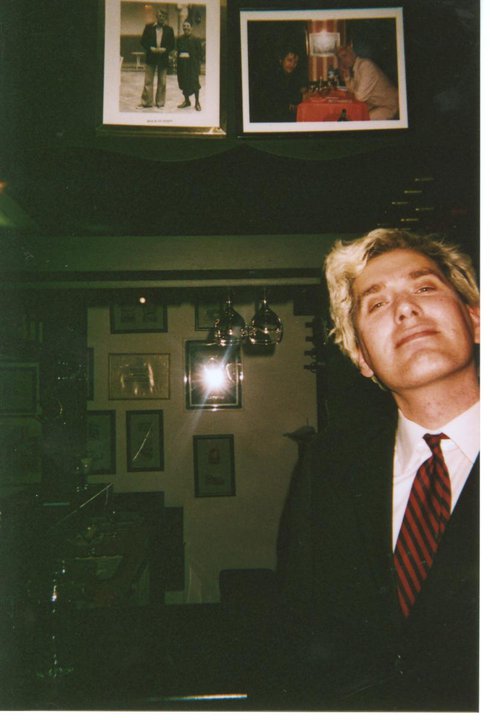
Mr O’Boyle, the owner of the Boogaloo bar on Archway Road, shows me how the venue has been redecorated. The red colour scheme has been changed to a greyish-green. On the wall near the bar there’s now a framed photo of myself with Shane MacGowan. It’s from our trip to Tangier in 2007. We’re sitting at a table in the El Minzah hotel, with me in a white suit, trying to look like Paul Bowles.
When I returned to the Minzah in 2009, I saw that a copy of the same photograph had been put up above the wine bar. What particularly pleased me was that it was next to one of Rock Hudson in the 1970s. Hence my expression in this photograph (taken in Tangier, 2009, by Ms Crimson Skye):
 
* * *
Friday 12th April 2014.
Sue Townsend dies. Creator of Adrian Mole, the greatest diarist in fiction, and as a fictional character up there with the best in any medium full stop. According to the appendix of a reissued edition, the first two Adrian Mole books were the number one and number two bestselling British novels of the 1980s.
She had an unfair reputation that she was somehow past her best after that, partly because Mole was so associated with the 1980s, but also because the idea of him getting older couldn’t compete as a concept: self-deluding teenage boys are funny, self-deluding men less so. But when you read the later books this proves to not be true: he just became more like Mr Pooter or Alan Partridge (and indeed the Partridge ‘memoir’ I Partridge owes a lot to Adrian Mole’s adult diaries).
I enjoyed the way the aging Mole updated his definition of being an ‘intellectual’ from understanding most of what Malcolm Muggeridge said on TV, to understanding most of what Will Self said on TV. And The Prostrate Years manages to be funny about chemotherapy – by no means an easy thing to do.
There’s a quote I remember from The Wilderness Years, when Mole is in his early twenties. It has a painfully familiar ring to it:
‘I have thrown my condom away. It had exceeded its Best Before date.’
Tags:
adrian mole,
Boogaloo,
derek jarman,
flaneuse,
irene adler,
shane macgowan,
sue townsend,
tangier,
visitors