Mind The Westwood
Sunday: Mother’s Day. Chatted on the phone to Mum in Suffolk (Dad recovering from a sudden drop in his condition last week). Bought Mum a Chet Baker CD box set from HMV Piccadilly. It’s a kind of double souvenir of history: a recording of the past, purchased in a shop that will also shortly be a thing of the past. Â Certainly the last time one can buy a CD in Piccadilly Circus.
My brother Tom, meanwhile, has appeared in Guitar Player magazine, talking about playing with Adam Ant.
***
London still freezing. Spent Sunday reading Toni Morrison’s Beloved for the college course.
Discovered Somerset House’s newish East Wing cafe. It’s open late even on Sundays, provides free refills for pots of tea, has nice staff, and lots of seats. CD music playing – techno-y instrumental fare- not too annoying. Hardly anyone about today: the ice rink has gone, but the lit-up summer fountains aren’t yet in place.
Also spent time in the ICA café. Â In the ICA, one often sees a few obvious-looking tourists on the way back from Buckingham Palace, who just come in to use the toilets. At the moment such tourists have to walk past an enormous Juergen Teller nude photograph of Vivienne Westwood.
***
A sketch of me from 2003, by Jason Atomic:
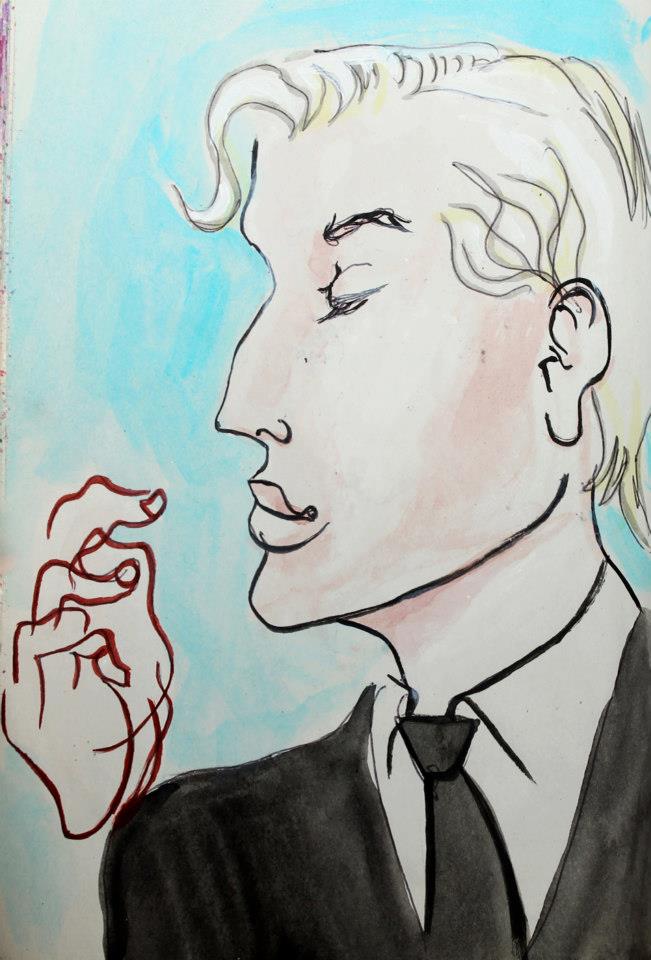
Credit: Jason Atomic. http://jasonatomic.co.uk
***
Travis Elborough tells me that he found a passage in my diary from June 2002 which now seems to anticipate the social media saturation of 2013:
‘When I first started this diary in 1997, when the Internet was in black and white, when you could leave your wife unlocked and still get change from a fiver, online diaries were a comparative novelty. I was even something of a Minor Internet Celebrity by default. But now these things called ‘web logs’ or ‘blogs’ (I do hate that word) are everywhere, and everyone is crying out like at the end of Death Of A Salesman: ‘ATTENTION MUST BE PAID.’
‘Before the Internet, people knew full well they were simply one of billions. They just didn’t let it bother them too much. Now, they go to their computers, log on, gaze out at a sea of a billion faces and find out to their horror that the world doesn’t revolve around themselves after all. And it terrifies them.’
Mr Elborough has an intriguing new book out: London Bridge In America. There are reviews at his website: http://traviselborough.co.uk/
***
Tags:
cafes,
college reading,
ICA,
jason atomic,
London,
somerset house,
spot the Sherlock quote,
travis elborough
Cafe City
Online, there’s now so much comment posing as content it’s hard not to get caught up in it all. Last week I found myself reading the comments on a Guardian column, which was itself commenting on the Daily Mail’s manufactured outrage – more comment – Â over Hilary Mantel’s article in the LRB. Which was a comment on the royal family. That’s four levels of commentary, with the royals at the core. Â The single quote of the Mantel piece that bears repeating is this:
“That’s what discourse about royals comes to: a compulsion to comment, a discourse empty of content.”
Quite. But it’s not just discourse on the royals. Today I find myself reading comment pieces on Seth MacFarlane’s hosting of the Oscars. Last night I stayed up to see the whole ceremony (redeemed by the divas – Streisand, Bassey, Adele). I watched Mr MacFarlane’s opening section, where he used misfiring jokes to illustrate the sort of jokes that would probably attract negative comments if he made them. Except he was still, technically, making them and putting them out there into the world at one of the biggest media events in the calendar. A cake and eat it situation. True to form, he attracted negative comments. But again – still in a cake-and-eat-it fashion – these media articles still quoted the bad taste jokes. Thus spreading them into the world, maintaining them, giving them longer life. And presumably such columnists got paid for doing so. It’s all getting a bit dishonest – getting pleasure from getting angry about something is not the same as just getting angry. I think that, unless it’s a source of income, one should just steer clear of this massive spiral of self-perpetuating tweeting and column writing and deliberate attraction of kneejerk responses that goes on every day. Myself most of all. I must write more about what I’m actually doing in my own life – away from the internet, that is. If only to, well, add more ‘original content’.
***
The internet catchprase ‘TL; DR’ (‘too long, didn’t read) should really be ‘TL;DR;SC’. Too long, didn’t read, still commented.
***
Winter lingers on in London, pleasing no one. Not least those who can’t afford to keep their homes heated for very long per day. So the city’s cafes are packed with those who are lucky enough not to have to work in an office, but not quite lucky enough to be able to keep their own rooms within room temperature.
Finding a seat at the British Library’s café in St Pancras has become impossible. There’s a row of armchairs in front of the King’s Library display, facing the entrance, which are built especially for laptop users, complete with little tables and power points in the arm rests. I’ve been coming to the BL for about ten years and have never ever seen a single one of these chairs going free. I wonder if it’s the same people who use them every day, who queue up outside as the building opens and rush to claim a seat as if they were deckchairs on a cruise liner (and the BL building does indeed resemble a redbrick ocean liner from some angles). I walk in, look around in frustration at the lack of places to sit, and walk out again.
I suppose I should be happy for all the people in this blissful situation. Now more than ever, London seems to be rammed full of students and researchers and academics and writers and, well, anyone whose job just involves bringing their laptop to a seat and a power socket. I don’t begrudge them their café-based, laptop-based lives; I just wish there were more seats in the BL to go around.
One main difference between franchise cafes and independent cafes is the music they play. Franchises have CDs imposed upon them by head offices. I’m convinced every branch of Caffe Nero has been playing exactly the same single compilation CD for the last year. I think Eat has the same CD too. Meanwhile independent cafes, such as greasy spoons, put on the radio. If a Starbucks ever put on the radio it would break their whole world– the whole point of a franchise is its lack of unpredictability.
The British Library café, like many state-funded museum cafes, refrains from music at all: perhaps another reason for its popularity. I wonder if unasked-for music, in this era of choice and no surprises and jukebox musicals and On Demand websites, is becoming much more objectionable as a result. I just hope the staff in franchise cafes don’t mind having to hear the same music all the time. It certainly bothers the hell out of me.
The blandness of franchises is meant to be welcoming – that’s how shopping malls are meant to work. But not in the case of HMV. Today I walk past their Trocadero branch in Piccadilly Circus, and see the ‘CLOSING DOWN SALE’ posters in its windows. It’s the last CD shop in Piccadilly to go. I take a browse among the racks, stickered with knockdown prices, but can’t find anything I want. Which is, I suppose, one reason they’re closing.
I did buy a brand new CD recently – the new My Bloody Valentine album (their first in 22 years). But as with so much New Stuff, I found out about it online, coupled with the information that the band were selling it directly from their own website. So I just clicked through and bought it. Hunting the CD down in a physical shop would seem redundant beyond belief. This is good for the band, in terms of their getting more of a cut of the price, not so good for record shops.
And yet, cheap non-digital entertainment still has its place. Twice last week, in the National Gallery café, and in Costa Piccadilly, I saw groups of teenage tourists not fiddling with their smartphones or laptops at all, but playing cards.
Tags:
British Library,
cafes,
flaneuring,
moaning
The Story Of The Art Over The Art Itself
London is deep in snow. I try to spend the days in cafes and libraries, to save on heating.
Monday 7th Jan was start of the spring term at Birkbeck; we’re now into the third week. Managed to finish the ‘Body’ essay on Woolf’s Orlando and Carter’s Nights At The Circus, polishing it with minutes to submission time. Probably could have used a few more days on it, but I’m just glad I made the deadlines for both of the Christmas essays. Trouble with this last one was that it took me a whole first draft before I realised what I really wanted to say. So I had to cut out 2000 words or so, worth hours of research and writing. One so wants to put in a note to the tutor with the offcuts, asking if they could somehow be taken into account. ‘I did all this extra work. I know it doesn’t show, but I still did it.’
Am back into the swing of lectures and seminars, while (still) battling a series of colds followed by a weekend of full-blown flu. Could barely think straight over the weekend. Am now feeling much better, but probably out of sheer boredom at not feeling better.
***
Set texts for the first half of term are: Sidney’s Astrophil and Stella, Kyd’s Spanish Tragedy, Middleton’s Revenger’s Tragedy, Crane’s Maggie: A Girl of the Streets, and Woolf’s To the Lighthouse. The humanities ‘Body’ class, meanwhile, continues to be wonderfully diverse from week to week: architecture by Le Corbusier and Eileen Gray, a video dance piece by DV8, photographic art by Ingrid Pollard and Deborah Padfield, poetry by Thom Gunn, and Oscar Moore’s newspaper columns about AIDS.
The DV8 piece – ‘Enter Achilles’ – has really made me want to go and see some modern dance shows. London is perfect for this: suddenly trying a whole new branch of culture, just in case you might like it. It’s just a question of finding cheap tickets.
Taste does change with time. For all you know you might now suddenly love, say, avant garde jazz, or ballet, or heavy metal, or modern opera, and not realise it. How would you know? You need to try a little of everything every now and then. With the possible exception of bungee jumping.
But it works the other way too. There’s been reports of people going to see the new Les Miserables film only to realise – while watching it – that they didn’t like musicals after all.
Not me, though. I’ve managed to see two excellent stage musicals in two weeks: Cole Porter’s Kiss Me Kate at the Old Vic with Mum (Jan 9th), then Sondheim’s Merrily We Roll Along at the Menier Chocolate Factory (Jan 17th, by myself). They reminded me that, yes, I definitely do still like musicals – the well-written ones.
***
Right now the media are going a bit silly over David Bowie’s new material, but it’s a kind of weird doublethink – they want something new, and yet they don’t want something new. Not too new. The new Bowie songs will be judged as part of the long-running Bowie narrative first and foremost, rather than on their own merit. The fact he retired for years then suddenly ‘came back’ is treated as if it were as important as the music itself. But that’s how critics work: they can’t actually deal with art in and of itself, it needs to be framed in narratives around the art – genres, biography, backstory, influence. The Story Of The Art is all part of the Art, they imply. Which is unfair. But then, I’m biased.
Tags:
birkbeck,
bowie,
ill,
musicals,
taste
Waking With Anita
I’ve written a piece in the New Escapologist, issue #8. It’s about Fun. The issue is available now: you can click here to buy it.
***
Christmas and New Year exploits: a lot of essay writing, or essay avoiding. But I still managed to do the following.
Christmas Day 2012: Fed the ducks in Waterlow Park once again (every year since 2001, I think). With Ms Silke once again too, though this year she’s moved. No longer in Highgate but Holloway, and she walked all the way to Highgate and back to do the duck feeding with me. We stood by the pond and drank mulled wine from a flask and ate chocolate reindeer, which looked suspiciously like Easter bunnies in a different foil wrapper. Ms S is still working at Archway Video, but it now looks likely that it’ll close for good sometime in 2013. Physical DVD libraries are struggling in the era of iPads, Netflix, TV catch-up services, iTunes and so on. A lot of Highgate customers have sensed this might be AV’s last Christmas, and have sent the shop a record number of Christmas cards this year. After we fed the ducks, Silke opened up the shop and showed me them all, including a card from Ray Davies of the Kinks. She lent me three DVDs: Cabin in the Woods (because I like Joss Whedon), Die Hard (because it’s apparently a good Christmas film), and Five Year Engagement (because I like Emily Blunt and romcoms).
Saw two of the three. Die Hard isn’t really my cup of tea, and isn’t that Christmassy really. But I’m glad I finally saw it, just in case I turned out to be an action movie fan on the sly. Alan Rickman steals the show, purring his way through the gunfire.
Cabin In The Woods: Loved its quips & sheer nerve. Much closer to Buffy (which I love). Pure Joss Whedon in tone, even though he only co-wrote it. Plays with the idea of cheating the audience out of the ending they think they want. Clever, cheeky, self-aware.
Boxing Day: Lavish meal and drinks in Crouch End courtesy Suzi Livingstone. Chatted to Anna Spivack and Suzi’s New Zealand friend Dianne. Discussion about NZ music: Headless Chickens, Chris Knox. Argument over whether Crowded House count as a New Zealand or an Australia band. ‘Well, the talented ones were from New Zealand…’
Thurs December 27th: To the Stapleton Tavern near Crouch Hill for Alex Sarll’s birthday. Dozens of people there. I ended up promising to attend the Joanne Joanne gig the next day, at least three of whom were at this gathering (Charley Stone the guitarist, Jo Bevan the singer, Other Jo whom I don’t know but who is an excellent bassist). Joanne Joanne is an all-female band who only play Duran Duran songs – but mainly their lesser known, more interesting songs. ‘Because the real Duran Duran are forced to do all the hits.’ I love that the name isn’t just a pun; there really are two Joannes in Joanne Joanne.
Friday 28th: Joanne Joanne at the Lexington: brilliant, particularly on ‘Hold Back The Rain’, ‘The Chauffeur’ and ‘Planet Earth’. Chatted to Deb Googe of MBV, who says the new My Bloody Valentine album might really, actually, really, no honestly, come back, be released in 2013. Also spoke to Kirsten, Lea Andrews, Katharine Gifford, Kevin Reinhardt, many others. Hung around with Sophia Wyeth as she DJ’d downstairs till chucking out time. Drank  too much and probably annoyed people. Woke up the next day with the amnesia and paranoia of such indulgence. Realised I was sharing the bed with an old Anita Brookner novel, which I don’t remember acquiring.
Other people wake up after a drunken night out having somehow gained a traffic cone or a torn poster from a wall or indeed a person. I emerge with an old Anita Brookner novel.
It’s very good, though: Lewis Percy.
Sat 29th: DJ-d at the Coronet in the Elephant & Castle for the Last Tuesday Society. Was still very hungover from the night before, and didn’t stay long after finishing at midnight. Think they enjoyed my DJ-ing. Had a few drinks by way of hair of the dog, but resolved to take a break after this night.
Monday 31st: Met Laurence Hughes for tea at Forks, on the other side of Highgate hill. Very nice sofas, hand made mince pies, cheap pots of tea. Watched the Jools Hootenanny to see my brother Tom playing guitar with Adam Ant’s band: so very proud of him.
Tuesday 1st: Dinner with Ella Lucas in the Turkish bistro – Bistro Laz – on West Hill. Just what I needed: was going a bit mad with all the essay worry.
Since then, it’s been essay work, or feeling ill (third cold in two months, varicose vein pains), or putting off essay work then making myself even more ill when I realise how behind I am. Thankfully today was productive purely down to making myself a timetable with reasonable goals in each session, then sticking to that.
A wish for 2013? I’d like it to be the year when I finally feel like I’m ‘right’ in my life. (to which a friend said, ‘That’s how everyone feels!’) The college course is great, but it’s not meant to be my whole life. I need to do more – and I want to do more. The trick is to timetable it all. Like this: I wrote ‘9.30-10.30pm: diary catch-up’, and here it is. Seems so silly.
Have promised to lay off alcohol for a couple of months. Teetotal since December 31st and counting.
(Sorry that this is too long. Not sorry that I got it done…)
Tags:
catching up,
charley stone,
DJ gigs,
drinking too much,
giving up drinking,
joanne joanne,
last tuesday society,
mbv,
starting the diary after a dry spell,
Tom Edwards,
varicose tiresomeness,
writing
DE’s Christmas Message
Long term readers will know that every Christmas I try to get my photo taken in front of a different Christmas tree somewhere in London. Sometimes I’ve chosen a tree in a new haunt: one in the Boogaloo pub, one in the London Library, and last year one in Birkbeck College. This year has been synonymous with the London Olympics, of which I’ve had only a cursory interest and certainly didn’t attend in person. However, I did enjoy the sense that the city really was at the centre of the world during the summer of 2012. That, and the added niceness that was in the air. There was no repeat of last year’s riots, and though it was hardly a Richard Curtis-like utopia, London did often feel like quite a nice place for a person to be in.
It was a year when I did a spot of personal ‘winning’ myself, finishing the first year of that English degree I’d always meant to do, ever since I dropped out of A-levels at school. This summer my final year marks were all Firsts. This by itself might seem like an item from one of those tiresome round-robin newsletters, a boring and ugly boast that one should keep to oneself. But in my case I have something of a history of giving up on projects and jobs, and of being late on deadlines, and of just trying to get out of doing work full stop. So I feel obliged to note what really did feel like a personal highlight. And I highly recommend adult education for anyone who needs a renewed sense of worth.
This year’s tree is at St Pancras station- another haunt which in 2012 became a rail connection for the Olympic village. The station has installed a ‘golden’ tree, which has rather an ingenious design. It’s made up of huge Olympic gold medals, one for each of those won by the British team, and they look just enough like traditional tree decorations too – specifically chocolate gold coins. Forming the body of the tree is a gold-coloured spiral strip, which I presume represents a medal ribbon. Then there’s the usual lights, but they’re inside the spiral, forming the tree’s core. I love how it’s such a simple idea, and how it’s kept simple, too. No overt branding. One aspect of the Olympics that put a lot of people off – at least in the run-up – was the sense of overly intrusive sponsorship.
From the people who won the medals, to the volunteers who participated in the ceremonies and who helped to direct visitors, the lasting legacy was, in the end, a celebration of people first, money second. This attitude seemed to last, too: I never thought I’d see a Conservative government criticising corporations for avoiding taxes, berating executives for six figure pay-offs, and campaigning for gay marriage.
So for 2013, I wish for more of this sort of thing. More concern for humanity, less concern for profit. More kindness, but also more accountability. More striving to make a unique contribution to the world, less striving to criticise the contributions of others. More sharing but also more empathy. I also wish that more people (by which I mean me) resist the temptations of Twitter and Facebook more often, particularly if they’re letting the need to be ‘Liked’ or ‘Re-tweeted’ go to their heads.
And I wish more people would take their free newspapers home rather than leave them cluttering up buses and Tube trains.
(Oh! And he was doing so well…)
A Very Merry Christmas.

St Pancras International, December 24th 2012.
Fanzines Full Of Women
I’ve written an article for the New Escapologist magazine, issue #8. It’s about the increasingly troubling nature of how to be happy when you’re a fortysomething non-conformist man (for want of a better epithet), via the Beach Boys, Stewart Lee, and Top Gear. You can order it here:
http://newescapologist.co.uk/2012/12/07/issue-eight-your-help/
***
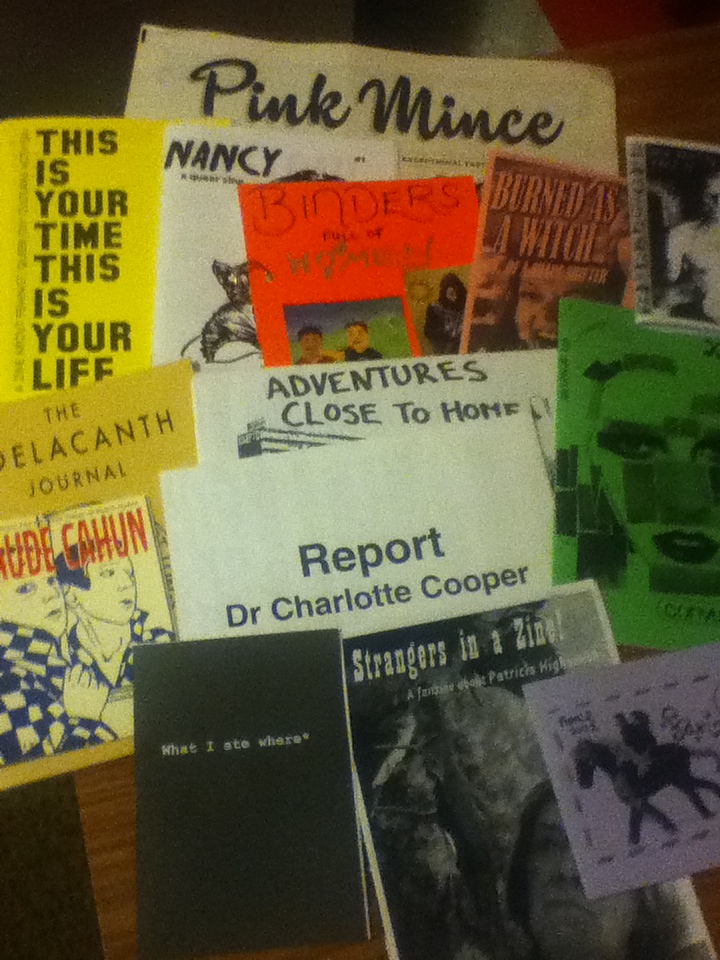
Recent outings: Saturday 8th December was spent visiting the Queer Zine Fest in Kennington. I was surprised that paper fanzines were produced at all in 2012, never mind zines with queer and feminist themes. As I discovered, there’s plenty of people making such zines, and plenty more keen to buy them: there was a healthy amount of attendees at the festival.
I wanted to buy and read pretty much all of the zines on display. Even though some of them were quite old – 90s back issues of Girlfrenzy for example – the majority of offerings were written and printed in the last year or two. So I decided to implement a rule: try and buy the latest zine on each stall, until I run out of money. My favourite is probably the Patricia Highsmith zine, Strangers In A Zine, but I also liked the concept behind Binders Full Of Women, a womens’ poetry anthology in the shape of ring binders, each with a different handmade cover. The title was a reference to a rather infamous statement made in October by the Presidential candidate, Mitt Romney. I loved the contrast between this seemingly redundant format of expression – the paper fanzine – and the quotation from the world of 2012 politics.
For more on Queer Zine Fest (which will return next year), go to:
www.facebook.com/lgbtqzinefestlondon
***
Today: am struggling under a heavy cold that I’ve had on and off for three weeks: possibly two different colds in tandem, if such a thing is possible. The work required for the college course has become particularly intense. I’ve found that as soon I’ve got to grips with the reading for one of the three concurrent modules, I’ve trespassed on the time I should have spent on the reading for the other two. The second year of a course is akin to a Difficult Second Album phase: the novelty has worn off, the freshness has gone, and one is left trying to remember how to do it – whatever ‘it’ is – all over again.
In the first year, the course felt more like a single concern that happened to be made up of three modules; now it’s like trying to juggle three demanding projects at once. And then write essays on top of that. I also have a couple of projects that are meant to be my ‘real work’ at the moment: a little book on Polari someone else has asked me to write, and a book I’ve asked myself to write. But time leaks away at the cruellest of speeds whenever one wants more of it. I find I barely have enough time to do the college course. Or at least, do it well.
Tuesday 11th December: Along with some fellow students, I attend a production of The Tempest, at the Lion And Unicorn Theatre in Kentish Town. The venue is new to me, despite having lived up the road for eighteen years. It’s certainly invisible from Kentish Town High Street: one has to walk down a quiet residential road and look for a pub, then look inside the pub for a theatre.  The company, Grassroots Shakespeare, gets its actors to direct themselves; there’s no single director. This means Prospero seems to be from one imagined production (Northern gangster – a kind of whispering Yorkshire De Niro), Ariel from another (loud, wacky, Batman costume, a bit Jim Carrey), while Miranda could be in a more traditional BBC Shakespeare in the early 80s, and so on. Still, it’s never dull, and when the song Full Fathom Five is followed with a rendition of Lionel Richie’s Three Times A Lady, no one is in the least bit surprised.
Tags:
college,
fanzines,
London,
shakespeare
The Ninth Week
The college course is into the ninth week of its Difficult Second Album phase. Tonight at Gordon Square we discussed Goethe’s Sorrows Of Young Werther, and the nature of solipsism in literature. This reminded me of a philosophy joke:
Q: How many solipsists does it take to change a light bulb?
A: One. He holds it still and the whole world revolves around him.
***
An email asks me to elaborate on why I called London “the most complicated metropolis on earth’ in an entry about the Mayoral election.
I suppose I was thinking about its organic patchwork of buildings, where the streets – in defiance of Mr Bono – are a clutter of historical names, compared to the tidily numbered grids of New York and LA. How it has medieval streets (streets older than whole countries) as the addresses of very modern tower blocks, like the Gherkin on St Mary Axe. And how it’s constantly struggling to stay a modern metropolis on top of all this history – coping with old streets not built for new traffic, trying to bring its ancient Tube and rail networks up to date with the rest of the world, all of that. There’s also the complicated social structure, with its extremes of wealth and poverty often squeezed together on the same block; the problems which gave rise to the riots in August 2011, while elsewhere in the city luxury flats are continued to be built, purely to make money rather than actually house people. These are difficult problems to solve, because it means stepping in and forcing those who have wealth, property and power to give some of it away. And there’s a big palace with a Royal Queen in it. Who is in charge, and yet isn’t in charge. It’s hard to explain why. Everything just about manages to co-exist. Just.
So I think that’s what I mean by complicated.
***
A new take on old history. During a lecture on Chaucer, the tutor points out that the Peasant’s Revolt isn’t called that any more. It turns out that it wasn’t all about peasants (there were rival factions of noblemen involved too), and they didn’t technically revolt. Instead, it’s now called the 1381 Rising.
That’s the trouble with learning facts: you have to check they don’t change behind your back.
Tags:
birkbeck,
London
Is it just me? Good.
Tuesday Oct 9th: First class on ‘The Novel’, half discussing The Handmaid’s Tale, half on the nature of novels full stop. Teacher is Anna Hartnell. Afterwards went for drinks at the Birkbeck bar with a group of fellow students – something I never really did in the first year, at least not as a group. They already have become a small gang of friends, at ease with each other. It was an atmosphere of ready-made affability, which I felt flattered to join. I’ve agreed to join them on a group outing to see a production of The Tempest in December – this year’s Shakespeare text.
***
Weds Oct 10th: First class on ‘Narratives Of  The Body’. Mainly an introductory lecture on theories of the body as separate (or not) from the Self, by Descartes and others. Teacher is Sam McBean. Didn’t feel too different to the other English modules, but that will probably change when we start to look at films and non-fiction. Metropolis up next.
***
Thurs Oct 11: Another day at Suzette Field’s in Muswell Hill, helping her with occasional publicity duties for A Curious Invitation. While I’m there she gets some big news from her agent: the book has a USA deal. She treats myself and the other Last Tuesday Society helpers to champagne on the spot. Some emails to book reviewers come bouncing back with depressing automated messages along the lines of: ‘We’ve got enough to deal with! Stop writing new books, everyone! There’s too many! Go away!’
There is too much new stuff in the world, it’s true. It’s no wonder people feel more ready to pore their energies into commenting on the few things already rich in commentary (eg news, celebrity, blockbuster movies, blockbuster art shows) rather than spend that same time and energy making new content, just so they feel less alone.
A common emotion on social media is: ‘Is it just me?’ Â The very British herd instinct in unwillingness to stand out. It’d be nice if more of a Robin Hood approach was adopted to commentary. A redistribution of the wealth of attention. But it’s understandable – no one wants to feel alone. And so we get The X Factor, watched by lots of people who don’t even like it. It’s just the need to belong.
***
Friday Oct 12th: To Suzette’s shop in Mare Street for the private view of The Party Show, a collection of artworks with a party theme, to tie-in with A Curious Invitation. My favourites are those by Abigail Larson, Chris Semtner, Slawka Gorna and Theatre Of Dolls. There’s also a couple of Cecil Beaton prints.  I chat to Rachel Garley, David Piper, Ella Lucas, and Durian Gray & Medlar Lucan, whose latest book for Dedalus is The Decadent Sportsman.
***
Sat Oct 13th: to the Soho Theatre to see the play I Heart Peterborough by Joel Horwood. A two-hander about a drag artiste and her accompanist, who are also father and son. Full of poetic monologues that you have to keep up with, a bit Steven Berkoff but with rather more campness and music. Milo Twomey (last seen playing Sebastian Horsley) brilliant as ‘Lulu’, with Jay Taylor playing the son – and many off-stage characters in quotation -Â equally impressive. Chat in bar afterwards with Clayton Littlewood and Clair Woodward.
Tags:
birkbeck,
last tuesday society,
soho theatre,
suzette field
Back To Bloomsbury
Monday 8 Oct 2012. My left leg is playing up; the varicose veins are back. Â I’ve had two operations on the laughable limb over the last fifteen years, stripping out the unsightly noodles, first by knife then by laser. But the things do tend to return and this time I may have to just live with them. I understand the NHS doesn’t do the operation any more unless it’s life-threatening. Still, a surgical stocking can alleviate the aches, so this morning I dig mine out and put it on. Its colour is an optimistic tan. Given my other leg is as pale as the tenant of a tomb (as Poe put it), my legs together resemble a novelty biscuit. It’s just as well I never wear shorts.
Tonight: to Gordon Square for the first proper class of the second year in my English BA. Monday evenings are now ‘Aspects of Medieval and Renaissance Literature’, Tuesdays are ‘The Novel’, while Wednesdays are ‘Narratives Of The Body’, being a deliciously varied module from the Humanities department. The first texts we’re studying are, respectively, Mr Chaucer’s poem Troilus and Criseyde (c. 1380), Ms Atwood’s novel The Handmaid’s Tale (1985), and Mr Lang’s film Metropolis (1927). The spice of life, indeed.
***
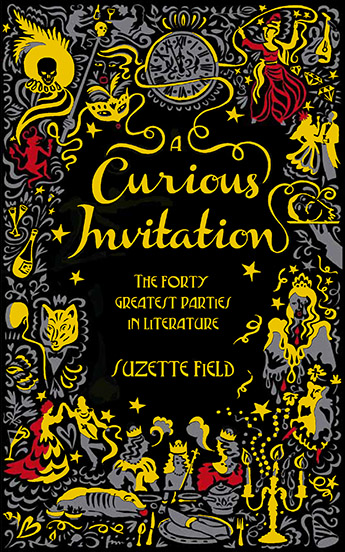
I’m currently helping Suzette Field of the Last Tuesday Society spread the word about her new book, A Curious Invitation. It’s a detailed look at the greatest parties in literature, my own suggestion to her being the flying party in Douglas Adams’s Life, The Universe and Everything. I was delighted to discover she’d included it in her final selection.
It’s probably the first – and last – book to discuss Joyce’s Finnegan’s Wake alongside Jackie Collins’s Hollywood Wives. Something of a genre-spanning feast for booklovers, it’s out in Picador this month, and naturally I highly recommend it. There’s a website all about it at http://acuriousinvitation.com.
Tags:
a curious invitation,
college,
suzette field,
varicose tiresomeness
Getting Off
After my Dungeness trip for my birthday, I spent last Tuesday to Thursday (Sept 4-6) in Suffolk, staying with Dad while Mum was away. I’m tempted to say, ‘looking after Dad’, but although he’s physically very weak, he surprised me by using both flights of stairs several times a day, and even cooked a meal for the two of us. Dad is 75, and now has pulmonary fibrosis added to the medley of deterioration his body has thrown at him for the last few years. There’s been strokes, black outs, arthritis, leg ulcers, and now the fibrosis, which means he has to keep a flask of compressed oxygen to hand, like a particularly cumbersome form of asthmatics’ inhaler.
The fibrosis gives Dad coughing fits, which I find distressing to witness on my first day. It is coughing that goes far beyond coughing, mutating into a painful, drawn-out retching for breath. But come the second day I realise this is something Dad has become used to, so I become used to it too.
I’m also relieved to discover he has no shortage of help: he’s fitted out with a panic button on a bracelet, and carries the phone handset with him everywhere. On top of that, friends who live nearby drop in on him every day.
While there I do the shopping, mow the lawn, take Dad’s watch away to get a new strap fitted (courtesy of the shopping mall near Bond St tube), wind up the ancient living room clock, and refill his oxygen flask from the huge canister that has moved into the garden.
***
Thoughts on gadgets and internet addiction. Dad has one of the now-ubiquitous iPads, which he uses for emails, the Web, films and on-demand TV. Mum has one too. I don’t, just as I don’t have an iPhone or smartphone or Blackberry – my mobile is a 7-year-old cheap Pay As You Go Motorola, in grudging pink. I never worry about it being on show and at risk of being stolen, as I think any would-be thief would die of embarrassment first. My only concession to the more desirable cult of oblong strokers is having an iPod Touch, which I have to admit I enjoy, particularly the camera. But I fear I enjoy it too much, using it more as a toy than a tool. Having social media and the Web so easy to access, I find it hard to get on with other things, like the small matter of studying for my college course.
By way of contrast I’ve invested in what I suppose is the polar opposite of an iPad – a Neo 2. This is a portable offline word processor with a little LCD screen, made in tough plastic and aimed principally at schoolchildren. In my case, it also suits someone with the self-control of a schoolchild. All you can do on it is write: a USB cable allows you to upload the results to a PC when you’re finished. It’s so basic that the battery lasts a whole year. I’m typing this on it in bed in the morning, in fact, as unlike laptops, it doesn’t get overheated on a duvet. Though I take what overheated bedfellows I can get.
The word ’empowered’ is often used for the way the Net has affected people’s lives, but in my case I feel far more empowered when I’m switching the Net off. So I’m trying out ways to cut down on internet usage without being cut off. At the moment I’m forcing myself to use college computers to check my email, and to only do so once a day. My home is now an offline oasis, with gadgets and power cables locked away in a cupboard until further notice. After only one day of not having Wikipedia or Twitter to hand I felt physical withdrawal pangs (how pathetic it seems to admit this), which rather suggests I was addicted. So it’s probably best to keep this detox routine going for a while longer.
Tags:
dad,
internet,
neo2




