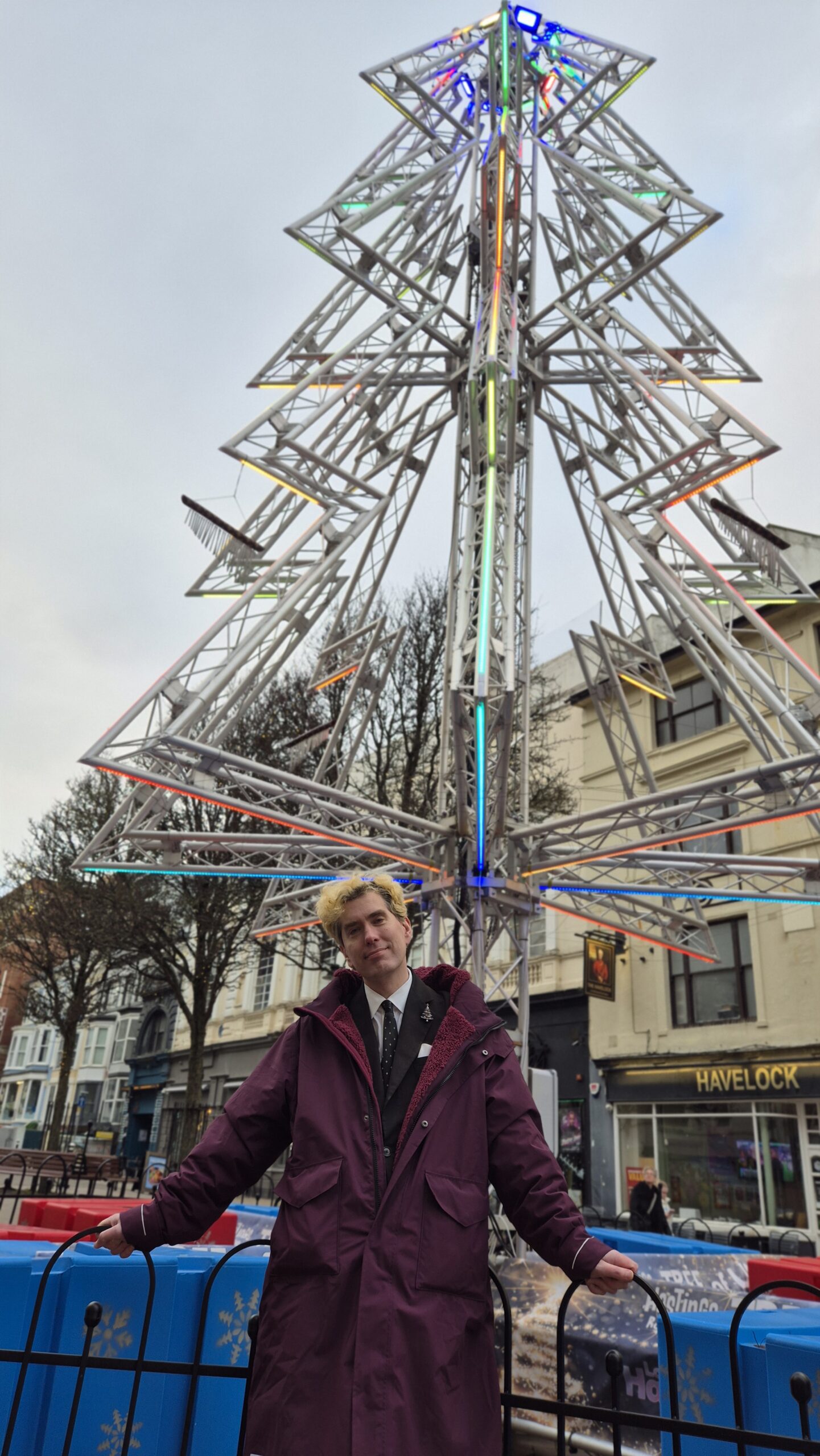
DE, Hastings, 28 December 2025. Photo by Victoria Redfern.
For some years now I have marked the Christmas period with a new photo of myself next to a Christmas tree. This year the choice was obvious.
In early December 2025, in Hastings, UK, where I currently live, a new aluminium tree-shaped structure appeared in the town centre. Decked with wind chimes and changing electronic lights, the Alu-Tree became something of a local conversation piece.
This object, it transpires, was a collaboration between the civic organisation Love Hastings, which provides improvements for businesses in the town centre, and the Hastings firm Metalworx, who normally make stages for rock festivals. Love Hastings wanted a solution to the problem of traditional trees being damaged every year by the strong coastal winds. They approached Metalworx, who unbeknownst to them had just made their first metal Christmas tree, an indoor one for Selfridges. So it was a fortuitous convergence of local needs, local expertise, and available funding.
Lovers of traditional leafy trees were still catered for: there was one in the nearby Priory Meadow shopping centre, which is much less exposed to the weather. Nevertheless, when the aluminium tree was installed it was met with adverse criticism on social media. On Facebook the tree was deemed ‘soulless’, ‘sterile’, and an ‘eyesore’.
I have to admit the tree’s daylight incarnation is inferior to how it looks at night, as shown in this video by Victoria Redfern:
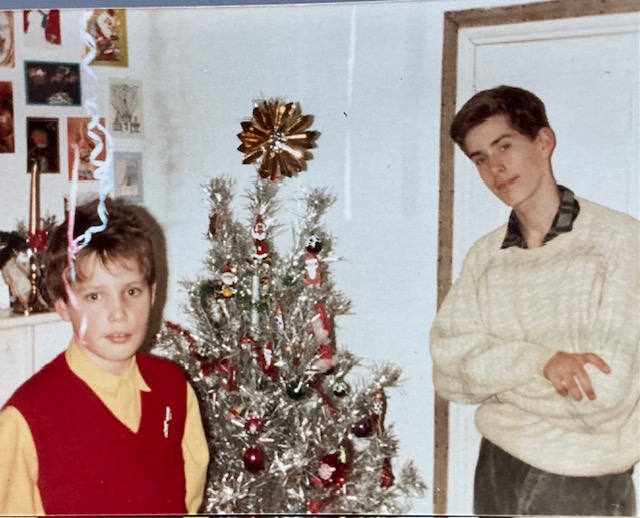
But I do like the tree’s daylight look too. It reminds me that I grew up with a silver artificial tree in my parents’ home, one made of branches of tinsel glued to steel poles, somewhat resembling glittery feathers. Each branch had to be carefully unsheathed from a cylinder of stiff brown paper, then slotted into the holes of a central pole, starting from the base up.
This assembly process was carried out every year by myself and my brother, and was hugely enjoyable. It had all the pleasure of a kit of Lego or Airfix, but with none of the butchness. The tree was sustainable in the current sense, too, lasting our entire childhoods. Here’s me and my brother with the tree in Suffolk, during the mid-1980s:
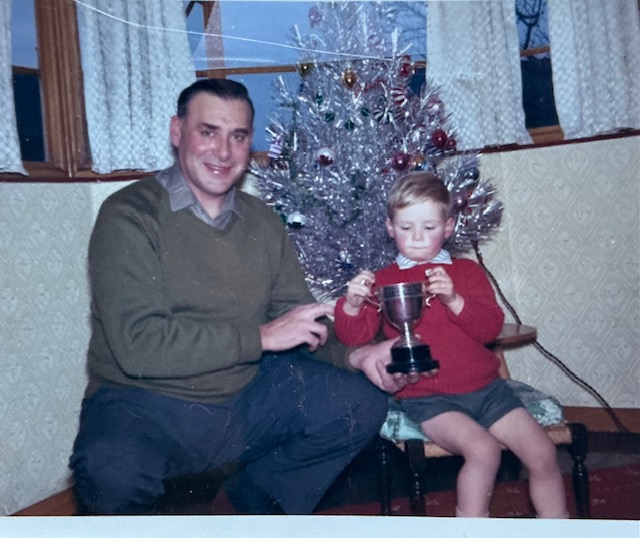
Yesterday I was speaking to my mother on the phone about writing this piece, and she revealed that my childhood tree had been her childhood tree too. It was made in the 1950s for a Selfridges display. After Christmas, Selfridges sold off the trees to staff and account holders. Mum’s mother was an account holder, and she bought one. The tree was used, we think, for about fifty Christmases.
Here’s the same tree in the early 1960s at my mother’s childhood home in Gravesend, Kent. In front of the tree are my grandfather John and my cousin Milton:
In this year’s tree photograph I am wearing my own practical solution to coastal winds: a lovely new Parka-style weatherproof coat – my mother’s Christmas present – as made by the Red company. The colour is Rich Burgundy: I no longer drink alcohol but I can still enjoy the aesthetic.
The coat is big enough for me to wear a suit and tie underneath, and indeed to show off my lapel brooch, which happens to be in the shape of another Christmas tree. I like the visual pun of a tiny tree in front of a huge one. Both fake trees celebrate artificial colours and strong looks, and both are liable to invite comment. I can relate.
One local newspaper called the aluminium tree ‘modernist’. I would call it camp modernist, the concept I researched as part of my PhD. Paul Baker’s book Camp! argues that as a season Christmas is (even) camper than Hallowe’en: his prime example is the tradition of the Rockettes Christmas dance show in New York.
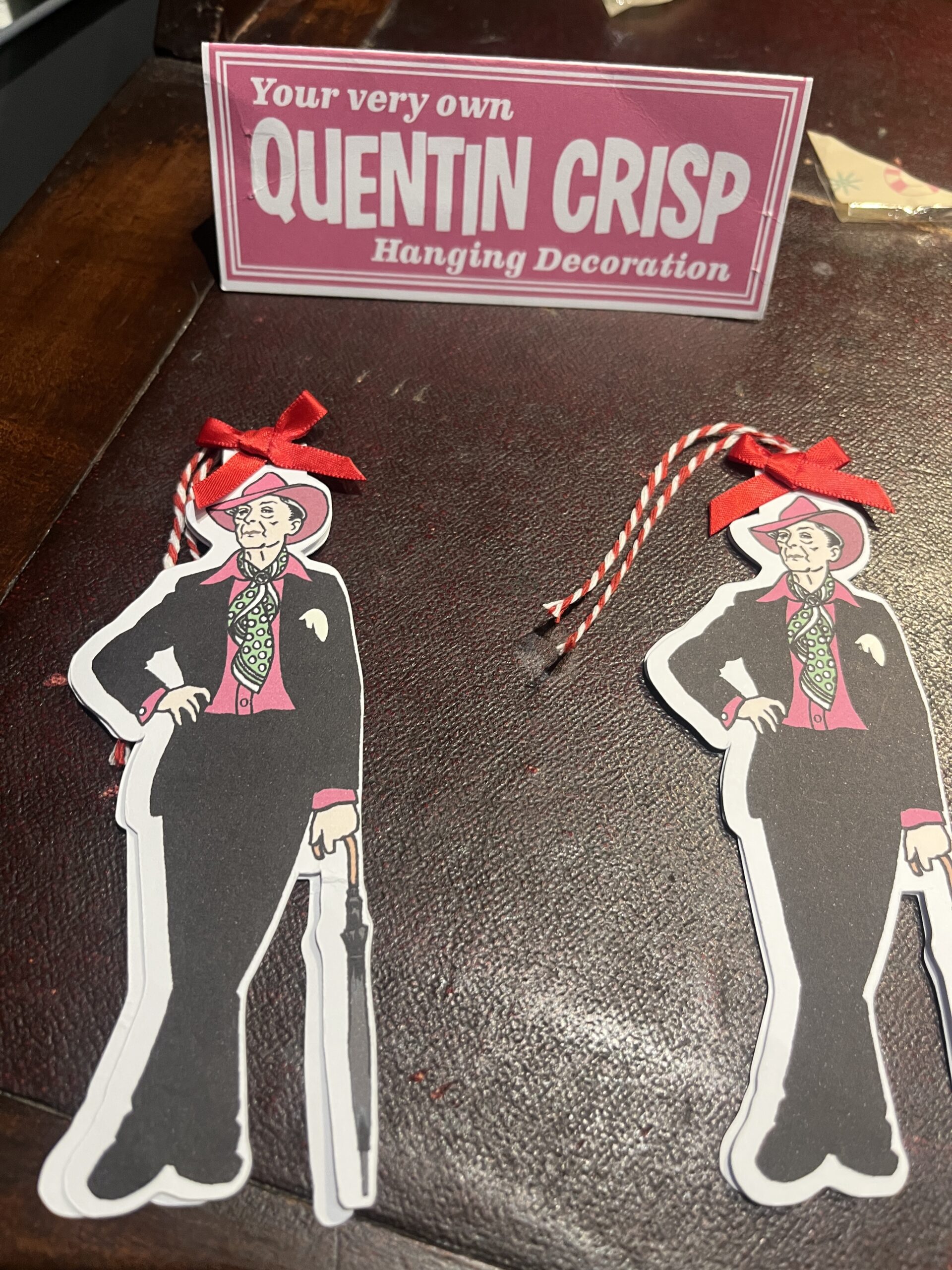
Christmas is also the birthday of the camp dandy icon Quentin Crisp, who delivered Channel 4’s inaugural Alternative Christmas Message in 1993. This Christmas I was given two Quentin Crisp tree decorations by two separate friends:
I’ve been called a Quentin Crisp imitator on occasion, who in turn was called an Oscar Wilde imitator, who in turn was called a J-K Huysmans imitator. All is creative imitation of a kind, like the tree. Dandyism is cosplay as oneself, but with a sprinkling of role models in the mix.
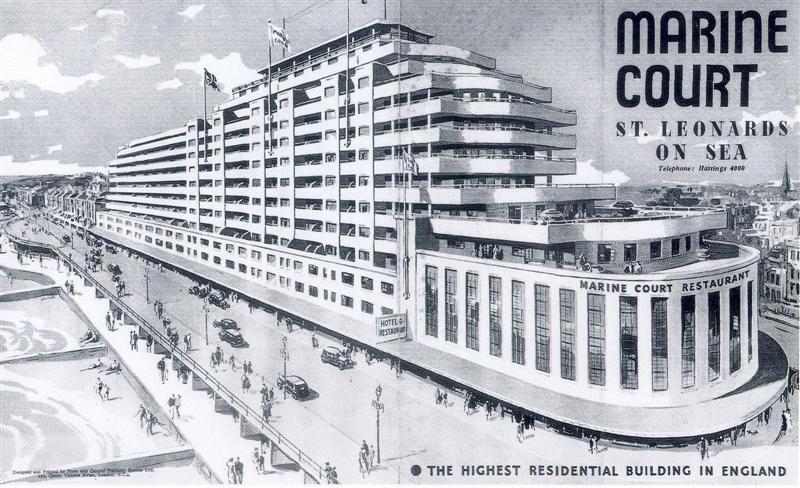
As camp modernist structures go, one might compare the Alu-Tree to Marine Court, the 1930s apartment block on the nearby seafront, built to imitate the Queen Mary ocean liner:
A block of flats impersonating a boat; an aluminium frame impersonating a tree. Hastings does seem to attract dressing up. There’s Pirate Day, Jack in the Green, the Frost Parade, and in summer 2025, a massed gathering of Kate Bush impersonators on the beach. What’s the collective noun, I wonder: a Dreaming of katebushai?
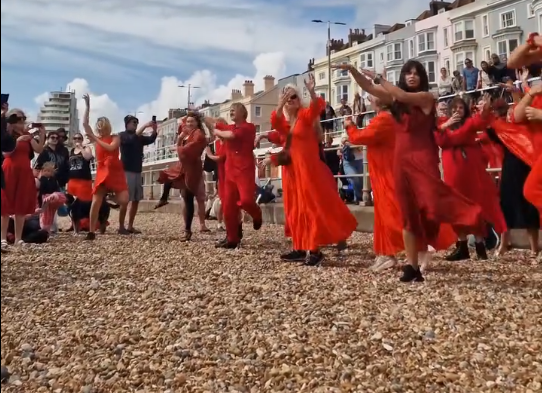
This still from a social media video of the event manages to include Marine Court (left, background), looking on approvingly. ‘You be Kate Bush, I’ll be the Queen Mary’.
The katebushai all wore floaty red dresses and recreated the dance from ‘Wuthering Heights’ in sync with the music. The official event was actually meant to take place high up on the West Hill, which makes sense, but poor weather the previous day had made the ground so muddy it had to be cancelled by the hosts at the last minute. Nevertheless, some of the dancers quickly organised an unofficial, guerilla version of the event, on the beach by the Goat Ledge café. This, I feel, is the true spirit of Hastings: creative imitation as an unstoppable instinct.
Given the rise of what people are calling ‘AI Slop’, where fake images and videos can be made online too easily, too anonymously, and too superficially, the meaning of physical experiences has now taken on a new level of intensity and value.
On a trip to London recently, I saw an advert on the tube encouraging people to retrain as plumbers. The tag line went something like: ‘Because AI can’t unblock a sink’. That’s hard to argue with.
AI ‘deep fake’ videos are certainly getting more and more uncanny, with all that word’s connotations of unease and fear. I used to think that my own physical speaking voice, which has a lateral lisp, was beyond AI imitation. But in 2025 I saw a whole YouTube channel of fake Slavoj Žižek lectures that convincingly imitated the philosopher’s own lisping voice:
Deep Fake AI Žižek:
The real Žižek, to compare:
In the deep fake video, the words spoken are not written by Žižek. They appear to be an original text by the anonymous person behind the YouTube channel, who probably used AI for that too.
The real Žižek has pointed out on his Substack (which for a while people thought was fake!) that, although the AI’s lisping voice is convincing, the videos fail to mimic his manic hand gestures, his sniffing, his stammering and other uniquely human tics. But perhaps it’s only a matter of time before AI can imitate those as well.
The question that bothers me is: why would someone go to the trouble of making a fake Žižek channel in the first place? I suppose it’s like the answer to why climb Everest: because you can. Because it’s there. In fact, AI creation offers a far quicker fix of pleasure than mountaineering. I assume the YouTube person went to the trouble of making the AI videos because it’s no trouble at all. Which, of course, is extremely troubling.
The irony is that deep fakes are a shallow thrill. There is deeper and more lasting pleasure found in offline fakery, with ‘real’ fake Christmas trees, ‘real’ fake ocean liner architecture, and ‘real’ fake Kate Bushes.
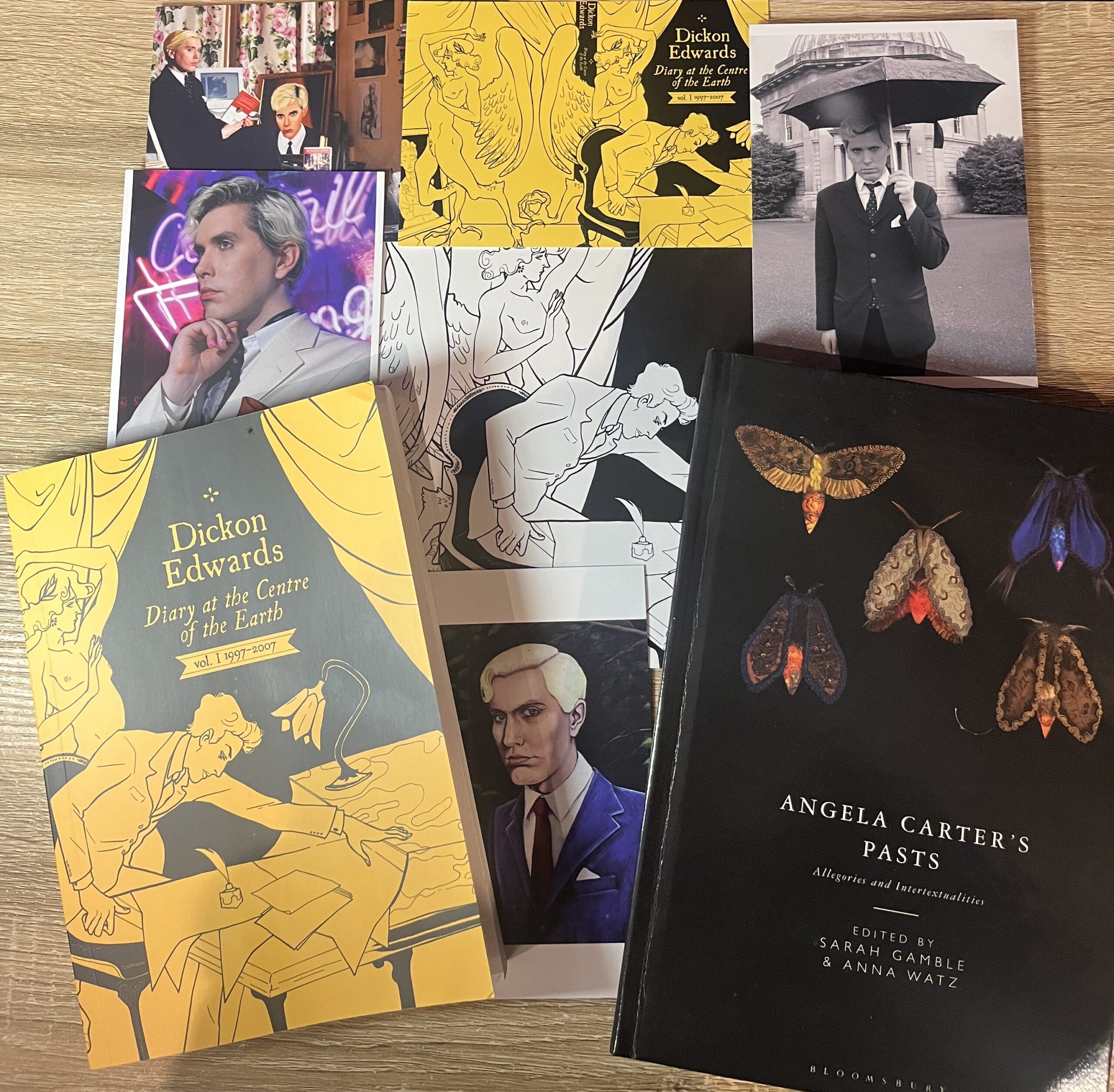
For my part, 2025 was the year I became a fake version of my own younger self. Young Dickon Edwards Cosplay. I authored a physical book, being an edited collection of my diary entries from the 1990s and 2000s: Diary at the Centre of the Earth, Volume One (P&H Books).
In fact, I had two books out in 2025 if you count the collection of academic essays Angela Carter’s Pasts: Allegories and Intertextualities (Bloomsbury Academic). My contribution for that book was an investigation into the making of Carter’s 1984 radio play about Ronald Firbank, A Self-Made Man. I was required by the book’s editors to conform to the Bloomsbury Academic house style. This meant using an author-date system for references and writing in a way that made use of my PhD training. More imitation, one could argue. Linguistic cosplay.
Meanwhile, my diary book’s bright yellow cover, by Lawrence Gullo, was commissioned by the publisher Rob Wringham as another example of creative imitation. It was a pastiche of Aubrey Beardsley’s 1890s covers for The Yellow Book, channelled through Mr Gullo’s own 21st century manga-esque drawing style. The social media platform Bluesky automatically censored pictures of the book cover as obscene. It isn’t, but Beardsley would have approved.
The yellow spine means the diary book tends to stand out on any shelf, as I tend to do in public, for better or worse. Whatever you think of the book or me, at least we’re easy to spot. But all the credit for the book’s physical appearance is really due to Mr Gullo and Mr Wringham. Publishers make books, authors just provide the raw material inside.
My own author epiphany was that all properly published books are the results of arguments. The author has argued with the publisher or editor about everything from the cover to possessive apostrophes, with many messages going back and forth, until both are satisfied. I can only apologise to Mr Wringham for being so fussy, and indeed, so slow and so late.
My first two author events for the diary book, in London in October, had to take place without any actual books. This was due to aberrant behaviour by the courier company, though I’m hardly in any place to judge others for human eccentricity.
We had the parties in London anyway. I was given gifts and drinks and food and flowers, making the events less like book launches and more like Book Showers. And the author turned up in person, which was the main thing. I am, after all, a limited edition object of one. Books are just an author’s stunt doubles.
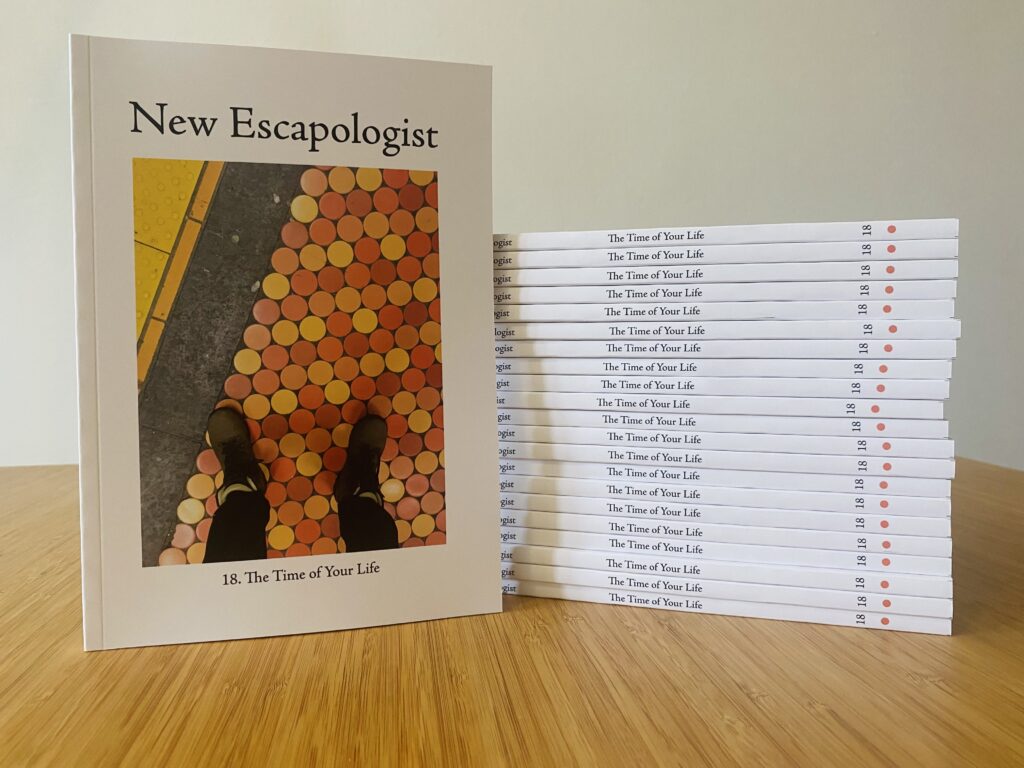
Thankfully I had some Emergency Merchandise to sell and sign. There were copies of the beautiful new issue (#18) of the New Escapologist journal, which includes a new interview with me, with lots of quotable lines to cut out and keep. The journal also has a fascinating interview with August Lamm, an anti-computer activist whom I admire:
We also had the new postcards of myself that were made to go with the limited edition Kickstarter copies. I took the idea from seeing limited editions of manga comic books that came with postcards. I really wanted a stash of them for myself, though, as I regularly send letters and cards in purple fountain pen ink. And I love getting replies, usually handwritten, but sometimes typed on old typewriters. Unique objects, all.
Limited edition vinyl records are part of the same pattern. Hastings HMV sells a £37 orange vinyl version of Taylor Swift’s latest album The Life of a Showgirl. The music can be heard online for free, and Ms Swift probably doesn’t need the financial support. Nevertheless, many people clearly do want to own her music in a form that is as offline and as physical as possible. The appeal is indicated in this salivating description from the HMV website:
Portofino orange glitter vinyl (translucent orange vinyl with gold glitter). Collectible double gatefold jacket with unique front and back cover. Full size gatefold photograph of Taylor. Double-sided foldout panel attached to gatefold which includes a unique poem written by Taylor on one side and a photo strip with 4 unique photos on the other side. Collectible album sleeves which include never-before-seen photos and album lyrics.
The Swift album is also available on audio cassette, which does baffle me a little. But I understand the appeal.
As for the popularity of live events, one can look to Oasis, with their expensive reunion shows in 2025. They played only old songs, thus imitating their own younger selves. People bought the pricy tickets in droves. The point was made.
Which brings me back to my own opening photograph – such value!
In the background, to the left of my right shoulder, is a Yates Wine Lodge that used to be a Victorian music hall. There’s a plaque outside that marks a performance there by Charles Dickens, one with a pleasing Christmas connection:
The plaque is a reminder that Dickens too did greatest hits tours in his later life, reading from A Christmas Carol and Pickwick Papers twenty years after they were published. Like Oasis, and now me, he was imitating his younger self. My diary book is a kind of greatest hits of the internet diary, as chosen by Mr Wringham.
Dickens also used a lectern to enhance the unique and physical nature of his performances. At my first book event in October where the books did arrive, at the St Leonards Reel Bar and art gallery, I was delighted to be provided with a lectern, and a balcony to read from. I’m hoping to do more such readings in 2026, with my own fold-up lectern if needs be.
This, then, would seem to be the Epiphanic message. Do more in the physical realm. More books, more events, more classes, more art galleries, more live performances, more merchandise, more limited editions, more zines, more dressing up, more dancing, more walking, more flowers and trees (artificial or real), more physical exercise (even for me), and more moving in space full stop.
AI has meant that the only way forward is to become your own deep fake. And no world is deeper than the one where AI cannot go: offline.
Happy 2026!
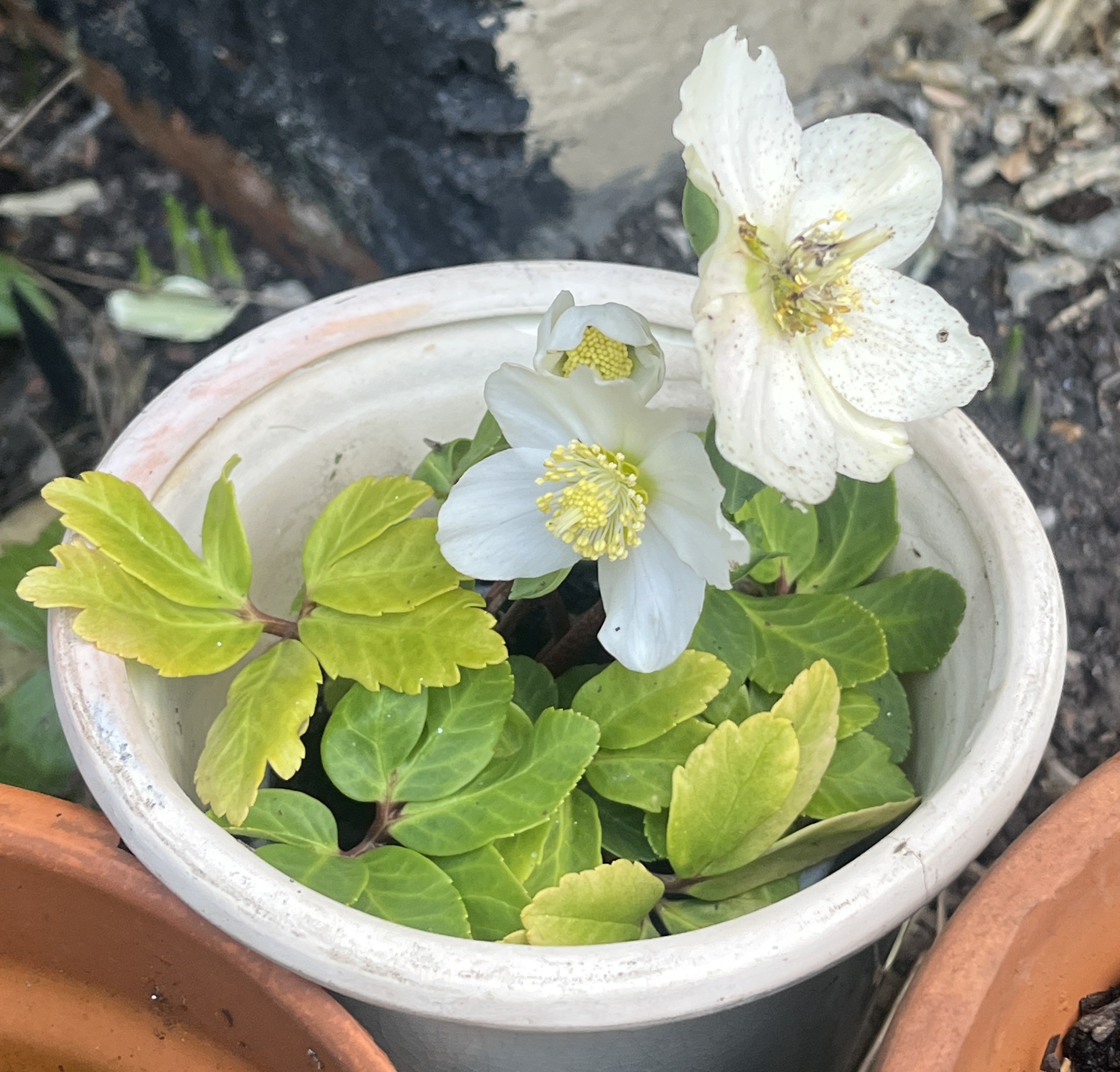
Christmas Rose, aka Helleborus Niger. My present for Mum’s garden in Suffolk.
*
You can buy Diary at the Centre of the Earth Vol 1 by clicking here.
Angela Carter’s Pasts: Allegories and Intertextualities is primarily aimed at university libraries, but can be ordered in paperback here.
*
Some other favourite things of 2025:
Novel (new): Prudence Bussey-Chamberlain’s Bone Horn (Cipher Press).
Novel (reissued): Brigid Brophy’s In Transit (Lurid Editions)
Memoir: Jodie Harsh’s You Had To Be There (Faber). The drag queen DJ whose fake name – a pun on the celebrity model Jodie Marsh – became their real name. More imitation as a way of becoming oneself.
Album: Kae Tempest’s Self Titled (Island Records). CD zine edition with printed lyrics and images.
Film: The Ballad Of Wallis Island. Seen at the Kino cinema, St Leonards-on-Sea.
Mum comes up to London for the day, and we do our own metropolitan version of the family get-together. First: to Somerset House Ice Rink, now a favourite symbol of Christmas in twenty-first-century London, as immortalised in the opening of Love Actually. Unfortunately today it rains like mad, and the ice rink is waterlogged. But this doesn’t stop the skaters, and they carry on gliding through the puddles.
We stick around at Somerset House to have a look at the current exhibitions. I’m delighted to see there’s a Tintin show, Tintin – Herge’s Masterpiece. Every inch of the gallery walls and windows are covered in Tintin illustrations. There are detailed scale models of scenes from the books, including a dolls’ house of Marlinspike Hall.
Then to the Courtauld next door, for Soaring Flight – Peter Lanyon’s Gliding Paintings, and Bridget Riley – Learning From Seurat. I always wonder how Ms Riley managed to create her 60s works without getting dizzy. A mere five minutes of her op-art canvases unsteadies my sense of reality. Though admittedly, that doesn’t take much.
We revisit some of the Courtauld’s permanent collection too. Paintings as old friends, world-famous masterpieces, right here by the ice rink. The Van Gogh self-portrait, Manet’s barmaid, Modigliani’s nude, Monet and Cezanne’s landscapes, Degas’s dancers.
Lunch in the top floor café of Foyle’s in Charing Cross Road, then a spot of book browsing, moving onto in Waterstone’s in Trafalgar Square. We’re impressed by their Book of the Year, The Fox and the Star by Coralie Bickford-Smith. It’s a beautiful children’s picture book, printed in blue cloth hardback on thick, high quality paper. Ms Bickford-Smith is a book designer by profession – her work can be seen in the Penguin English Classics range. Hers is an ornate and symmetrical style that nods to William Morris’s woodcut designs for the Kelmscott Press, but also to Jan PieÅ„kowski’s more recent silhouettes. With The Fox and The Star Ms Bickford-Smith not only writes the original story, but illustrates, designs and typesets the finished object as well. Even the credits for the font and the paper stock have a touch of the exotic: ‘set in Agfa Wile 12pt/15pt, printed on Munken Pure Rough’.
Waterstones are also making a small point here about the current role of print books in a digital age. 2015 saw them withdraw Kindles from their shops, while the sales of print books rose for the first time since the rise of ebooks. Significantly, although The Fox and the Star has clearly been produced using the latest digital design and publishing programs, the end product is entirely physical; there is no ebook edition. In this sense, print is the ultimate upgrade of digital. The page is a screen that finally stops moving, and the viewer can finally relax.
Ms Bickford-Smith’s story is a simple fable for small children, about a young fox coping with the loss of his friend, the Star. But it lends itself to wider readings of grief and personal bereavement, particularly when one learns that the author was inspired by the loss of her mother at an early age.
Mum treats me to a copy. Later, I peruse the pages at home. My own reading of the tale is inevitably bound up with thoughts of Dad, and I get a little weepy.
By 4pm on this Shortest Day, it’s completely dark. We take a busy Clipper boat up the Thames to Greenwich, taking in the lights of the city. Then a further ride, this time on the Emirates Air Line cable car link, which spans the Thames from the O2 Dome in Greenwich to the Royal Victoria Dock in Newham. It turns out to be easy to just turn up and get a whole car to yourself. No queues; in fact, barely anyone on the thing at all. The moment when the car first ascends from the terminus and soars high above the water is the most heartstopping one. It swings a little in the wind, which is unnerving, but only a little.
We take the DLR and tube to Liverpool Street, where I see Mum off on the train to Suffolk.
* * *
Thursday 24th December 2015.
Adventures in youth slang. In a branch of Pret today, a young man at the table next to me says his companion, ‘I find that so jokes‘. As in funny. I knew about this usage from the internet, but thought it was confined to the enclaves of cyberspace. This is the first time I’ve heard it said aloud. But it’s still yet to appear on Gardener’s Question Time, I think.
I attempt to see a film in the evening with Shanthi S, but we’re thwarted by her news website employers, who force her to work late. She has to work on Christmas Day as well, via her computer at home. The news must not rest.
All the cinemas in London seem to shut down completely on Xmas Eve after 6pm, but we have a pleasant time with cocktails and food at the Dean Street Townhouse in Soho (see previous entry).
Shanthi reminds me how in New York it’s common for people to go to the cinema on Christmas Day, often combining it with Chinese food. There’s nothing like that in London. Many pubs, restaurants and convenience stores are open, but certainly no cinemas. The transport system still shuts down completely on December 25th – the only day in the year when it does. Even in 2015, London is essentially a Christian city.
* * *
Friday 25th December 2015.
Christmas Day, spent in Highgate. Rainy, windy, cold and overcast. I phone Mum for a chat in the morning, then brave the rain to walk up to Waterlow Park, for my traditional feeding of the ducks.
The rest of the day is spent in my room, hacking away at the essay, while swigging from a large bottle of Baileys. My Christmas lunch is a microwaved carton of ‘White Christmas’ soup from the New Covent Garden Soup Co. Plus Quorn cocktail sausages. And lashings of back pain (currently seeing a GP, trying treatments).
Still, I’m grateful not to be one of the thousands in Northern England affected by devastating floods. I think about how we’re now getting close to 2019, the year that Blade Runner is meant to be set in. A film in which the future means constant heavy rain.
* * *
Saturday 26th December 2015.
I upload a diary entry that was meant to be a few words, apologising for not writing a diary entry. It ends up ballooning into 1500 words.
Evening: to the Curzon Soho, a cinema that proudly advertises itself in its window posters as a ‘Force Free Zone’. Its three screens are showing a diverse programme of films, none of which are the new Star Wars. There’s Carol, Grandma, the Peggy Guggenheim documentary, The Lobster (still), and Ice and the Sky. I plump for Grandma, a low-key indie road movie in the vein of Little Miss Sunshine and The Daytrippers.
Grandma stars Lily Tomlin as a grumpy lesbian poet (in her first leading role since 1988’s Big Business with Bette Midler!). She drives her pregnant granddaughter around various locations in order to raise the money for an abortion. It’s a simple conceit, but full of wit, poignancy and thoughtful characterisation; with jokes that rely on the audience knowing who Simone De Beauvoir is.
* * *
Monday 28th December 2015.
Evening: To Vout-O-Reenee’s for Atalanta Kernick’s birthday drinks. Lots of queer, dapper ladies, and women from the 90s London music scene. I chat to the writer Ngaire-Ruth, Debbie Smith (AK’s partner), Harris (one of the Drakes, a performance group of besuited butch women), and also to Ms Shir from Israel (which she refers to as ‘the land of blood and honey’). Plus Alex, the (straight male) drummer from the band Nightnurse. He’s now in Department S, of ‘Is Vic There’ fame. I discover that he also pops up in Shaun of the Dead, as a zombie on a daytime TV talk show. Indulge myself with the bar’s ‘Dunkin Donut’ cocktail: milk, cacao, Kahlua.
* * *
Thursday 31st December 2015.
New Year’s Eve. I stay in by myself. Again, by choice. Again, to work on the essay. I discover the true sound of NYE in residential city streets: the constant revving of pizza delivery mopeds.
In the essay, I suddenly find myself using the word ‘ekphrastically’. At which point it’s midnight, so I take a break, open the Prosecco, and watch the fireworks at the London Eye, via the internet. Far better than being surrounded by drunken people who don’t know what they’re doing. Here’s to choice, difference, and 2016.
* * *
Sunday 3rd January 2016.
I finish the essay – with a fifth draft – and deliver it online. Celebrate by watching the new Sherlock film, the Victorian one, which is superb. Also enjoy Charlie Brooker’s 2015 Wipe, his satirical review of the year. It ends on a pessimistic note, but I take comfort from the knowledge that Mr Brooker’s style of ‘loner grumpiness’ is now a necessary fabrication. It’s quite funny that he has to keep up the image of the angry, lonely outsider shouting at the TV from his sofa, when these days he is married and has children, and indeed a successful TV career. I worry, though, about my own grumpiness. I’m heading into a new year, still without any sense of a ‘career’, still very much feeling like a outsider. And yet Ms Shanthi said to me this week, when I was apparently acting in a bar like I owned the place, ‘You’re more like Hugh Grant than you think!’
* * *
Tuesday 4th January 2016.
To the ICA cinema to see Joy, the new David O. Russell film, starring Jennifer Lawrence. As was the case with Mr Russell’s Silver Linings Playbook, it also has Bradley Cooper and Robert DeNiro, and the same mix of quirky plot details with straightforward realism. The quirky plot in this instance being the tale of a young woman who invents a self-rinsing mop. There’s a little of Frank Capra’s ‘American inspiration’ style in this particular mix, though, and thanks to Ms Lawrence being so utterly likeable, it all works. Indeed, I come out of the cinema with a real sense of warmth. It’s also a nice companion to Carol, being another Christmas tale of a woman finding out who she really is.
* * *
Thursday 7th January 2016.
First class of the MA’s spring term. I’m now on a module that’s specifically about contemporary US fiction. This week we study Paradise (1997) by Toni Morrison. It uses elements of mystery and magical realism, much like Beloved, but with a much larger cast of characters. As a result, the reader has to do a fair amount of work just to work out what’s going on – the narrative can switch perspectives and even historical eras, halfway through a sentence.
* * *
Friday 8th January 2016.
I finish reading Diana Athill’s Alive Alive Oh! Some new words: she calls Highgate ‘a bosky place’ (leafy, wooded). As a child she wore ‘jemimas’ – overshoes of waterproofed felt. ‘Galoshes were considered sissy, whereas jemimas, although they looked much more old-womanish, were perfectly acceptable on manly feet’.
Also, she expresses the unexpected luxury of having to use a wheelchair, especially when visiting art exhibitions. ‘The crowd falls away on either side like the Red Sea, and there you are, lounging in front of the painting of your choice in perfect comfort’.
On life advice at 98: ‘Avoid romanticism and abhor possessiveness’. And on her innate sense of not wanting to be a mother: ‘I remember thinking when looking at a small baby, ‘I’d much rather pick up a puppy.”
* * *
I look back over the previous year’s diaries. I think I saw more films than ever – it must be close to a hundred. In which case, here’s some Favourite Things of 2015. I recommend them all.
Friday 20th December 2013. I am pleased to receive about two dozen cards this year, made all the more special by the high cost of postage and the dominance of the internet. Post from abroad is especially meaningful: I’m sent a beautiful pop-up one from Eileen C in New York and a pictorial Christmas aerogramme from Danika H in Australia.
Although people rarely send cards and letters today, two Christmas books this year on the subject have proved to be very popular. There’s Shaun Usher’s anthology Letters of Note and Simon Garfield’s historical account, To The Letter. The Usher book is based on his website, where the very technology that killed off the letter – the internet – has turned out to be perfect for celebrating it. I feel all the more grateful for receiving an actual letter at Christmas, from Danika, and I’ll make sure I reply in kind.
Another sign of the times this week: the gay section in Time Out magazine has been axed. It’s assumed that, like cinema listings, there’s no longer any need to turn to a paper magazine to find out about events: Facebook events pages and online listings have become the default. Gay issues, meanwhile, are more mainstream than ever, with Conservative politicians supporting campaigns for gay marriage, and campaigns against homophobia around the world (such as in Russia and Uganda) given decent coverage by the media. This week has also seen Alan Turing finally pardoned for the crime of having consensual sex with another man. His mistake was to have it in the 1950s. Actually, as my dad once told me, it was pretty much frowned on to have sex in the 1950s if you were heterosexual, too.
But the question of promoting gay culture separately in terms of identity and role models is an ongoing one. As it is, London still has its annual LGBT film festival (at the BFI) and its own gay bookshop (Gay’s The Word in Marchmont Street – hitting 35 years old next January). Coming out as gay is still a big issue – Tom Daley making the headlines of late. So Time Out’s decision does seem premature. But then, like all paper listings magazines, it’s been struggling full stop.
* * *
Saturday 21st December 2013. To Somerset House with Ella Lucas, to see the exhibition on the late British fashion editor, collector, string-puller, muse and Lady Gaga lookalike, Isabella Blow. Ingeniously, the exhibits that can’t go on mannequins, such as letters and faxes, are in white display cases which sit surreally on mannequin legs – with shoes from Ms Blow’s collection on the cases’ feet. One letter, on Harpers notepaper, is from Hamish Bowles, who is also one of the other dandies in the I Am Dandy book. He writes to Ms Blow, ‘Long for your next appearance – stepping out of a reverie by Ronald Firbank…’
Much of the exhibition is of Philip Treacy’s exotic hat and mask creations, Ms Blow being his biggest champion. One mask has a grid of jewelled Swarovski crystal nails in a black silk net, rather reminding me of the Pinhead monster in Clive Barker’s Hellraiser. I check the caption, and it turns out to be a direct homage: ‘Hellraiser mask with nail detailing‘. Any exhibition which references Ronald Firbank and Hellraiser is fine by me.
A word learned: ‘chopine’. A historical type of women’s platform shoe, popular in the 15th to 17th centuries. Modern versions of which are in the Blow collection. More like a platform clog, really.
One of the information panels on Ms Blow’s history begins with the phrase ‘Forced to work for a living…’
* * *
Sunday 22nd December 2013. I visit the Museum of London, and am pleased to see that its shop stocks A London Year, the diary anthology which includes me alongside Pepys and co. It’s the closest I’ve come yet to being a museum piece.
On the raised pedestrian walkway around the corner, I take a look at the ruins of the original London Wall, where the layers of medieval brickwork can be seen on top of the Roman foundations. There’s an information panel about the ruins, provided by the museum. It’s dated 1980 and has been laminated against the elements, though 33 years later the elements have won, and much of the text is now faded and illegible. The panel about the ruins is itself a ruin.
In the evening I turn a corner in Clerkenwell Green and suddenly see the Shard and St Paul’s from a distance, both lit up. From this angle they appear as if standing right next to each other, though the Thames and several districts separate them geographically. Tonight the former looks like a Christmas tree, and the latter like a bauble. I stare up from the silent street at them, thinking how London always was this constant shrug of old with new, just like the two parts to the Wall and the ruined panel. Inside the Crown Tavern, more shrugging: Wizzard’s eternal Christmas song on the pub stereo, while the first word I overhear as I enter is someone saying  ‘Facebook’.
* * *
Monday 23rd December 2013.
The London Library’s last day before closing for Christmas, and the last day of its late night hours, closing at 9pm. It transpires that not enough members use the library quite that late, so in 2014 ‘late closing’ will mean 8pm instead. I sit in the historic Reading Room from 8.30pm till the end, which as expected means I am the only one there. Just me, all the books and journals, the famous soporific armchairs, the fireplace, and the Christmas tree. Utter, serene peace. I soak it in.
As soon as I leave, though: chaos. Heavy wind and rain has hit Britain, causing transport shut downs and power cuts at the worst possible time of year. Although the effect on London is relatively minor, my umbrella is a wreck before I make it out of St James’s Square. At Piccadilly Circus, where I get the tube, the clear plastic bubble over Eros has burst, scattering polystyrene chips of fake snow all over the road. Like some Biblical retribution against worshipping false gods, this idealised image of Christmas weather – pretty fake snow in a bubble – has been eclipsed by real Christmas weather – ugly, uncontained wind and rain.
* * *
Tuesday 24th December 2013.
To the Hackney Picturehouse to see a 1940s Christmas-themed film I’d not seen before, The Bishop’s Wife, in which Cary Grant plays an angel helping a troubled New York priest, played by David Niven. Despite his otherworldly role, Cary Grant is just dressed as Cary Grant, with the usual immaculate dark suit. One character is an eccentric aged scholar,  an atheist who nevertheless loves the traditions of Christmas. On discovering Cary G’s celestial identity, he remarks ‘Oh, that’s annoying.’ I think that’s how I’d feel.
Even though the story centres on David Niven’s bishop, the film’s parting message about Jesus feels unusual, even jarring. Yet I remember how it works fine in The Holly and The Ivy, a British film from the early 50s, also about priests at Christmas. I think the fact that Niven’s daughter is played by ‘Zuzu’ from It’s A Wonderful Life reminds me why: American films are happy to tell Christmas stories about angels, but they usually leave out Christ himself.
It’s still an issue today. I read a piece in the Guardian this week where an American writer remarks how the British are perfectly happy to say ‘Merry Christmas’ to each other, as opposed to ‘Happy Holidays’, regardless of religion – or lack of it – of those present. It’s just tradition. But among the cards from British people I get, some are indeed saying ‘Happy Holidays’, so perhaps that’s changing.
The first time I saw the word ‘holidays’ used to mean Christmas was in a TV advert. The product was that great ambassador of the American way, Coca-Cola. That may be another reason why ‘Happy Holidays’ has yet to catch on: for some (and I include myself), it feels too American.
* * *
Wednesday 25th December 2013. I spend Christmas by myself in Highgate, once again enjoying the palpable and rare peace in the city. The changed background hum of low traffic without buses. Morning spent hungover from mixing prosecco and Baileys the night before. I chat to Mum at length on the phone.
At 1pm, I meet up with Silke R once again for my own tradition of feeding the ducks in Waterlow Park. Silke is currently staying in the flat attached to Archway Video, the film rental library on Archway Road where we both once worked. An independent family business since the 1980s, the shop stocked a huge range of films, first on VHS, then DVD, and eventually, Blu-Ray. The customers included Daniel Craig, Maureen Lipman, Ray Davies of the Kinks and Brett Anderson of Suede. This year, the shop is an empty shell, closed for good since the summer. Silke now works for Odeon, an irony given that video shops were first thought to be bringing about the death of cinema. It wasn’t cinema that killed video shops, though, but online services like Lovefilm, Netflix, and of course Amazon.
In Muswell Hill a few months ago I bumped into one of the shop’s old customers. ‘I do miss that shop,’ he said fondly. ‘Though of course I hadn’t been in for years.’ He didn’t seem to notice how one statement was related to the other.
Thursday 26th December 2013.
With the lack of traffic on Boxing Day, combined with the sense of enforced family gatherings reaching the point of strained boredom, some local teenagers play football in the street outside. I first worry about them breaking any windows, but then I realise that young people playing ball games in the road is very old indeed. All the museum photos say so.
I walk around St Pancras in the afternoon. Most of the people I see fall into two categories. There’s aimlessly wandering tourists, who seem baffled that everything is shut for a second day. A handful of them climb on the gates of the British Library to take photos of the empty piazza. The other category is football fans, because Boxing Day means sport. People in Chelsea scarves are looking particularly pleased with themselves.
Friday 27th December 2013.
CHRISTMAS MESSAGE 2013.
This year’s photograph of me with a London tree is of course a ‘selfie’, one of 2013’s Words of the Year. With thanks to the London Review Bookshop for letting me take it on their premises on Christmas Eve.
The bookshop tree represents not just my current life as a student of literature, but my increasing concern about the effect of digital culture on independence, in every sense. On a blunt commercial level, the online tax-dodging colossus that is Amazon is obviously threatening the future of independent, non-corporate shops like the LRB. Bookshops, like cinemas and libraries, are pleasant places for staff to work in and for customers to go and immerse themselves in culture, at their own pace, offline and away from the ubiquity of the computer screen. No advertising sidebars tearing your concentration to shreds. One book I bought at the LRB this year was The Circle by Dave Eggers, which paints a near-future world where Amazon and Google and social media have reduced people’s lives to a banal flatness of public algorithms and vanished privacy.
This theme also connects neatly with Channel 4’s Alternative Christmas Message by Edward Snowden, the whistleblowing fugitive of the USA security services. Mr Snowden cited another novel about a world without privacy, 1984, and said some rather powerful things:
‘A child born today will grow up with no conception of privacy at all. They’ll never know what it means to have a private moment to themselves, an unrecorded, unanalysed thought… And that’s a problem, because privacy matters. Privacy is what allows us to determine who we are and who we want to be.’
The Queen’s own Christmas message also touched on the need for personal time alone, though she linked it more with prayer and meditation. Certainly a child born today in the case of baby Prince George has even less privacy than most children, but the point stands. What grabbed my attention with the Queen’s message was that she also mentioned ‘even keeping a diary’ as an example of creating a space for private reflection. Which is where I come in.
This year saw my online diary’s first emergence in book form, in the form of extracts in the anthology A London Year. Like the books about letters, it’s a celebration of individual minds reflecting in privacy. Their words are only later published when the appropriate permissions have been sought, and when an editor has done their own reflecting on what part of private writing might, as Shuan Usher puts it, be ‘deserving of a wider audience’. An amount of consideration and reflection has been applied, in other words. Although my own diary is published online first, it actually begins life as a series of far more personal notes made in my own paper notebooks. And even when published online, I try to evoke the more private nature of the printed page by the omission of one key element: no comments box.
A blog with no comments is as close to the reflective, personal and locked-off experience of the printed page as it can get. If you write online, I highly recommend it. Let comments belong on social media. Writing and reading are after all anti-social activities, and need to be. Humans are social creatures, but socialising needs to be kept apart from the production and consumption of writing. The more people can disconnect by way of balance, the better.
(I’ve now realised that Mr Usher also omits a comments box from his Letters of Note website too.)
It’s rather impractical to call for a boycott of Amazon, Google and social media now, and I wouldn’t want to. I use those things all the time myself. But my wish for 2014 is to try to resist the technology that wants us to only live through an endless scrolling of screens, that only what matters is to join the shallow noise, the unconsidered chatter, the indiscretion, the unkind photos passed around at the expense of others and the Fear of Missing Out. I wish to balance these activities with more appreciation of three beautiful ‘I’s: individualism, independence and immersion.
And I wish you a very happy what’s-left-of-Christmas, and a splendid New Year.
Here’s this year’s DE Christmas card image. Photo taken in April 2008 by Phoebe Allen. Digital snow added in December by Daniel Clift.
***
Here’s this year’s DE In Front Of A Christmas Tree In London shot, by Heather Malone. Taken outside the Natural History Museum, Christmas Eve 2008, at about 10pm.
***
And here’s one I took today, while mooching along Parkland Walk to get to a Christmas Dinner in Crouch End. It’s the scary hidden sculpture of a spriggan (an unkind creature from Cornish folklore), by the artist Marilyn Collins. Seems even more magical (or more scary) on Christmas Day:
Further to the last entry, I suppose it’s something of an achievement to be singled out for having funny hair in Camden Town. That perennially youthful hub of North London where the current fashion is for young men to wear their hair in a kind of spilt paint-pot effect. It’s as if their hair has not so much been styled as thrown onto their heads from a great height.
I do like the trend for young men wearing scarves at all times, though. Often indoors. A couple of days ago I saw a fashionable looking boy on the Archway Road with his Ugg-ed up girlfriend. Not just a tangle of scarves and skinny jeans, but sunglasses on his head too. In mid December.
It’s never a bad thing for young men to have to feminize themselves to fit in. Though I’m obviously biased. Make-up is often a leap too far, though. One feels sorry for the ‘brickies in drag’ of the 70s glam rock era, or the 60s hippies who really wanted to be lads, or those backing musicians in 80s New Romantics bands who were not at one with their eyeshadow. Scarves are more do-able.
The fashion also favours the boyish side of androgyny (and again, I’m biased). A scarf hides an Adam’s Apple, or corrects Nature’s omission of one.
***
Where was I? (All over the place, today, Mr E. Still, carry on.)
Yes, the last Fosca gig at Islington. It was fine, no one died (Oh do stop that!). Maybe not as many people as one might hope. Alex S says the heavy rain of the 13th definitely made some people stay at home. He quotes Frank Skinner:
‘You can spend your life trying to be popular, but at the end of the day, the size of the crowd at your funeral will be largely dictated by the weather.’
It’s so true. And it was a funeral, after all. Some kind comments afterwards: great sound, great performance, shame we’re splitting up. That it would be even more of a shame if I never took to the stage again. Well, we’ll see.
Matt Haynes says our one-off line-up and going out with a one-off vinyl single in 2008 reminded him of the equally perverse last Field Mice gig in 1991 or so. There, the band aired brand new songs which hadn’t been released then and never were released afterwards (and remain unreleased even now, I think…). Here’s to perversity.
I’m just glad we managed one last London gig at all. That’ll do, Fosca, that’ll do.
I stand around afterwards with a box of the new single and last album, in case anyone wants to buy them. And as it happens, they do. To my absolute surprise I attract a small queue. I sell all the copies I’ve brought. Including, by accident, my own copies. Oops. And I sign some, too. I’m getting good at signing things in noisy places (or if I’m feeling a bit deaf), asking people to quickly write their name on a bit of scrap paper nearby, then confidently spelling their name correctly on their book or record.
Boy H had to go back to the US (and snow) the same evening. Pretty much for good. What with him and Fosca I had to deal with two big goodbyes in one night. I plumped for my usual tactic. I got a bit drunk.
So: single again. Alone, but not lonely. All kinds of invites from friends who are also spending the festive break in London – dinner there, drinks here, a concert of carols if I fancy it. Too lucky to grumble.