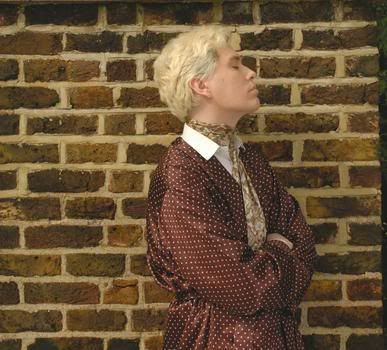
A reminder that this month’s Beautiful & Damned night is next THURSDAY, Oct 19th.
THE BEAUTIFUL & DAMNED – OCTOBER EDITION
Date: Thursday 21st October
Times: 9pm to 12.30am.
Venue: The Boogaloo, 312 Archway Road, London N6 5AT, UK. 020 8340 2928.
Tube: Highgate (Northern Line). Buses: 43, 134, 263.
Price: Free entry, but do please dress up. Cocktails for the best dressed.
Full description on the DE News page.
Mr Borges’s Heaven
In the Rare Books reading room of the British Library. I get an immense thrill on receiving my first Rare Book – a gloriously illustrated first edition of Richard Marsh’s The Beetle – in a protective blue cardboard box. The lid is kept shut by thin lengths of string wound round delicate little cardboard cogs. To open any book preserved in such a way has the air of a childhood Christmas. The resulting thrill, I have to admit, is the closest I’ve come to sexual ecstasy for some time.
Directly in my line of sight in the desk opposite is a fifty-ish man with a greying beard, glasses on a string, and a slightly mucky jumper. He is consulting some enormous gilded tome. I can’t help being distracted when at one point he suddenly bangs his fist on the desk and says ‘that’s it!’ – albeit in a whisper.
Recent merchandise acquisitions: a cream-coloured tote bag by The Hidden Cameras, which Anna S thinks is a laundry bag. More bands should market their own laundry bags. Plus a promotional strip of tear-off bookmarks for ‘The History Boys’. Am pleased to find my two favourite Boys, Dominic Cooper’s Dakin and Jamie Parker’s Scripps (who to me resembles a teenage Trevor Howard), are on either side of the same bookmark.
Fanzine Ghosts
To Anna S’s for a haircut. Am rather gratified to find that the layer of unbleached hair underneath is still pretty healthy, thick and devoid of any signs of thinning or greyness. David B goes off to his night shift job, Anna goes off to the club Stay Beautiful, and I just go home for a quiet evening in. Not so much due to any lack of energy as preferring to get on with a few things at my desk.
I have a new neighbour, a face from the past – Ms Sophie W. She once interviewed me for her fanzine nearly ten years ago. In fact, I came across the fanzine last week while tidying up a pile of clutter. Not only is Orlando in it, but so is David, in his former band Guernica, featuring the now prominent London DJ, Erol Alkan on guitar. There’s also an interview with The Longpigs, dominated by their guitarist, Richard Hawley. These days, Mr H is successful as a solo artist, his appeal somewhat further-reaching than that of The Longpigs. Even real people buy his records. I can’t see how anyone would want to get passionate and hot under the collar about his entirely inoffensive music and minimum-risk appearance, but then I forget that making pleasant music for its own sake is more than enough for most. Not everyone wants to make a statement. He does appear to be re-writing Buddy Holly’s True Love Ways on more than one occasion, but there are worse songs to re-write.
Read an excerpt from AN Wilson’s Betjeman biography, concerning his bisexuality. The great poet once described an attractive female secretary as looking enticingly like ‘a ruined choirboy’. And that famous line in A Subaltern’s Love Song about lusting after a hardy tennis player always struck me as a rather unusual way to describe a girl:
The speed of a swallow, the grace of a boy
But then, where some say ‘bisexual’, I say ‘English’.
That’s Entertainment
More mixed thoughts on the Fry documentary. I’m annoyed by the constant cliched use of Philip Glass music, only serving to remind the viewer that this is TV entertainment like anything else. In one of the segments about people who manage to be depressed and NOT famous, there’s a woman who can barely get through the day, who has to constantly guzzle a myriad of different pills even to keep her in this lifeless state. Fair enough, but then the Philip Glass soundtrack swells yet again to accentuate her voice-over, and we’re reminded it’s just another TV programme cut to a tried and tested formula.
That’s entertainment. Lives edited to taste. Yes, I realise that’s what documentaries are. But you’re not meant to be jarringly reminded of the fact. Someone should tell such directors that the works of Philip Glass (or if wet, Coldplay) are not the only fruit. Or even ask their own presenters for a few suggestions, given Mr Fry is a classical music buff.
Cut to a New York composer. Filmed at his piano, I shouldn’t wonder:
PHILIP GLASS (for it is he): The depression first hit me when I realised that British TV documentaries kept lazily using my music for everything from climate change to terrorism to heroin addiction. Since then I’ve just not been the same.
OMINOUS REPETITIVE MUSIC UNDERNEATH (by Mr Glass): boodoo boodoo boodoo boodoo…
This tendency is actually two decades old, starting with the 1983 movie Koyaanisqatsi. Timelapse montages of buildings against the sky, the clouds zooming past above, the traffic like fireflies below. All set to Philip Glass’s pounding arpeggios and doom-laden, but rather listenable, mathematical pulses of melody. Since then, this format has been imitated so much in portentous TV ads and documentaries, it’s become a kind of Stairway To Heaven for directors. Just as that Led Zeppelin tune is the one that guitarists can’t help playing in music shops, TV directors can’t stop themselves from saying, “Bung on a bit of Philip Glass, that’ll work well.”
====
Still, it drives me to rent out ‘The Hours’ and see it for the first time since its release a couple of years ago. More depression as entertainment, certainly, but more honestly so. And this time, Philip Glass tailors his music to fit. I think this is why I ultimately prefer fiction to documentary. Fiction looks for truth in fabrication, documentary applies fabrication to truth. In Fiction, saying to yourself, “This wouldn’t happen” doesn’t matter too much, not if there’s other elements to stay for. With documentary, the set-up pieces, the contrived tableaux, the shot of the presenter arriving at someone’s house where there happens to be a camera crew already set up; it’s as fictional as fiction. I find fiction more truthful.
=====
So to ‘United 93’, a much-praised movie dramatisation of the fourth 9/11 flight, the one which crashed into a field. This has been hyped as a sensitive account, dedicated to the memory of those that died, and so on and so forth. Who are they kidding? It’s entertainment like anything else. We see the four terrorists viciously kill the pilots and a few passengers as they take over the plane, additionally slitting the throat of a stewardess because, “We don’t need her any more”. They might as well be in an Indiana Jones film.
This initial burst of cartoonish evil sets us up for a payback like any other thriller movie. You want the ‘Baddies’ to be defeated, but as we already know what has to happen in the end, the makers invent little victories that might have happened… but very probably didn’t. Outrageously, a German passenger (whose widow was one of the relatives not consulted by the director) is depicted pleading for appeasement, trying to stop the others revolting from their seats, and they turn on him as if he were as guilty as the terrorists. Then they viciously, brutally kill the hijackers one by one – just like in the movies – as the plane hurtles to its fate, a sea of hands grabbing for the pilot’s joystick, trying to wrest control seconds before the inevitable.
To describe a 9/11 movie as exciting and entertaining, which is what ‘United 93’ is, seems profoundly distasteful, but that’s the currency it’s trading in. It’s only distasteful in the way ‘Titanic’ is distasteful (by being a bad movie), and ‘The Queen’ isn’t (by being a good movie). Such flicks exist in a different world altogether, where dramatic arcs matter more than accuracy or even likelihood of accuracy. As a tribute to the memory of those that perished, it’s on very insincere grounds indeed. I felt the same when watching “Saving Private Ryan”, in the scenes where surrendering Germans on Omaha Beach are shot dead by Americans. Movies are movies, even the ones that call themselves memorials. They all end with the usual white text on a black background, telling us what happened in the real world afterwards. Just as ‘United 93’ does.
But then again, this is an argument which began with the TV news crews deciding what to show from that day. Was it distasteful to broadcast the footage of the planes hitting the towers over and over again? What about the people jumping from the towers? How much reality do you want? How much can you take? And so on. And this is the line taken by the movie directors. Whether you like it or not, they reason, 9/11 looked like a Hollywood movie. Or three. Or more. So they cover their consciences with the world ‘memorial’, insisting that some of the relatives of the deceased are ‘on their side’ (much like bigots who say ‘some of my best friends are…’) and promises that a percentage of the movie profits will go to, oh, some 9/11-connected charity or other. They may as well be saying “Will that do”?
My overriding response to which is a resounding “Hmmmmmph…” I realise all writers and film-makers are vultures of a kind, and I’m no different with this diary. I just try to be careful not to be obviously offensive to those who might be watching. And one way is by resorting to fiction over documentary, or fiction that claims to be documentary. Which is where we came in.
Remove the cowardly disclaimers, change the names and the event, and the film is what it is – a good thriller based on a true story, but only based. Gus Van Saint’s ‘Elephant’ is a fine example of how to translate filmic events to film. It’s obviously about Columbine, but doesn’t claim to be. As with much in life, once you start dropping names, you’re cheapening yourself.
If a memorial is about “lest we forget”, here it’s lest we forget America’s lust for vindictive, brutal payback rage, and their lust for understanding the world through simplistic but impressively entertaining movies. As if you could forget. If ‘United 93’ is Hollywood being ‘sensitive’ to recent events, one dreads the opposite.
Mission Entirely Possible
Watch the Stephen Fry documentary on depression. The clips from him rehearsing to present some glossy awards ceremony are interesting. The director asks, “Happy, Stephen?”. “Happy???” he mutters as the crew moves to the next cue. “Oh, yes, ‘happy’. I remember that…”.
As ever, I find confessions about phases of despair from the massively successful both fascinating and infuriating. It’s hard not to shout “Oh just get over yourself, Mr Millionaire” at the screen, though one useful message persists: that of plunging oneself into work as at least one kind of cure.
I find myself wanting to shout the same sort of things at the passages of unrelenting self pity in some of Alan Bennett’s Untold Stories essays (especially ‘Written On The Body’, his unusually candid account of feeling off sick when Sex was handed out). Particularly as he himself dislikes the idea of The Artist As Tragic Figure.
Is the viewer and reader meant to think “Poor, poor Stephen” and “Poor, poor Alan”?
No, I decide, not really; both Bookish National Teddy Bears are several steps ahead of their audiences’ thought processes, and deal with any accusations of self-obsession in a kind of knowing pre-emptive manner, which of course just endears them further. Ultimately, they’re just being honest about their feelings. Which is very hard to get away with when you’re terminally English, depression or no.
Which is why Men are from Mars, Women are from Venus, and self-help books are nearly always from America.
Sunday: to Heathrow on a mission from the Boogaloo circle. Given the generosity they’ve showered upon me in the past, I think I’m going to be asked something akin to being in ‘The Manchurian Candidate’. “We’ve done a lot for you, Mr Edwards. And today’s the day you pay us back. You must now kill the Prime Minister.”
Thankfully I just have to deliver some business documents to Victoria M Clarke as she changes planes en route to Tokyo, where the Pogues are touring. At the airport, she buys me lunch and gives me plenty of encouragement, contacts and tips for getting my so-called writing career going. While checking in, she is told she can bring her lipstick in her hand luggage, but not her liquid make-up. The ludicrous state of air travel in 2006.
Then to Camden where Ms Anna and Ms Suzi L have been drinking the afternoon away, while waiting for me. I can’t help thinking of that Noel Coward play, Fallen Angels. Anna cooks us all dinner, and we discuss what to do with Anna’s rodent infestation: it ignores her vegetarian mousetraps. Plus what to do with the old computer scanner Suzi has kindly given me: it refuses to work with my Mac OS X, and I can’t find a driver for Mac OS 9 which might possibly work instead, if I switch my laptop to something called ‘Classic Mode’. It’s a pain that technology only makes life easier if you keep up with it.
Pop in at the Boogaloo and chat to the Kashpoint kid Eddie, who I’d forgotten comes from Ipswich like me. We chat about what’s changed there (I’m dismayed to hear Martin & Newby, the long-running hardware store with the 70-year-old light-bulb in the toilets – has gone), and he asks me if I know of any jobs going in my London spheres of existence. I guffaw at this somewhat, feeling like the doctor who is more ill than the patient. But then I give him a few suggestions as to places to look. I don’t feel like I’m someone to look up to exactly, but I forget that some younger people view me as having Made It in some ways. If only having Made It to the age of 35, with all the osmotic dribbles of experience that engenders, simply by being alive for longer. Age is an illusion of experience:
Have cleared away the piles of clutter on my floor for the first time in about ten years. My landlady insisted on cleaning my carpet, and for once I decided to view this as an opportunity rather than an intrusion. Quite a transformation. I can actually have people to visit and not apologise for its state. Progress of a kind.
Eating For One (But Not Cooking)
Modern solitude.
I am married to a man called ‘Pierce Film Lid’.
One of London’s Trendiest Fashionistas
Here’s the Time Out London piece, clipped from their website:
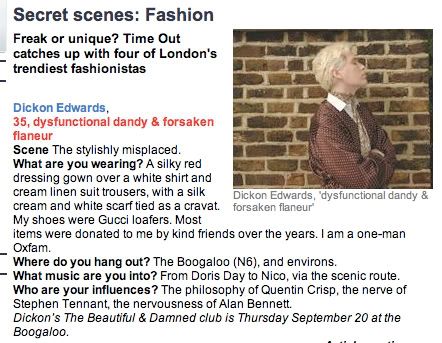
A larger version of the photo is here.
Full article online here.
Strange that they didn’t use a full-length photo, having asked about my shoes and trousers.
One of ‘London’s trendiest fashionistas’? If so, it’s only in the way Peter Sellers’s character in ‘Being There’ is an influential politician.
There was a letter in the magazine the following week:
“Let me get this right. The hottest underground trends in town are… a variety of ponces wearing silly clothes!… Thankfully I am off to see The Fall in Cricklewood, now that’s what I call alternative.”
Never mind me being the anachronistic one: who uses words like ‘ponce’ these days, outside of that scene in ‘Withnail & I?’
Anyway, I don’t think The Fall are exactly strangers to ‘ponces in silly clothes’, given they once collaborated on a ballet with Michael Clark and Leigh Bowery: gentlemen who rather make me look like Chuck Norris.
In the last few months, without lifting a finger to hustle or promote myself, I’ve been featured by The Penny, Inside Out, The Enfield Advertiser, BBC TV and Time Out (several times now).
For better or worse, in some of these instances I feel slightly mistaken for what I’m not. I feel they haven’t quite ‘got’ me. But why should they? There is no reason to feature me at all. As ever, I look more famous than I really am. Until I have something to point to, like a book or an album or a produced script – with decent distribution and marketing behind it, mind- I suppose this is the way it has to be. A club night host, and an online diarist.
But the latter isn’t ‘enough’ by itself, while the former isn’t really my calling. If I took it seriously and put the hours in, I could make The Beautiful & Damned into a proper, paying hit event – even a franchise – given the attention it’s generated as a laid back hobby night on a Thursday night in Zone 3. I could move it to a more central location, book live acts, get in guest DJs, spend money on glossy flyers, even make a career of it. But that isn’t really me, either. I’m better at being a guest than a host. I need something else to point to.
Soon, I hope.
Renowned Curating
Says Mr R sadly, about a French girl he was chatting to: “I thought we were hitting it off. But I now realise she wasn’t flirting with me. She was just being French.”
Spend two nights in a row DJ-ing at the Boogaloo. The first is a last-minute booking for a private function. It’s something to do with a design company. Or possibly a design magazine. I don’t ask questions, not even when the event involves a transparent holiday caravan being parked on the pavement outside.
Shane MacGowan DJs with me, and his set includes Irish folk numbers such as ‘Barnyards Of Delgaty’ by the Clancy Brothers, played next to ‘Tommy Gun’ by The Clash. Which is pretty much Shane MacGowan in a nutshell. He also spins two versions of a couple of songs, in a sort of compare-and-contrast way. One is ‘Beyond The Sea’ by Bobby Darin, preceded by the original French version, ‘La Mer’ by Charles Trenet. Less known, at least to me, is ‘Stranded In The Jungle’ by The Cadets, a curious novelty hit from the 50s that cuts back and forth from a scene in the said jungle – an encounter with cannibals, naturally – to a swinging doo-wop party in the US. Mr MacG also plays a version of this by The New York Dolls.
The next evening is The Beautiful & Damned, which goes smoothly enough. Films shown: ‘The Eagle’ (Rudolph Valentino) and ‘Sunrise’. When I started the club, we had terrible problems with records being jogged by vibrations of the Charleston-esque dancing, but this no longer happens. The Boogaloo managers have invested in one of those proper CD decks for DJs with a mixing desk built in. Plus my laptop playing mp3s is all non-moving parts, so one can violently shake the table and the music isn’t affected in the slightest.
I put up a few photocopies around the venue, taken from library books on Garbo and other 20s & 30s film stars. One of which, Anita Loos, turns out to be a screenwriter and novelist – best known for ‘Gentlemen Prefer Blondes’. I am mesmerised by her hairdo: the kind of scruffy bob more associated with London 2006 than Hollywood 1932. I’ve said before that all good authors should have hairdos that can be seen from outer space, so I now must read everything she’s written.

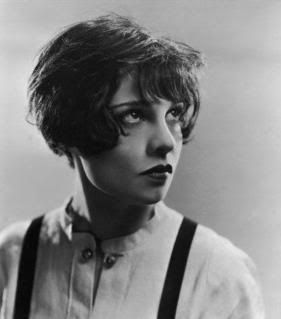
The British Library has dozens of Garbo biographies – not bad for someone who banged on about being left alone.
In a silly mood, and recalling that I prefer the term ‘curator’ to ‘DJ’, I use the following phrase on the club’s poster: ‘Renowned Curators Dickon Edwards & Miss Red Stagger Through The Vaulted Archway Road… to present ‘The Beautiful And Damned’.’
This a reference to the much-derided opening line of The Da Vinci Code. It’s only me who notices, I suspect. But that’s fine with me.
At Beautiful & Damned, Shane MacG insists I play ‘Layla’. After trying hard to say no to him for some time, I finally play the famous squealing rock section, and skip the lesser-known laid-back piano coda. Which makes His Nibs come up and tell me off. So I play that too, a little later. About five people come up and ask me what it is. They all recognise it from the film ‘Goodfellas’: it’s the music playing over a montage of gangsters’ bodies being discovered in different locations. A car, a freezer lorry.
The evening ends with just myself and Mr MacG drinking into the small hours, the pub locked up, the staff gone. I doze off on the sofa next to him, awake at about 4.30, and stagger across the road to bed.
I take home a belated birthday present given to me over the decks by Mr Pushaun, who works in films. It is Anna Massey’s autograph.
Ticking Different Boxes
Wednesday 20th Sept. Spend the day seeing two new film-festival-type films, Esma’s Secret and Red Road, which have a fair amount in common. At times they even seem like the same film, in the way that action blockbusters can resemble each other. Both have won awards at festivals, and this makes me wonder why arthouse movies are generally considered more edifying than mainstream popcorn fare.
You could argue it’s a question of ticking a a different series of boxes. ‘Little Miss Sunshine’ and ‘Me You And Everyone We Know’ are arthouse movies that seem so aware of their own genre, they are arguably just as formulaic as those Hollywood dramas seemingly created purely to win Oscars. The ones that feature someone with a disability or some other feature that singles them out. All those films have the same plot: A Struggle Against Adversity, Triumphing In The End. But the same is true of the arthouse scene.
The Popcorn Movie must make money. The Arthouse Movie must win film festival awards. The Popcorn Movie must have a certain amount of guns, explosions, or if it’s a romcom, it must finish with a last-dash declaration of love between people who were having a perfectly reasonable life anyway. The Arthouse Movie must try to Say Something about the Human Condition. But not too quickly. And the characters must be generally having a Hard Time throughout. One common feature of arthouse dramas is that information must be withheld, eventually released to the audience as a kind of chocolate-drop reward for sitting still for so long. Once we get The Awful Revelation, we can all go home.
Esma’s Secret was originally called Grbavica, taking its name from its setting: a grim suburb of Sarajevo. Red Road also takes its name from its location: an equally grim suburb of Glasgow. Both are about melancholic women living in the aftermath of some male-instigated trauma, hinted at but unspecified until the final reel. Not so much a Whodunit as a What-was-dun-to-her.
They’re both extremely well acted and directed, and seem terribly real; if it wasn’t for this sense of one box being firmly ticked: the one where you get the audience to stick around for the Awful Revelation. Once the audience feels they’re being strung along for a chocolate drop, as I did, the realism suffers somewhat. And it’s unfair to everything else about the movie. Particularly ‘Red Road’, which has an incredible emotional pull and is otherwise full of original images and ideas.
I was reminded how well ‘Mysterious Skin’ deals with this problem, by following two characters: one is trying to find out the Awful Truth, while the other knows it all too well – and we’ve all been privy to it from the off. To put the shocking secret at the start of the movie rather than the end sidesteps this cliche altogether, while still keeping the audience in suspense, as we get to follow the character in the dark. A building up and an aftermath at the same time.
I suppose wanting to steer away from being accused of boxes-ticking is a kind of box-ticking in itself. Go one step further, and you could say that life can be boiled down to just ticking the right boxes, too. Happiness, tick. Money, tick. Realising your potential, tick. Paying the rent, tick. Perhaps the Afterlife is just filling out a survey form like everything else.
When critics die, do they judge their life out of five stars? Do they look back on their life as an ‘adrenaline-pumping powerhouse’ or a ‘rare treat’ or ‘powerful’?
Dickon Edwards – Nominated for A Lifetime’s Lack Of Achievement Award.
Beautiful & Damned – Last Call
Quick reminder that this month’s Beautiful & Damned night is this THURSDAY.
Recently featured in Time Out magazine’s special on ‘Secret Scenes: The hottest underground trends and subcultures in the capital today.’
THE BEAUTIFUL & DAMNED – SEPTEMBER EDITION
Date: Thursday 21st September
Times: 9pm to 12.30am.
Venue: The Boogaloo, 312 Archway Road, London N6 5AT, UK. 020 8340 2928.
Tube: Highgate (Northern Line). Buses: 43, 134, 263.
Price: Free entry, but do please dress up. Cocktails for the best dressed.
‘Unmissable!’ – Time Out.
‘A divine London night out’ – The Penny Magazine.
With its proud motto of ‘Never Knowingly Underdressed’, The Beautiful And Damned now includes silent movies like ‘Pandora’s Box’ screened on a backdrop to illustrate one’s dancing or conversation. A timezone-jumping decadent disco curated (as opposed to ‘DJ’d’) by Mr Dickon Edwards and Miss Red, the B&D encourages patrons to dress up in their own take on period glamour, ideally with a nod to the styles of the 1920s & 1930s, though anything more stylish than the ubiquitous Old Street fashions is welcome. Cigarillos, braces, tweeds, beads, silk scarves, summer dresses, unforgiving teddy bears, Pimms & high hats.
Drink, dance, and ponder the nights tenderness to an eclectic but discerning mix of Sinatra (Frank & Nancy), Strauss waltzes, soundtracks, musicals, El Records, Peggy Lee, Doris Day, Gilbert & Sullivan, Ella Fitzgerald, Dory Previn, Bugsy Malone, Cabaret, Chicago, deviant disco, shadowy soul, parvenu pop, insouciant indie, and easy listening for difficult children.