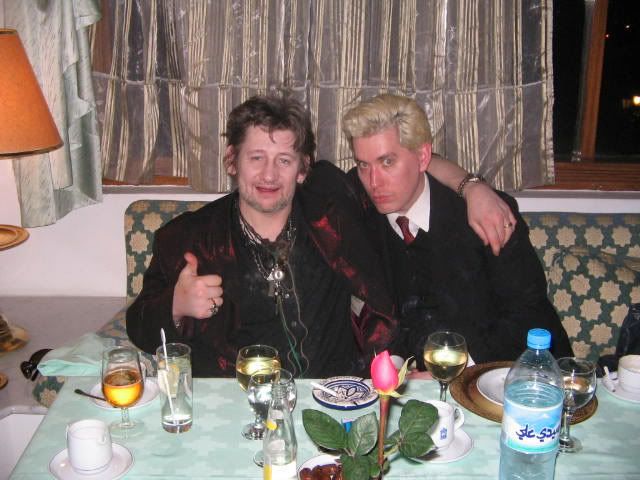
The Naming
Why do I bother even checking my Myspace messages, when most of them are either along the lines of this:
“Hey, I noticed in your profile that your [sic] into interesting music,
you may like to check out ours…”
Or:
“Do you want to track who is visiting your MySpace page? Sign up here.”
Or:
“This user has had their profile deleted before you’ve even read their message. A waste of time all round, really, isn’t it?”
I have a perfectly serviceable email address. Quite why this has to be eschewed in favour of a message system that’s saturated with ads and doesn’t even work properly is beyond me. My MySpace profile even tells people I only regularly check my direct email, not my MS page. And yet, I get streams of pointless advertising and bored souls suddenly popping out of the ether to tell me they quite like my funny name, or my funny look, or that they quite like one of my favourite films. Direct email has more consideration, in every sense. Which surely makes it more attractive. Consideration and deliberation.
I would delete the page, but feel I should hang onto it for the same reason I hang onto a mobile phone. It’s not so much going with the crowd – which is the very reverse of my philosophy – but knowing that you must never turn your back on the crowd’s preferred methods of communication. You have to be contactable on others’ terms, in order to exist on yours.
My three DJ gigs last week were all very enjoyable. I’m not exactly one of those DJs who show off their mixing and matching of tempos and the like – I just play records.
I suppose I’m a DJ who doesn’t like DJ culture (which is also the name of a rather tuneless single by the Pet Shop Boys). I can barely bring myself to even type the phrase ‘mash up’, let alone attempt such a thing on the ‘decks’. My aloofness helps – I like to think I’m playing to the one person in the room who feels the most alone. It’s all too easy to feel alone in a crowded room, far more so than when you’re at home by yourself.
At How Does It Feel on Sat, I manage to play Judy Garland, Ute Lemper, Bugsy Malone selections and so on alongside the Chills ‘Heavenly Pop Hit’ and Dressy Bessy’s fantastically sassy two-chord delight, ‘Girl, You Shout’, with HDIF host Ian Watson’s specific encouragement. He pointed out that the whole idea of being a guest DJ is that you play the sort of thing a club doesn’t normally hear. That said, I was torn between playing what I wanted to hear, and what I thought people would get up and dance to. Still found myself reaching lazily for ‘Roadrunner’ when I should have gone with Dory Previn’s ‘Yada Yada La Scala’ or the Shock Headed Peters’ ‘I Bloodbrother Be’. Next time, I’ll be more assertive. This Thursday is Beautiful & Damned, and if I can’t be assertive in my own club, where can I be?
The aloofness also helps bat off people requesting something you haven’t got. I’m getting quite good at maintaining an expression evincing something along the lines of “I suspect you’re going to ask me to play something I haven’t got. Don’t even think it. I am not of your world. Not with those shoes.”
Taylor Parkes tells me of his newly born son. For the name, I suggested Dickon. It was worth a shot. He’s toying with ‘Mohammed’, if only to make life more interesting; the boy is Caucasian. He was joking.
I’m happy for Mr P, though I wonder if this means he’ll gradually revise his social circle to increase the parent to childless wastrel ratio among his friends, as many parents naturally do. Most of my acquaintances are childless, even the ones over 35. It’s not that I find the childless more interesting, it’s that people with children rarely seek to know me. Babies are narcissists by default, and I’m a narcissist by admission. There may be a conflict of self-interest.
Actual children I tend to get on with, having baby sat for years, though never for actual babies. It’s the under 3s I can’t deal with. All that lying in bed and screaming for undeserved attention: I get enough of that at home.
What does fascinate me is the business of naming. If you don’t name your child within six weeks of its birth, the Government fines you. And then, I wonder, does it allocate a name itself, like orphans and foundlings, going through the alphabet? “We’re up to C. We haven’t had a Carruthers in this parish for a while, so…”
DJ Life
I had to make it back from Tangier for Saturday evening as I had a DJ booking at a private party for a friend of a friend. They paid well, though Shane offered me the same money to stay with him and miss it. I couldn’t possibly renege on a gig booking, and Victoria Clarke turning up at the Minzah on Thursday made it easier to say goodbye and make my way home solo on Sat morning, leaving him in more tried and tested company. He grumbled but let me go. I think they’re still there now.
It did mean me getting my first ever plane by myself, and spending a dreary five hours in the dull departure area at Casablanca airport. Would love to have walked around Casablanca for a bit, but the way my passport was stamped meant I couldn’t even visit the outer section of the airport, the one with proper shops rather than duty frees.
Found myself waived through the customs at Heathrow like royalty, even though I was a slightly alternative-looking man coming back from a druggy country. I swanned past while sniffer dogs were set to work on the suitcases of families with small children. Perhaps I just have Harmless written all over my face. Still, I was hardly complaining, as I made it back to Highgate with barely 30 mins before the DJ gig.
Two more DJ dates this week. One is tonight, a late booking at ‘Loss: An Evening Of Exquisite Misery’. I am told I have to play the most miserable songs I know. Given the date, Nico’s My Funny Valentine is a must. The Carpenters, Smiths, Shangri-Las and Mr Cohen willl also be on the menu. I’ll put down the list here afterwards.
Then on Saturday I’m the guest DJ at 60s girl group / 80s indiepop club How Does It Feel To Be Loved, the first time time back since I started Beautiful & Damned. It’ll be hard to not punctuate the Smiths and Supremes with the likes of Ms Garland and selections from Bugsy Malone. I may not entirely succeed. We shall see.
How Does It Feel To Be Loved?
Saturday February 17th
The Phoenix, 37 Cavendish Square, London W1G 0PP,
three minutes walk from Oxford Circus tube station,
9pm-3am, £4 members, £6 non members.
Membership is free from http://www.howdoesitfeel.co.uk
At The Villa Delirium
One of the appointments I have to cancel in order to dash off to Morocco is with an ADHD specialist, to see if I might have Attention Deficit Disorder. So I miss it due to being distracted.
Back in Highgate, up at 6am to watch the world coming to life and force myself into a writing discipline once again. This time, it’s the coming back that energises, rather than the holiday itself. Tangier Mark Two was more restless and stressful, with me worrying about money, Shane’s health, my health, being bothered by hustlers (I wasn’t really, after we’d escaped the port), being mugged at night (not at all). A complete bag of nerves. Shane offers me some kif (the local dope) to calm me down, and even valium, and I give it a go. But of course, it isn’t really me. Though the problem IS me. I don’t think I’ve ever calmed down in my life. I don’t know how to.
As part of this general restlessness, I do a bit of hotel hopping in the week I’m there, with Shane’s permission. I go from the £105 a night five-star Minzah to the £9 a night Hotel El Muniria in Rue Du Magellan. This is Tangier’s Beat Hotel, or their equivalent of the Chelsea Hotel, compared to the Minzah’s Ritz. Also known as the Villa Muniria or the Villa Delirium, it’s where Burroughs installed himself for much of his Tangier days, holding druggy parties with his naughty chums: Ginsberg, Kerouac, Francis Bacon, and so on.
The actual room where Burroughs wrote Naked Lunch, No 9, is now ‘privee’. The owner, a tall mustachioed gentleman, now lives there. I meet him in the bar below, the Tanger Inn, when Shane & I go there one night. These days the Muniria is a family-run pension. Clean enough, and the wardrobes and beds themselves are agreeable, but most rooms have to share toilets or bathrooms across the corridors, and many of the doors are so stiff, it’s impossible to go to the toilet without summoning the strength of Hercules and making an almighty slamming sound. All those Beat types must have been pretty butch. Well, compared to me. Need I even make that observation?
I am shown what used to be Jack Kerouac’s room, with a fantastic view of the sea and the city from the rooftop terrace, but turn it down because it means sharing a toilet. There’s my life for you in a single sentence.
Early February appears to be Tangier’s coldest, wettest time of year, and the Muniria has no heating. So getting up at night to go to the loo is even more of an ordeal. There’s the freezing cold, the having to nip across the public corridor to the shared lav, and the ridiculously stiff doors to wrench noisily open and slam deafeningly close at every stage. Add to that the danger of being caught by a some fellow guest – inevitably a badly dressed backpacker spending a night here on their way to Fez – in one’s night clothes. The shame of it.
The lady in charge of the Muniria kindly lets me switch rooms for one night. I go from No 3 to No 6, which does have its very own toilet, shower and writing desk, at no extra cost. You’d have thought this would make me happier, but then I dwell on the cold, the fact there’s only hot water in the morning and evenings, that I left my umbrella in the first taxi we took, and that the Rue Du Magellan outside is a pretty dodgy street, particularly at night. It’s on a steep slope, and some sections are steps only, so cars can’t come here. No street lights, though there’s a safer stretch of road halfway along which one can take as a diversion. Twice the time to reach the main streets, but half the fear. One evening I look up the steps of the shorter, steeper route and note there’s one light in the darkness. It’s from the cigarette of a man standing alone in a bricked-up doorway. And I wonder what it’s liked to be mugged at a 45 degree angle.
I consider this place is ideal in the summer, but not for early February. After two nights at the Muniria, I up sticks and move to the Hotel Rembrandt around the corner. £28 a night, three star, heating and en suite bathroom and toilet, on the main high street (Boulevard Pasteur), built in the 1950s in a kind of mock Art Deco style, and yet another relic from the Interzone years. It’s the Tangier equivalent of the New Piccadilly Cafe, and suits me to a tee. Not too much, not too little.
When I get home, I discover that the Rembrandt was the hotel of choice for one particular visitor to Tangier, who went there regularly. Someone who I therefore have more in common with than the Beats, whether I like it or not.
Kenneth Williams.
DE & SMG. El Minzah Tangier, Feb 2007
B&D Feb
Writing this from the El Minzah Hotel’s 1930s Moorish Wifi. Fezzes everywhere. And yes, I did have to look up the plural of ‘fez’.
Mr MacGowan is still here. The El Minzah is very Moorish.
I bet I’m not the first to make that joke, but I don’t care, frankly.
Here’s this month’s details for B&D:
THE BEAUTIFUL & DAMNED – FEBRUARY EDITION
Date: Thursday 22nd February
Times: 9pm to 12.30am.
Venue: The Boogaloo, 312 Archway Road, London N6 5AT, UK. 020 8340 2928.
Tube: Highgate (Northern Line). Buses: 43, 134, 263.
Price: Free entry, but patrons are strongly encouraged to dress Timelessly Stylish.
More info on the News page.
No LiveJournal For Morocco
A number of friends and fellow online diarists I enjoy use the Livejournal system to host their entries. I’d love to know what they’re up to this week, but weirdly the Moroccan government blocks the entire LJ system from the nation’s net. The other big blogging site, Blogger, remains untouched, so surely it can’t be deliberate. Anyone wanting to say something against the government can just get a Blogger account instead.
Seems rather harsh on the entire LiveJournal world. It’s not always photos of cats and talking about Harry Potter.
O LiveJournal people: I do hope you haven’t been wiped out by bird flu. And if you have readers in Morocco, or rather if you want to have readers in Morocco, you should bear this in mind.
Update: one way of getting around this block is by going to www.mathcookbook.net There they are! After a fashion.
Â
Â
Opulence and Decadence
 The El Minzah Wine Bar, Tangier, early hours of Sunday February 4th 2007.
The bar is meant to close at midnight. However, Mr MacGowan’s status as an international musician of repute ensures we’re allowed a generous extra three hours. The wall is akin to some of those theatre bars around Covent Garden; full of framed signed photos of vaguely known persons who’ve visited the place. But the El Minzah’s diet is far more varied. Paul Bowles, several times. Jean Genet. Richard Harris. Steven Berkoff. Winston Churchill. The actress Julia Stiles. John Malkovich. So we agree to send the staff a signed photo of Mr MacG for their collection. It’s the least you can do for a Tangier lock-in. And to be fair, he is a good name for the wall of a foreign bar. The Richard Harris photo really swung this thought: Opulence and Decadence.
Having trouble getting my iBook online in the hotel. The El Minzah’s wifi is erratic: it gives perfect internet when I log on, but then after few minutes the Net is gone, even though the Airport connection itself is intact. The staff aren’t sure why, and I can’t explain myself too well in what can only be described as Pigeon Whatever. On top of which, I don’t speak Computer very fluently either. So nothing progresses there.
I resort to plugging in the laptop to my room’s phone socket, and search for a free local dial-up ISP. No joy, so I have to resort to a pricy call to some European dial-up service. The Moroccan ISPs I find either have changed their numbers, or don’t accept Macs. Or something. The sad thing is, I’m really not sure. Unlike what my neighbour said the day after I appeared on a TV programme about the Internet, I’m not really into computers. I’m like one of those car drivers who need to call the AA for the slightest malfunction. The computer is a tool: I don’t need to know how it works any more than a TV addict needs to know the history of the cathode ray.
I have heard that more modern travellers have no problem with this sort of thing. Rhodri Marsden kindly talked me through how to get online in some foreign desert via Bluetooth and my mobile. The only problem is, my mobile isn’t Bluetooth. In fact, I’m still not sure what a Bluetooth actually is. A slightly downsized pirate? Bluebeard’s stunt double? And this is where the more gadget-heavy, youth-clinging readers sit back and laugh a superior laugh.
Well, so be it. I provide a public service. Always good to be a writer who knows less than the reader. I do hate the omniscient God-like image of the narrator. Who the hell does a third party storyteller think he is? All narrators are at best, control freaks. At worse, blasphemers. Or do I mean that the other way round?
Unreliable narrators are the only ones you can really trust.
Tangier Two
Am back in Tangier as the travelling companion of Mr MacGowan. Here for a week. This time, we’re in the El Minzah hotel, which is more Graham Greene than Bill Burroughs. The rooms cost a pricy £100 a night, but it’s a plush 1930s affair with immaculate terraces, courtyards, swimming pool, sea views, free wifi (though I have to bring my laptop to the ‘Business Room’ on the first floor), staff in fetching fez-topped uniforms, belly dancers in the restaurant, large gardens and indoor fountains, all tasteful rather than tacky.
I’m not sure if it’s worth staying here at the El Minzah for the full week. I fear a number of ‘deductions’ will be added to the final bill, find some of the staff a little officious and unfriendly, and am all too aware that I must often come across as an idiot monoglottal English tourist asking to be milked for his money (or rather, my host Mr MacGowan’s money).
Though that’s the suspicion brought on, probably unfairly, by the infamous ‘faux guides’ who approach you on the streets. Even men marked with laminated ‘Offical Tourist Guide’ badges who insist they’re not hustlers steer you to another man who will get you a taxi, then to a taxi driver, then to a third man who says he is your Official Guide for… for walking you from the taxi to the hotel, and so on. A man who walked us from the ferry to the taxi asked for 50 euros (£33) as I rummaged through my wallet. What on earth did he expect me to say in return? I gave him 10, he asked for 15. And got it. £10 for five minutes’ work. Well, I was really paying him £10 to leave me alone.
And this was a man with a laminated Official Tourist Guide badge. I’m getting better at smiling and saying ‘sorry, no’. I’ve been here before: I should know what to expect. But when you’ve just walked off a ferry after two hours of being thrown about on the sea, you do feel rather fragile and off your guard.
Maybe some of these gentlemen are indeed Official Guides. But I just want to be left alone until I actually need help.
The ferry crossing from Algeciras was an unusually rough ride. We were caught in a storm, and the horizon line through the windows dipped in and out of view with nauseous rapidity. During the journey, you have to get your passport stamped by a police officer, who commandeers a table in the corner of the cafe. The pitching and tossing of the ship didn’t bother him in the slightest, calmly working away and stamping the pages while his queue of passengers held onto columns and rails for dear life.
“More like the Irish Sea than the Med” says Mr MacG.
Brownout
I learn a new term from Dad, who’s experienced power failures in Suffolk due to high winds. The term is ‘brownout’, as opposed to blackout. This is when there’s a dimming or partial power cut to a building or locality. As favoured by futurological writers like Herman Kahn and Alvin Toppler, when they predicted 21st century difficulties. Now in regular use, like Mr Reid’s ‘not fit for purpose’.
Have been told off for dwelling on Big Brother so much. In fact, it’s gotten worse. Have now started to watch ‘Shipwrecked’, another reality show purely created in order to watch young people in swimwear as they argue on a desert island.
Am off to stay with Dad in Suffolk for a few days, which will be a trashy TV free zone. He doesn’t ban it. It’s just that I would feel more ashamed if I watched it there. This can only be a good thing.
Sunday: meet friends in The Flask in Highgate. Used to be a student-heavy pub, now is absolutely packed with polite middle class types. I slightly grumble at this to David B, who retorts ‘would you prefer loud middle class types? What do you want from a pub?’. I suppose ultimately what I want is a room that’s barely attended, featuring only people I have personally vetted on the way in.
Educating Jade
Home Minister John Reid wants to split the Home Office into the Ministry for Security and the Ministry for Justice. What’s even more Orwellian is the sinister phrase he uses to describe the Home Office as it stands, which like ‘inappropriate’ has started to creep into everyday authoritarian language. “Not fit for purpose.”
Talking of not fit for purpose, yet more Jade Goody thoughts.
Davina McCall’s schoolteacher-like question to Jade Goody on her crowd-less eviction from the Big Brother House: “What have you learned from your experience in the BB house?”
Like a lot of measures from the programme makers, this is to my mind rather disingenuous. If they really wanted their human lab rats to actually learn anything, they should let them have easy access to reference books: dictionaries, encyclopaedias. Even the residents of prisons and rehab clinics are allowed books; it’s just the BB house that bans them. Presumably because they might stop threatening each other and sit around talking about novels. Less engrossing TV, perhaps, but then books have helped to reinvent Richard & Judy. Why not BB, given the show now badly needs a major rethink itself?
Implementing a modest Big Brother library and book group would be my suggestion. Then the UK housemates who can’t pronounce ‘influential’ or ’embryo’ or have any idea where Suffolk is could rectify these shocking shortcomings, and not just feel comfort in remaining ignorant.
Unlike many columnists and pundits, I don’t want Jade Goody to have her career ruined. I want her to spend some of her fortune enhancing her mind the way she’s enhanced her chest. She could have the best teachers in the country. If, like everything else she does, this top-rate private tutorship would have to be covered in the public eye, then why not start a new series called Educating Jade? Finally, a makeover show that didn’t induce suicide. No doubt the producers would insist on the usual Trinny-and-Susannah format of two bossy teachers tearing a strip off her, but so be it. Get me Endemol!