An Unclever Day
This isn’t a great entry. I keep starting and stopping at it, then giving up. I think I’m just having a rather unclever day, and that’s fine. At least there’s been recent diary entries which have spawned three lines I’m pretty pleased with (“My CV has only one sentence: ‘Don’t you know who I AM?’; “Happiness can be so depressing”; and “Crowds can make one feel so lonely”).
If there were three novels which each had one of those lines as their opening sentence, I’d buy them. That’s the benchmark for me. The only point-scoring is with oneself.
Much of this sluggishness is probably just being hungover. Last night I happily polished off a bottle of extremely pleasant Bulgarian Chardonnay while half-watching the Eurovision Song Contest with Taylor Parkes.
Suffice it to say that there is no way on earth I would watch this broadcast alone or sober. Getting drunk with a friend in front of bad TV (by which I mean the kind which invites talking over, or indeed shouting at) is such a simple and lovely pleasure. Particularly with someone with whom there’s less than zero chance of any tipsy snogging. There’s a line from one of the newer Fosca songs where a character accidentally says out aloud “If alcoholic sex doesn’t count, I’m a virgin”.
And again, because I’m not feeling particularly clever today, just typing out that lyric is terribly comforting. I find my daily life is a constant battle of self-justification, and I now realise why there are so many award ceremonies. I’ve yet to won a proper award of merit myself, unless you count a poem I wrote at school about South Africa, which won Highly Commended in the Suffolk Free Press. Ye gods, it was terrible. Like those films which win Oscars purely because they contain the things Oscar-winning films are meant to contain, I was only too aware I was writing to an award-baiting formula, writing to please the competition judges, not to please myself or to find out new things about myself. I also suspect there were no other entries.
Similarly I’d much rather read and indeed write a strange but fun novel about, say, a sarcastic iguana driving a lorry full of eyelids to a winking conference, than some brow-beating tome about characters ‘finding themselves’ and ‘learning a valuable lesson about life’. Unless it’s the iguana with the eyelids doing the self-discovery in question.
But this approach can work against oneself, too. There’s a notorious cliche of pompous rock interviews that goes “We just do what we do and if anyone else likes it it’s a bonus.” Still, that’s entirely fair enough, however hoary and common the sentiment.
I would say I do write to be read, or to be listened to. But I also write in order to make what doesn’t exist, and should exist, exist. Whether or not I’m successful in this, and how original or not it appears to be is down to the reader or listener. I start some dance steps, and offer my hand, and try my best. With this entry I’m tripping over my own feet somewhat, but better that than sitting it out and leaving the dancefloor empty (or indeed my metaphors flailing like dying insects).
Of all the songs released since time began, I’m fairly certain not one contains the lyric “If alcoholic sex doesn’t count, I’m a virgin.” And I really want there to be one. That’s why I want to make the song, finish it, and release it to the world.
Yesterday I applied this approach to deciding what to do with my daytime. “Today, I must see new things and visit new places, within my budget of next to nothing,” I promised myself.
So I visited a giant squid preserved in a tank, touched specimen jars from Darwin’s Beagle voyage, opened a beehive door to take a look inside, and drank a coffee in the quiet yet airy and stylish RIBA cafe.
(All of which win Highly Commended at today’s Dickon Edwards Awards for Nice London Things. The squid and specimens are on the Natural History Museum’s Darwin Centre tour, and the beehive is a new addition to its Wildlife Garden outside. The RIBA cafe is at 66 Portland Place, first floor.)
Fosca Concerns – Part 3
Just as well I need to write a second entry today to make my weekly quota. Because I’ve got so much more to say about band life.
Regarding my group Fosca in 2007, I’ve started to wonder about the point of continuing with the band. What’s frustrating is that we do have fans who absolutely adore us, all over the world. Just not enough in any one place. Or not enough fans in positions of music biz power who could take the group to a higher rung on the ladder. Certainly no one that wants to be our manager or handle the nuts and bolts of the band machinery like website updating, hustling for gigs, hustling for labels and so forth.
There’s so many undignified, unstylish trappings – being one’s own roadie, dragging instruments around, paying for pricy rehearsal rooms reeking of sweat from the countless bands that have been in the room before you. I feel the weight of every loathsome soundcheck accumulated through my life, ever polite humouring of every disinterested in-house sound engineer. Having to round up band members who have day jobs and busy lives and find a time slot which they can all agree on. Having to rehearse against the noise of the band in the studio next door, who are going through their 20th take on ‘Knocking On Heaven’s Door’ for their residency at The Beergut And Firkin the following month. It’s a truly graceless world. I want less and less of it these days. Not when there’s books and libraries and cafes and gardens and parks and cathedrals and galleries and natural history museums with stuffed lemurs.
Whenever I see someone carrying a guitar about on public transport, I actually feel nauseous. Well, unless they’re female: that’s still far less of a cliche. The whole blokiness of the rock world is still very much in evidence. I would enforce a quota – only so many males are allowed to make rock music. And they have to justify being different to all the other males. On pain of having their guitar taken away. I would also apply the same capping to rock music journalism. There must be only a certain amount of writing about music by men.
There must be no more books or reviews or articles about Morrissey and The Smiths unless all the ones by men have been matched in quantity by pieces by women. That could only be a good thing. If you go to a Morrissey gig, there’s a healthy half-and-half gender representation in the audience. In fact, the fans who actually follow a band around on their tours, who send letters and honest fanzines (as opposed to fanzines written by budding music journalists) are more likely to be female. Yet the vast majority of published books and articles about rock are by men. Women are more honest and intimate about their love. Men prefer to work out their devotion in professional writing. The only truly useful kind of music criticism is a kiss. I’d far rather be hugged than analyzed. Who wouldn’t?
(By the way, the only honest book about Morrissey and The Smiths is the Mark Simpson one.)
I now tend to not go to gigs at all unless someone I want to be with invites me out. The awfulness of the lone not-young man at the indie gig is not a part I have any wish to play. Without a companion, something will annoy me about the evening sooner or later. Someone will dance too close to me and jostle me. The bar staff will take too long to serve me. There will be couples kissing and canoodling in my view. Happiness can be so depressing. Crowds can make one feel so lonely. And I feel I’ve DONE all this before. There’s so much else I could be doing which I’ve NOT done before.
You don’t mind the more tiresome trappings of band life when you’re young and more carefree. At thirty-five, life in general drags you down, age drags you down, younger people drag you down, and you have to really, really, want to do anything that you end up doing. It all requires more justification and arguing of the pros and cons. Every day I wake up and ARGUE with myself about how I’m going to spend the day. Aloud. It’s quite a sight.
Rachel in the band thinks we should avoid the whole ‘toilet’ circuit of small venues altogether and just play the gigs we know we’ll enjoy, if our expenses are met by the promoters. I have to agree with her. In Sweden, we are far more likely to be worshipped than politely applauded and talked over. One must never pass up any opportunity of being worshipped.
The last time we played in Sweden, people invaded the stage and hugged us. That’s what we do it for. That’s the only reason anyone should do anything for.
Fosca Concerns – Part 2
Before I rant on about the continuing problems of continuing with Fosca, I want to post a couple of recent photos.
Here’s one taken by Noted Author Travis Elborough, in the Boogaloo. Mr Elborough has written a bestselling book about the old London Routemaster bus. He also wears rather nice pointy boots. In this photo I am clearly drinking, and am either drunk or about to become drunk. Our mutual friend Ms Jennifer Connor is on the right. I think it’s rather like one of those distorted scenes from ‘Love Is The Devil’, the film about the painter Francis Bacon.

And here’s one taken by Ms Connor, in Pond Square, Highgate. Which is haunted by the ghost of a chicken that killed the other Francis Bacon. The 17th century F.B. who didn’t refuse a knighthood (“So AGING!” is what the 20th Century Bacon said, refusing his own chance to be a ‘Sir’).
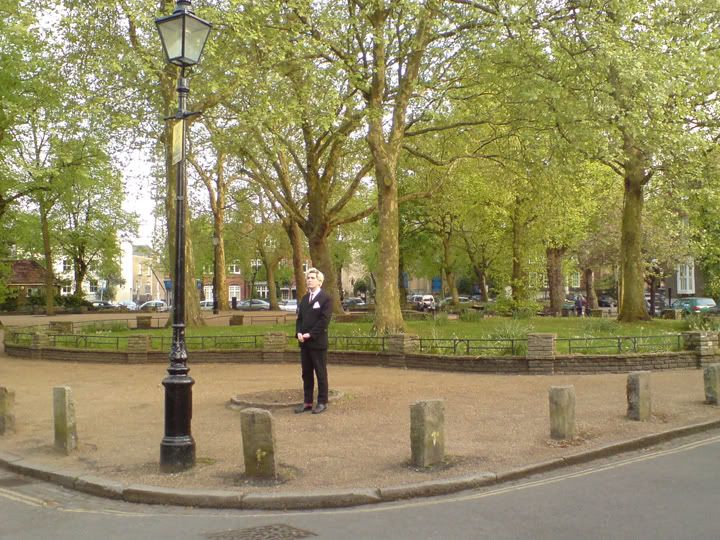
As part of an experiment in food preservation, Sir Francis of old stuffed a Highgate chicken with snow, caught a terrible chill, and died. The half-plucked chicken’s ghost has been seen howling and flapping around Pond Square in the centuries since. If by chance it appears in this photo, do let me know. I do like a good chicken ghost story.
This is also a handy guide to How To Spot Dickon Edwards From Quite A Long Way Away.
Dad writes to comment on my entry on the changing attitudes toward recycling. He lists the three Stages of Innovation, which apply to anything from the Internet to the Horseless Carriage:
1) Eccentric / mocked
2) Trendy / worthy
3) Official / commonplace.
Onto some ranting. Living alone and aloof as I do, I find all too easy to succumb to the general sense of wondering ‘what’s the point?’ about anything. You know the sort of line of thinking. Life is just too hard. So much annoys or goes wrong, or so it can seem if I let one of my spiralling funks descend. Hence the need for Diary Angels.
But this is more about Dickon the Eccentric Writer, Dickon the Wandering Flaneur, Dickon the Gentleman and Dandy. I can do those things from now to the age of 99. And I intend to. Dickon the Indie Band Leader is a different matter. Music is far more complicated, both to make and to disseminate.
If you have something to say to the world, choosing to do so by music can be wonderful, but can also be a gamble. You can reach far more people than if you were to put out your message in, say, a book, but you can also reach far fewer. And musical success is about so much more than just the music. There’s the right timing, the right packaging, the right media buzz, the right hair, the right comparisons, the right gigs, the right string-pullers behind the scenes. So much has to be aligned in just the right way. And then you realise that not everyone likes your style of music, or indeed music at all.
I’m in danger of sounding like the Mark Gatiss ‘failed rock star’ character in The League Of Gentlemen. But then, I’ve met similar figures in all spheres of creativity. At some function or other I was collared by a very forlorn gentleman who used to have a column in a national newspaper, but was booted out in order to make way for some brasher, younger columnist. He’d failed to make himself into a Name, he said. He thought it was enough to just be a good writer.
All creativity is narcissism in the end. I’m just more honest about it than most.
My CV has only one sentence:
“Don’t you know who I AM?”
(another one for the Book of Dickon Quotations, there)
I’ve also been chatting to some of the older figures in both the music world and book world. At a recent music industry launch:
Record Label Man: You’re best out of the music game, Dickon. These days, it’s full of self-deluding fools. I think you should get into the author scene – your image would have more effect. So many successful songwriters are just failed authors, anyway.
And then, at a recent book launch:
Publishing Man: You’re best out of the literary scene, Dickon. These days, it’s full of self-deluding fools. Have you thought about being in a band? Your image is very striking and would have more effect in the music world. So many successful authors are just failed rock stars, anyway.
The publisher had no idea about my past, suffice it to say. And he thought I was about 25.
Fosca Concerns – Part 1
Fosca have confirmed a rare concert on Saturday 7th July. It’s in Saffle, deep in Northern Sweden. Two hours by train from Gothenburg, fairly close to the Norweigan border. Suits me.
The event is a little indie festival called Rip It Up, and we’re playing alongside veteran Sarah Records act St Christopher. Whose album ‘Bacharach’ is rather glorious; airy and graceful and really rather lovely, like The Walker Brothers on an indiepop budget. I think the last time I saw them play was in 1990 at the Kentish Town Bull & Gate, when I was just starting to realise there was a whole underground scene of bands that strove for a certain gentle pop beauty rather than joining in with the usual drug-loving noise merchants. At that gig, the opening synth line of ‘The Thrill Of The New’ went straight through me in just the right way. It hit the spot. In fact, it remains one of my favourite gig moments in all my years of concert-going.
More details on the Rip It Up festival here:
http://www.facetterad.net/ripitup/english.html
Line-up will be myself, Rachel Stevenson, Kate Dornan and Tom Edwards. It will be rather fantastic. We have our most devoted fans in Sweden, with their home-made videos of Fosca songs on YouTube and the like. Can’t wait to unveil our latest giddy work to them.
An email from Taiwan:
I don’t suppose there is *ANY* possibility of you making a recording of this concert available to fans….? Even just a standard, un-mixed soundboard recording made available on CD-R to people from this list would be awesome… and certainly wouldn’t lose you any money! Consider it! Some of us will most likely NEVER get to see you live.
I think any live recordings should be organized and circulated among the fans. All I can suggest is to contact the Swedish Fosca fans and see if they’ll help. They’re out there somewhere. Or better still, perhaps someone will film our set and put it on YouTube, as seems to be the fashion these days.
In the meantime, we still have an album to finish. Since we started work on it in 1867 or whenever it was, I’ve dithered and hit a slough of despond. I’ve acted just like a heroin addict, but without the actual drug. It’s cheaper. Heroin addicts let time drift by because they’re busy enjoying the comfort of the drug. I let time drift by because I was enjoying the comfort of either the sadness, or the nothingness itself.
In the hiatus, the other band members have moved house, worked with other bands, changed lovers, got married, got back with lovers, changed careers, changed genders, changed species, changed trains in 1930s Berlin… Well, maybe not all of the above.
This new Diary Angels discipline has shaken me up, however, and I’ve enlisted a third-party producer, the extremely clever Alex Mayor, to help finish the Fosca album in his Hackney studio. First session on Monday week.
I think self-production is all very well, but Tom and I were tending to tweak and twiddle each track forever, until we couldn’t hear anything anymore. The best thing about DIY recording is there’s no pricy by-the-hour studio fees to worry about. It’s also the worst thing about DIY recording, as you have no deadline to work to. And now Tom’s busy pursuing a career as a session guitarist in tandem with his day job, so he just can’t don his producer hat at present. A fresh element is required. Enter Mr Mayor.
(to be continued in a second entry, later today)
Yada Yada La Scala
To the Scala venue in King’s Cross, guest of Ms Charley Stone, to see the bands Congregation and Electrelane.
Shall I say something interesting about the Scala? It’s a 1920s cinema. And it continued to be a cinema for sporadic periods all the way up to the early 1990s. Iggy & The Stooges played their only London gig there in 1972, and it’s the setting for the cover photo for their album Raw Power.
It’s also directly responsible for the classic Neil Jordan film The Crying Game. The film’s producer Stephen Woolley was also the Scala’s manager during its 80s life as a popular art-house cinema. To help finance the film he borrowed directly from the Scala’s box office takings. No Scala, no Crying Game.
Citing the fable of the scorpion and the frog crossing the river, The Crying Game is about the nature of things and the nature of people, versus situations that play on such natures. Its principal theme is that very Neil Jordan concern (whether it’s lonely vampires, werewolves, transvestites, prostitutes or IRA soldiers) – individuals caught up in situations that suppress individuality. His heroes are not so much rebels as gentle souls trying to do the decent thing. Accidental rebels.
So, as I think about this 1920s cinema which gave birth to The Crying Game, I think about how these connections neatly fit with the band headlining tonight, Electrelane.
Like The Crying Game, they tilt at a level of gender issues and androgyny which isn’t what they’re actually about, but is undeniably a part of their appeal. On paper they are four ladies on drums, bass, guitars and keyboards – the usual rock set-up – but their music is very removed from the identity of its players. They are as unlike personality-driven girl bands such as The Bangles or The Go-Gos as one could imagine, playing a brand of shifting art-rock; mainly instrumental with vocals as instruments more than carriers of lyrics.
Sometimes there’s elegant flourishes of intricate melody, sometimes there’s all-out noise. A lot of very studious, serious noise. Some pieces – as opposed to ‘songs’ – start and stop, slow down and speed up, become suddenly quiet or suddenly loud. And back again. They have a classical music approach to the rock band.
I am told they are more ‘Kraut Rock’ than ‘Prog Rock’, but I’m not the kind of boy to argue over musical pigeonholes. If you think I’m going to comment more on their appearance than their music, you’ve come to the right flaneur. Though their music has an androgynous ‘don’t look at me’ approach, they are better dressed than most all-male groups of a similar musical style. Their haircuts are elegant, and whether intentionally or not, Eletrelane’s hair is compatible with the flapper bobs, thick wavy partings and boy-cuts of those 1920s screen stars the Scala was built to worship in the first place. Same haircuts in the same space, eighty years apart. A temple to the 1920s ladies’ haircut, worshipped then as now.
Their thin, boyish-haired and boyish-dressed drummer has a distaff Crying Game appearance – an exquisite androgyny that steals hearts of all persuasions, that soldiers would die for. One imagines her journeying to the Trenches in male dress, writing letters home to her Violet Trefusis-like sweetheart.
Stage right, their guitarist is dressed in the kind of timelessly elegant dress that suggests she is about to launch into the ditties of Noel Coward, rather than wrestling ear-splitting feedback from her Gibson SG guitar. She handles the instrument in the manner of a Wodehouse character playing a game of whist, yet the sounds she produces are as muscular as the labours of the most swaggering and sweaty rock god.
One more fact about the Scala: Hawkwind played here in their 70s prime. And indeed, Electralane have their moments that recall Silver Machine, that chugging guitar hit beloved of regional indie discos from my youth. Admittedly, these are the moments where I decide to go to the toilet. When a band face each other on stage and grind away noisily at their guitars for extended periods, I can only salute so far. But that’s just me.
The Scala is packed to capacity, and it’s hard to find anywhere to stand without being jostled by strangers. A man keeps bumping into me as he dances, so I move to another part of the crowd. Then the new man in front of me also starts bumping into me as he dances. So I move right to the back. Then a woman treads squarely and painfully on my foot as she passes. I take the Universe’s hint and spend the rest of the gig in the bar.
Electralane are just too big for the Scala. Good for them, but they really should play larger venues next time. It’s hard to enjoy a band fully when one’s attentions are drawn by sweaty strangers constantly shoving themselves at you.
Also present at the gig are people I’ve known on and off since the mid 90s: Emma Jackson and Adrian L, and Rory M the Romo club doorman of old. They all look exactly the same as they did in 1996. Emma J was once in the teen band Kenickie writing unkind songs about the ugliness of Sunderland school dinner ladies. These days, she subscribes to the London Review Of Books and is a full-time academic and lecturer. But she’s still funny with it. Electralane do attract a certain chin-stroking type of intellectual (Emma J calls them Wire Magazine Types), but they also attract perfectly fun-loving people who enjoy music because it delights their heart, not because it lends itself to analytical essays. Brightly-dressed young and not-so-young girls and boys, dancing along even to the most seriously arty bits.
I did want to describe the Electrelane fans as either:
1) Gentlemen who intensely collect records.
2) Ladies who intensely collect other ladies.
But that’s unfair. Though both tribes are in evidence tonight – lots of men in glasses and half-beards, lots of women with boyish haircuts – there’s also plenty of, dare I say it? I think I will dare. Normal people. Blokes who are real blokes. Ladies who like real blokes. Straight couples. There’s even a few beefy lager lads, who stand to my right at the bar in football tops, all convict haircuts and ruddy cheeks, arguing over which of their many pints is Grolsch and which is Carling, as one of their number orders a seemingly endless amount of lager for his friends.
Before the gig, Ms Charley and I have dinner in a cheap but lovely cafe across the road. On the laminated menu are different fillings for jacket potatoes. One description in particular makes Charley laugh:
“Tuna – all styles.”
Recycling In Style
Many domestic refuse collection services in the UK are winding down from weekly to fortnightly, for the first time in my lifetime. Or they are threatening to do so, and it’s not always clear when it may happen. Which I entirely approve of.
Whether the more densely-populated areas such as my own dear Haringey will make the switch and stick with it is going to be interesting, what with the dangers of increased vermin and aroma concerns. But in terms of making what Americans terms a ‘wake-up call’ to the wasteful UK populace, it really seems to be working.
People are visibly recycling more and ditching less. Or rather, they’re purchasing fewer items which cannot be easily recycled. It’s the plastic tubs, carrier bags, fast food cartons, ready meal trays and other plastic food packaging that Haringey Council can’t take away (ho and indeed ho), even though many of these items are themselves marked as recyclable with those cute little symbols. It’s all very well saying there’s special depots to go to to dispose of such materials (eg for the long-term batteries used in electronic devices), but on the whole many people are just going to put everything their council can’t collect automatically into their normal dustbin.
Now that there’s this threat of fortnightly collections, however, people are really starting to enjoy the challenge of reducing their waste. Seeing one’s dustbin liners contain fewer and fewer items feels rather good for the soul. Even neighbourly one-upmanship can be used to do good in this regard; recycling is now seen as a matter of civic pride rather than the hippy-like eccentricity it once was. The curtain-twitchers have become the ‘alternative’ types they once feared.
To be the household on one’s street with the most black bin liners outside its gate is now utterly shameful. Black bags are black marks. This is the secret of real social change. Once you can harness the power of public embarrassment, you can make the English do anything.
Maybe some sort of 21st Century ASBO stocks should be brought back for certain repeat offenders; not to pelt burglars with rotten fruit, but just to embarrass them in public. Perhaps they should be forced to wear a pair of Mickey Mouse ears and nose. Or just dress them like me. There could be a sign above the miscreant’s head saying: “Here is a local criminal. Doesn’t he look gay?”
Maybe that wouldn’t work in the case of the Krays. I haven’t thought it through.
But I digress.
For my own anti-waste part, I’ve reduced my ready meal intake dramatically. I rarely buy them anymore. When you’re made more aware than ever that plastic tubs and trays just take up a landfill site for no good reason, it’s really hard to ever buy them again. And of course, there’s just no style to them. Not even those really nice ones at Marks & Spencer.
Wax-lined drinks cartons have had to go from my life, too. However ‘innocent’ the smoothies within say they are, if your council cannot recycle them in their weekly collection tubs, they’re the work of Satan.
A pressing concern is the recycling of CDRs and old VHS tapes. But thanks to the Web, I’ve now learned you can send away your piles of unsellable CDs to be made into burglar alarm boxes and street lighting:
http://www.london-recycling.co.uk
Here’s a company that will take your old VHS tapes off you for 20p a go:
http://www.tapesuk.co.uk/acatalog/Tape_Disposal.html
That trendy anti-waste shopping bag which people queued up for the other week has come under fire. Its slogan ‘I’m Not A Plastic Bag’ has been parodied as ‘I’m Not A Smug T–t’ by one Brick Lane stall holder who makes her own bags. Of course, to advertise to the world that you’re NOT smug is extremely smug in itself.
The news coverage of such bags will only last so long, and I suspect the irony is that they’ll be put out for recycling themselves in a few months, replaced by some other trendy bag. But what will stay is a general sense of people cutting down on their conspicuous consumption. Good news.
Children Of Night
Sunday. To The Bullet Bar – formerly the Verge – in Kentish Town for the engagement party of the prong-haired, make-up clad music critic Simon Price and his doll-ed up girlfriend Ms Jenna (literally – she is dressed as a porcelain Victorian doll, and looks wonderful).
Present are faces from the past and present: Tim Chipping, Xavior Roide, Andrew Mueller, Chris Roberts, Taylor Parkes, Rhoda B, Ms Anwen’s Marc, DJ Val, David R-P, Seaneen, Tallulah. As it is with Mr Price’s clubs, plenty of glittery-attired people of all 48 genders, and a few takes on Cillian Murphy’s character in Breakfast On Pluto, as good an indication as any of the average attendee of Mr Price’s clubs. There’s also lots of older and more soberly-dressed people who are clearly family members. Both mothers make approving speeches.
Normally it’s the drably-dressed ones that I fear are going to attack me for my appearance – as has even happened in Mr P’s own club on occasion. But this is a private party, and Mr Price is in charge. Normal people are allowed in as long they don’t jeer at the more outlandishly attired and eccentrically coiffeured. Well, not to their faces anyway. It’s nice to go out and feel entirely safe like this.
Some might call those who dress like Mr Price and his dancing friends ‘Goths’. But despite their love of cemeteries and the iconography of death, Goths tend to be quite gentle and non-violent. It’s the other types of Children Of Night that I really fear.
Outside the Bullet Bar I wait to catch a 134 bus home, and when it comes, it zooms right past me. Full up. But I don’t mind too much. Buses at night really don’t agree with me.
On the previous night, Saturday, I take a 263 from Archway to Highgate. It’s a very short journey, but I am feeling rather tired. The time is about 9pm. Within seconds of the bus moving away, an undeniable stench of dope smoke fills the vehicle. The driver stops the bus and calls out for the smoker in question – the only person on the top deck – to desist. A young man in a puffy tracksuit and a baseball cap bounds angrily down the stairs and has a heated discussion with the driver.
“Look mate, do I have anything in my hands? Do I? Do I?”
He’s clearly disposed of the joint in question, which is the idea. But now he’s going to have an argument with the driver anyway. For the sake of it. Just because he wants to feel right. And myself and all the other passengers have to sit and wait until this petty tableau peters out. And we just hope he doesn’t involve us. There’s the inevitable stand off, and the argument quickly hits a loop of the same phrases uttered on both sides, again and again. As all such arguments do. I jump off the bus quietly and walk home, leaving them to it but feeling upset that this sort of thing happens far too often.
I’m sometimes accused of acting like the world revolves around me. If only. Sadly, on Saturday nights, if not every night, I’m made indelibly aware that the world really revolves around shouting young men (and women) like this. Readers who aren’t keen on my more liberal and Guardian-esque entries will be reassured to know that it’s on occasions like this I find it hard not to think of Daily Mail-ish terms like ‘feral youths’. These are the young people who shout, scream, fight, intimidate and generally make getting about London at night that little bit more stressful for me and my non-violent friends. One could argue that there’s always been youths like this in every generation, and always will be. But that doesn’t make me feel any happier about getting back from a party.
I can’t help thinking that perhaps these youths really should join the army. Not to kill people, but to keep the peace. Or perhaps just a boxing club. They’re clearly teeming with surplus aggression, and it does seem unfair to spend it on people in their immediate vicinity, hostages to these brasher striplings. Like any other energy source, this aggression should be harnessed to do some good, not channelled into petty arguments with unlucky bus drivers. And that’s about as Daily Mail as I get. I have such sympathy for the casualty staff and bus drivers who work at nights. Whatever they are paid, it can’t be enough.
So if I can’t afford a taxi, which is rather the case at present, I’m finding it can be safer and less stressful to walk the streets at night than catch a bus. And I do need the exercise. So when the 134 passes by, packed and unyielding to new passengers, I take the Universe’s hint.
Thankfully, though they act to the contrary, such youths are not the world. The Diary Angels page is still growing, and can be found here. Thirty-eight Angels so far. Most of whom, I’m fairly certain, don’t pick arguments with bus drivers about their right to fill a bus with dope smoke and pretend they haven’t.
I’ve already sent the Angels their first exclusive: a lovely e-card of colour artwork, specially commissioned from Oxford artist Jeremy Dennis. It’s of me at my laptop surrounded by a host of said Angels, with reference to an early Beardsley self-portrait where he’s working as a clerk, entitled “Le Debris D’un Poet”.
Ladies, Form A Queue
This week’s episode of Doctor Who concerns a mad scientist who makes himself decades younger, only to undergo a horrific side-effect. Has he never read any science fiction? Or even The Picture Of Dorian Gray? I’m reminded of a similar episode of Star Trek. In that story, when the character in question first appeared it was so obvious he was a young actor in old man make-up that one immediately knew what was going to happen.
At least the Doctor Who version sported such a convincing cosmetic job it was difficult to tell whether they’d cast a genuinely elderly actor. Or in this case, an older and balder Richard Briers. But no, it was Mark Gatiss underneath, who soon reverted to his more familiar appearance as a younger man. For his more monstrous incarnation he was replaced by a computer-generated scorpion-thing with a human face, straight out of Clive Barker’s Undying game. Small children watching must have had nightmares, which is obviously the idea.
The story is tried and tested, and so is the desired effect. It’s a magic formula about a magic formula. Though it was more about prolonging life than reclaiming one’s lost youth and beauty, the coinciding of this fictional story with news stories about people queuing up to buy theBoots No. 7 Protect and Perfect serum is exquisite. From Cleopatra and her milk baths, to the unpleasant Mr Gray of Oscar Wilde fame, to that Hammer horror film where Ingrid Pitt bathes in virgins’ blood to keep the prosthetic make-up wolves from her door. And now Doctor Who on TV, and Boots The Chemist in the real world.
[Idea for parody: The Picture Of David Gray. A mad scientist invents a serum which turns him into a monstrously inoffensive singer-songwriter with a wobbly head who has a few big hits about ‘Babylon’ or something, then vanishes from trace. Probably been done. ]
It’s the third time in as many weeks that there’s been news stories about women forming long queues outside London shops. First for some trendy shopping bag, then for Kate Moss’s clothing range at Topshop, and now for this Boots anti-aging cream.
Walking around Highgate with Anna S on Saturday, by way of a post-haircut stretching of the legs, we pop into the Flask pub for a quick drink. There’s a long queue at the bar. We don’t like the Flask THAT much, so we repair to the Angel Inn down the road, where there’s empty seats and no queue. There’s two men playing chess, and two women playing Trivial Pursuit. Which sounds like I’m trying to make a clever metaphorical point, but I’m not, honest.
Like the one in the Flask, most queues are not worth being in. Not really. I generally am suspicious of anything that can make people queue up when they don’t really need to. Particularly if it’s generated huge amounts of column inches.
But the thing is, these ladies are not queueing for just a bag, or just some celebrity-endorsed clothes, or just some skin cream. This is about being part of something that other people have been convinced to desire, which means they desire it too. And once again, it’s back to Tom Sawyer and his queue of boys paying to paint his fence for him. They’re not being conned, because they’re happy. A hunger has been generated, and they’re more than happy to satisfy it, however unnecessary it looks on paper.
God: But what do you want? What do you really want?
Mankind: I’ll have what everyone else is having.
Liz Jones in The Daily Mail, on the queues for Ms Moss’s range:
Actually, the queuing part – fuelled as we were by free bottles of water and packets of sweets – was quite fun.
Elsewhere:
“It’s a really fun thing to do with your friends,” said one 14-year-old girl. “We came prepared with hot chocolate, and the atmosphere in the queue was fantastic.”
Less happy are queuers for the Boots cream, covering their faces from the cameras. Perhaps they’re mutating into nasty scorpion monsters.
One feels the need to print up the following on stickers and affix it to the Boots shelves:
… Boots paid for the research [featured on BBC TV’s Horizon programme]. It sponsored the study, led by Christopher Griffiths, professor of dermatology at Manchester University… He said: ‘I only tested Boots products. If I’d tested other firms’ products, I may have seen changes with theirs too.’
So much for The Science Part. But then, this isn’t what they’re queuing for. People who use this cream really want the warm, skin-renewing glow from the sense of acquiring that which is desired en masse:
Head of customer care at Boots, Graham Hardy, said: “We’ve heard many stories as to why women should be top of the list to receive the serum, including ‘It’s my son’s wedding in three months’ time”.
Had I written the Doctor Who story, I’d have taken more of a Dorian Gray slant (Reader’s Voice: Oh Mr Edwards, you surprise us!). I’d have asked questions about male vanity, metrosexual men, boy bands, toy boys, Mark Oaten’s hair falling out as his alibi for taking on rent boys, and all the attendant homoerotic connotations.
The Boots stories have hinted at this, but prefer the chivalrous take:
“We have had some men in buying it, but whether we can believe that it’s for their wives and girlfriends as they claim and not for them is up for debate.”
Harry Roach, 73, was the first in line after creeping out of bed shortly after 4am to surprise his wife. The retired production manager from Wythenshawe said: ‘Edith had been trying to get hold of this cream for some time. She was over the moon. I’m definitely in her good books.’ Edith cooked him a huge breakfast as a thank you. The retired secretary said: ‘He is a very good husband and it was a lovely gesture. Friends will be jealous.‘
Never mind the cream itself; the feeling of getting one over on one’s neighbours, of owning whatever object of desire is in the news, will always do miracles for the complexion.
Three Ages Of Boyz
Friday evening. I’m in the Queens pub in Crouch End with some friends. Charley S, Anna S, Suzi L, Rhoda B. Also at the table are friends of these friends: Ms Miriam, and the bleached-hair couple Ms Francesca and Mr Rory. And later we’re joined by Ms Miriam’s friend Mr Steve (it helps that to me he has a slight resemblance to Miranda’s boyfriend Steve in Sex & The City), and later still, Ms Seaneen and Mr Rob.
On introduction – or even re-introduction – I have a little difficulty getting the names right of some of the Friends of Friends. It’s always been a problem for me. My brain works in such an odd way that if I’m not in regular contact with someone, their face and name can just fade from memory completely. Someone I’ve met only in clubs looks completely different to me if I see them in the open air, or in daytime. They can be terribly annoyed with me if I can’t recognise them or recall their name.
It’s as if there’s only a limited amount of names and faces I can store in my memory, and too many of those spaces have been taken up by people on TV or in magazines or figures from literature and history, who don’t even have the courtesy of knowing who I am in return. I know how to spot AE Housman in a crowd, and indeed know exactly where he lived when he wrote A Shropshire Lad. Yet visiting my friend Anna S’s for my haircut yesterday, a place in Archway I visit fairly often, I still have to take a piece of paper with her address on. Admittedly there’s a blue plaque at the former building, and none at Anna’s flat. Though I’m sure it’s only a matter of time. “Dickon Edwards came here to have his hair cut”.
Despite meeting in the pub’s beer garden, we all have to move to a table indoors as the evening progresses. It’s currently deceptively sunny during the day, but really rather chilly after five. Charley looks positively upon these changes of the season, rejoicing that she’s just seen her first swift of the year. By way of contrast, Suzi L bemoans the first flying ant.
At one point in the evening there’s a sudden cloud of potential violence, as a man at the bar shouts at the staff “Don’t tell me what to do! No one tells me what to do!”
It looks as if he might throw his pint glass at someone – anyone. Or do worse. But thankfully he just storms out the door and the atmosphere is calm once more. What’s particularly unusual is his appearance – not your usual pub troublemaker in sports wear, with a convict’s haircut and a face that’s permanently screwed up in knife-edge anger at the world. This forty-something gentleman has long, almost pirate-like brown hair and an expensive black suit over an arty black jersey. This being Crouch End, he could well be a playwright that’s just had a terrible career setback. Or a hugely expensive divorce settlement that’s not gone his way.
Also in the pub I bump into Emily Dean. Which is a bit of a coincidence as it’s the same day her sister sends me a clipping from her rather fun ‘Giving Fag Hags A Voice’ column in Boyz Magazine. It says terribly nice things about me. Here it is. (click on the image to view the page as a PDF file).

You can see the white marabou shrug worn by her sister in the photo, the one donated by one of their mum’s oldest friends, the glamorous 70s pop star and hit songwriter Lynsey De Paul. One of my earliest TV pop memories was watching Ms De Paul and Mike Moran performing Rock Bottom, their Eurovision Song Contest entry for the UK. This would have been 1977. Other people remember Punk Rock, I remember Lynsey De Paul. Much as I love the Sex Pistols, between clothes passed on by Johnny Rotten and clothes passed on by Ms De Paul, I have to say the latter is more ‘me’. So I’m absolutely delighted to be in the presence of her shrug.
Rachael Dean adds:
“Over the years Lynsey has given us some classic pieces. Favourites include a peacock blue velvet, jewel- encrusted, bell bottom jumpsuit and a pair of bell bottom jeans with red feathers and beads sewn along the seams, and a couple of floor length mink coats (very Joan Collins in The Stud).
I’m in heaven amid such descriptions. Just typing the words ‘Lynsey De Paul’s white marabou shrug’ gives me an almost criminal sense of pleasure.
I once saw an early live version of Little Britain, where Matt Lucas played a male police officer called Inspector Lynsey De Paul. It was joke you either got and found funny or didn’t, like their naming of council estates after contestants from the 90s comedy show Whose Line Is It Anyway, or calling a pub The Scarecrow And Mrs King. It’s a kind of Half Man Half Biscuit approach to comedy: names and references which can surely only make a limited amount of people smile.
Equally, last night’s Doctor Who had the Doctor ‘reversing the polarity’ of a wicked machine. This reference to the Jon Pertwee days would have made no difference to the viewing experience of most normal people, but the hardcore Doctor Who fans of a certain age would have been terribly pleased.
The Boyz photo is from a DJ gig I was booked to do for the Dean sisters, the same evening I returned from Tangier. I think I look pretty good considering I’d been awake for nearly 72 hours and had just flown in from Africa. I haven’t smoked since then, so the photo also features my last cigarette. Well, up to now.
I’m fairly sure this is my third appearance in Boyz Magazine, the lively if naughty weekly magazine supplied free to gay bars and clubs in the UK. The first time was as part of the band Orlando, the second as part of Fosca in a piece on Club V, and now I suppose this is the Third Age Of Dickon Edwards: dandy and occasional DJ until I can find something else to be Best Known For. Not that I’ve quite finished with Fosca, though.
The editor of Boyz used to be a chap called Hudson, who wore a Parka and was very much into indie music and guitar rock, rather than the more stereotypical choices of the average gay club attendee – techno, Kylie, trance, disco. Essentially, repetitive dance music made by computers for sweaty gentlemen to frolic to. Though the 90s did see the coming of clubs like Popstarz where Uranist boys were allowed to enjoy Blur and The Strokes, I don’t think the tide was ever completely turned in this direction.
But it did mean that for years Boyz happily featured indie guitar bands alongside the latest news on whatever DJ remixes were ‘having it large’ in the clubs. There’d be an interview with some band, and then a large pull-out photo of a young gentlemen appearing only as Nature intended him, for the purposes of what society used to call Against Nature.
The last section of the magazine was always a generous helping of pages containing adverts for the kind of pleasures one would expect in a colourful gay publication. The bands come and go, and the DJs come and go, but the adverts always stay the same.
White Marabou Shrug

Lynsey De Paul’s white marabou shrug. Me. The same paragraph.
Happiness.
(more on the provenance of this clipping tomorrow)
P.S. The next Beautiful & Damned is May 24th.




