Everything Is Sexy To Someone
Dad, a fellow Doctor Who fan, asks if the Gormley statues moved when myself and Mum were looking at the nude bikers, and thus not looking at the statues. He’s referring to the Doctor Who story that evening, “Blink”, where the monsters are the kind of stone angels found in cemeteries. They move and get you whenever they’re not being watched, or even if you blink. Truly gripping in the old-fashioned 70s Doctor Who style (even though it involves the world of DVD extras), well-written and beautifully acted. One can certainly imagine the army of bronze Gormleys going after people. I imagine his big box of fog is a particularly good place to attack victims.
***
Sunday afternoon – to the Wolseley in Piccadilly for afternoon tea. I always have Earl Grey with scones. Present are Xavior Roide, Suzi Livingstone and Hazel Barkworth. Suzi and Hazel have tickets to the Princess Diana memorial concert, at which Duran Duran and the Spice Girls are playing. Xavior still has a seemingly charmed if deeply unusual life where strange men he found on the Internet come round and pay him for the pleasure of cleaning his flat. It’s their fetish, their sexual kink: cleaning the flats of young men, and paying for this pleasure. Like a naughtier version of the Tom Sawyer fable. Apparently these men don’t even wear special clothing in which to do it.
Everything is sexy to someone: you just have to find them. There must be people somewhere in the world who derive erotic pleasure from filling out other people’s tax returns. Though there is always a line drawn somewhere. “I’m only attracted to filling out the tax returns of buxom blondes between the ages of twenty-five and thirty who wear opera gloves. Nothing strange.”
***
Mum and I walk through the courtyard of Somerset House, as we’ve never seen it outside of winter when the famous ice rink is in place. On this scorching June day, the courtyard is host to a grid of fountains set in the ground. A few brave tourists walk through the narrow gaps and take photos of each other, fully-clothed. Small children in swimsuits jump about in the jets with their Dad, while their Mum sits at the side with the piles of shoes and clothes. It’s the sort of thing one sees on the front of newspapers the next day, always with some caption about record temperatures. The hottest June on record. The hottest day of the year so far. The hottest day since last Tuesday.
Many of the offices around the courtyard still belong to the Inland Revenue. For years this space of ice rinks and fountains and simple joy was a car park for tax inspectors. I like the juxtaposition of these eternal extremes: uncomplicated children’s happiness against complicated adults’ grumpiness. If you do have to work in a tax office, I imagine there’s worse sights to look out of the window at in between all those forms and filings. Beats car parks, anyway.
A Matter Of Life And Death: On Stage
I find some days contain enough novelty and adventure to generate several diary entries, while others are wastelands of duty, chores, reading and writing (or trying to write) and quiet nights in. It’s not so much that nothing happened on these duller dates, more that nothing new or particularly noteworthy happened.
If you’re going to see “A Matter Of Life And Death” and would rather not know about the controversial ending, best avoid this entry. The ending has been debated in corners of the national press, though, and I would say the point of the production is the whole show: it’s not a murder mystery. I knew about the ending in advance myself, and it was still pretty shocking.
So, it’s the previous Saturday, and I’m at the National Theatre with Mum to see the stage production of A Matter Of Life And Death, based on the 1940s film by Powell and Pressburger. It has had mixed reviews, not least because of its choice of endings, where the David Niven character lives or dies on the toss of a coin. What’s more, the coin in question is handed to a member of the audience to do the honours. It’s said that some audience members have fibbed about the result in order to save the hero’s life. Mum and I agree that if the coin were handed to us, we’d have to refuse and ask the next nearest person to oblige.
At this Saturday matinee, the coin comes up heads, and the Niven character lives. But though the audience sighs in relief, the closing song, presumably in place for both endings, is still pretty sombre and bleak. Either ending is a sad one, because of the point it raises: war is random and death is unfair.
This is something of a departure from the classic film’s conclusion of love winning against the celestial order. It’s a very 2007 interpretation by director Emma Rice, who blends in post-Dresden awareness, and indeed post-Iraq awareness. She also nods to her own personal story concerning memories of her bell ringing grandfather, who survived the War but was a witness to many who died. The show features much otherworldly bell ringing, and only by reading Ms Rice’s poignant programme notes does one truly appreciate this detail.
Also in the programme are real letters home from airmen, including one to be handed to their parents in the event of death. It’s from the base at RAF Wattisham in Suffolk, with a Bildeston phone number. Bildeston is the village I grew up in.
Much as the 1940s film is a masterpiece, I have always thought that parts of the trial sequence are very of its time and hold up the otherwise timeless nature of the story. Mr Niven’s prosecuting counsel is the first American soldier to be killed by a British bullet, and there follows a lengthy musing on very 1940s attitudes held by the UK and US towards each other.
In Ms Rice’s stage remix, the prosecution is conducted by no less than William Shakespeare, who calls witnesses from the dead mothers of Dresden and Coventry, all dressed identically. The Niven character is the pilot of a Lancaster Bomber with over sixty ‘ops’ to his name. The show thus argues that his unfair death breaking a loving couple apart is no different to the umpteen similarly dividing deaths he’s had a hand in himself. And thus to the climactic coin-tossing over his own life.
It’s certainly thought-provoking, and though Mum and I thoroughly enjoyed the show, I can understand why many fans of the film, or indeed just people who disagree with this concluding sentiment, aren’t entirely happy with it.
I would say it’s better not to judge the production as an adaptation of the film, more as an idiosyncratic and personal spectacle that takes the Niven movie as a departure point for its own ideas. Of which there are plenty.
It’s not a dull couple of hours: the company are the very physically-inclined Knee High group from Cornwall, who specialise in a more physical and visual approach to drama. The star of the show is the staging itself, the actors merely its servants. Nurses on bicycles (but unlike what we saw later on Waterloo Bridge, they’re fully clothed), pedalling upside down on hospital beds, lots of ropes and climbing about on swinging platforms, lots of original songs (even a rap-style number at one point) lots of precision choreography and inspired costume and set design, and one favourite moment of mine where pocket torches shoot up out of the players’ hands to become stars in the night sky. Imaginative ensemble playing all round.
The opening scene where the Niven hero falls in love over the radio with a female base operator is still incredibly powerful and moving, and is pretty much a straight lift from the film, though the heroine here is English, not American. But with all the music and rope climbing and similar goings-on, there’s times when the story can’t help but take a back seat to the spectacle.
Still, when you’re an actor trying to play out an emotional scene while negotiating a series of hospital beds suspended some distance above the stage, that’s only to be expected. At such moments, the audience are more concerned that the players aren’t going to have their limbs broken, let alone their hearts broken.
Actually, I wonder how the Knee High Company wish each other good luck before a show? It can’t possibly be “break a leg”.
Voyeurism With Mother
Saturday, 9th June, 4.30pm or so. A painfully hot day in London. Well, painful if you insist on wearing a black suit with a lining purely because that’s who you are. Should have worn the white linen one, only it doesn’t last long before needing a good dry cleaning, while the black ones are more practical. For a person living hand-to-mouth, I must spend far more on dry cleaning than I do on food. But what are luxuries to some are essentials to me.
I am standing on Waterloo Bridge, the South Bank end by the National Theatre. With me is my mother. We have just seen the matinee performance of ‘A Matter Of Life And Death’ by the Knee High Company, and are about to walk across the bridge and into the main part of the city.
Then my mother says, “Oh, look.” And I stop nattering on about whatever I am nattering on about and see if I can see what she sees. Always had a problem with that one. I rarely notice what others notice when walking in company, most of my badly-wired brain dedicated to the act of being in company itself. It’s only when I’m alone do I really notice my surroundings.
So I look up and I do notice something unusual. Lots of bronze statues of nude men on the roof of the Hayward Gallery and surrounding buildings. I know exactly what they are, as will any Londoner with the slightest interest in the arts. They are the work of artist Antony Gormley, and are based on body casts of his own unadorned physique. We passed one earlier on, on the bridge itself. He’s been doing variations on this theme for so long now, I feel more familiar with Mr Gormley’s genitals than I am with my own.
Funny how we like modern artists to more or less stick with the one sort of idea. When Damien Hirst dies, regardless of his coloured dot paintings and medicine cabinets and anything else he does, the obituaries will have the animals in formaldehyde. For David Hockney it won’t be his photo montages or fax machine pictures or the opera set designs or the paintings of his dog. It’s going to be the swimming pools. Oh, and maybe that one of the couple and the cat. Henry Moore – big lumpy human-like sculptures in parks. Barbara Hepworth – big lumpy abstract sculptures in parks. And even though Mr Gormley is currently exhibiting a new kind of installation – a huge cube of fake fog visitors can walk into – he’s still The One Who Does The Body Casts. Still, it’s not if he’s resisting the label. This time, his body-cast bronzes are on the rooftops of London.
“Oh yes,” I say to Mum. “I see them. Lots of nude men on the roofs.”
“Never mind those. I meant the real nudes on bikes. In front of us.”
My eyes had skimmed over what I thought was some ordinary group of cyclists mounting the bridge. But now I see what she means. The cyclists are the first in a long parade of hundreds, blocking our way forward. And they are naked.
Nude Gormleys above, real nudes on bikes below. My mother standing next to me. The phrase “I don’t know where to look” springs to mind.
Some carry banners protesting against oil-guzzling vehicles stealing the roads, but whatever the message of protest is, it is rather upstaged by the mass nudity on display. Mostly men, about 35% women, pale and pink flesh everywhere. Some are slightly less naked – a few underpants and shorts or bikinis. One or two are even fully clothed. But the vast majority have it all out. Just as well it’s a hot day.
As is usually the case, many bodies on display are less Michaelangelo and more Michael Moore (in every sense). But I’m happy for their cause.
My unease, though, is the one experienced when watching a movie with one’s parents, and there’s a sex scene. Except this is real. I feel I am essentially staring at a parade of real genitals with my mother. And me just out of therapy.
She thinks it’s all rather fun, of course. It’s me that’s mortified. Mortified, and overdressed, in a sea of the undressed.
One or two of the younger riders are actually rather comely. And my thoughts are that, with my luck and my image, there’s no reason not to suspect that this could be my last exposure to attractive naked flesh, between now and the grave. Standing on the street, fully dressed, with my Mum at my side.
And so, as this atypical event is happening, I am thinking, “typical”.
Share The World’s Resources
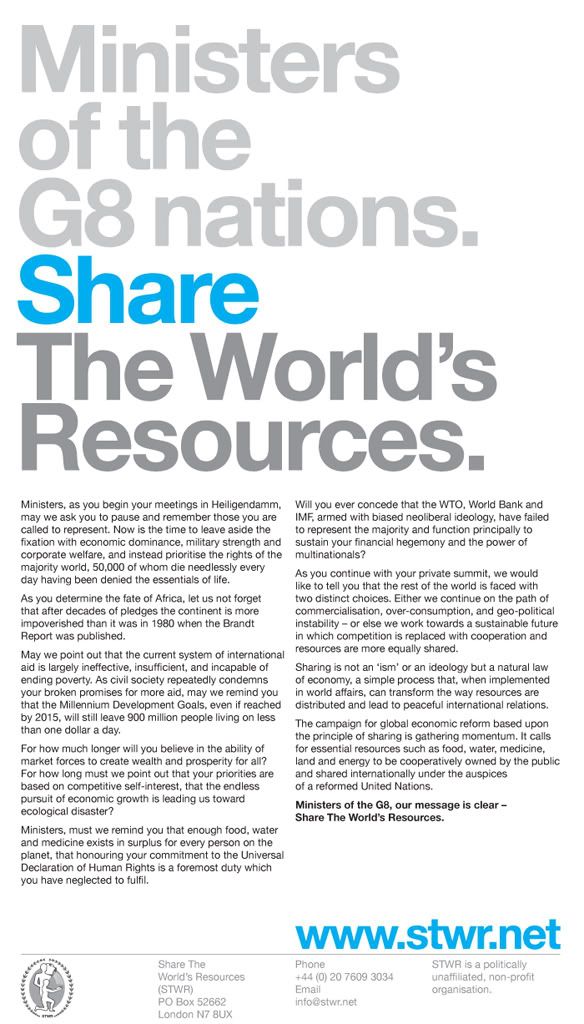
My friend Ms Connor toils in the salt mines of the commercial design world, and has lent her talents to a humanitarian organisation called Share The World’s Resources. She worked on this advert of theirs, which took up a page in the Guardian this week:
http://i211.photobucket.com/albums/bb150/jenconx/STWR_G8Letter.jpg
She writes:
The G8 Nations comprise 2/3 of the world’s economic power, yet only 14% of its population. If you’ve got time, please read the ad (which is a letter to the G8) and feel free to spread the word about STWR to as many people you can. This is about spreading ideads that can change things for the better – nothing more, nothing less. Highlighting the reality of issues facing our world as a whole such as global climate change, poverty, and a severe lack of accountability of governments and corporations to do what is right by us.
For more about STWR: http://www.stwr.net/
Creative DJs
Many blogs have open comment boxes. I don’t. Not for me. I prefer to have an email form on the website for anyone who really does want to get a message to me. A little like ‘Letters To The Editor’. It’s only a few clicks of the mouse away from the diary, by which time a reader would have worked out if they really do want to go ahead with their correspondence or are just bored and hey, it wasn’t really important anyway.
I would say about 80% of blog comments are entirely trivial and unnecessary. And that’s putting it nicely. It can be summed up in an equation. Internet + blog comment button + boredom = unnecessary comments, unflattering to reader, author and the human race. Many of such comments are by people who went to university, too. It does them no favours. It’s no good having a First in English from Oxford if the moment you go online, you turn into a dizzy 8-year-old girl.
If Virginia Woolf were about now, would she be posting photos of her pets and expecting the world to give a hoot? Oh wait, she published ‘Flush’, an entire book about a dog. Okay, bad example.
I went onto Myspace last night to find about a hundred messages waiting for me. Most of which were strangers plugging their bands or clubs. The others were, well, hardly the stuff of literary biography. No serious enquiries or proposals. The MySpace website itself was taking so long to respond that I just gave up. Life really is too short to spend hours at a computer pressing ‘delete’ and waiting for the page to refresh.
Too many areas of the Web have made it far too easy to generate pointless messages, and far too difficult to delete them. A decade’s blogging experience has taught me that asking people to write to you directly rather than post a public comment filters out all kinds of knee-jerk trifles, heckling for its own sake, and childish pettiness. There’s a place for that, sure. But I can only read so much of it per day. Once again, there just has to be a balance between Heat Magazine and the Times Literary Supplement.
There’s a feed of this diary on LiveJournal, and occasionally I take a peek to find a comment or two. I wish such commentators would email me directly instead, or I could miss something well-considered like this:
… but Dickon, DJing is creative, it has to be… There are people who’ve set up club nights which have had a far greater impact on people’s lives than most bands… Most good DJs also are musicians, they can match rhythmically, they know how to build a set, they are aware of the context of the music they are playing. See Erol Alkan or Larry Levan. And I’m not ashamed to say my residency has paid me a four figure sum over the past year, because I’m good at what I do, be it ‘just’ DJing… I could have just written, ‘it was good enough for John Peel’ here… But I do agree that ultimately first hand creation is the ultimate aspiration, because it takes more effort, not just some effort. Which is why I am going back to it.
You’re right, it is perfectly possible to be a creative DJ. Erol Alkan certainly is one, with far more ideas and creative worth than many derivative bands, who I don’t regard as creative in the slightest; more like joining in. I do like the odd Daft Punk, Death In Vegas, Basement Jaxx and Chemical Brothers record. They’ve all blurred the original artist / DJ distinction somewhat, and are very much in the ‘creative’ box.
Fatboy Slim is also a master of his art, though when I see footage of him performing to a massive festival crowd and doing his “arms in the air! make some noise!” gestures, part of me does think, “I miss the Housemartins.”
Regarding John Peel, I’d say he was more a broadcaster than an ordinary DJ, with his unique voice punctuating and branding his shows, which is far more creative than just playing records back to back. His voice was as important as his taste.
Still, that’s very true about DJs, club scenes and journalists influencing new bands. Though I would say they’re more catalysts and departure points, not destinations in their own right.
My point – and the Fosca song – is really addressed to artists that give up their songs entirely to become the more lazy, non-creative kind of DJs, slipping into a DJ career because it’s an easier ride and a regular wage. Less risk. More keeping your head down. Safer and more financially secure than marching up to the microphone and expressing oneself via an original lyric. But if you prefer it anyway, then fine. Personally I’d feel a bit itchy myself if I did it as my main activity. It wouldn’t feel entirely right.
God knows I’ve met many PRs, managers, TV producers and promoters who are far more original thinkers, smarter wordsmiths and indeed better dressers than the so-called talent they work for. They should be the ones on stage and on camera, not their clients. Essentially, I feel that if you do have a creative itch, it should always be scratched.
I appreciate the financial side of a proper DJ career is tempting, and it wasn’t easy to turn down offers of paid club work this month. But I’d made a promise to my heart that it was Latitude only for the time being, so I can think more about finally finishing the Fosca album. And because I don’t want to become a regular working DJ – it’s not really me. Just now and again is fine.
Which is a shame on a strict survival level, as I could really use the money. Still it’s better to be poor and happy than paid but itchy. And am I happy? Don’t answer that.
Anyway, at past gigs, I’ve introduced ‘Don’t Be A DJ’ (written years before I did any regular DJ-ing) with a kind of disclaimer:
“This next song… I don’t necessarily agree with in its entirety.”
It gets a laugh.
B&D At Latitude
Last night – mixed the Fosca song ‘Don’t Be A DJ’. It’s not strictly anti-DJ-ing, more about people who fall into non-creative jobs around the creative works of others, where they can keep their head down, immune from any criticism. Fear of tall poppy syndrome. PRs who should be stars, working for dull stars who should be PRs (or anything else). Music journalists who are more attractive and have more to say then the dull bands they have to write about. How even the finest piece of music criticism only benefits the subject not the writer. A beautiful essay on Scott Walker only benefits Scott Walker. Whereas if Scott Walker recorded a beautiful song about the journalist… it would STILL only benefit Scott Walker. Thus with DJs. The need to rely on the works of others adds a level of compromise that irks me.
And this is one reason why I’ve turned down any hints of a career in either field myself. I feel the need to get on with writing an original song, story, or even just something in this diary. I’d feel a fraud if I did DJ-ing or reviewing seriously. It’d feel like an alibi. An excuse for not doing what I’m meant to be doing.
Had a discussion about this with producer Alex M, and we agreed that even the lowliest creative act, the record no one buys, the song no one hears, is still more noble than the finest book on pop music. Because creating is always greater than spectating. Then we thought about oh, Coldplay or someone we don’t care for. Are we really saying that Coldplay have more worth than great critics like Paul Morley or Simon Reynolds?
We solved this one by deciding that what Coldplay did wasn’t at all creative… Ah, a cheap jibe I know. I’m sure they feel the sting in their glittering mansions. Sorry, Coldplay.
It’s not like the art of literary biography, writers on writers: if a book on the Sex Pistols survived their music, it’d be worthless. The best thing a book on pop can do is make you go and listen to the records. They can never really stand alone, by their own nature. Writing about music will always be popular, because of the need to make sense of the abstract. But it still needs to come from, and go back to, the music. I leaf through a magazine and read some great pieces on bands I’ve never heard, and it’s all pointless unless I can get hold of the music too. It can’t stand alone in its own right. Just as DJ-ing can’t happen without records, but you can make records without being a DJ.
Dear Lord, let me not die a Fan.
Still, the occasional and unusual bout of DJ-ing here and there is fine, I decide. So I have turned down all offers of summer DJ work except one – the Latitude Festival in Suffolk.
I wasn’t sure if I was going to be booked or not, but today I find out for sure. Yes, it’s on. I’m booked. With Miss Red too, as The Beautiful & Damned. DJ-ing every evening in the Cabaret Arena, while silent movies and strange tableaux abound. And I will be shunning loitering within tent in favour of staying with my parents, in the cottage they rent every year by the Southwold lighthouse. Once again Latitude coincides neatly with their week’s holiday nearby. I like festivals which seem to be arranged entirely around my mother’s holiday plans.
I’ll bring a change of suit this time: last year, I had some unkind comments from passers-by when I walked around Southwold after three days, still in the same white ensemble. It wasn’t very white by that point.
Let’s see who else is there. CSS, Bat For Lashes, Arcade Fire, Jarvis Cocker, Patrick Wolf, Camera Obscura, Charlotte Hatherley, I’m From Barcelona, Final Fantasy, Stewart Lee, Bill Bailey, Dylan Moran, Josie Long, Mark Steel, Jeremy Hardy, Marcus Brigstocke, Roger McGough, The Puppini Sisters, Robin Ince and his Book Club (which I hope includes Martin White), Simon Munnery, Esther Freud. But I should also do the festival serendipity bit: wander into a tent and see if something I’ve not heard of delights the heart.
In my bone fide creative life, Fosca have been asked to play London on Weds August 1st. The Windmill in Brixton. Headlining, for the first time in… well, it must be years. So we said yes. Please come. Bring everyone else. Because, oh, because we’re worth it.
Some of Fosca are single. Well, all right, just me.
When choosing which bands to go and see, at any time, you should be told which band members are in relationships and which one’s aren’t. It should be in the listings. Never mind “Rock” and “Jazz” and “Blues”. There should only be two categories:
“Bands With Single Members Who Are Looking, Actually.
“Everyone Else.”
Dispatches From Slightly Outside The Modern World
The video for that song about chocolate biscuits by The New Royal Family is online:
http://www.youtube.com/watch?v=5N1qFjZc7_g
It’s like a kind of jolly dream – the ones you really have as opposed to the ones Dr Freud wants you to have. I have a cameo role as a butler, and filmed my bits a month or so ago. For the record, I prefer Fig Rolls.
I have sheepishly joined Facebook, the latest online networking playground. I don’t really understand it. It just seems to be the latest faddy thing to do, following on from Friends Reunited, Friendster and MySpace. Heigh ho, another ‘log in’, another password to forget, another web Inbox to check when I already have a perfectly good email address. But it’s clearly the latest thing to do if you want to be contactable by those who understand the real world more than I. So, as I have a mobile phone in order to pass through the realm of those who live and die by their mobiles, so I must join Facebook.
On Have I Got News For You this week, the guest host is the veteran newsreader Moira Stuart. In the early 80s, she was seen as radical: the first black woman to read the news for the BBC. Recently she was taken off the news, and I think it’s partly because of her very rigid accent – once labelled as BBC Received Pronunciation – sounding out of place on 2007 TV.
In fact, on HIGNFY she was asked what her accent was. “I don’t have one,” she replied. Well, she didn’t have one when she started out. In the 80s, all BBC TV announcers spoke in the same way. But the world has changed around her: they now either have articulate regional accents (Welsh and Northern Irish are particularly popular: “Noy on BBC2…”), or they have a kind of false-modesty, non-specific Southern English voice, like BBC RP but with the edges filed off. Like Mr Blair. In order to haughtily address the nation, you must no longer sound like you’re haughtily addressing the nation.
Ms Stuart has gained an old-fashioned accent simply by not changing the one she thinks she doesn’t have. She could probably move to Radios 3 or 4, though, where such voices are still monarchs. Albeit more honest monarchs.
The HIGNFY writers made her read out various jokey appeals for work, purely so they could hear her anachronistic tones grappling with the latest networking jargon:
“If you’re watching this and you’re a TV producer, why not ‘Poke’ me -”
(She pulls a shocked expression, and the audience laughs.)
“I never thought it would come to this… (she tries reading it again) Why not ‘Poke’ me on… Facebook?”
***
Tuesday. For no reason, I’m in a stressed-out, upset mood. So I find things to upset me rather than be upset because of things. A sticky day, pushed against other people on a packed 43 bus that stops everywhere, then pushed against other people on a packed Silverlink train that seems to take longer than usual. Add to which spending four hours solid in a hot underground studio, finding that I have to phone up Tom and get him to email me a drum track for use then and there, finding that my email isn’t working just when I need the track, wondering if Rachel is getting my messages about singing tomorrow, and so on. None of this matters in the greater scheme of things, obviously, but when you’re in just the wrong frame of mind, everything matters too much.
The garish new London Olympics 2012 logo is the city’s current talking point. It gives me a headache, and the animated version reportedly produces epileptic fits. Still, I’m proud that this is a city where the aesthetic qualities of a mere logo can be the subject of intense feeling. Other countries get upset about content; we get upset over style. Or rather, the money behind the style. Once people could put a price to the logo (400,000 pounds), it was back to the price of everything, and the value of nothing. No story about a painting in the news comes without a mention of its fiscal worth.
Without the price tag, the furore over the logo would have no index. It’s ugly – that should be enough. But no, the consensus must be: it’s ugly AND it costs a lot of money. It’s like the old joke: “The food’s terrible here. AND it’s in such small portions.”
Many people use price tags in order to understand the world, which I think is their failing. I don’t, which is mine.
New Old Music
Last night: in the Hackney studio again, this time for ‘Come Down From The Cross’. I add new vocals and revise the lyrics to fit producer Alex’s new edit. Originally the song did bang on for a bit, and he’s now brought it in under four minutes. The trouble with having unlimited time when recording – at least, for me – is that I think of more and more riffs and melodies around the same chord structure. The result is seven catchy riffs all fighting to be heard at once, where one would do. The ear can only really pick out one melody at time – the rest is all background warmth. All notes should form part of one melody, or nothing. With Alex on board, we’ve cut it down and let the songs breathe a little.
On the overground train to Hackney, a fifty-ish man with greying sideburns and baseball cap gets on, reaches to the ceiling for a handrail, then stops himself in time when he realises it is actually a fluorescent lighting tube. Unfamiliar with the Silverlink line, I’ve made the same mistake myself. He suddenly speaks to me, with a heavy accent:
Man: London is horrible.
Me: I’m sorry?
Man: London. London is horrible.
Me: Aha.
Man: Milano is much better.
I want to say something in my city’s defence, about how he’s probably not seen all of it in order to make such a judgement. The free parks, the free galleries and museums, the architecture, the history, the secrets, the adventures. But I keep quiet.
To be fair, the Silverlink train line is not one of the capital’s highlights. Florescent lighting tubes where there should be handrails don’t help, and neither does the system’s current incompatibility with the Oyster Card. It seems ridiculous to have to buy an overland rail ticket to get from Camden Road to Hackney Central, and not be able to do so via the Oyster Card, which integrates all the city’s buses and underground trains. Still, this is such a common gripe that it’s only a matter of time before the inevitable. (I check – Oyster will be compatible with Silverlink from November this year).
I wonder if my Milan friend is aware of the Oyster card system. If not, I can appreciate that London’s travel prices are indeed horrible for the outsider. All visitors to London for more than a day must educate themselves about Oyster Cards, or end up spending a fortune unnecessarily.
I review some music for Plan B:
Candie Payne “I Wish I Could Have Loved You More” (Deltasonic)
Rose Melberg “Cast Away The Clouds” (Vinyl version: Where It’s At Is Where You Are)
Suburban Kids With Biblical Names “#3” (Yesboyicecream Records)
North Sea Radio Orchestra “The End Of Chimes EP” (oof! Records)
Andres Segovia “The Fabulous Andres Segovia” (El Records)
Steven Brown “Brown Plays Tenco” (LTM)
Sebastian Cabot, Actor “Bob Dylan, Poet: A Dramatic Reading With Music” (Rev-Ola)
Some notes on each one.
Candie Payne: Young Liverpool singer, unabashed ersatz retro in the John Barry / Phil Spector mode. ‘One More Chance’ is far and away the best song, well-written and well-sung, and deserves to be heard by everyone.
Rose Melberg: US twee-pop veteran (from such bands as Tiger Trap) going all Virginia Astley and pastoral. Best track is the vinyl-only one, which is just as well. I have to get a wet cloth out and clean the caked dust off my turntable for the first time in centuries to review the album. Bonus track in question is a gorgeous cover of a 1971 song by English folk artist Anne Briggs. The LP insert sports a poster-sized photo of the singer against a snowy landscape, immaculate in red coat, white socks and black wellingtons.
Suburban Kids With Biblical Names – the Swedish Pastels, or one of them. Quirksome but never irksome, flaunting their jauntiness.
North Sea Radio Orchestra – chamber-folk ensemble who use dead poets (eg Longfellow) as their lyricists, and thus are right up my street. Have played libraries and churches and have been featured on BBC Radio 3’s Late Junction programme, to no one’s surprise whatsoever. Coming from the classical side of the spectrum but with an indie bent (how many other classical ensembles put out 7″ vinyl EPs in 2007?). I am an instant fan.
“The Fabulous Andres Segovia”, a typically stylish El Records compilation of classical guitar recordings from the pioneer and virtuoso Segovia, who’s credited with rescuing the humble acoustic guitar and rebuilding it for the classical world. Includes enlightening sleeve notes on his historical importance, plus a dark beauty in period Spanish garb on the cover.
“Steven Brown Plays Tenco” – a curiously arty mini-album from the late 80s. San Francisco avant garde artist Brown interprets the works of Luigi Tenco, a Brel-esque Italian songwriter who shot himself dead in the late 60s, because a mainstream pop festival rejected his work. I’ve had some unkind reviews too, but I think that’s a rather overly dramatic response. Even for me.
Sebastian Cabot was a rotund actor popular on US 60s sitcoms for playing posh English gentlemen, and provided the voice of Bagheera in Disney’s Jungle Book. In 1967, for no discernibly good reason he released a spoken word album reciting Bob Dylan lyrics to a freestyle musical backdrop. Suffice it to say, the album begs to be filed alongside similar works by William Shatner (Like A Rolling Stone is particularly Shatner-ish), but despite that, the charming, twinkling backing arrangements render it frequently engrossing, even touching. Certainly unusual.
The Mirror Of Recycling
Two fascinating articles on waste and recycling: I would print them out and send to family and friends, but that would be an unnecessary waste of paper and thus invoke the gods of irony. If you can stand to read long articles on a computer screen (and chances are you probably do spend hours as it is staring at one), please do so in this case.
One is a full investigation by Andrew O’Hagan for the London Review Of Books. He hangs out with those who collect the bins, the managers of landfills and furnaces, and a curious pair of gentlemen who shun money, live together in a van and exist purely on the food thrown out by supermarkets (though as one letter the following issue asks, what about their fuel, insurance, road tax? What happens if they crash into someone?).
Mr O’Hagan points out how it’s easy to forget that recycling is older than modern consumerism. Many have memories of used bottles taken back to the shop and exchanged for pennies, and the term ‘dustcart’ in the first place refers to the dust recycled in Victorian brick manufacture:
The 19th century was the age of salvage, and Victorian Britain was a recycling nation by necessity: wood was redeployed and bone was ground down; ash was spread on the land, and the only things buried were bodies and vegetable matter.
He also touches on the more poetical and philosophical side of current waste concerns: waste as a record of life, and thus death. The landfill as monument:
At the near edge it seemed there were Tesco bags as far as the horizon; I looked down and saw a bottle of children’s bubble mixture, a squashed box of Typhoo tea, a tin of Dulux paint, a Capri Sun fruit drink carton: the recent detritus of an average life, and in the distance there were more plastic bags trapped in the branches of a copse of trees and blowing in and out like struggling lungs.
Mr O’Hagan’s wonderful essay is here in full:
http://www.lrb.co.uk/v29/n10/print/ohag01_.html
By way of contrast, his fellow LRB contributor Mary Beard emails me the link to her “all very well, but…” piece in the Times, addressing the selfishness of liberals who use recycling purely as a way of salving their 4×4 conciences. Recycling as a kind of liberal confession booth:
The problem is that the amount of high-minded effort that goes into recycling at home (all that careful sorting of the plastic bottles from the glass ones, the removal of the plastic cover from the newspaper supplement you never read, and so on) tends to make you feel that you have already done your bit for the planet. ‘I recycle so I’m OK.’
http://timesonline.typepad.com/dons_life/2007/06/does_recycling_.html
***
Last week I announced I’m retiring from DJ-ing for a bit (with the exception of the Latitude Festival – though they seem to be dithering). And since then, I’ve had more offers of paid DJ work than ever before. Typical. It’s a career move based on The Cutty Sark via Joni Mitchell. You don’t know what you’ve got till it’s gone.
***
A reader emails on the ‘the world behind every mirror’ theme in the last Doctor Who and the Sandman story I was reading at the time:
The concept is also there in a Borges story (which inspired China Mieville’s novella ‘The Tain’, where the very peed off people from behind the mirror gain their freedom and revenge).
Sounds great; must read that. For a Get Out Of Genre Free card, it’s always best to mention Borges. And I understand Mr Miéville is one of the few sci-fi authors allowed to be on BBC Radio 3 arts programmes without the world coming to an end.
On genre:
The odd thing is how certain authors get rescued – Ballard, for instance, is now regarded as a literary writer, ever since his books became set in a recognisable present (whether his writing has changed, or reality has become more Ballardian, is another case entirely). More accurately, ever since his publishers started marketing him that way.
I would say the same about Ian McEwan, whose earlier books like The Cement Garden were dark and strange and ‘cultish’. Today, he’s part of the UK arts mainstream.
Tory leader David Cameron has done a Doctor Who and turned himself from a lofty superhuman (from Planet Eton, an eternal plane of the powerful and godlike looking down on the real world) into an ersatz normal human of sorts – a living zeitgeist index of what he regards normal people do. To this end, he has had his photo taken reading the latest McEwan novel. On the train.
Shopping For One
I think I may have to finally stop reading the blogs and online diaries of people I know personally when I’m feeling a bit down. The trouble is, if they’re writing about being sad and miserable, it’s depressing. And if they’re writing about their successes, name-dropping anecdotes and their careers soaring, it’s… even more depressing.
Well, no, of course, one really thinks, good for them; I’m happy for them, and I wish them well. But during one’s darker nights, I regret to confess the presence of an inner imp of Envy, pouting childishly and whining “how come THEY’VE got a huge house / perfect lover / perfect career / their own private elephant, and I haven’t?”
And that’s just one’s friends. Enemies get a far easier ride, because at least you know where you are with them. I really must get that imp painlessly put down.
Envy is not only a perniciously pointless and unflattering sin, it doesn’t even make sense. Not only could I be getting on with pursuing said objects of desire for myself, what’s crucial to the mix is I’m not anyone else and they’re not me. People say “I wish I could spend a day in David Beckham’s shoes”, but if they really did switch bodies, they’d lose everything Mr Beckham had in seconds. They’d mess it up. The change would be so pronounced, it would lead to the footballer being thrown into an asylum for good.
Besides, I’m as happy as can be expected at the moment. I’ll admit I have a fridge that still holds unopened bottles of expensive booze, gifts from others, which I have promised to only drink with a lover. I’ve had them for nearly a year, now. But I don’t mind. I’ll just have to find another reason to drink the champagne – the release of the Fosca album, perhaps.
(and as I type this, someone I don’t know in a country I’ve never visited sends me several times the minimum donation for the Diary Angels fund. I really can’t complain.)
What does matter is that I’m not in any physical pain. Even those various aches and bouts of mysterious localised soreness have gone away. The ointments have run out, but so have the ailments. Just as well.
***
Thing is, although I don’t have a cold of any sort, at this time of year I am likely to occasionally find myself suddenly sneezing. Just once or twice a day – not even worth buying the anti-hay fever treatments. What I would really like to know is: why am I cursed with such a loud, outrageous bellowing comedy sneeze (like something off a 1950s radio comedy), while daintier sorts get to make a noise akin to a sniffly kitten? Can I train myself to sneeze in a quieter fashion?
***
Thought when buying razors. I bridle at the Gillette latest Men’s brand – FIVE blades on one head plus a sixth tucked away, presumably for special occasions. It’s such a male kind of marketing – more of anything is meant to be better, regardless. I will never fill manly enough to buy anything from Mr Gillette, so I plump for the Boots’ own brand – a comparatively sissy three blades. When buying razors, I go by Ockham’s.
***
Innocent, the aggravatingly pretentious drinks firm, has renamed its ‘Juicy Water’ range, which is more water than juice.
The drink is now called ‘This Water’.