The Lath As Voyeur
Happier news. The ear is nearly back to normal, and the ceiling will be replastered in the morning.
Liz wonders if the Africa shape is some kind of sign to heed. A trip to the Sahara to find My Heart’s Desire? Tangier for a third time? Which reminds me: when I chatted to Sophie Parkin at the Horsley party, she told me her new book for children is set in Tangier.
Sebastian’s book has been getting lots of typically polarising reviews, from sheer hatred to sheer love (six out of six stars in Time Out). I think it’s the sort of book that reminds me of the Gillray cartoon Tales Of Wonder. Three prim ladies sit at a table wearing shocked yet riveted expressions, as a fourth reads from the latest Gothic novel. “It’s so disgusting. Keep going!”
Get Mr H’s remarkable memoir here.
One more plug. I’m DJ-ing at the Scala on November 10th, as part of the White Mischief mini-festival. British Sea Power are playing, there’s a Steampunk / Jules Theme theme, and a myriad cabaret delights will be on the stylish menu. It’s put on by Ms Alex De Campi, who directed that Schema video I was slightly in, and Mr Toby Slater, who I first met in 1995 when he was a schoolboy DJ. Should be quite an event. There’s a discount on tickets if you follow the instructions at the White Mischief Website.
Learned today: what exactly the ‘lath and plaster method’ means. I’m all for education though exposure (the rubbing-off method of learning), and they don’t come much more exposed than my ceiling. Its beady laths are now following me around the room via the three-foot peep hole. The Lath As Voyeur.
Seems it’s not at all unheard of for lath & plaster ceilings to collapse when water even looks at them in a funny way, and I’m lucky it was just a small area rather than the whole ceiling.
LH emails to say he was rained on as a child by an old ceiling collapsing in its entirety:
My mother rushed in to find me slightly dazed and white from head to foot, like people are in films after being booby-trapped with flour-bombs…
An Ear’s Caprice
Still deaf in one ear. I now think the hole in the ceiling is ear-shaped. Perhaps my right ear is spending a holiday as a three foot hole in a ceiling, out of sheer caprice.
My ceiling, today:
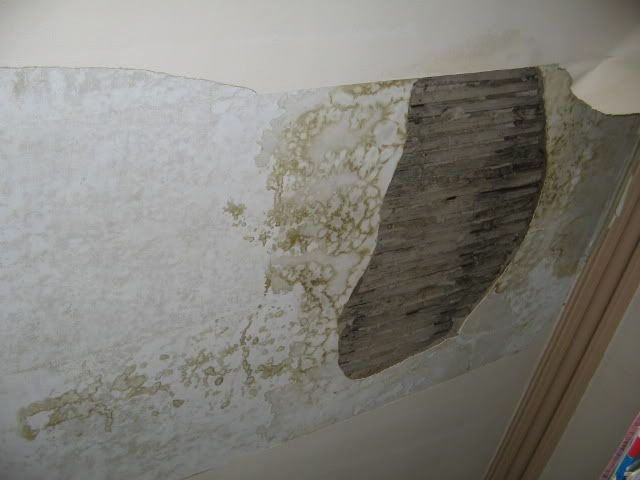
A few small pieces of dark plaster and dirt have fallen through overnight, and the patch on the carpet is still damp. The room absolutely reeks of clay and plaster dust, so I’m off out for a bit. Another 25 books to get rid of. Found a signed copy of Gore Vidal’s Palimpsest, then remembered it wasn’t mine.
On closer inspection, the hole may be trying to impersonate Africa:
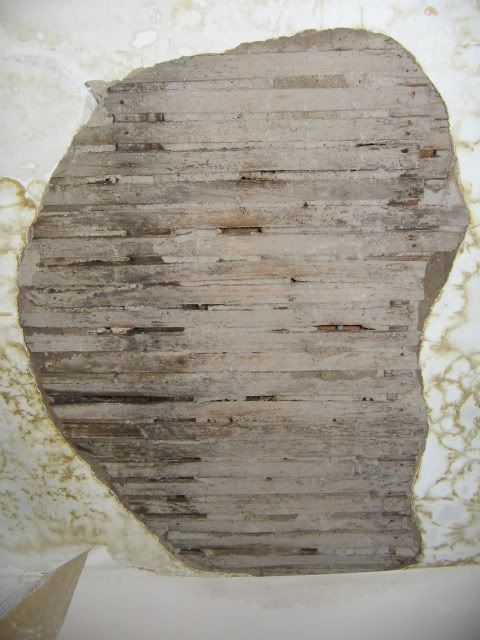
A Ceiling Unzips
My ceiling has unzipped itself.
I come in at 7pm to find water dribbling steadily onto my bed, and look up to see an ominous bulge in the ceiling. I show it to Kahlil and Liz from upstairs – who thankfully haven’t quite moved out yet – and they explain it’s due to a misfitting hot water joint they’ve installed. ‘Ikea pipe meets Victorian pipe.’ The joint is now fixed, but a fair amount of water has already leaked through the floorboards during the day, when everyone was out. Including me.
They apologise like mad, but I assure them it’s hardly their fault. These things happen. And it could have been worse. It could have happened when I was in the bed.
They fetch a broom and bucket, and use the broom to flatten the bulge so the remaining water drains into the bucket, ending the drips. I thank them, then wash and tumble-dry the bed linen and apply several rolls of kitchen towel to the puddle on the carpet. It could have been worse.
And then the ceiling collapses.
Lumps of damp, ancient plaster tumble onto the bed, exposing a dark three-foot oblong of wooden boards in the level above. The strip of wallpaper that held them in place peels down in its entirety, tearing noisily across the width of the ceiling until it reaches the other side. The effect is like a giant unzipping his fly. It takes the best part of ten seconds, and I blankly sit there and watch it happen, like Laurel and Hardy. Not thinking ‘I should act fast’, but ‘This is interesting. I wonder what’s going to happen next?’
After the dust settles, I go upstairs again and tell the neighbours. They’re mortified – far more than me – and spring into action, clearing up the mess, hoovering up the dirt and the dust, including the dirt which was there before the plaster fell in. Jokes suggest themselves about my room looking like a bomb has hit it – but how can anyone tell?
They clear the debris into bin liners, load me up with new bedding, do my washing up, and move the bed away from the gaping dark hole that now punctuates my ceiling, just in case anything else falls through. That’ll do for tonight. Watch this space. In case it falls down.
This has happened just as I was thinking that my life needed shaking up, that I could do with a real change. Well, the ceiling now needs to be re-plastered and papered, and to do that I’ll have to finally hone down my possessions and clutter so they can be easily cleared or packed away. Just as well I’ve been paring down my books and audio cassettes already.
The room now smells of clay and plaster dust. Which isn’t entirely unpleasant. It’s the smell of work. Of work past (the fallen plaster must be Victorian), and of work to come.
The drenched items on my bedside table – Ground Zero – include the Dalai Lama’s Little Book Of Wisdom. Maybe the plaster is a big fan of the Chinese Army. Plus a bookmark advertising a new work on Quakerism, Ground And Spring, which has a photo of a bubbling water feature. The caption is ‘Let nothing disturb you. Let nothing affright you.’
***
Earlier that day, I nearly collide with Cherie Blair as she comes out of the British Library Conference Centre. After that, I accompany Claudia A as she takes a terrified Sevig to the vets’ for his annual cat jabs. Given the relatively devastating events of the evening, these details now sound like witches’ omens.
Speaking Underwater
Quite a lot to type up. The trouble is, whenever I start to go into any amount of depth, it often takes me so long that I don’t even finish the diary entry. I have to remind myself that it’s better to write little entries, than none.
Yesterday – to the New Piccadilly Cafe for the last time. I bring Claudia Andrei and she takes my photo in this now doomed vintage setting, taking in the decor, formica tables and the horseshoe menu that has remained in place since the 50s. I shake hands with Lorenzo and the other staff. Goodbye, Piccadilly.
In the London Library earlier that afternoon. Quite crowded, so I have to share a table opposite an intense young man in glasses. I half-mumble, half-whisper something in the manner of ‘is this seat free?’ and he gestures back that it probably is. Though I sense he’s doing so begrudgingly.
After a few minutes I look up from my book, and note he’s staring directly at me.
Another quarter of an hour or so, and I dare myself to look up. And yes, he’s still staring right at me.
The problem with being stared at – and I speak with some experience – is that one never really knows the cause. Does he stare at me because he recognises me? Or because he thinks I look like someone who should be recognised? Or because I look unusual? Or because he finds me attractive? Or is there something on my face – a white smear of rushed toothpaste around my lips? How do you tell one type of stare from another?
I should add that I am wearing a little make-up. But what’s modern life if a gentleman can’t wear a discreet dab of Touche Eclat in The London Library?
In the cafe afterwards, Claudia says, ‘You’ve got a tidemark of foundation on your chin.’
***
Monday evening: soiree in the flat upstairs hosted by Liz & Kahlil, who are moving out after seven years, to live on a boat somewhere in Kent. Other neighbours past and present are there, including Hugh and Zoe. Zoe brings some South African Jewish biscuits she’s just baked.
I’m finding conversation a little difficult as my right eardrum is entirely blocked up, and my left isn’t great either. I can just about hear others okay, but when I speak, my voice sounds like it’s underwater.
This is my fault entirely. I’d been finding external noises more distracting than usual lately, whether it’s hedge-trimming in the street outside in Highgate, or readers stomping about between the desks in the British or London Libraries. So I’ve started using earplugs; the foam kind you insert. Best brand appears to be Hearos Ultimate Comfort, as available from the counter at the drum shop in Denmark Street. If it’s good enough for drummers, it’s surely good enough for me. The Hearos do the trick perfectly, but after using and extracting a pair, I note with disgust that they are absolutely coated in earwax.
So I do what you’re now not supposed to do – shove Cotton Buds (or in my case, rolled-up bits of tissue) inside my ears in an attempt to clean them out. And yes, I make things worse, pushing all the wax together at the other end. This effectively renders me hard of hearing in one ear, and completely deaf in the other. A cautionary tale of wanting silence too much.
I know what has to be done next, because I have made the same stupid mistake before. I book an appointment with my local NHS nurse to have my ears syringed. But first, she chides me, I must spend five or six days in Earwax Purgatory, putting olive oil in them twice a day. This softens the wax up, so it can then be properly syringed.
And as I squeeze a pipette’s worth of Extra Virgin into my auditory orifices, I think of Hamlet’s father.
***
At the Neighbours’ Soiree, talk turns to Northern Rock, the mortgage company whose financial woes are currently dominating the headlines. There’s people queuing up outside high street branches to get their money out, like that scene in It’s A Wonderful Life. Or indeed, Mary Poppins. The government have said ‘No need to panic.’ Which of course, is the quickest way to make anyone panic.
Apparently it’s to do with a credit butterfly flapping its wings in the US, producing a fiscal tidal wave for this particular company in the UK. Or is it the domino effect? Maybe it’s butterflies flapping their wings near some dominoes. I may know nothing about banking, but I do know it’s a bad idea to invite butterflies to an exhibition of standing dominoes. Butterflies will only give you butterflies.
Anyway, I’d never even heard of Northern Rock before this week. I thought it meant Oasis.
Kanye West’s Lack Of Sinistral Linocuts
While buying CDs in HMV Oxford Circus, a lady approaches me.
‘Weren’t you at the Sebastian Horsley party?’
‘I was.’
‘I was wondering if you’d be interested in having your photo taken modelling some suits? For Paul Smith?’
Easiest question in my life. I give her my details.
And there I was worrying that I wasn’t ‘networking’ enough at the swanky Horsley do. Now I realise that just turning up and standing around is all that’s really necessary. Turning up at all is nine-tenths of everything. Turn up at a blank page, and you WILL write. The next step is turning up on time, and doing it regularly enough, but I’m working on that.
***
Here’s the CDs I bought, all of which I highly recommend. Interestingly, all three feature British bookish types playing soul music, whether Northern or Philly. Sissy Soul, if you like.
Edwyn Collins: You’ll Never Know (My Love)
The original indiepop soulboy, without whom etc etc. CD sleeve features Edwyn’s left-hand drawing of a badger, part of his therapy after losing the use of his right arm via the life-threatening stroke a couple of years ago. The song is his blissful Philly-Soul-influenced best since Orange Juice’s ‘A Sad Lament’. Crunchy guitars, echoey blips, soaring ‘Betcha By Golly Wow’ falsettos, catchy chorus.
I can sincerely say it’s the best single out this week to come with a free left-hand drawing of a badger. Does Rhianna give you southpaw watercolours of wolf cubs? Does Kanye West offer sinistral linocuts of lemurs? You see, that’s just where they’re going wrong.
Here’s the Edwyn video. Note his Peter Andre and Steps dolls.
Andy Lewis & Paul Weller: Are You Trying To Be Lonely?
Andy Lewis replaced me in the soul-tinged indie band Spearmint. He’s a rather gifted music maker in his own right, and when Mr Weller heard this Dexys-like stormer of a song, he demanded to sing the lead vocals. Mr Lewis has immaculate taste in books as well as pop music, and is responsible for introducing me to the darkly delicious London tales of Christopher Fowler.
The Go! Team: Proof Of Youth
The giddy multi-ethnic, multi-everything Brighton band’s second album, featuring Public Enemy’s Chuck D on one track. I love that the Go! Team are the missing link between Public Enemy and I’m Being Good, an archetypal tiny indie guitar band if ever there was one.
The chap in charge of the group is a bookish bloke called Ian, who believes in a musically bisexual, if not downright sissy approach to modern rap and hip-hop. All their songs sound like eight Music and Video Exchange records played at once, threatening to fall apart at any second. One of said records is clearly Neneh Cherry’s ‘Buffalo Stance’, another Malcom McClaren’s ‘Double Dutch’. Which is not a bad start in my book. An utterly glorious sweetshop of an album.
Do watch the lovely video for ‘Doing It Right’ if you haven’t already.
Shakespeare On Crutches
Weds: meet Mum at the New Piccadilly Cafe for lunch, then onto the Globe Theatre to see Love Labour’s Lost. The NPC is in its last couple of weeks, closing Sunday 23rd. It’ll be truly sad to see it go, with its decor and menu unchanged since the 1950s. Owner Lorenzo was on the BBC local news the other week. He tells of the time a group of bequiffed Greasers had a punch-up in the place during the cafe’s early days. ‘They must be in their seventies and eighties by now,’ Lorenzo says. ‘But if I see them again I’ll still ask them to pay for the windows.’
Must get a few new photos of myself in there before it’s too late.
From one out-of-time landmark to another: the Globe Theatre, on the South Bank. The word ‘replica’ always makes me think of that Steven Wright line that borders on the philosophical: ‘Came home today to find everything had been stolen and replaced with an exact replica.’
One of the actors, William Mannering, has broken his foot, and there’s a announcement begging forgiveness for the necessity of ‘Elizabethan NHS’ crutches onstage. The crutches in question are covered in black fabric, and the actor uses them to great comic effect (and practical – scaring off a few pigeons that invade the stage). I think of that most famous use of black crutches in Shakespeare – Antony Sher’s Richard III.
Love Labour’s Lost is pretty fluffy and slim on story, but makes up for it with lots of wordplay, verbal duels and general parading about. The ending is curiously downbeat, and hints at the sequel that never was, Love’s Labour Won. Which was referred to in a recent Shakespearean episode of Doctor Who, filmed in the Globe.
On a first trip to the Globe, the venue itself is very much the star, with its painstaking period reconstruction, octagonal timber shape and ceiling ever open to the elements. Today there’s a good sized audience for a matinee, with the expected students, schoolchildren and American tourists in visible evidence. In fact, I have yet to pass by the outside of the Globe without hearing at least one American accent cutting through the South Bank’s hubbub like a siren. But then, the Globe itself was rebuilt at the instigation of Sam Wanamaker, the American actor. And I think Lucy M, now one of the editors of the RSC Complete Shakespeare, once told me that all the major Shakespeare conferences and seminars are in the US, rather than the UK.
Mum and I are having nothing of the standing-only area down the front, just as I’m not keen on being a Promenader at the Proms. I like to sit down, not just for the comfort but for the guarantee of a fixed, linear, and indeed sheltered space. We also hire a couple of £1 cushions for the wooden seats, which are well worth it.
The play only uses a bare minimum of props and backdrops, but there’s a couple of beautifully-realised puppet deer (for the hunting scenes), and some truly fantastic period costumes, with the women in huge gold and green dresses forming billowing pools of colour whenever they sit down. As well as the tousled and crutches-wielding Mr Mannering, there’s Trystan Gravelle as Berowne, with his dark, thick floppy hair and dark, thick Welsh accent, who scoffs his lines with speed yet relish, treating Shakespeare’s syllables as luxury chocolates. Katherine is played by the striking Oona Chaplin, half-Spanish granddaughter of Charlie, while Gemma Arterton’s Rosaline is pure porcelain haughtiness a la Sophie Ellis-Bextor.
The cast are clearly having fun, which for a venue like this and a Shakespearean comedy as wordy as this, is just what’s needed to rub off on those looking on. I think the Globe – like any open-air venue – probably suits comedy better than tragedy. The likes of Hamlet work better in closed spaces, rooms as dark boxes, with no distractions. Comedies are more flexible to the wandering eye.
I’d say A Midsummer Night’s Dream is the most obvious choice for the outdoor stage, with its magic and its visual set-pieces, but the lesser-known Comedy Of Errors would work well at the Globe too – a straight farce with funny plot twists that doesn’t really need latter-day visual gags to bump up the laughs. Turns out the Globe put it on last year, however, so it’s probably going to be a while before they do it again.
***
Thought re the McCanns case, currently dominating newspapers with much the same treatment as a national emergency or state of war. By going with the theory that the culprit is the last person one suspects, I wonder if the Portuguese police are adoring fans of Agatha Christie.
Braking Trains
Tuesday evening, written up belatedly. To the Royal Albert Hall for one of the Proms concerts. I have a ticket in the stalls, courtesy of Rob Cowan, for which I’m truly grateful. The seat commands a decent view from the stage left side, is comfortable, and even swivels to provide extra leg room for those of us with long, unsupple legs.
The main arena is standing room only, for the ‘Prommers’ which give the concerts their name and defining feature. Inexpensive tickets, cheap access to top-rate classical performances, as long as you don’t mind queuing and standing. Some of the Prommers take it very seriously indeed, attending every single one of the 70-odd summer dates and forming little intense societies of their own. Some of them organise collections for charity, and in the interval there’s a group announcement from the arena, saying how much they’ve raised so far. They don’t have a microphone, so they make the announcement together like a chant.
I’ve been a Prommer myself once, as a teenager for Mussorgsky’s Pictures At An Exhibition. I remember chatting with – and being looked after by – a thin, bespectacled Prommer who was famous among the regulars. He was first in the queue, and I was told he always had his own place down the front, dead centre. I remember tuning in for the televised Last Night At The Proms that year, and easily spotting him down the front, singing along with all the flag wavers. I can’t quite tell from the stalls if he’s still there these days, though.
I’ve come to hear Bartok’s Music for Strings, Percussion and Celesta (1936) and Ligeti’s Atmospheres (1961). The Bartok is moody and strange and folk-influenced, while the Ligeti is downright avant-garde. Soundscapes of colour, the tuning of braking trains from distant dreams. Atmospheres features in the dark screen ‘overture’ to Kubrick’s 2001: A Space Odyssey. Kubrick also uses Ligeti for the bits with the monolith, and the long bit at the end where the astronaut’s pod whizzes through endless landscapes of oddness. If it’s in 2001 and sounds scary, abstract and otherworldly, it’s Ligeti.
Note to self: stop pronouncing him ‘Li-GET-tee’ It’s ‘LIG-erty’. Hungarian, not Italian.
What makes tonight’s concert attractive enough to fill about 80% of the Hall, even in the midst of a Tube strike, is not just the inclusion of this challenging fare (the Ligeti’s never been played at the Proms before), but that the orchestra playing it is more suited to traditional Strauss waltzes and polkas. It’s the Vienna Philharmonic, conducted by Daniel Barenboim.
The Telegraph gives this concert a critical pasting the next day, saying the VPO are too polished, corporate and old-fashioned to handle the modern stuff. Well, the Bartok is 70 years old and the Ligeti is 40, but it’s modern enough for the VPO, established in 1842.
It’s true they’re hardly innovative in the gender equality stakes: I read that their first female member was only admitted in 2003, making front page news in Austria at the time. It does seem an anachronistic, golf-club-like imbalance these days, particularly when the audience tonight (like classical fans in general) is about fifty-fifty male and female. In fact, two women behind me comment loudly on how few ladies are on stage. ‘There’s one – on harp!’. ‘I think I see another one in the woodwinds…’
2001 – Humanity discovers an alien monolith.
2003 – the VPO discovers women.
But old-fashioned or no, they do the difficult stuff perfectly well as far as my ears are concerned. The slow, sparse first movement of the Bartok piece has the audience gripped from the off. It’s almost as if the entire Albert Hall is holding its breath. Barenboim jumps in the air for the faster passages.
And the Ligeti is astonishing; suitable otherworldly and dreamy. At one point, two men open up a grand piano and stroke the strings inside with what I imagine are special Ethereal Soundscape brushes.
Also in the programme are more melodic, traditional pieces: Kodaly’s Dances Of Galanta and Enescu’s Romanian Rhapsody No 1. There’s also two encores of Strauss: the catchy Annen-Polka and a fitting Hail To Hungary (given the Eastern European theme), complete with shouted ‘hoy!’ at the end. All of which pleases both audience and performers (there’s even some dancing in the Prommers’ arena), but it’s the experimental stuff that really delights my heart.
I really should go to more classical gigs. Apart from anything else, they smell nice. People are generally better deodorised.
The new school and college year is about to begin, because I overhear this from the crowds spilling out of the Albert Hall:
Girl: Oh I really love my year, daddy!
Dad: Are you with all your buddies?
The tube strike isn’t a pain at all. For many, it’s an excuse for to get some exercise from walking, particularly as the weather’s warm and dry. I happily march all the way across Hyde Park at night, along the main road that runs down the middle, and along Oxford Street to Tottenham Court Road. Then I catch a tube home. The Northern Line is unaffected, so my journey isn’t as awkward as it could be. It’s been a perfectly lovely evening, in fact.
Horsley Night
Thursday evening. To the Spectrum Gallery in Great Titchfield Street, for Sebastian Horsley’s book launch and art show. The place is fairly small, and the art on display is effectively his greatest hits. The video of his crucifixion in the Philippines. A shark painting, from his close-up encounters with the beasts. A copy of the ‘This Is Not A Brothel’ sign from his front door. One of his beautiful suits.
Horsley bridges the Emin & Warhol world – art as advert for the artist – and the Soho Hooligan world of Bacon, Hambling, Melly, Bernard, Hamilton, and Quentin Crisp. He is possibly the only person to quote Quentin Crisp even more than me. Though he actually did actually meet Quentin, and suggests some of Crisp’s later quotes were his in the first place.
When Jarvis Cocker first appeared on TV, he was introduced as ‘a cross between Scott Walker and Quentin Crisp.’ Which wasn’t (and isn’t) entirely him. But it was a good start. A departure point. People need a way in; a handrail with which to approach the new.
Crisp was Firbank meets Saki meets Wilde. And Wilde was Ruskin meets Huysmans meets anyone else in the room at the time:
Wilde: I wish I had said that.
Whistler: You will, Oscar, you will.
All innovators begin life as a one-man tribute band. As long as it’s on the way to becoming a tribute to themselves.
And so it is with Sebastian Horsley. Not the first man to be crucified, of course. Not even the first man to be crucified in recent years, given it goes on in the Philippines every Easter. But he is the first Westerner, and remains the only one. Dominik Diamond tried it for a TV show called Crucify Me, but his nerve left him right before the nails were driven in, and he called it off.
Flicking through his book, Dandy In The Underworld, I spot a Quentin-esque line immediately. It’s on the importance of living in small flats and bedsits. ‘I never know what people do with the rooms they are not in.’ But then Sebastian adds, ‘I’ve been in bigger women.’
Dandy In The Underworld is a terrific read: a litany of hedonistic, decadent acts. Some of which are the usual suspects: drugs, sex, degradation. But Horsely puts a personal, darkly funny spin on them all. He’s a gifted writer, cutting to the chase, one step ahead of his own critics. ‘I’ve suffered for my art,’ he says. ‘Now it’s your turn.’
The event at the gallery is packed, with people spilling out into the street. For someone who describes himself as untalented and unsuccessful, Horsley is impressively popular. Maybe because he doesn’t take himself too seriously. Make people smile, if you must make them do anything. Absinthe is served, and I’m afraid I help myself to a glass. Just the one, mind.
Names. I say hello to Sebastian, Sebastian’s family, Victoria Clarke, Miss Hattie, Sophie Parkin, Viktor Wynd, another man called Dickon (no one is terribly impressed by two Dickons meeting: the universe fails to implode), a young couple, fresh in London and hitting the top parties already – the boy is called Alexei. An AIDS charity worker turned teacher. Lots of girlish young men who look down their elegant noses at you (or at least, me). I eventually gravitate to Lady Billy from the Club Kitten scene, and Bleach Blonde Sarah, current landlady of Miss Shanthi. Billy and Sarah are in a band together called Wet Dog. Mark Keds says hello to them: I remember him from the band the Senseless Things. I bought their single, ‘Too Much Kissing’, when it came out, with its Jamie Hewlett sleeve. This was 1989. They all repair to Electrogogo, but I opt for bed.
Frequently asked boring question:
‘How do you know Sebastian?’
Answer: ‘Osmosis.’
‘Nice meeting you’, I say to one man who’s passing through.
‘You’re lying, aren’t you.’
‘Yes.’
‘It suits you.’
Actually I was lying that I was lying, but wanted to play his game. Sebastian’s approach rubs off on you.
Maybe I should try being deliberately rude, as opposed to being inadvertently rude. It’s so tiring having to apologise.
You know, I don’t think I’ve ever been deliberately rude in my life. Evasive, yes. Stand-offish, certainly. But not actually telling people to get knotted. Maybe that’s where I’ve been going wrong all this time.
Ahem. (clears throat)
You can all get knotted, frankly. You and the boat you rode in on.
I think I need lessons.Â
Buy Sebastian H’s decadent feast of a book here.
A Quiet Birthday
Monday: spend my birthday in a perfectly happy state. No drinks, no social gatherings in a bar or club. Instead I plump for a day on my own, loafing about the British Library cafe and Reading Rooms (reading a book about happiness, in fact), going to the Post Office to send Fosca CDRs to labels and post the rarer books which I’ve sold on Amazon (which were NOT gifts to me), and a bit of indulgent shopping. Suits me fine. I’m meeting friends later this week as it is.
I had a perfectly lovely surprise meal thrown for me last year, which in happiness terms will keep me going for a long time yet. Sometimes, one’s birthday can feel like New Year’s Eve, ie strained, enforced jollity for its own sake. Worrying that you’re not happy enough. Happiness for me this year meant solitude, and not worrying. I was happy.
I didn’t fancy the idea of a drinks gathering organised at short notice, which people would find hard to attend (particularly with the Tube strike) and having to refuse alcohol while surrounded by people getting drunk.
At the Highgate garden party on Saturday, I was frequently offered drinks (Oh, poor Dickon! Our hearts bleed!). I gave in and supped a little Pimms and fruit punch, but couldn’t really enjoy it, knowing I was meant to be on the wagon and worrying that I’d get drunk. So I’m still struggling a little with that, and thus felt awkward about a birthday drinks do.
One year, though, I’d like to throw a proper bash in a venue, advertised weeks in advance (the only real way to do gatherings in London) with films, DJs and dancing. Maybe an ‘If….’ party, with everyone dressed as schoolboys.
The Tube strike is planned to go on until Friday morning. I have things to go to. So, a good excuse to do lots of walking.
Receive lots of birthday greetings via email and Facebook (much thanks). A few Facebook Gifts this year, which are cute little cartoon images of presents. Certainly very Green-friendly. No wrapping paper, no space taken up in the real world.
Tim Chipping sends me the new Edwyn Collins album in digital form, along with a video e-card. It’s that famous 60s Bob Dylan film where he holds up signs featuring words from the song’s lyrics. On the e-card, Dylan’s words are replaced by ‘Happy Birthday Dickon’. Very clever stuff.
My parents and brother send me generous amounts of much-welcomed money, along with a copy of McSweeney’s Quarterly No. 13. This is the big literary comics anthology edited by Chris Ware. Staying on that tip, I use some of the money at Gosh Comics, to buy a similar anthology: Ivan Brunetti’s Anthology Of Graphic Fiction, published by Yale University. I also pick up a copy of Gaiman’s Stardust, the version illustrated by Charles Vess, so I can compare it with the forthcoming film. Am meant to be attending a press screening on Thursday, though Sebastian Horsley is having his book launch the same evening.
Oh, and they had sold out of Scott Pilgrim Vol 1.
Films seen recently include Disney’s Fantasia. Whenever I come back to this, it’s a different sequence that appeals. As a child, I first favoured the Mickey Mouse ‘Sorcerer’s Apprentice’ segment, then the ballet with the crocodiles, hippos and ostriches. Today it’s the opening Toccata and Fugue that connects with my 36-year-old self, with its backlit live-action orchestra mixing into a dazzling parade of abstract, dreamy animation.
But I still like the hippos.
36DE
My 36th birthday. Up at 6am again, so the day has hope. No appointments today. I can pretty much do what I like, as long as it doesn’t cost very much. Perhaps a mooch around town, and then to the London Library. Somewhere where quietness has been subscribed to. I need to have a serious think about things, so it helps to go where the serious thinkers go.
Looking at the number 36 written down, thoughts of what I want to do with the rest of my life spring up. There was a George Melly documentary on TV the other week, screened in memoriam. He was interviewed during his last years, and said there were many things he wished he’d done: been more of a poet, painter, novelist, alongside all the singing, memoir writing, journalism and generally living large.
‘But I’ve never done anything I didn’t want to do,’ he said, uttering the phrase like a credo.
Now, civilisation was pretty much built on a good deal of people doing things they didn’t want to do, throughout history. As I write, all over London people are off to jobs they’d rather not do, indeed might hate with a passion. But they are jobs they can do, which need to be done (one hopes) and which pay the bills.
That’s fine for those who can adapt easily to the World Of Work. But for those of us who are shaped slightly wrongly for much of the world’s fixed slots, it’s not so easy to do. If I’ve learned anything after thirty-six summers, it’s that there’s no point in working purely for money if you hate what you’re doing. Apart from anything else, hating a job means in my case that I won’t do a good job, so I’ll soon be sacked, and then it’s been a waste of time all round.
Some birthday messages to myself. Maybe to others, too.
You should probably spend less time on the Internet. If you just keep your diary updated, and stick to one place on the Web, people will know you’re still alive and are more or less okay, and that’s usually all they need. You have enough real friends in real life, and should spend more time consolidating these friendships. Friendship is sacred, if it’s truly meant.
Don’t dwell on those who find you ‘interesting’ from afar, or those in whom you’ve awoken some spark of remote obsession. All unsolicited attention flatters, but its active cultivation will do no favours to admirer and subject alike. Instead, spend more time on those who truly know you and love you.
Concentrate on learning to properly swim in one social pool, rather than paddling in the shallow end of so many. This one is going to be tricky at first, but stick with it.
At 36, you’re meant to more or less know where your abilities lie. You’re told – by people you don’t really know – that you can write well. Well, write. Write more. Write better. Read up on technique. Practice. Maybe take a course. Write stories. Screenplays. Lyrics for others. Don’t get to your grave having only written about what other people have done, reviewing other people’s music, books and films. Not if you know you want to do your own. So make your own. Make many. Do it. Work at it. Become faster. Get feedback. Improve.
Last night: I watch the film Beyond Therapy. It’s a late 80s comedy directed by Robert Altman, adapted from a stage play. Altman is clearly not best suited to the material, because the film really doesn’t work. It’s certainly not worthy of being mentioned in the same sentence as Short Cuts. Jeff Goldblum plays a bisexual trying to have it both ways. He lives with Christopher Guest (whose convincingly swishy performance is close to the one he does in the fantastic Waiting For Guffman), but he also wants to date the lady from Airplane. And everyone’s seeing therapists.
Jeff Goldblum does his usual thing, speaking… as if… he hasn’t… had much… sleep… the night… before. And the dialogue overlaps in that chatty Altman way. But the scripted jokes become lost and the audience is left high and dry.
I was sitting there thinking I could fix the script myself, or even fix the direction. Not daring to suggest I could outdo Robert Altman, but I could see which bits were not working, and was thinking what could be changed, given it’s an adapted play. Any filmic tendencies need to be quietened down, so the words and the performances can engage more directly.
But the other sides of directing tend to put me off: the long hours, the painstaking repetition, and the diplomatic nature; having to be overly nice to so many people even in the most stressful of circumstances. I wouldn’t have the nerve to be a tyrant, a la Von Trier. I actually rather like actors. Still, that’s one thing on the big To Do list.
An over-used phrase to say when having watched a bad movie is ‘that was ninety minutes of my life I’ll never get back.’ But in the case of films like Beyond Therapy, which left me thinking how I could fix the thing, it was ninety minutes well spent.
‘I would have preferred the film to have done this’, some critics say. So make your own film, I say.
***
Saturday evening: to a fun garden party at the home of Jen C and Alex & Bill M, in Highgate. Home-made cupcakes, marshmallow-flavoured Rice Krispie cakes, a raffle with prizes, and games of badminton on the lawn. I chat to Senay S for the first time in years; great to see her again. Actually it’s a Baxendale reunion, with Tim B and Alex M all there.
I mention to American Emily that I’ve applied for that Time Out job.
‘So have I!’ she replies. And we imagine we probably know a few other applicants somewhere along the line.
‘Hope you get it.’
‘No, I hope YOU get it.’
I don’t envy whoever has to sort through the applicants. Must be hundreds.
We talk about the ‘things to improve about Time Out‘ blurb which the advert asked for, and Emily thinks the Guardian Guide has stolen much of Time Out‘s potential audience. The Guide is a cute little mini-supplement packaged with the newspaper’s Saturday edition, containing arts reviews and a decent smattering of local listings. It’s handy in size, and manages to be vaguely fizzy and in touch without feeling too trendy. And it steers clear of getting into the ‘praise one thing for not being another’ tone which in some quarters is mistaken for ‘lively’.
Right. Off into town I go.




