‘A Triumph!’
[photo from Smash Hits Productions of Taiwan]
The new Fosca album, The Painted Side Of The Rocket, is released today as a legal download at the iTunes Store:

You can also get it on MP3 at Klicktrack Music:
http://www.klicktrack.com/shop/release.jsp?r=71172
Here’s a free MP3 of ‘Confused And Proud’; the new, dreamier version:
http://www.butisitart.org/downloads/Fosca_Confused_and_Proud.mp3
In the US, Entangled Records have the CD, plus the book and some older Fosca releases:
http://www.entangledrec.com/advanced_search_result.php?keywords=fosca&x=0&y=0
I note the album is at No. 10 in their Bestsellers list, just behind our old friends Trembling Blue Stars.
The CD will be given a proper UK release via Forte Distribution next month, date to be confirmed. We’ll play an album launch gig in London some time after that.
Otherwise, it’s available via mail order from the label (based in Sweden), here:
http://www.butisitart.org/order/
I’m looking into the possibility of having the London launch somewhere slightly unusual yet suitable, eg a bookshop, library or museum. This might mean having to sort out hiring a PA and organising our own wine and beer and soft drinks, much like a book launch or private view. Never done such a thing before, but I’m willing to give it a go.
What I’d love is to do is play a UK festival. There do seem to be so many new ones starting up these days. But how one gets to play them without an agent, short of rudely sending festival organisers CDs and hoping for the best, is beyond me.
I do get bookings as a DJ, but it’s not really done to reply along the lines of ‘thanks for wanting me as a DJ, but can you book my band as well, or instead?’
Thing is, I’ve never felt quite so cut off from the UK band scene as I do now. I’d like to think this makes the Fosca album all the more interesting: music out of time, genuinely uncaring of the scenes and musical fashions, as opposed to bands who pretend to be unique, but take pains to ensure they’re compatible with the current XFM sound or whatever it is. But I fear it just means we might as well be an unknown bunch of entry-level nobodies, and thus the album doesn’t stand a chance in the country of its makers. Worse than that, as youth is not exactly on our side.
And yet the other day in Highgate Avenue I was collared by a young man who was going from door to door, distributing leaflets for a curry house. As I walked past, he eyed me and called out:
‘Excuse me, mate. I couldn’t help noticing that you look like you work in the music industry.’
I stopped, somewhat dumbfounded by this remark, and tried to think of a suitable response.
‘Er…’
‘It’s just that I’m a singer-songwriter trying to network. Do you have any advice?’
‘Well… I’m in a band.’
‘And you’re signed, yeah?’
‘Um… (feebly) We’re playing a tour of Sweden.’
‘So you must have management, an agent and so on, yeah?’
‘Actually, no… Look, I’ve got to go… (walking away quickly, blurting desperately) Er, use the internet! MySpace!… Facebook! Er… MySpace again!’
***
Do I really look like I’m ‘someone who works in the music industry’? To the point where struggling musicians feel the need to accost me in the street for advice?
There MUST be some way of converting this ‘talent’ of looking more successful than I really am, into an iota of an income. Suggestions to the usual address.
What I now realise I should have told the young leafletter is that the best way to earn a living in the music industry is to do anything else BUT be in a band. Be an in-house sound engineer, or run a rehearsal studio. All Fosca’s earnings – and we do make some (if always three figures rather than four)- go straight back into studio fees. When you realise that asking – and getting – upwards of £40 for providing three hours of broken PAs, battered mic stands and dented mics, you soon find out that the rehearsal room business is a buyer’s market.
There ARE one or two reasonably-priced places in London which actually care more about pleasing customers than making money for its own sake, but their weekday evening slots are impossible to secure unless you’re a band who rehearses every week, all year round.
Me: One of these days I’m going to open my own rehearsal room business, with flowers in every room, and well-maintained shiny new equipment.
Charley: Dickon, it would be trashed in one day!
Me: Not with me. I’d only allow nice, gentle people to use it. I’d ask for references.
***
I’m told Sonic Magazine in Sweden has just called the album ‘a triumph’ and ‘a much welcome return… 8 out of 10’:
http://sonicmagazine.com/index.php?option=com_content&task=view&id=2053&Itemid=85
I’m also told ‘Confused and Proud’ is on rotation on some college radio stations over there.
An email from Bandung in Indonesia:
Hi Mr. Dickon Edwards… I’m one of your fans from Indonesia, is there any chance to release Fosca here..and is there any chance to get Fosca play some gigs here?? Love you, Joz.
You see, I wish this kind of thing made the slightest bit of difference when trying to get Fosca any kind of radio play, press coverage or festival booking in my own country whatsoever. But I’m still grateful to get the emails.
Last Monday was the first rehearsal for the Swedish tour. It did me the power of good – certainly more so than any CBT therapy or painkillers. I felt I was getting somewhere again. We’re airing an old song that hasn’t been played live since 1999, the Cohen-meets-Abba title song from ‘On Earth To Make The Numbers Up.’ Having Charley Stone on guitar really adds a oneiric texture and scope to the sound; we’re taking old songs somewhere new: a more aurally androgynous sensibility.
We rehearsed at a place called Enterprise Studios, in Denmark Place off Charing Cross Road. It’s like Diagon Alley in Harry Potter: one of those hidden London streets you walk past all your life, until it’s specifically pointed out that it exists. There was a huge huddle of fashionably dressed young people outside, and I passed adverts on the walls for bands seeking members ‘under 25 only’.
I know I’m rather biased, but it seems more acutely important than ever for bands to be younger and derivative, than older and unusual. Unless you’re on the level of REM or Nick Cave, you’re the wrong kind of Not Young.
But this is all starting to sound like typical Grumpy Old Man talk, and I’d hate to be a typical anything. I have songs to get on with and write, as we’re recording a new single in Sweden during the tour. Pressing on and making new stuff is the only answer. Everything else one just has to shrug off.
Finishing The Hat
Still feeling woozy and disorientated, my fingers as I type not quite feeling as if they’re mine. There’s a kind of numbness in my fingertips.
My copies of the new things have arrived. Instantly I think about a line from Sondheim’s Sunday In The Park With George, neatly summing up the joy of the painter’s process:
‘Look, I made a hat / Where there never was a hat.’
I feel this applies particularly when, like the George of the musical, the creator in question feels rather lacking at being a normal human being, away from the world of making or writing. It’s perfectly possible to be creative and NOT be a Colin Wilson-style outsider or dysfunctional or bohemian or battling with drug addiction or just strange. But if you are feeling lost in the world, and lost in your life – whether for a moment or a lifetime – seeing the finished results of your creative act really helps make sense of the relentless confusion of it all. Ah yes, you think. THAT’s what I’m good for.
Whether it’s something I’m good AT is neither here not there, not when it comes to deciding to make the things in the first place.
Last time I put out an album, I mentioned it on an email mailing list. Someone piped back unkindly along the lines of, ‘Woo! Well, look out, pop charts!’
Well, yes, it’s unlikely the album’s sales will give Nickelback any sleepless nights. But if a tree falls in a forest and no one blogs about it, it does still make a sound.
‘I’m rather happy with the way I fell just then,’ thinks the tree. ‘I fell in a way that was purely me. Other falling trees are available, and have better press agents, but none of them fall quite like me. Maybe no one heard me. Doesn’t matter. I still did it.’
Look, I made a book and a CD. Where there never was a book and a CD.
Viral Boy
Feeling a bit better now, partly via painkillers but mostly through the nice lady doctor at Whittington A&E who gave me a while-you-wait blood test and stopped me worrying myself to death. The waiting room only had three or four other patients, so I didn’t feel too guilty about seeking this emergency second opinion.
Thankfully I didn’t need the nasty lumbar puncture. But it turns out I do have a high lymphocyte percentage, meaning I’ve got a viral infection that will eventually burn itself out naturally.Â
She sent me on my way with a pill for the nausea and an injection up my bottom for the pain. Or it may have been for fun.
Sick Note Update
I’m hot-headed in all the wrong ways. Feel riddled with a disorientating headache (making it hard to read from this screen), plus am additionally burdened with nausea, loss of appetite and a dizzy fever. The traffic was unusually deafening on my walk to Highgate Group Practice. Either everyone has turned up the volume on their cars, or I’m ill.
So I’ve just seen the GP. She suspects it’s an ear infection, and has put me on a course of antibiotics. I’ve no rash or neck stiffness, so she doesn’t think meningitis is the case, but the only true way to rule it out is for me to go to Whittington A&E (a short bus ride or 15 min walk away) and get a lumbar puncture. This means spinal fluid extracted and tested. It does seem rather drastic. But sitting here worried out of my mind – when I can think straight at all – I’m considering going along and asking for it, if only to put my mind at rest. In every sense.
Sick Note
Have this recurring headache – a painful pounding behind the eyes -Â now coupled with nausea and feverishness. The headache’s been going on for a couple of weeks now, previously thought to be a touch of flu, but right now I feel particularly bad. I wonder if it’s just down to broken sleep patterns and not eating properly.
Of course, if I look up the symptoms on the Net, I get anything from flu to meningitis. I also wonder if I’ve finally inherited my dad’s migraines.
Was going to write a proper diary entry, but feel too awful to do so. To bed with Mr Neurofen, I guess, and see what the morning brings.
Earthquake In Highgate
A few minutes ago, I could have sworn this bed was shaking. Just a little.
First thought was it might be one of those odd body reflexes: twitches, tics, or one of those times when you can feel your pulse acutely, by leaning too hard against the pillow, or staying too still in certain positions.
Second thought was: the neighbours really have gone too far this time.
Just checked the BBC news site, and it appears it really was an earthquake. A very mild, slightly embarrassed kind of earthquake. A don’t-mind-me, terribly English earthquake. Muttering, ‘Scuse me…sorry… sorry! Just getting to my seat somewhere else in the world…’
Fosca Press Release
I’ve just prepared a press release for the Fosca album. Thought I might as well post it here. I’ve had to think about all the things that might vaguely pique the curiosity of journalists.
Reading the press quotes again, ancient though they are, cheered me up today.
***
FOSCA
The Painted Side Of The Rocket
Fosca is the eccentric UK pop band fronted by Highgate-based dandy and wordsmith Dickon Edwards. Since forming in 1998, they’ve released four singles and three albums, toured several times across Europe, received radio play by John Peel, and found their lyrics quoted in a Swedish novel (Martina Lowden’s Allt).
After leaving the slightly acclaimed group Orlando, Mr Edwards started Fosca with a revolving line-up of London musicians, recruited partly down to their musical prowess, but mostly on what he thought of their dress sense at the time (Mr Edwards still has a strict ‘no trainers’ rule, believing running shoes are for running in, not for playing guitar in). However, some members have managed to stick around for the duration, notably Rachel Stevenson (keyboards / vocals).
From 2000 – 2002, Fosca were signed to Shinkansen Records, recording two albums with Saint Etienne producer Ian Catt. The results won fans all over the world, with NYC label Secret Crush Records taking their name from the Fosca single Secret Crush On Third Trombone. Two unofficial videos were made by separate groups of fans – both from Sweden – for Secret Crush and for the obscure b-side Confused And Proud. Given its curious popularity beyond its status, this latter song has now been reworked and re-recorded for the third album.
For the last five years, Mr Edwards has concentrated on non-Fosca activities, such as appearing on BBC1’s Imagine in his dubious capacity as a pioneer blogger; writing music and film reviews for Plan B Magazine, DJ-ing for dress-up club nights like The Beautiful & Damned (including four nights at the 2007 Latitude Festival); collaborating with the Monochrome Set’s Bid for his group Scarlet’s Well, writing a new Afterword for Jerome K Jerome’s The Idle Thoughts Of An Idle Fellow (Snowbooks) and contributing an article about a trip to Tangier with Shane MacGowan, for The Decadent Handbook (Dedalus Books), where he was described by the Daily Telegraph as possessing a certain ‘wonky charm’.
After much idling, bouts of ill health and general misfortune, the third Fosca album was finally completed in a Hackney basement in summer 2007, with Tom Edwards (guitar / programming) and Kate Dornan (keyboards, recorder, vocals). As Shinkansen had wound down, Sweden’s But Is It Art Records stepped in to release the album. And no, Fosca still have no idea why their most devoted fans tend to be Swedish.
DISCOGRAPHY:
Nervous London: CD EP, Something Velvet Records, 1999
The Agony Without The Ecstasy: CD EP, Shinkansen, 2000
On Earth To Make The Numbers Up: CD album, Shinkansen, 2000
Supine On The Astroturf: CD EP, Shinkansen 2001
Secret Crush On Third Trombone: CD EP, Shinkansen, 2002
Diary Of An Antibody: CD album, Shinkansen 2002
Confused & Live – Fosca In Concert: live CDR, But Is It Art 2007
The Painted Side Of The Rocket: CD album, But Is It Art 2008
***
SELECTED MEDIA KINDNESS FOR FOSCA
‘Diary Of An Antibody is Dickon Edwards’s second revenge attack on humanity. His couplets are relentlessly sharp…
– Simon Price, Independent On Sunday
‘Accomplished and muscular whimsy… An attractive noise… 80’s bombast saved and beyond by sharp lyrics and impeccable timing… Secret Crush On Third Trombone is one of those “must have” records.’
– from “Unpeeled”, the paper-only fanzine for the John Peel show.
‘Some of the time, Fosca remind me of the Pet Shop Boys, except you most certainly can’t dance to Dickon’s anguish, and occasionally they sound like the Divine Comedy, only with far more excellence. ‘
– Everett True, New York Press
‘Secret Crush On Third Trombone is the perfect pop song… A gleaming chorus and lyrics about schoolchild angst that glides along wonderfully. It’s sunny, fun, and brilliantly put together. ‘
– UK club Strange Fruit’s newsletter, “Fruitbowl”, issue 35.
‘Wordy and sickly, neurotic pop music’
– Richard Smith, Gay Times (UK)
‘Secret Crush on Third Trombone’ .. the best single of the summer… Simply a marvellous throwaway three minutes of sheer unrepentant Pop, all magnificent chorus hooks and jibes at the shaky nature of growing up and old and away from your youth.’
– Tangents Webzine
‘Calculated to reignite those “New Smiths” tags … The crucial difference is the juxtaposition of bouncy killer keyboards and arch observational narrative… Fosca do disposable pop with a twist… that it isn’t disposable.’
– In Love With These Times webzine
‘Incessant and striped-candy sweet. Imagine Belle and Sebastian had grown up listening only to the insane, gaudy Euro-Pop they have on Eurotrash and you’ll have some idea. Fosca play outsider anthems for those in need of wit and sparkle.’
– Drowned In Sound website
‘This band are winning the crown of “coolest new-wave-ish band in London” award as we speak.’
– Dagger fanzine, Santa Rosa, California
‘On Earth To Make The Numbers Up… is singly the best record to come out of the UK in 2000.”
– Indiespinzone.com (Sweden)
Fosca CD + book now available
I’m pleased to announce that the new Fosca album The Painted Side Of The Rocket is now available to order at the But Is It Art website:
http://butisitart.org/order/
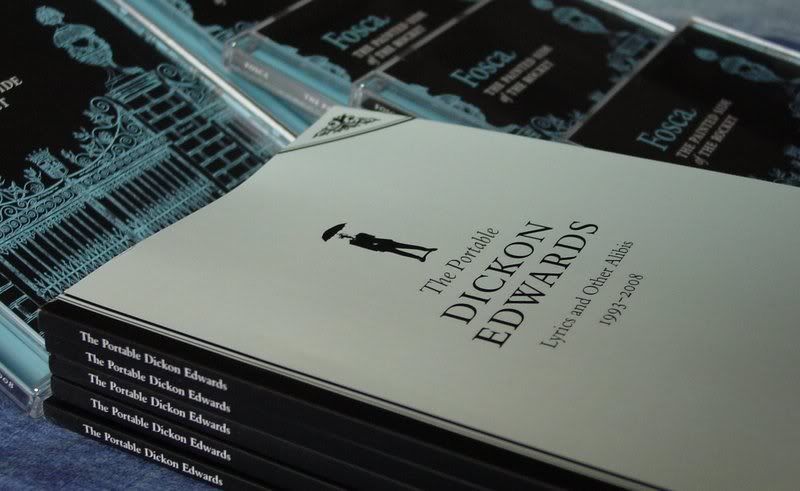
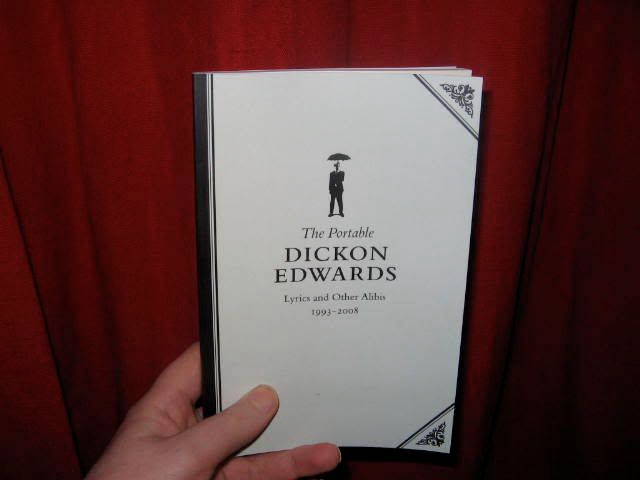
100 copies are accompanied with a limited edition book of lyrics and other writings, The Portable Dickon Edwards. The book is not available separately.
The album will also be available on iTunes some time in March.
An 80s Indulgence
We apologise for the delay in proper diary entries. This is due to Mr Edwards feeling a bit more poorly and low than usual, and having to fend off inner cries of ‘Oh Heavens, what’s the point of it all, I should have joined the Marines.’
Whilst we are waiting for Mr Edwards’s brain to start working again, our crew will be passing among you shortly to serve complimentary asterixes.
***
In the meantime, here’s some music.
I’ve been enjoying the TV programme Ashes To Ashes lately. A glamourous if haughty person who lives in a bizarre 80s world that could all be part of their damaged imagination…
but enough about me.
Here’s some 80s pop videos I’ve been using to crack the ice of my moping mindset. They’re always playing inside my head, but for those of you yet to get telepathy in your area (I hear it lost out in the format wars to Blu-Ray), click on the stills to drink from the addictive if calorie-free charms of Ms YouTube:
The Waitresses: I Know What Boys Like (1982)
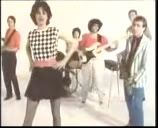
If the formula to a good pop song is to make it sound like a child’s nursery rhyme – or a child’s playground jeer -Â this is a pretty perfect exponent. Note the now utterly anachronistic use of smoking in an MTV video, and the sax player’s red tie with black shirt. Yes, Shampoo covered this song in the 90s. And yes, the Waitresses also did ‘Christmas Wrapping’.
Here’s the reverse of the red & black look, as modelled by a Style Council backing singer turned solo:
Tracie: The House That Jack Built (1983)
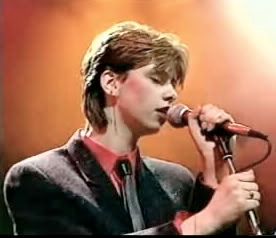
Doesn’t she look wonderful? Tracie Young walks onstage to the kind of raucous wolf whistles one might associate with a burlesque turn, yet she remains fully buttoned up in black suit with long sleeves & trousers, padded shoulders, shiny tie, and red pocket square hanky. It’s like a New Romantic Burka. One day, someone will start a religion where everyone dresses this way forever. It may have to be me.
Berntholer: The Choice (1981)
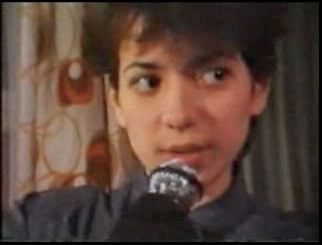
Rather more obscure, this is a charming example of what else was going on at the more alternative end of the early 80s pool. I was reviewing a compilation of Belgian ‘Cold Wave’ bands last year (released on LTM Records), and fell belatedly in love with this gaggle of art-pop types, channelling the Factory Records scene in their own odd and lovely way. A bit like the Liquid Sky soundtrack, and a bit early Altered Images too, what with all the child-like posing and smirking. Note the singer’s gloves: is it cold, or is it the 80s? I ask myself that question daily.
Aztec Camera: Oblivious (1983)
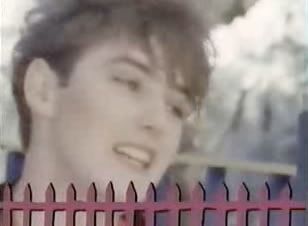
Roddy Frame + 80s hair and make-up = Alan Cumming now. And an Ivor Cutler introduction too. What’s going on with all the Tarot cards? Am I mad, in a coma, or reading Dickon Edwards’s diary? Note the jeans. Hey, Aztec Camera: good of you to ‘turn up’.
What The New Things Look Like
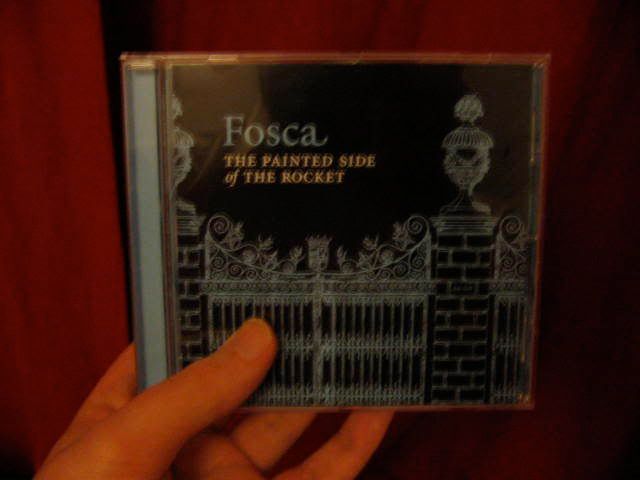
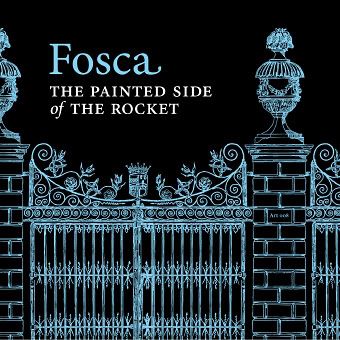
The new CD:
The new book: