
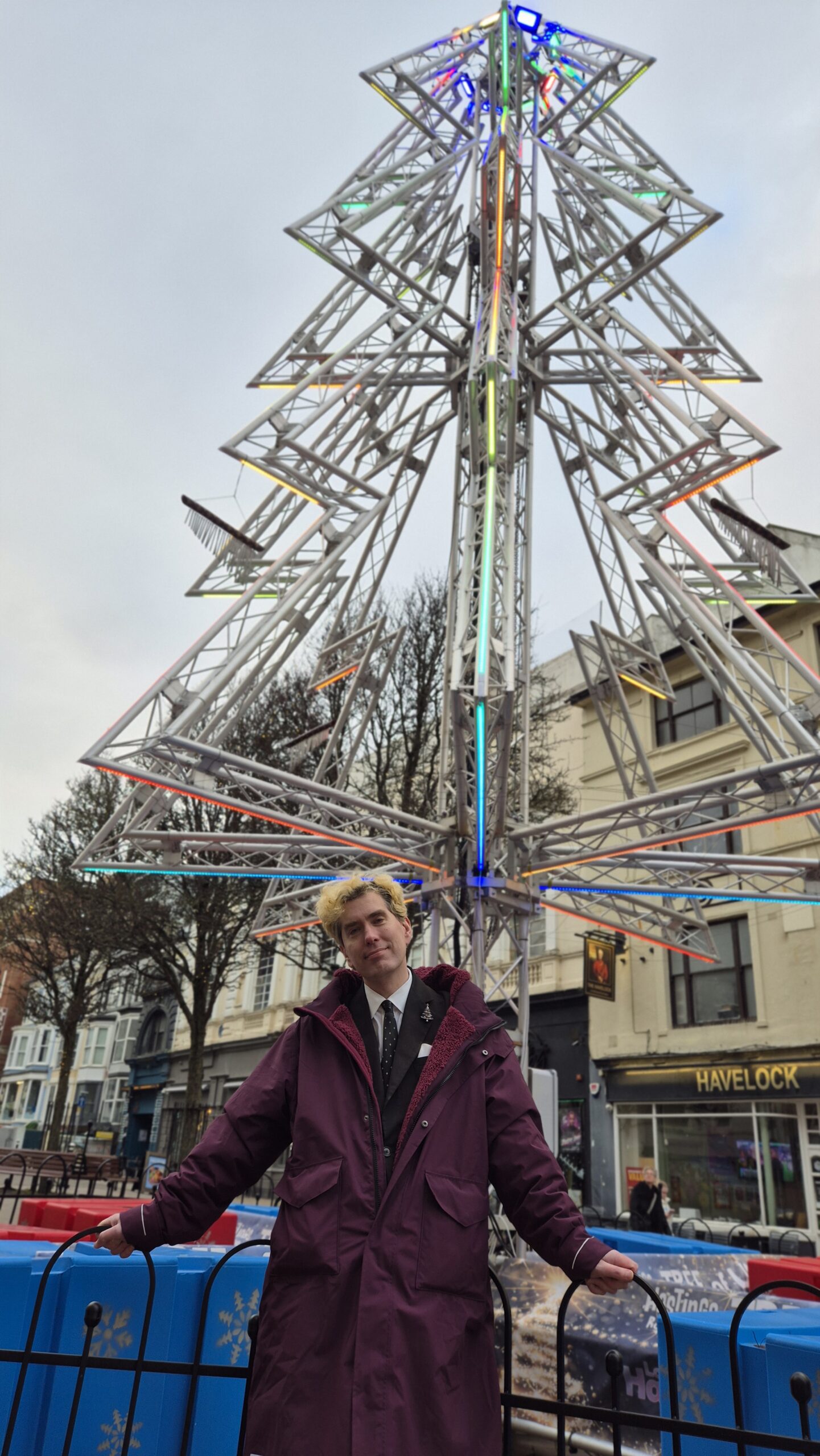
For some years now I have marked the Christmas period with a new photo of myself next to a Christmas tree. This year the choice was obvious.
In early December 2025, in Hastings, UK, where I currently live, a new aluminium tree-shaped structure appeared in the town centre. Decked with wind chimes and changing electronic lights, the Alu-Tree became something of a local conversation piece.
This object, it transpires, was a collaboration between the civic organisation Love Hastings, which provides improvements for businesses in the town centre, and the Hastings firm Metalworx, who normally make stages for rock festivals. Love Hastings wanted a solution to the problem of traditional trees being damaged every year by the strong coastal winds. They approached Metalworx, who unbeknownst to them had just made their first metal Christmas tree, an indoor one for Selfridges. So it was a fortuitous convergence of local needs, local expertise, and available funding.
Lovers of traditional leafy trees were still catered for: there was one in the nearby Priory Meadow shopping centre, which is much less exposed to the weather. Nevertheless, when the aluminium tree was installed it was met with adverse criticism on social media. On Facebook the tree was deemed ‘soulless’, ‘sterile’, and an ‘eyesore’.
I have to admit the tree’s daylight incarnation is inferior to how it looks at night, as shown in this video by Victoria Redfern:
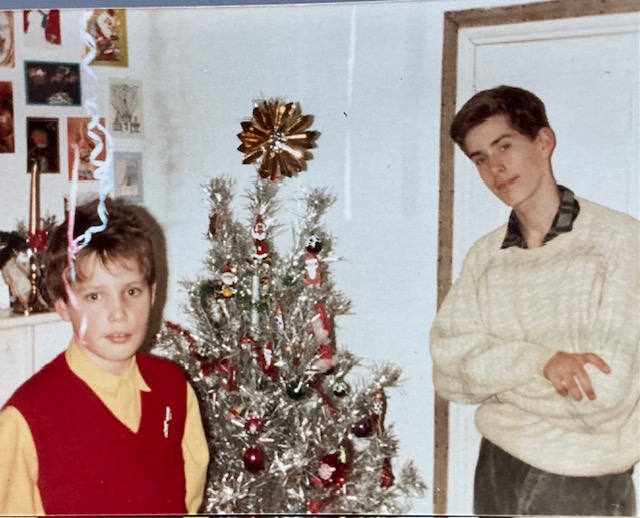
But I do like the tree’s daylight look too. It reminds me that I grew up with a silver artificial tree in my parents’ home, one made of branches of tinsel glued to steel poles, somewhat resembling glittery feathers. Each branch had to be carefully unsheathed from a cylinder of stiff brown paper, then slotted into the holes of a central pole, starting from the base up.
This assembly process was carried out every year by myself and my brother, and was hugely enjoyable. It had all the pleasure of a kit of Lego or Airfix, but with none of the butchness. The tree was sustainable in the current sense, too, lasting our entire childhoods. Here’s me and my brother with the tree in Suffolk, during the mid-1980s:
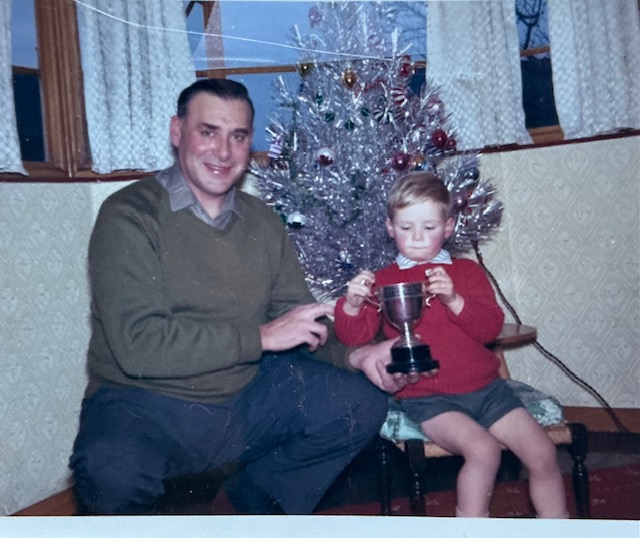
Yesterday I was speaking to my mother on the phone about writing this piece, and she revealed that my childhood tree had been her childhood tree too. It was made in the 1950s for a Selfridges display. After Christmas, Selfridges sold off the trees to staff and account holders. Mum’s mother was an account holder, and she bought one. The tree was used, we think, for about fifty Christmases.
Here’s the same tree in the early 1960s at my mother’s childhood home in Gravesend, Kent. In front of the tree are my grandfather John and my cousin Milton:
In this year’s tree photograph I am wearing my own practical solution to coastal winds: a lovely new Parka-style weatherproof coat – my mother’s Christmas present – as made by the Red company. The colour is Rich Burgundy: I no longer drink alcohol but I can still enjoy the aesthetic.
The coat is big enough for me to wear a suit and tie underneath, and indeed to show off my lapel brooch, which happens to be in the shape of another Christmas tree. I like the visual pun of a tiny tree in front of a huge one. Both fake trees celebrate artificial colours and strong looks, and both are liable to invite comment. I can relate.
One local newspaper called the aluminium tree ‘modernist’. I would call it camp modernist, the concept I researched as part of my PhD. Paul Baker’s book Camp! argues that as a season Christmas is (even) camper than Hallowe’en: his prime example is the tradition of the Rockettes Christmas dance show in New York.
Christmas is also the birthday of the camp dandy icon Quentin Crisp, who delivered Channel 4’s inaugural Alternative Christmas Message in 1993. This Christmas I was given two Quentin Crisp tree decorations by two separate friends:
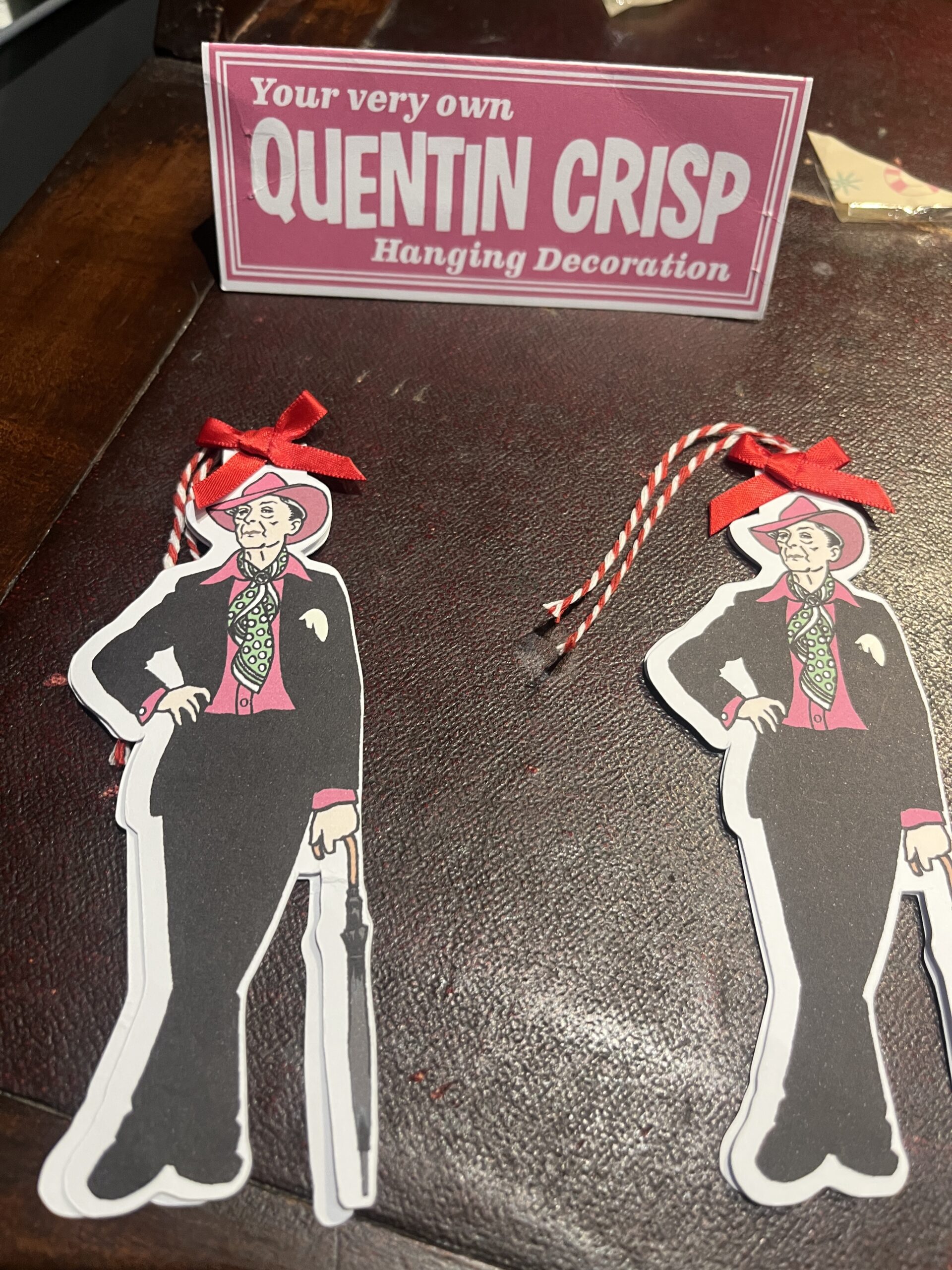
I’ve been called a Quentin Crisp imitator on occasion, who in turn was called an Oscar Wilde imitator, who in turn was called a J-K Huysmans imitator. All is creative imitation of a kind, like the tree. Dandyism is cosplay as oneself, but with a sprinkling of role models in the mix.
As camp modernist structures go, one might compare the Alu-Tree to Marine Court, the 1930s apartment block on the nearby seafront, built to imitate the Queen Mary ocean liner:
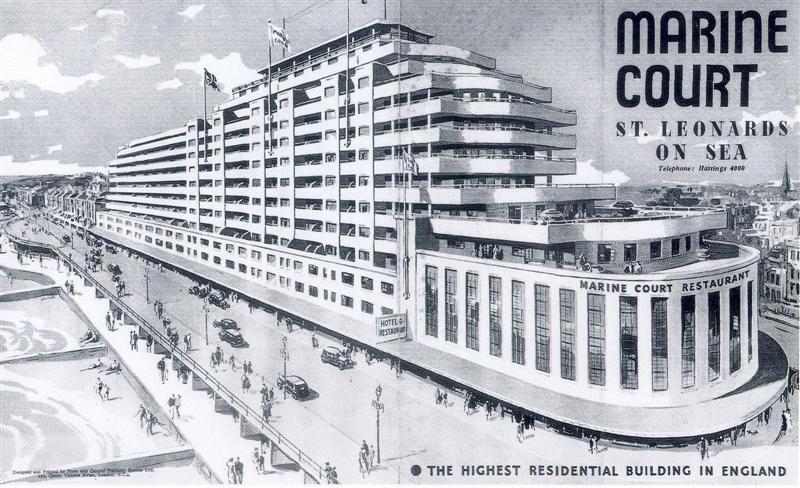
A block of flats impersonating a boat; an aluminium frame impersonating a tree. Hastings does seem to attract dressing up. There’s Pirate Day, Jack in the Green, the Frost Parade, and in summer 2025, a massed gathering of Kate Bush impersonators on the beach. What’s the collective noun, I wonder: a Dreaming of katebushai?
This still from a social media video of the event manages to include Marine Court (left, background), looking on approvingly. ‘You be Kate Bush, I’ll be the Queen Mary’.
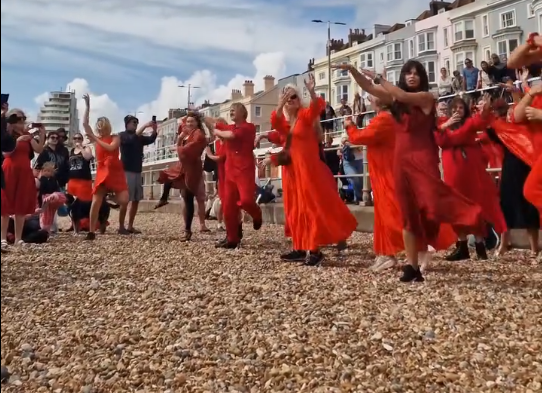
The katebushai all wore floaty red dresses and recreated the dance from ‘Wuthering Heights’ in sync with the music. The official event was actually meant to take place high up on the West Hill, which makes sense, but poor weather the previous day had made the ground so muddy it had to be cancelled by the hosts at the last minute. Nevertheless, some of the dancers quickly organised an unofficial, guerilla version of the event, on the beach by the Goat Ledge café. This, I feel, is the true spirit of Hastings: creative imitation as an unstoppable instinct.
Given the rise of what people are calling ‘AI Slop’, where fake images and videos can be made online too easily, too anonymously, and too superficially, the meaning of physical experiences has now taken on a new level of intensity and value.
On a trip to London recently, I saw an advert on the tube encouraging people to retrain as plumbers. The tag line went something like: ‘Because AI can’t unblock a sink’. That’s hard to argue with.
AI ‘deep fake’ videos are certainly getting more and more uncanny, with all that word’s connotations of unease and fear. I used to think that my own physical speaking voice, which has a lateral lisp, was beyond AI imitation. But in 2025 I saw a whole YouTube channel of fake Slavoj Žižek lectures that convincingly imitated the philosopher’s own lisping voice:
Deep Fake AI Žižek:
In the deep fake video, the words spoken are not written by Žižek. They appear to be an original text by the anonymous person behind the YouTube channel, who probably used AI for that too.
The real Žižek has pointed out on his Substack (which for a while people thought was fake!) that, although the AI’s lisping voice is convincing, the videos fail to mimic his manic hand gestures, his sniffing, his stammering and other uniquely human tics. But perhaps it’s only a matter of time before AI can imitate those as well.
The question that bothers me is: why would someone go to the trouble of making a fake Žižek channel in the first place? I suppose it’s like the answer to why climb Everest: because you can. Because it’s there. In fact, AI creation offers a far quicker fix of pleasure than mountaineering. I assume the YouTube person went to the trouble of making the AI videos because it’s no trouble at all. Which, of course, is extremely troubling.
The irony is that deep fakes are a shallow thrill. There is deeper and more lasting pleasure found in offline fakery, with ‘real’ fake Christmas trees, ‘real’ fake ocean liner architecture, and ‘real’ fake Kate Bushes.
For my part, 2025 was the year I became a fake version of my own younger self. Young Dickon Edwards Cosplay. I authored a physical book, being an edited collection of my diary entries from the 1990s and 2000s: Diary at the Centre of the Earth, Volume One (P&H Books).
In fact, I had two books out in 2025 if you count the collection of academic essays Angela Carter’s Pasts: Allegories and Intertextualities (Bloomsbury Academic). My contribution for that book was an investigation into the making of Carter’s 1984 radio play about Ronald Firbank, A Self-Made Man. I was required by the book’s editors to conform to the Bloomsbury Academic house style. This meant using an author-date system for references and writing in a way that made use of my PhD training. More imitation, one could argue. Linguistic cosplay.
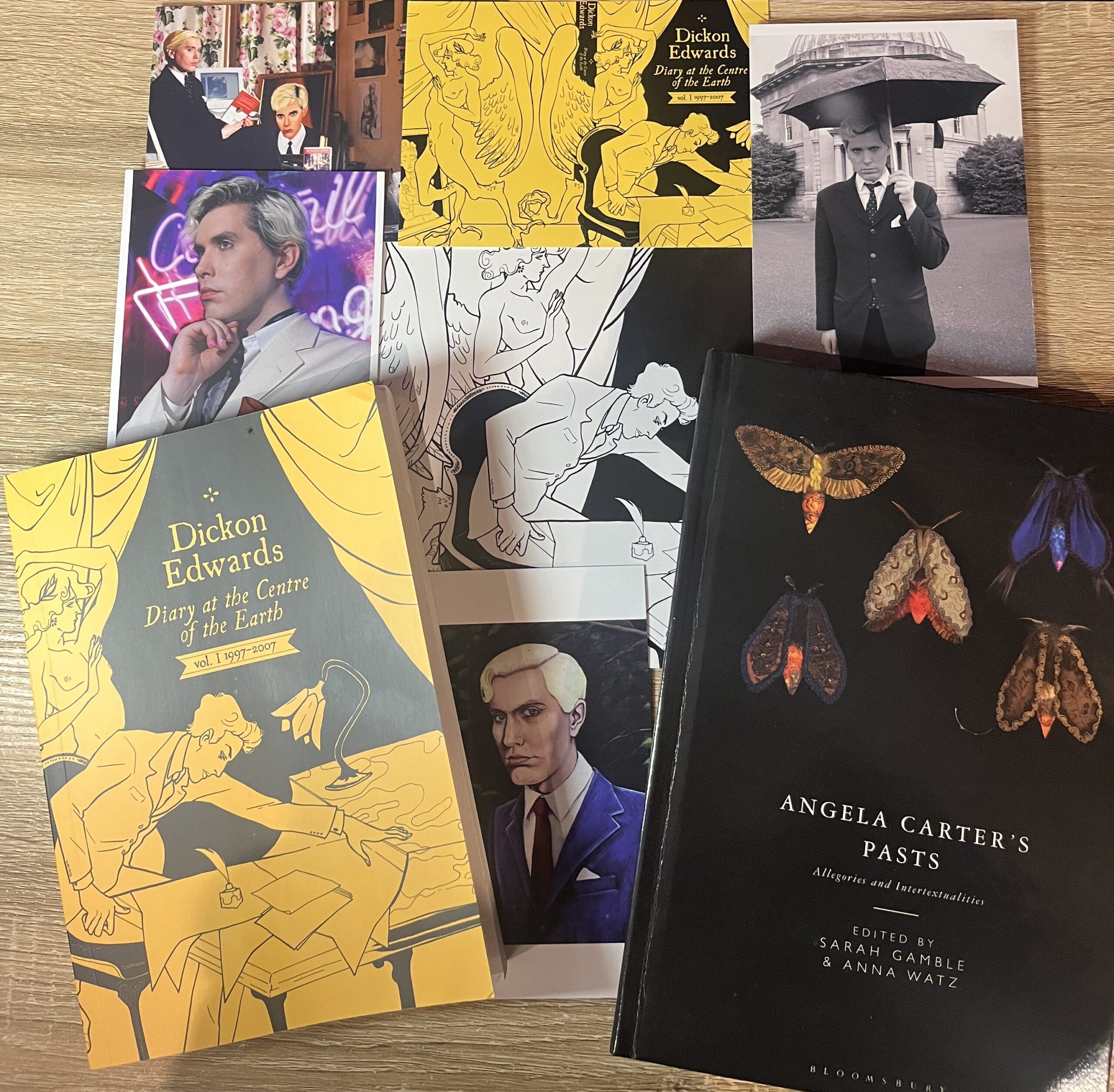
Meanwhile, my diary book’s bright yellow cover, by Lawrence Gullo, was commissioned by the publisher Rob Wringham as another example of creative imitation. It was a pastiche of Aubrey Beardsley’s 1890s covers for The Yellow Book, channelled through Mr Gullo’s own 21st century manga-esque drawing style. The social media platform Bluesky automatically censored pictures of the book cover as obscene. It isn’t, but Beardsley would have approved.
The yellow spine means the diary book tends to stand out on any shelf, as I tend to do in public, for better or worse. Whatever you think of the book or me, at least we’re easy to spot. But all the credit for the book’s physical appearance is really due to Mr Gullo and Mr Wringham. Publishers make books, authors just provide the raw material inside.
My own author epiphany was that all properly published books are the results of arguments. The author has argued with the publisher or editor about everything from the cover to possessive apostrophes, with many messages going back and forth, until both are satisfied. I can only apologise to Mr Wringham for being so fussy, and indeed, so slow and so late.
My first two author events for the diary book, in London in October, had to take place without any actual books. This was due to aberrant behaviour by the courier company, though I’m hardly in any place to judge others for human eccentricity.
We had the parties in London anyway. I was given gifts and drinks and food and flowers, making the events less like book launches and more like Book Showers. And the author turned up in person, which was the main thing. I am, after all, a limited edition object of one. Books are just an author’s stunt doubles.
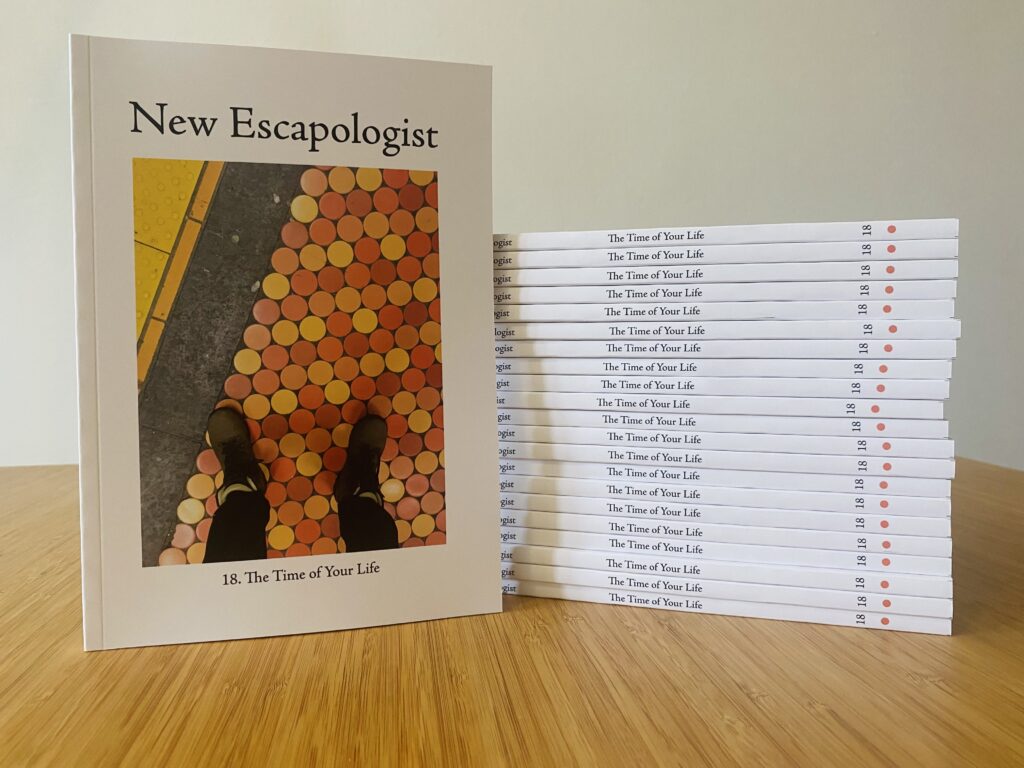
Thankfully I had some Emergency Merchandise to sell and sign. There were copies of the beautiful new issue (#18) of the New Escapologist journal, which includes a new interview with me, with lots of quotable lines to cut out and keep. The journal also has a fascinating interview with August Lamm, an anti-computer activist whom I admire:
We also had the new postcards of myself that were made to go with the limited edition Kickstarter copies. I took the idea from seeing limited editions of manga comic books that came with postcards. I really wanted a stash of them for myself, though, as I regularly send letters and cards in purple fountain pen ink. And I love getting replies, usually handwritten, but sometimes typed on old typewriters. Unique objects, all.
Limited edition vinyl records are part of the same pattern. Hastings HMV sells a £37 orange vinyl version of Taylor Swift’s latest album The Life of a Showgirl. The music can be heard online for free, and Ms Swift probably doesn’t need the financial support. Nevertheless, many people clearly do want to own her music in a form that is as offline and as physical as possible. The appeal is indicated in this salivating description from the HMV website:
Portofino orange glitter vinyl (translucent orange vinyl with gold glitter). Collectible double gatefold jacket with unique front and back cover. Full size gatefold photograph of Taylor. Double-sided foldout panel attached to gatefold which includes a unique poem written by Taylor on one side and a photo strip with 4 unique photos on the other side. Collectible album sleeves which include never-before-seen photos and album lyrics.
The Swift album is also available on audio cassette, which does baffle me a little. But I understand the appeal.
As for the popularity of live events, one can look to Oasis, with their expensive reunion shows in 2025. They played only old songs, thus imitating their own younger selves. People bought the pricy tickets in droves. The point was made.
Which brings me back to my own opening photograph – such value!
In the background, to the left of my right shoulder, is a Yates Wine Lodge that used to be a Victorian music hall. There’s a plaque outside that marks a performance there by Charles Dickens, one with a pleasing Christmas connection:

The plaque is a reminder that Dickens too did greatest hits tours in his later life, reading from A Christmas Carol and Pickwick Papers twenty years after they were published. Like Oasis, and now me, he was imitating his younger self. My diary book is a kind of greatest hits of the internet diary, as chosen by Mr Wringham.
Dickens also used a lectern to enhance the unique and physical nature of his performances. At my first book event in October where the books did arrive, at the St Leonards Reel Bar and art gallery, I was delighted to be provided with a lectern, and a balcony to read from. I’m hoping to do more such readings in 2026, with my own fold-up lectern if needs be.
This, then, would seem to be the Epiphanic message. Do more in the physical realm. More books, more events, more classes, more art galleries, more live performances, more merchandise, more limited editions, more zines, more dressing up, more dancing, more walking, more flowers and trees (artificial or real), more physical exercise (even for me), and more moving in space full stop.
AI has meant that the only way forward is to become your own deep fake. And no world is deeper than the one where AI cannot go: offline.
Happy 2026!
*
You can buy Diary at the Centre of the Earth Vol 1 by clicking here.
New Escapologist Issue #18 can be purchased here.
Angela Carter’s Pasts: Allegories and Intertextualities is primarily aimed at university libraries, but can be ordered in paperback here.
*
Some other favourite things of 2025:
Novel (new): Prudence Bussey-Chamberlain’s Bone Horn (Cipher Press).
Novel (reissued): Brigid Brophy’s In Transit (Lurid Editions)
Memoir: Jodie Harsh’s You Had To Be There (Faber). The drag queen DJ whose fake name – a pun on the celebrity model Jodie Marsh – became their real name. More imitation as a way of becoming oneself.
Album: Kae Tempest’s Self Titled (Island Records). CD zine edition with printed lyrics and images.
Film: The Ballad Of Wallis Island. Seen at the Kino cinema, St Leonards-on-Sea.
Zine: Leila Kassir’s Blue Mist Round My Soul: Images from Lockdown Walks. Available on Instagram by sending a message to: https://www.instagram.com/spineless.wonders
Art: Michelle Mildenhall’s latex art exhibition, at Unit 2, St Leonards-on-Sea.
Tags: Angela Carter, best of 2025, bloomsbury academic, christmas, christmas 2025, Christmas trees, diary at the centre of the earth, diary book, epiphany, hastings, mum, p&hbooks, poniesandhorsesbooks, robert wringham



